
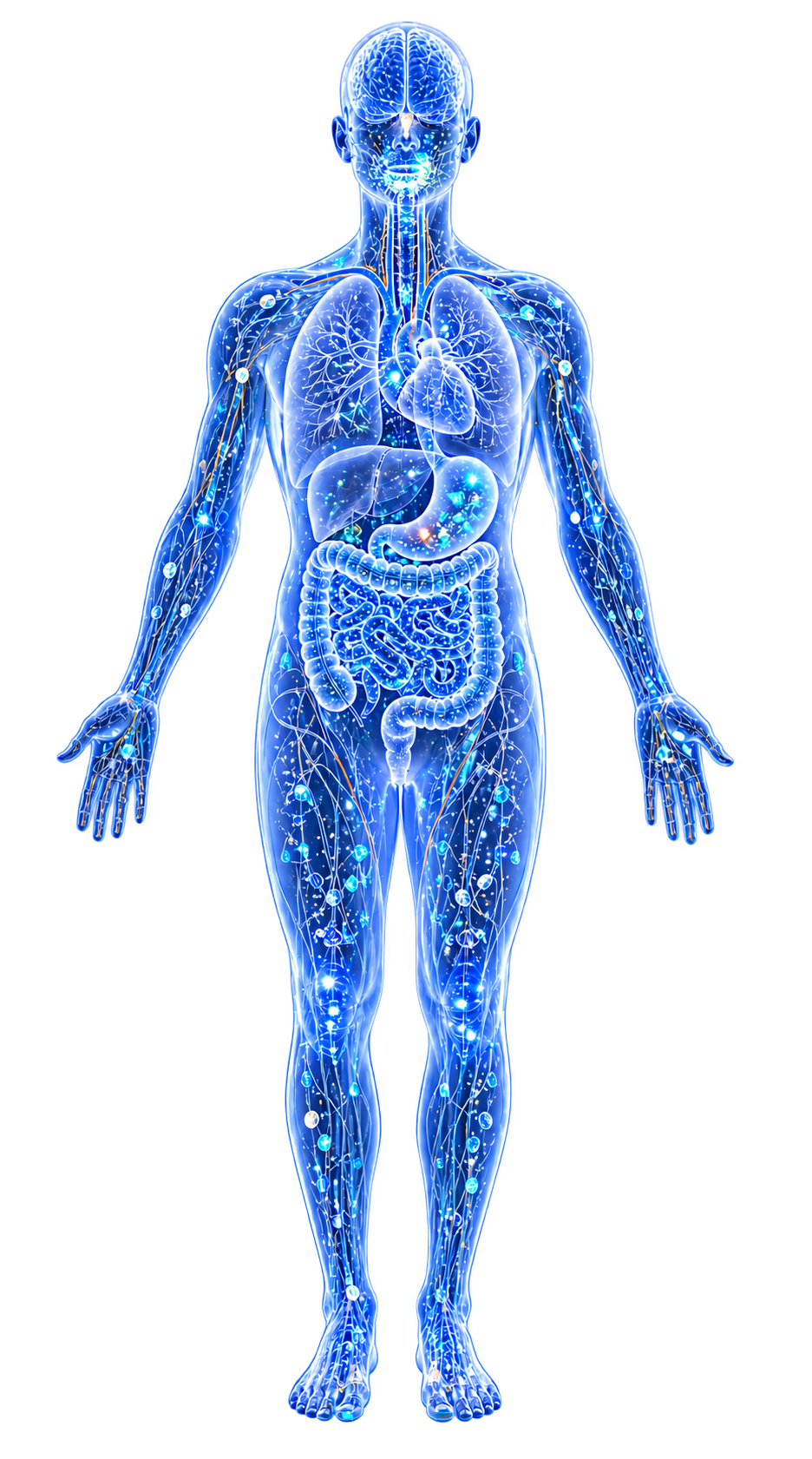
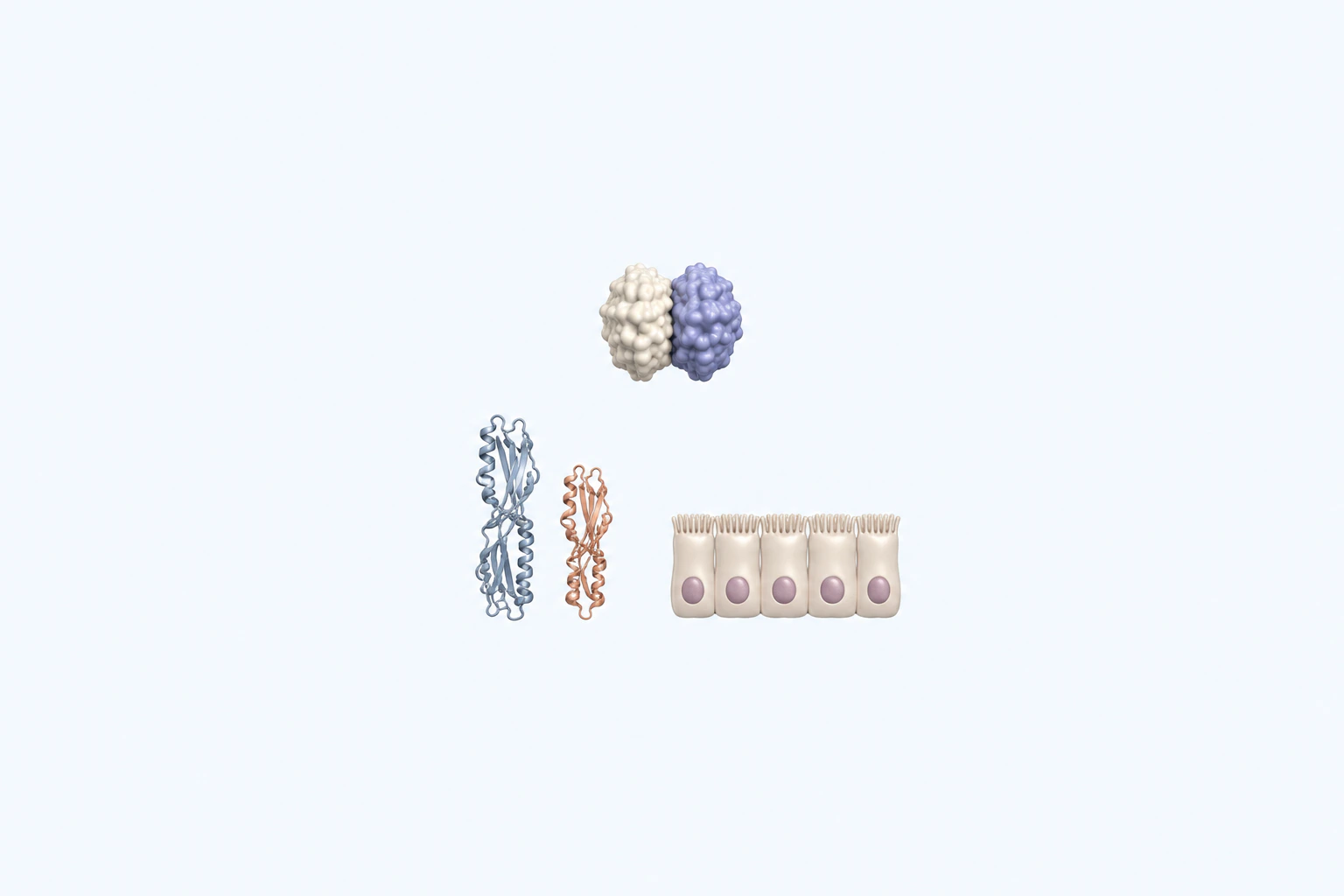
Generic cytokine and epithelial receptor-context orientation for human interleukin-22. This is not a measured protein conformation, observed binding event, expression result, disease state, biomarker, diagnosis, or treatment effect.
Scientific media record4 verified identifiers
- Subject
- Interleukin-22biological-process
- Review
- Editorial review completeIdentifiers authority-verified · Accessibility validated · · interleukin-22|interleukin-22-mechanism-v1.webp
- Digital source
- Trained-algorithmic mediaCreated with a trained generative algorithm and reviewed by WikiBiome for subject identity, scientific framing, identifiers, provenance, and accessibility.
- License
- CC BY-SA 4.0Created
Interleukin-22 (IL-22) is an immune signaling protein that helps coordinate host responses at epithelial surfaces. In the gut evidence represented by WikiBiome, group 3 innate lymphoid cells (ILC3s) are a prominent source, while Th17-associated responses can also include IL-22.
Its target context is the tissue barrier: IL-22 can support epithelial integrity, antimicrobial defense, and repair rather than acting only as a general marker of systemic Metal-Driven Inflammation.[1]Participation of short-chain fatty acids and their receptors in gut inflammation and colon cancerMaria Daniella Carretta, John Quiroga, Rodrigo Lopez et al. · 2021Open reference 1 ↓[2]Nickel Allergy and Allergic Contact Dermatitis: A Clinical ReviewAhlström MG, Thyssen JP, Wennervaldt M et al. · 2019Open reference 2 ↓
IL-22 is not uniformly beneficial or harmful. Its meaning depends on the producing cell, tissue, initiating signal, duration, disease state, and accompanying cytokines. Barrier-supporting activity in one model can coexist with inflammatory or tumor-associated activity in another.
Evidence map12 cited passagesInspect provenance +
Interleukin-22 (IL-22) is an immune signaling protein that helps coordinate host responses at epithelial surfaces. In the gut evidence represented by WikiBiome, group 3 innate lymphoid cells (ILC3s) are a prominent source, while Th17-associated responses can also include IL-22. Its target context is the tissue barrier: IL-22 can support epithelial integrity,
One route begins with microbial tryptophan metabolism. Indole metabolites can activate the aryl hydrocarbon receptor, which regulates ILC3 activity and promotes IL-22 production in mucosal immunity. This provides a mechanistic bridge from microbial metabolism to a host epithelial response, but the direction and magnitude depend on the specific ligand and cel
A second route begins with short chain fatty acids. A review of SCFA receptors describes FFAR2 signaling in ILC3s and places IL-22 downstream of this immune-cell program, where it supports tissue integrity and host defense. The same review emphasizes that SCFA receptors are expressed across epithelial and immune-cell populations, so an observed SCFA associat
Within homeostatic mucosal signaling, IL-22 is linked to epithelial repair and antimicrobial defense. It is often discussed alongside tight-junction integrity, mucin, IgA, and antimicrobial-peptide programs. These outcomes are related but are not interchangeable measurements: detecting IL-22 does not prove that the barrier has recovered, and improved barrier
An animal study of DSS colitis illustrates the context problem. A ketogenic diet altered the microbiome, reduced colonic ILC3 abundance and IL-22 expression, improved barrier markers, and reduced disease severity; fecal transfer reproduced part of the protective effect in germ-free mice. In that model, lower IL-22 accompanied improvement even though IL-22 ca
Outside the gut, a clinical review of nickel allergic contact dermatitis places IL-22 within a Th1/Th17-skewed T-cell response that also includes IFN-gamma and IL-17. This is a skin hypersensitivity context and should not be generalized to intestinal homeostasis.
Fungal signals add another layer. A cancer-mycobiome review describes Candida- and other fungus-associated IL-22/ILC pathways within immunosuppressive and tumor-promoting microenvironments. It also reports poorer survival in a Candida-dominant gastrointestinal-cancer pattern associated with IL-22 and several tumor pathways. These findings support an IL-22 co
In a prospective case-control study of multiple sclerosis, disease-associated microbial species correlated with plasma IL-22 and other inflammatory cytokines. Such correlations connect microbiome composition to an immune profile, but they do not establish which organisms produced the signal or whether IL-22 drove disease activity.
Negative findings are equally important. A case-control study of children and adolescents with autism reported several cytokine differences, but IL-22 was not significantly different between groups. WikiBiome treats that result as outcome-specific negative evidence rather than omitting it or interpreting it as proof that IL-22 is irrelevant to every autism s
Microbial indoles and SCFAs provide plausible upstream routes, but organism abundance alone does not prove IL-22 pathway activity.
Animal diet, colitis, or fecal-transfer experiments establish biological plausibility; they do not prove a human dietary treatment effect.
A null result in one cohort and specimen type should remain visible alongside positive associations from other settings.
Contents
1. Microbiome-to-barrier signaling2. Barrier defense and tissue repair3. Context-dependent inflammatory effects4. Fungal and tumor contexts5. Human association and negative evidence6. Evidence interpretation7. Related pagesMicrobiome-to-barrier signaling#
One route begins with microbial Tryptophan Metabolism. Indole metabolites can activate the aryl hydrocarbon receptor, which regulates ILC3 activity and promotes IL-22 production in mucosal immunity.
This provides a mechanistic bridge from microbial metabolism to a host epithelial response, but the direction and magnitude depend on the specific ligand and cell type.[3]Microbiota-derived tryptophan metabolites in vascular inflammation and cardiovascular diseaseNadja Paeslack, Maximilian Mimmler, Stefanie Becker et al. · 2022Open reference 3 ↓
A second route begins with Short-Chain Fatty Acids (SCFAs). A review of SCFA receptors describes FFAR2 signaling in ILC3s and places IL-22 downstream of this immune-cell program, where it supports tissue integrity and host defense.
The same review emphasizes that SCFA receptors are expressed across epithelial and immune-cell populations, so an observed SCFA association should not automatically be assigned to IL-22 without pathway-level measurements.[1]Participation of short-chain fatty acids and their receptors in gut inflammation and colon cancerMaria Daniella Carretta, John Quiroga, Rodrigo Lopez et al. · 2021Open reference 1 ↓
These pathways explain why loss of indole-producing or SCFA-producing organisms can be discussed as loss of IL-22-supporting ecological function. They do not establish that the abundance of any single organism determines a person's IL-22 level.
Barrier defense and tissue repair#
Within homeostatic mucosal signaling, IL-22 is linked to epithelial repair and antimicrobial defense. It is often discussed alongside tight-junction integrity, mucin, IgA, and antimicrobial-peptide programs.
These outcomes are related but are not interchangeable measurements: detecting IL-22 does not prove that the barrier has recovered, and improved barrier markers do not prove that IL-22 caused the improvement.[1]Participation of short-chain fatty acids and their receptors in gut inflammation and colon cancerMaria Daniella Carretta, John Quiroga, Rodrigo Lopez et al. · 2021Open reference 1 ↓
The producing-versus-responding-cell distinction is important. The evidence summarized here places IL-22 production in immune populations such as ILC3 or Th17-associated cells; epithelial cells are represented primarily as the responding tissue. Claims that colonocytes themselves produce IL-22 require separate direct evidence.
Context-dependent inflammatory effects#
An animal study of DSS colitis illustrates the context problem. A ketogenic diet altered the microbiome, reduced colonic ILC3 abundance and IL-22 expression, improved barrier markers, and reduced disease severity; fecal transfer reproduced part of the protective effect in germ-free mice.[4]Ketogenic Diet Alleviates Colitis by Reduction of Colonic Group 3 Innate Lymphoid Cells Through Altering Gut MicrobiomeKong C, Yan X, Liu Y et al. · 2021Open reference 4 ↓
In that model, lower IL-22 accompanied improvement even though IL-22 can support barrier integrity in other settings. The study therefore argues against labeling every increase as protective or every decrease as harmful.
Outside the gut, a clinical review of nickel allergic contact dermatitis places IL-22 within a Th1/Th17-skewed T-cell response that also includes IFN-gamma and IL-17. This is a skin hypersensitivity context and should not be generalized to intestinal homeostasis.[2]Nickel Allergy and Allergic Contact Dermatitis: A Clinical ReviewAhlström MG, Thyssen JP, Wennervaldt M et al. · 2019Open reference 2 ↓
Fungal and tumor contexts#
Fungal signals add another layer. A cancer-mycobiome review describes Candida- and other fungus-associated IL-22/ILC pathways within immunosuppressive and tumor-promoting microenvironments. It also reports poorer survival in a Candida-dominant gastrointestinal-cancer pattern associated with IL-22 and several tumor pathways.[5]The mycobiome in human cancer: analytical challenges, molecular mechanisms, and therapeutic implicationsTing Ding, Chang Liu, Zhengyu Li · 2025Open reference 5 ↓
These findings support an IL-22 connection in cancer ecology but do not show that IL-22 alone caused the survival difference.
This is why “barrier-protective cytokine” is an incomplete definition. IL-22 can participate in epithelial defense while also appearing in chronic inflammatory or tumor-associated networks. A page or study must specify tissue, cell source, disease state, and measured outcome before assigning direction.
Human association and negative evidence#
In a prospective case-control study of multiple sclerosis, disease-associated microbial species correlated with plasma IL-22 and other inflammatory cytokines.
Such correlations connect microbiome composition to an immune profile, but they do not establish which organisms produced the signal or whether IL-22 drove disease activity.[6]The Gut Microbiota in Multiple Sclerosis Varies with Disease ActivityThirion F, Sellebjerg F, Fan Y et al. · 2023Open reference 6 ↓
Negative findings are equally important. A case-control study of children and adolescents with autism reported several cytokine differences, but IL-22 was not significantly different between groups.[7]Cao 2021 — Dysbiotic Gut Microbiota and Dysregulation of Cytokine Profile in Children and Teens With Autism Spectrum DisorderXia Cao, Kevin Liu, Jun Liu et al. · 2021Open reference 7 ↓
WikiBiome treats that result as outcome-specific negative evidence rather than omitting it or interpreting it as proof that IL-22 is irrelevant to every autism subgroup.
Evidence interpretation#
IL-22 concentration is a context-specific measurement, not a universal score of barrier health or inflammation. ILC3 and Th17-associated cells can produce IL-22; epithelial tissue is a major response compartment in the evidence summarized here.
Microbial indoles and SCFAs provide plausible upstream routes, but organism abundance alone does not prove IL-22 pathway activity.[3]Microbiota-derived tryptophan metabolites in vascular inflammation and cardiovascular diseaseNadja Paeslack, Maximilian Mimmler, Stefanie Becker et al. · 2022Open reference 3 ↓[1]Participation of short-chain fatty acids and their receptors in gut inflammation and colon cancerMaria Daniella Carretta, John Quiroga, Rodrigo Lopez et al. · 2021Open reference 1 ↓
Animal diet, colitis, or fecal-transfer experiments establish biological plausibility; they do not prove a human dietary treatment effect.[4]Ketogenic Diet Alleviates Colitis by Reduction of Colonic Group 3 Innate Lymphoid Cells Through Altering Gut MicrobiomeKong C, Yan X, Liu Y et al. · 2021Open reference 4 ↓
Tumor, skin-allergy, neurologic, and intestinal findings should not be merged into a single beneficial-or-harmful label.
A null result in one cohort and specimen type should remain visible alongside positive associations from other settings.[7]Cao 2021 — Dysbiotic Gut Microbiota and Dysregulation of Cytokine Profile in Children and Teens With Autism Spectrum DisorderXia Cao, Kevin Liu, Jun Liu et al. · 2021Open reference 7 ↓
References 7
Numbered by first appearance in the article, then reconciled with its declared source list.
- 1
Maria Daniella Carretta, John Quiroga, Rodrigo Lopez et al. (2021). Participation of short-chain fatty acids and their receptors in gut inflammation and colon cancer. Frontiers in Physiology.
- 2
Ahlström MG, Thyssen JP, Wennervaldt M et al. (2019). Nickel Allergy and Allergic Contact Dermatitis: A Clinical Review. Contact Dermatitis.
- 3
Nadja Paeslack, Maximilian Mimmler, Stefanie Becker et al. (2022). Microbiota-derived tryptophan metabolites in vascular inflammation and cardiovascular disease. Amino Acids.
- 4
Kong C, Yan X, Liu Y et al. (2021). Ketogenic Diet Alleviates Colitis by Reduction of Colonic Group 3 Innate Lymphoid Cells Through Altering Gut Microbiome. Signal Transduction and Targeted Therapy.
- 5
Ting Ding, Chang Liu, Zhengyu Li (2025). The mycobiome in human cancer: analytical challenges, molecular mechanisms, and therapeutic implications. Molecular Cancer.
- 6
Thirion F, Sellebjerg F, Fan Y et al. (2023). The Gut Microbiota in Multiple Sclerosis Varies with Disease Activity. Genome Medicine.
- 7
Xia Cao, Kevin Liu, Jun Liu et al. (2021). Cao 2021 — Dysbiotic Gut Microbiota and Dysregulation of Cytokine Profile in Children and Teens With Autism Spectrum Disorder. Frontiers in Neuroscience.
Article network
Mentioned here 12
Pages linking here 17
Connect the evidence
Publicly readable discussion by ORCID-authenticated researchers. Questions, interpretation, methods, corrections, and new evidence stay attached to this record.
No discussion yet. Start with a precise question or a source-backed observation.
Published page changes
This record shows only material changes published on this page, including changes to its content, evidence, conclusions, or author context. Internal processes and discussion activity are excluded. Pending, declined, and withdrawn proposals remain private.
- published revision
Created “Interleukin-22”: Interleukin-22 (IL-22) is an immune signaling protein that helps coordinate host responses at epithelial surfaces. In the gut evidence represented by WikiBiome, group 3 innate lymphoid cells (ILC3s)…
Created “Interleukin-22”: Interleukin-22 (IL-22) is an immune signaling protein that helps coordinate host responses at epithelial surfaces. In the gut evidence represented by WikiBiome, group 3 innate lymphoid cells (ILC3s)… Published sections: Interleukin-22; Microbiome-to-barrier signaling; Barrier defense and tissue repair; Context-dependent inflammatory effects; Fungal and tumor contexts; Human association and negative evidence; Evidence interpretation; Related pages. · Karen Pendergrass · +82 −0
Inspect exact Git diff ↗