

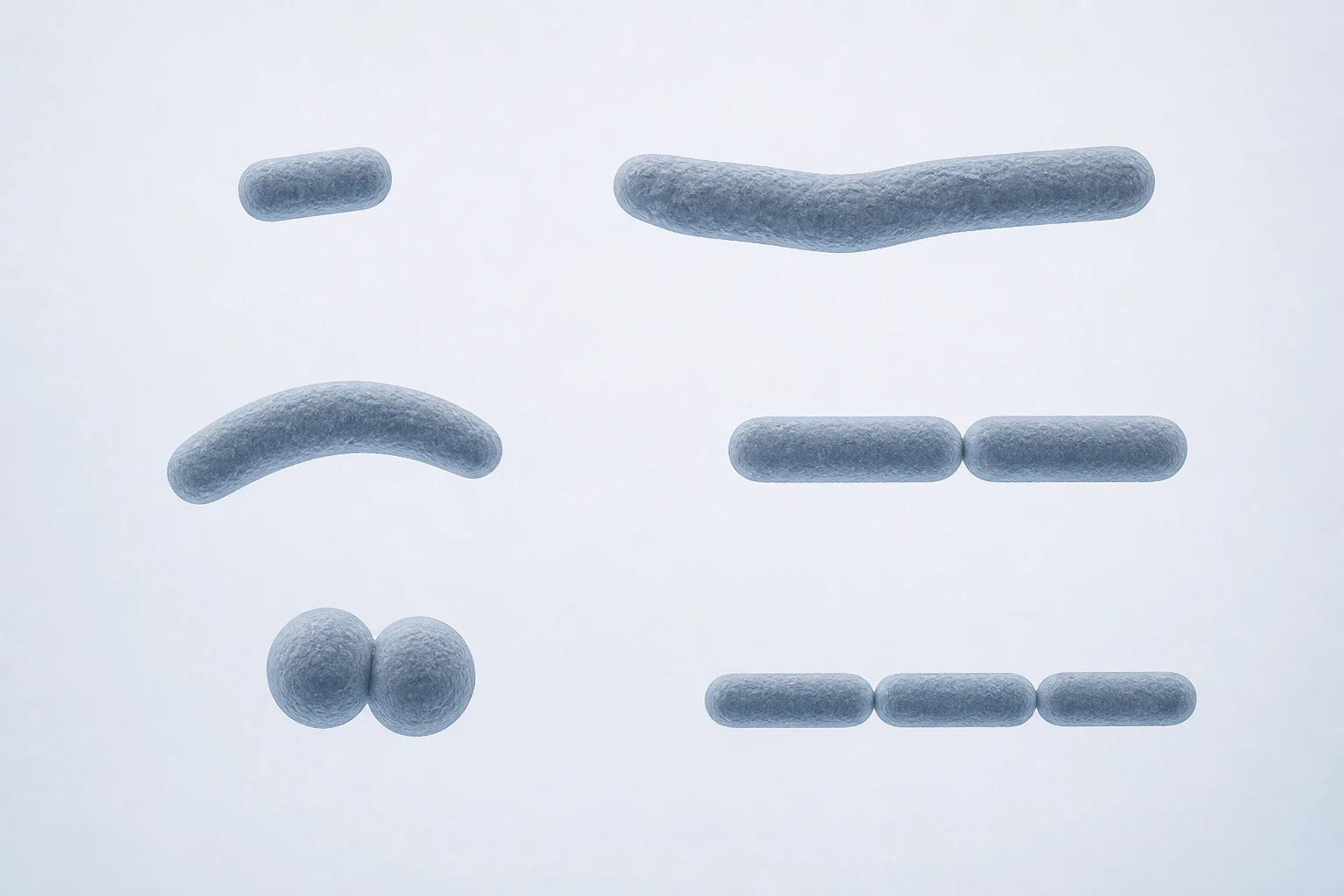
Selected Eubacteriales morphology diversity, shown as ten type-genus-anchored or current-descendant rod and coccoid bodies in six groupings. This is a representative higher-rank morphology-diversity reconstruction, not a universal order form; it is non-exhaustive, non-diagnostic, and not a micrograph.
Scientific media record1 verified identifier
- Subject
- Eubacterialestaxon · order
- Identifiers
- NCBITaxon:186802
- Review
- Editorial review completeIdentifiers authority-verified · Accessibility validated · · eubacteriales|eubacteriales-microbial-community-v1.webp
- Digital source
- Trained-algorithmic mediaCreated with a trained generative algorithm and reviewed by WikiBiome for subject identity, scientific framing, identifiers, provenance, and accessibility.
- Scientific basis
- Eubacteriales — NCBI TaxonomyEubacteriales — LPSNThe families of the EubacterialesEubacterium — LPSN
- License
- CC BY-SA 4.0Created
Eubacteriales Buchanan 1917 (Approved Lists 1980) is the current correct name for NCBITaxon:186802. LPSN records Clostridiales Prévot 1953 (Approved Lists 1980) as a validly published heterotypic synonym, not a separate current order.[1]NCBI Taxonomy — Eubacteriales (NCBITaxon:186802)Author information pendingOpen reference 1 ↓[2]LPSN — Eubacteriales Buchanan 1917 (Approved Lists 1980)Author information pendingOpen reference 2 ↓[3]Buchanan 1917 — The families of the EubacterialesRobert Earle Buchanan · 1917Open reference 3 ↓[4]Skerman, McGowan, and Sneath 1980 — Approved Lists of Bacterial NamesV. B. D. Skerman, Vicki McGowan, P. H. A. Sneath · 1980Open reference 4 ↓
The microbiome studies summarized below commonly used “Clostridiales,” database-era family assignments, or named groups such as “Clostridiales Vadin BB60.” WikiBiome preserves those source labels. Canonicalizing the order name does not establish that every historical assignment maps unchanged onto current Eubacteriales, and it does not silently relabel a study's measured taxon.
Evidence map4 cited passagesInspect provenance +
Eubacteriales Buchanan 1917 (Approved Lists 1980) is the current correct name for NCBITaxon:186802. LPSN records Clostridiales Prévot 1953 (Approved Lists 1980) as a validly published heterotypic synonym, not a separate current order.
The Clostridiales Vadin BB60 group is causally protective against GERD (OR = 0.95, 95% CI 0.91-0.99, p = 0.027). This subgroup's SCFA production likely strengthens esophageal and gastric mucosal defense.
(Mendelian randomization, n=148,984)—Class-level Clostridia identified as a causal schizophrenia risk factor (OR 1.16), highlighting the need for sub-order resolution.
(Mendelian randomization)—Clostridiales Vadin BB60 group causally protective against GERD.
Contents
1. Taxonomy2. Metal Dependencies3. Ecological Role4. Conditions Associated5. Key Studies6. Cross-ReferencesTaxonomy#
Order Eubacteriales, class Clostridia, phylum Bacillota (historically Firmicutes); NCBITaxon:186802. Major health-associated families: Lachnospiraceae (Clostridium cluster XIVa), Ruminococcaceae (Clostridium cluster IV), Eubacteriaceae. Historical Clostridiales classifications included organisms since reassigned outside current Eubacteriales, including Clostridium difficile.
Taxonomic note: “Clostridiales” remains common in historical and source-database classifications. Many taxa once placed under that label have been reassigned to other orders, so source-era order-level findings require their original database and taxonomic resolution.
Metal Dependencies#
Iron. Ferredoxin-dependent oxidoreductases are central to anaerobic metabolism among many organisms historically grouped as Clostridiales. Iron-sulfur clusters in ferredoxins enable electron transfer for Butyrate synthesis and amino acid fermentation.
Many organisms in those source-era groupings lack aggressive iron acquisition systems (siderophores), relying on ferrous iron uptake. This can make them vulnerable to competitive exclusion by siderophore-producing Enterobacteriaceae in iron-replete inflammatory environments.
Selenium. Selenocysteine-containing formate dehydrogenases and glycine reductases occur across organisms historically grouped as Clostridiales, linking host selenium status to the metabolic activity of some butyrate-producing bacteria.
Cobalt. Corrinoid (vitamin B12)-dependent enzymes support one-carbon metabolism and methyl transfer reactions across many organisms historically grouped as Clostridiales. Some species are de novo B12 synthesizers.
Ecological Role#
In the Healthy Gut#
Studies using the historical Clostridiales label describe these organisms as prominent members of the healthy colon. Reported functions include. Butyrate production: Lachnospiraceae and Ruminococcaceae produce the majority of colonic butyrate, the primary energy source for colonocytes.
Regulatory T-cell induction: Clostridium clusters IV and XIVa (now Oscillospirales and Lachnospirales) are the most potent microbial inducers of colonic Tregs, maintaining immune tolerance.
Secondary bile acid metabolism: Clostridiales perform 7-alpha-dehydroxylation converting primary to secondary bile acids. Colonization resistance: Dense populations of source-defined Clostridiales occupy ecological niches that would otherwise be available to pathogens.
In Dysbiosis#
Depletion of health-associated taxa reported under the Clostridiales label recurs across Cardiovascular Disease, Crohn's Disease, Multiple Sclerosis, and other inflammatory conditions. These observations concern source-defined taxa and do not support a uniform effect across every current member of Eubacteriales.
Conditions Associated#
GERD (Protective)#
The Clostridiales Vadin BB60 group is causally protective against GERD (OR = 0.95, 95% CI 0.91-0.99, p = 0.027).[5]Wang K 2024 — Causal Gut Microbiota-GERD Associations via Bidirectional Mendelian RandomizationKui Wang, Suijian Wang, Yuhua Chen et al. · 2024Open reference 5 ↓ This subgroup's SCFA production likely strengthens esophageal and gastric mucosal defense.
Cardiovascular Disease (Depleted)#
ACVD patients show depleted butyrate-producing Clostridiales including Roseburia and faecalibacterium, contributing to barrier dysfunction, endotoxemia, and vascular Metal-Driven Inflammation.
Crohn's Disease (Depleted)#
Clostridium clusters IV and XIVa are consistently depleted in CD, representing the loss of key butyrate producers and Treg inducers.
Key Studies#
[6]Zhou 2024 — Gut Microbiome and Schizophrenia: Insights from Two-Sample Mendelian RandomizationKeer Zhou, Ancha Baranova, Hongbao Cao et al. · 2024Open reference 6 ↓ (Mendelian randomization, n=148,984)—Class-level Clostridia identified as a causal schizophrenia risk factor (OR 1.16), highlighting the need for sub-order resolution.
[5]Wang K 2024 — Causal Gut Microbiota-GERD Associations via Bidirectional Mendelian RandomizationKui Wang, Suijian Wang, Yuhua Chen et al. · 2024Open reference 5 ↓ (Mendelian randomization)—Clostridiales Vadin BB60 group causally protective against GERD.
Cross-References#
- Clostridia—the parent class
- Lachnospiraceae—a health-associated family included in historical Clostridiales classifications
- Ruminococcaceae—a second major butyrate-producing family
- butyrate—a key metabolite produced by multiple source-defined Clostridiales taxa
- Roseburia—a major butyrate producer depleted in CVD
- faecalibacterium—a studied anti-inflammatory organism included in historical Clostridiales classifications
- Clostridium difficile—an organism whose historical placement illustrates the breadth and later revision of Clostridiales classifications
- Gastroesophageal Reflux Disease (GERD)—Clostridiales Vadin BB60 group is causally protective
References 13
Numbered by first appearance in the article, then reconciled with its declared source list.
- 1
Author information pending. NCBI Taxonomy — Eubacteriales (NCBITaxon:186802). NCBI Taxonomy.
- 2
Author information pending. LPSN — Eubacteriales Buchanan 1917 (Approved Lists 1980). List of Prokaryotic names with Standing in Nomenclature.
- 3
Robert Earle Buchanan (1917). Buchanan 1917 — The families of the Eubacteriales. Journal of Bacteriology.
- 4
V. B. D. Skerman, Vicki McGowan, P. H. A. Sneath (1980). Skerman, McGowan, and Sneath 1980 — Approved Lists of Bacterial Names. International Journal of Systematic Bacteriology.
- 5
Kui Wang, Suijian Wang, Yuhua Chen et al. (2024). Wang K 2024 — Causal Gut Microbiota-GERD Associations via Bidirectional Mendelian Randomization. Frontiers in Immunology.
- 6
Keer Zhou, Ancha Baranova, Hongbao Cao et al. (2024). Zhou 2024 — Gut Microbiome and Schizophrenia: Insights from Two-Sample Mendelian Randomization. Schizophrenia (Nature Partner Journal).
- 7
Zhuye Jie, Huihua Xia, Shi-Long Zhong et al. (2017). The gut microbiome in atherosclerotic cardiovascular disease. Nature Communications.
- 8
Sophie Candon, Alicia Perez-Arroyo, Cindy Marquet et al. (2015). Candon 2015 — Antibiotics in Early Life Alter the Gut Microbiome and Increase Disease Incidence in a Spontaneous Mouse Model of Autoimmune Diabetes. PLoS ONE.
- 9
Ma M, Zheng Z, Li J et al. (2024). Association between the Gut Microbiota, Inflammatory Factors, and Colorectal Cancer: Evidence from Mendelian Randomization Analysis. Frontiers in Microbiology.
- 10
Jarno Honkanen, Arja Vuorela, Daniel Muthas et al. (2020). Honkanen 2020 — Fungal Dysbiosis and Intestinal Inflammation in Children with Beta-Cell Autoimmunity. Frontiers in Immunology.
- 11
Wenjie Ma, Long H. Nguyen, Mingyang Song et al. (2021). Dietary fiber intake, the gut microbiome, and chronic systemic inflammation in a cohort of adult men. Genome Medicine.
- 12
Su X, Yin X, Liu Y et al. (2020). Su et al. 2020 — Gut Dysbiosis Contributes to the Imbalance of Treg and Th17 Cells in Graves' Disease Patients by Propionic Acid. The Journal of Clinical Endocrinology & Metabolism.
- 13
Lan Zhao, William C. Cho, Mark R. Nicolls (2021). Colorectal cancer-associated microbiome patterns and signatures. Frontiers in Genetics.
Article network
Connect the evidence
Publicly readable discussion by ORCID-authenticated researchers. Questions, interpretation, methods, corrections, and new evidence stay attached to this record.
No discussion yet. Start with a precise question or a source-backed observation.
Published page changes
This record shows only material changes published on this page, including changes to its content, evidence, conclusions, or author context. Internal processes and discussion activity are excluded. Pending, declined, and withdrawn proposals remain private.
- published revision
Revised “Taxonomy”: now reads “ruminococcaceae (Clostridium cluster IV), Eubacteriaceae. - Historical Clostridiales classifications included organisms since reassigned outside current Eubacteriales, including Clostridium difficile.…”.
Revised “Taxonomy”: changed “ruminococcaceae (Clostridium cluster IV), Eubacteriaceae. - Pathogenic/opportunistic members: Clostridiaceae (clostridium difficile, clostridium perfringens), Peptostreptococcaceae (peptostreptococcus…” to “ruminococcaceae (Clostridium cluster IV), Eubacteriaceae. - Historical Clostridiales classifications included organisms since reassigned outside current Eubacteriales, including Clostridium difficile.…”. Revised “Cross-References”: changed “included in historical Clostridiales classifications - clostridium difficile -- an organism whose historical” to “included in historical Clostridiales classifications - Clostridium difficile -- an organism whose historical”. · Karen Pendergrass · +2 −2
Inspect exact Git diff ↗ - published revision
Created “Eubacteriales”: Eubacteriales Buchanan 1917 (Approved Lists 1980) is the current correct name for NCBITaxon:186802. LPSN records Clostridiales Prévot 1953 (Approved Lists 1980) as a validly published heterotypic…
Created “Eubacteriales”: Eubacteriales Buchanan 1917 (Approved Lists 1980) is the current correct name for NCBITaxon:186802. LPSN records Clostridiales Prévot 1953 (Approved Lists 1980) as a validly published heterotypic… Published sections: Eubacteriales; Taxonomy; Metal Dependencies; In the Healthy Gut; In Dysbiosis; GERD (Protective); Cardiovascular Disease (Depleted); Crohn's Disease (Depleted); Key Studies; Cross-References. · Karen Pendergrass · +101 −0
Inspect exact Git diff ↗