
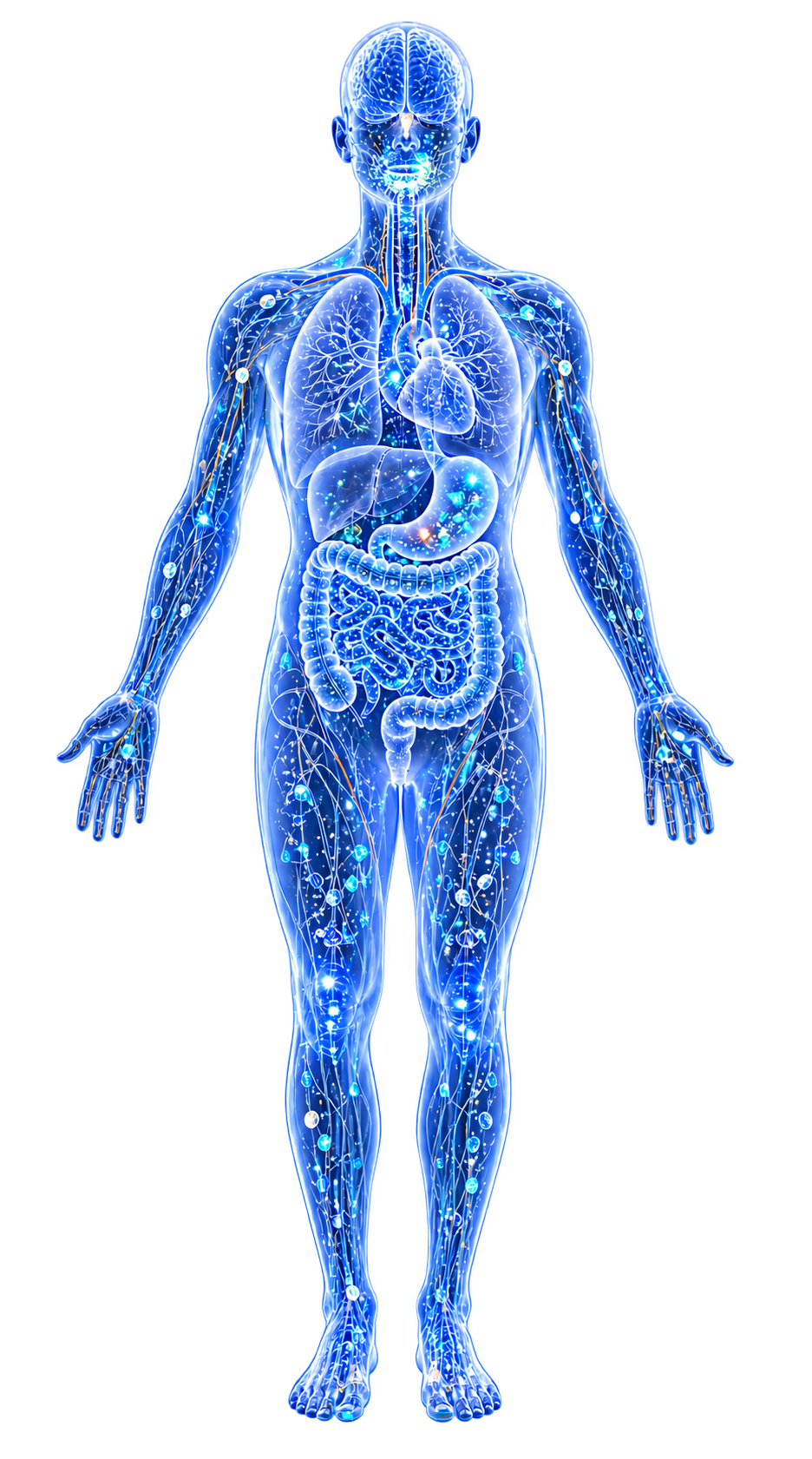
The NLRP3 inflammasome is a host innate-immune signaling complex that connects cellular danger signals to caspase-1 activation.
In the canonical pathway represented in WikiBiome's evidence vault, caspase-1 processes the inflammatory cytokines IL-1beta and IL-18 and cleaves gasdermin D, whose membrane-forming fragment participates in pyroptotic cell death.[1]Luan 2025 — Fatty Acid Synthase Inhibition Improves Hypertension-Induced Erectile Dysfunction by Suppressing Oxidative Stress and NLRP3 Inflammasome-Dependent PyroptosisJiaochen Luan, Mengchi Yu, Qi Gu et al. · 2025Open reference 1 ↓
NLRP3 is not a microorganism or a microbial product. It is a host response system that can be engaged by signals arising from infection, microbial metabolites, barrier failure, tissue damage, oxidative stress, or toxicant exposure.
Its importance to WikiBiome is therefore relational: it is one route by which changes in microbial ecology and metal exposure can become host Metal-Driven Inflammation.[2]Influence of Microbiota on NSAID Enteropathy: A Systematic Review of Current Knowledge and the Role of ProbioticsRekatsina M, Paladini A, Cifone MG et al. · 2020Open reference 2 ↓[3]Nucera 2024 — Non-essential heavy metal effects in cardiovascular diseases: overview of systematic reviewsNucera S, Serra M, Caminiti R et al. · 2024Open reference 3 ↓
Evidence map13 cited passagesInspect provenance +
The NLRP3 inflammasome is a host innate-immune signaling complex that connects cellular danger signals to caspase-1 activation. In the canonical pathway represented in WikiBiome's evidence vault, caspase-1 processes the inflammatory cytokines IL-1beta and IL-18 and cleaves gasdermin D, whose membrane-forming fragment participates in pyroptotic cell death.
NLRP3 is not a microorganism or a microbial product. It is a host response system that can be engaged by signals arising from infection, microbial metabolites, barrier failure, tissue damage, oxidative stress, or toxicant exposure. Its importance to WikiBiome is therefore relational: it is one route by which changes in microbial ecology and metal exposure ca
The pathway should be interpreted as a sequence, not as a synonym for inflammation. Upstream signals increase or activate inflammasome components; the assembled pathway activates caspase-1; caspase-1 then enables mature IL-1beta and IL-18 production and gasdermin-mediated pyroptosis. In a combined rat and cell-culture study, changes in NLRP3, caspase-1, gasd
The same study used fatty-acid-synthase inhibition and antioxidant-pathway manipulation to place reactive oxygen species upstream of the measured NLRP3 cascade in that model. Because the work used hypertensive rats and rat endothelial cells, it supports the pathway mechanism but does not by itself establish the same causal chain in every human disease.
Microbial influence can begin at a damaged epithelial barrier. A systematic review of NSAID enteropathy describes Gram-negative bacterial lipopolysaccharide engaging TLR4, followed by NF-kappa-B and NLRP3 signaling; germ-free or differently colonized animal models in the reviewed literature also showed that microbial context altered susceptibility to intesti
An independent rat study linked indomethacin exposure to intestinal dysbiosis, bacterial translocation, impaired barrier structure, and increased hepatic TLR4, NLRP3-pathway, IL-18, and caspase-1 measurements. Its accompanying human observations were associative, so the study supports a plausible gut-barrier-to-inflammation route without proving that NLRP3 c
Microbial signals need not be limited to bacterial LPS. A gut-thyroid-axis review describes microbiota-derived extracellular ATP as an NLRP3-associated signal linked to IL-1beta and IL-18 secretion, while a cancer-mycobiome review describes fungal beta-glucans, chitin, and mannose engaging C-type lectin receptor–CARD9 pathways that converge on NF-kappa-B, re
Metal-associated NLRP3 findings often sit inside a larger oxidative and endothelial-injury pattern. An overview of eight systematic reviews reports cadmium-associated cardiovascular mechanisms that include reactive oxygen species, NF-kappa-B, NLRP3 signaling, reduced nitric-oxide availability, and increased endothelin-1. The human evidence establishes exposu
This distinction matters. Detecting NLRP3 expression or correlated cytokines does not prove inflammasome assembly, caspase-1 activity, gasdermin cleavage, pyroptosis, or clinical causation. Stronger mechanistic claims require measurements across multiple steps or interventions that perturb the proposed pathway.
NLRP3 activity is not uniformly pathological. A review of short-chain-fatty-acid receptor biology describes epithelial FFAR2 signaling that promotes IL-18 secretion through NLRP3 in support of regulatory T-cell activity, IgA production, and intestinal tissue integrity. The same receptor family can have different effects across epithelial and immune-cell cont
That context dependence is why WikiBiome does not label every NLRP3-associated change as beneficial or harmful. The biological meaning depends on the initiating signal, cell type, duration, tissue, downstream products, and whether the response resolves or becomes chronic.
Caspase-1 activity and gasdermin-D cleavage provide more direct evidence of the canonical pyroptotic cascade when measured alongside NLRP3.
Microbiome associations require an explicit bridge—such as LPS translocation, microbial ATP, fungal pattern recognition, or a measured metabolite—before NLRP3 should be described as microbiome-mediated.
Contents
1. From sensing to inflammatory output2. Microbial signals and barrier failure3. Metal and oxidative-stress convergence4. Context-dependent effects in the gut5. Evidence interpretation6. Related pagesFrom sensing to inflammatory output#
The pathway should be interpreted as a sequence, not as a synonym for inflammation. Upstream signals increase or activate inflammasome components; the assembled pathway activates caspase-1; caspase-1 then enables mature IL-1beta and IL-18 production and gasdermin-mediated pyroptosis.
In a combined rat and cell-culture study, changes in NLRP3, caspase-1, gasdermin-D fragments, IL-1beta, and IL-18 moved together with oxidative stress and endothelial injury.[1]Luan 2025 — Fatty Acid Synthase Inhibition Improves Hypertension-Induced Erectile Dysfunction by Suppressing Oxidative Stress and NLRP3 Inflammasome-Dependent PyroptosisJiaochen Luan, Mengchi Yu, Qi Gu et al. · 2025Open reference 1 ↓
The same study used fatty-acid-synthase inhibition and antioxidant-pathway manipulation to place reactive oxygen species upstream of the measured NLRP3 cascade in that model.
Because the work used hypertensive rats and rat endothelial cells, it supports the pathway mechanism but does not by itself establish the same causal chain in every human disease.[1]Luan 2025 — Fatty Acid Synthase Inhibition Improves Hypertension-Induced Erectile Dysfunction by Suppressing Oxidative Stress and NLRP3 Inflammasome-Dependent PyroptosisJiaochen Luan, Mengchi Yu, Qi Gu et al. · 2025Open reference 1 ↓
Microbial signals and barrier failure#
Microbial influence can begin at a damaged epithelial barrier.
A systematic review of NSAID enteropathy describes Gram-negative bacterial lipopolysaccharide engaging TLR4, followed by NF-kappa-B and NLRP3 signaling; germ-free or differently colonized animal models in the reviewed literature also showed that microbial context altered susceptibility to intestinal injury.[2]Influence of Microbiota on NSAID Enteropathy: A Systematic Review of Current Knowledge and the Role of ProbioticsRekatsina M, Paladini A, Cifone MG et al. · 2020Open reference 2 ↓
An independent rat study linked indomethacin exposure to intestinal dysbiosis, bacterial translocation, impaired barrier structure, and increased hepatic TLR4, NLRP3-pathway, IL-18, and caspase-1 measurements.
Its accompanying human observations were associative, so the study supports a plausible gut-barrier-to-inflammation route without proving that NLRP3 caused the reported neurodevelopmental outcomes.[4]Mohamed 2023 -- Unveiling the Interplay Between NSAID-Induced Dysbiosis and Autoimmune Liver Disease in Children: Insights into the Hidden Gateway to ASDDoaa I. Mohamed, Hebatallah H. Abo Nahas, Asmaa M. Elshaer et al. · 2023Open reference 4 ↓
Microbial signals need not be limited to bacterial LPS.
A gut-thyroid-axis review describes microbiota-derived extracellular ATP as an NLRP3-associated signal linked to IL-1beta and IL-18 secretion, while a cancer-mycobiome review describes fungal beta-glucans, chitin, and mannose engaging C-type lectin receptor–CARD9 pathways that converge on NF-kappa-B, reactive oxygen species, and NLRP3 signaling.[5]Zhu et al. 2024 — Intestinal Microbiota Regulates the Gut-Thyroid Axis: The New Dawn of Improving Hashimoto ThyroiditisZhu X, Zhang C, Feng S et al. · 2024Open reference 5 ↓[6]The mycobiome in human cancer: analytical challenges, molecular mechanisms, and therapeutic implicationsTing Ding, Chang Liu, Zhengyu Li · 2025Open reference 6 ↓
Metal and oxidative-stress convergence#
Metal-associated NLRP3 findings often sit inside a larger oxidative and endothelial-injury pattern. An overview of eight systematic reviews reports cadmium-associated cardiovascular mechanisms that include reactive oxygen species, NF-kappa-B, NLRP3 signaling, reduced nitric-oxide availability, and increased endothelin-1.
The human evidence establishes exposure–disease associations more strongly than it establishes NLRP3 as the sole causal mediator.[3]Nucera 2024 — Non-essential heavy metal effects in cardiovascular diseases: overview of systematic reviewsNucera S, Serra M, Caminiti R et al. · 2024Open reference 3 ↓
This distinction matters. Detecting NLRP3 expression or correlated cytokines does not prove inflammasome assembly, caspase-1 activity, gasdermin cleavage, pyroptosis, or clinical causation. Stronger mechanistic claims require measurements across multiple steps or interventions that perturb the proposed pathway.[1]Luan 2025 — Fatty Acid Synthase Inhibition Improves Hypertension-Induced Erectile Dysfunction by Suppressing Oxidative Stress and NLRP3 Inflammasome-Dependent PyroptosisJiaochen Luan, Mengchi Yu, Qi Gu et al. · 2025Open reference 1 ↓
Context-dependent effects in the gut#
NLRP3 activity is not uniformly pathological. A review of short-chain-fatty-acid receptor biology describes epithelial FFAR2 signaling that promotes IL-18 secretion through NLRP3 in support of regulatory T-cell activity, IgA production, and intestinal tissue integrity.
The same receptor family can have different effects across epithelial and immune-cell contexts.[7]Participation of short-chain fatty acids and their receptors in gut inflammation and colon cancerMaria Daniella Carretta, John Quiroga, Rodrigo Lopez et al. · 2021Open reference 7 ↓
That context dependence is why WikiBiome does not label every NLRP3-associated change as beneficial or harmful.
The biological meaning depends on the initiating signal, cell type, duration, tissue, downstream products, and whether the response resolves or becomes chronic.[7]Participation of short-chain fatty acids and their receptors in gut inflammation and colon cancerMaria Daniella Carretta, John Quiroga, Rodrigo Lopez et al. · 2021Open reference 7 ↓[5]Zhu et al. 2024 — Intestinal Microbiota Regulates the Gut-Thyroid Axis: The New Dawn of Improving Hashimoto ThyroiditisZhu X, Zhang C, Feng S et al. · 2024Open reference 5 ↓
Evidence interpretation#
NLRP3 expression alone is evidence of pathway availability or priming, not proof of an assembled, active inflammasome. IL-1beta and IL-18 are important outputs but can be influenced by pathways outside the specific experiment being interpreted.
Caspase-1 activity and gasdermin-D cleavage provide more direct evidence of the canonical pyroptotic cascade when measured alongside NLRP3.[1]Luan 2025 — Fatty Acid Synthase Inhibition Improves Hypertension-Induced Erectile Dysfunction by Suppressing Oxidative Stress and NLRP3 Inflammasome-Dependent PyroptosisJiaochen Luan, Mengchi Yu, Qi Gu et al. · 2025Open reference 1 ↓
Animal and cell-culture pathway experiments establish biological plausibility; they should not be presented as proof that inhibiting NLRP3 will improve a human condition.
Microbiome associations require an explicit bridge—such as LPS translocation, microbial ATP, fungal pattern recognition, or a measured metabolite—before NLRP3 should be described as microbiome-mediated.[2]Influence of Microbiota on NSAID Enteropathy: A Systematic Review of Current Knowledge and the Role of ProbioticsRekatsina M, Paladini A, Cifone MG et al. · 2020Open reference 2 ↓[5]Zhu et al. 2024 — Intestinal Microbiota Regulates the Gut-Thyroid Axis: The New Dawn of Improving Hashimoto ThyroiditisZhu X, Zhang C, Feng S et al. · 2024Open reference 5 ↓[6]The mycobiome in human cancer: analytical challenges, molecular mechanisms, and therapeutic implicationsTing Ding, Chang Liu, Zhengyu Li · 2025Open reference 6 ↓
References 7
Numbered by first appearance in the article, then reconciled with its declared source list.
- 1
Jiaochen Luan, Mengchi Yu, Qi Gu et al. (2025). Luan 2025 — Fatty Acid Synthase Inhibition Improves Hypertension-Induced Erectile Dysfunction by Suppressing Oxidative Stress and NLRP3 Inflammasome-Dependent Pyroptosis. Frontiers in Immunology.
- 2
Rekatsina M, Paladini A, Cifone MG et al. (2020). Influence of Microbiota on NSAID Enteropathy: A Systematic Review of Current Knowledge and the Role of Probiotics. Advances in Therapy.
- 3
Nucera S, Serra M, Caminiti R et al. (2024). Nucera 2024 — Non-essential heavy metal effects in cardiovascular diseases: overview of systematic reviews. Frontiers in Cardiovascular Medicine.
- 4
Doaa I. Mohamed, Hebatallah H. Abo Nahas, Asmaa M. Elshaer et al. (2023). Mohamed 2023 -- Unveiling the Interplay Between NSAID-Induced Dysbiosis and Autoimmune Liver Disease in Children: Insights into the Hidden Gateway to ASD. Frontiers in Cellular Neuroscience.
- 5
Zhu X, Zhang C, Feng S et al. (2024). Zhu et al. 2024 — Intestinal Microbiota Regulates the Gut-Thyroid Axis: The New Dawn of Improving Hashimoto Thyroiditis. Clinical and Experimental Medicine.
- 6
Ting Ding, Chang Liu, Zhengyu Li (2025). The mycobiome in human cancer: analytical challenges, molecular mechanisms, and therapeutic implications. Molecular Cancer.
- 7
Maria Daniella Carretta, John Quiroga, Rodrigo Lopez et al. (2021). Participation of short-chain fatty acids and their receptors in gut inflammation and colon cancer. Frontiers in Physiology.
Article network
Mentioned here 12
Pages linking here 14
Connect the evidence
Publicly readable discussion by ORCID-authenticated researchers. Questions, interpretation, methods, corrections, and new evidence stay attached to this record.
No discussion yet. Start with a precise question or a source-backed observation.
Activity and accepted changes
Accepted researcher context, editorial status, public discussion, and upstream Git revisions are shown together. Pending, declined, and withdrawn proposals remain private.
- published revision
Add NLRP3 inflammasome concept and link batch
Karen Pendergrass · +75 −0
Inspect exact Git diff ↗