

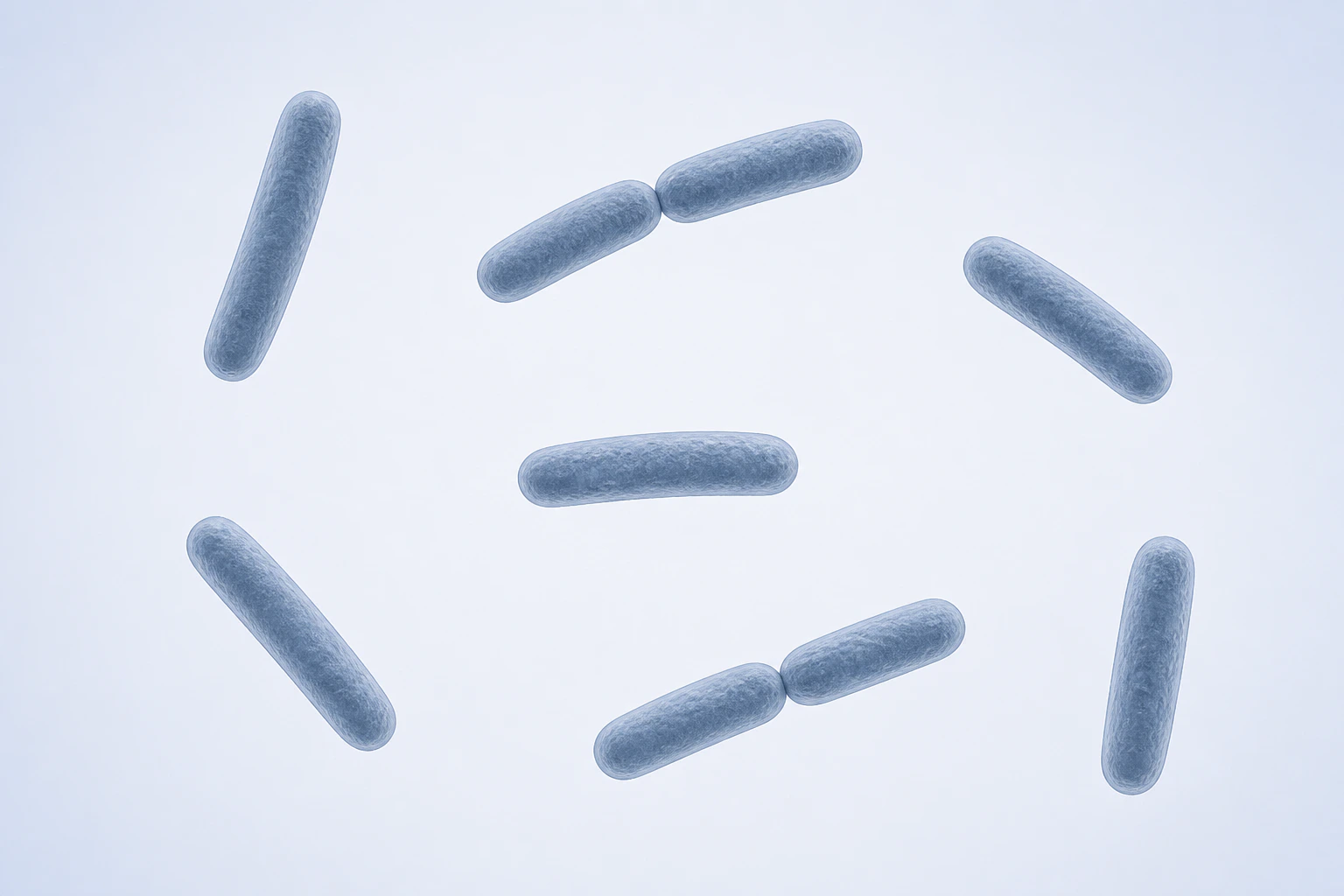
Representative Agathobacter rectalis rod forms, shown as nine bodies in five single and two paired groupings. This current-name scientific reconstruction is non-diagnostic, is not a micrograph, and belongs only to Agathobacter rectalis—not the retired Eubacterium rectale alias.
Scientific media record1 verified identifier
- Subject
- Agathobacter rectalistaxon · species
- Identifiers
- NCBITaxon:39491
- Review
- Editorial review completeIdentifiers authority-verified · Accessibility validated · · agathobacter-rectalis|agathobacter-rectalis-morphology-v1.webp
- Digital source
- Trained-algorithmic mediaCreated with a trained generative algorithm and reviewed by WikiBiome for subject identity, scientific framing, identifiers, provenance, and accessibility.
- Scientific basis
- Agathobacter rectalis — NCBI TaxonomyAgathobacter rectalis — LPSNAgathobacter gen. nov. and Agathobacter rectalis comb. nov.Agathobacter rectalis reclassification record
- License
- CC BY-SA 4.0Created
Agathobacter rectalis (Hauduroy et al. 1937) Rosero et al. 2016 is the selected current name for NCBITaxon:39491. NCBI Taxonomy lists Eubacterium rectale as a homotypic synonym, and LPSN identifies A. rectalis as the correct validly published combination.[1]NCBI Taxonomy — Agathobacter rectalis (NCBITaxon:39491)Author information pendingOpen reference 1 ↓[2]LPSN — Agathobacter rectalisAuthor information pendingOpen reference 2 ↓
Rosero and colleagues proposed the transfer to the new genus Agathobacter using phenotypic, chemotaxonomic, 16S rRNA, and housekeeping-gene evidence.[3]Rosero 2016 — Reclassification of Eubacterium rectale as Agathobacter rectalisJaime A. Rosero, Jiří Killer, Hana Sechovcová et al. · 2016Open reference 3 ↓
Evidence map4 cited passagesInspect provenance +
Agathobacter rectalis (Hauduroy et al. 1937) Rosero et al. 2016 is the selected current name for NCBITaxon:39491. NCBI Taxonomy lists Eubacterium rectale as a homotypic synonym, and LPSN identifies A. rectalis as the correct validly published combination. Rosero and colleagues proposed the transfer to the new genus Agathobacter using phenotypic, chemotaxonom
The transfer has not been free of scientific disagreement. Sheridan and colleagues objected that the evidence did not adequately support moving the narrowed human-gut species definition into the proposed genus. WikiBiome follows the current NCBI and LPSN selection for canonical naming while retaining that published limitation. Canonicalization therefore reco
The cited TEDDY record reports source-labeled Eubacterium rectale among short-chain-fatty-acid-producing taxa depleted in children who progressed to type 1 diabetes in a prospective cohort of 783 children. A cross-sectional CKD multi-omics study likewise reported source-labeled E. rectale depletion across its 88-participant severity cohort. A 96-participant
Reviews cited by WikiBiome report historical E. rectale labels in cardiovascular and neurodegenerative literature. Their summaries do not establish a disease-wide effect. Likewise, Mendelian-randomization records using the “Eubacterium rectale group” label concern a legacy genus-level feature rather than a verified A. rectalis species measurement.
Contents
1. Nomenclature and Published Disagreement2. Reported Human-Microbiome Evidence3. Cross-ReferencesNomenclature and Published Disagreement#
The transfer has not been free of scientific disagreement. Sheridan and colleagues objected that the evidence did not adequately support moving the narrowed human-gut species definition into the proposed genus.[4]Sheridan 2016 — Objections to the proposed reclassification of Eubacterium rectale as Agathobacter rectalisPaul O. Sheridan, Sylvia H. Duncan, Alan W. Walker et al. · 2016Open reference 4 ↓
WikiBiome follows the current NCBI and LPSN selection for canonical naming while retaining that published limitation. Canonicalization therefore records the selected nomenclatural convention; it does not claim unanimous phylogenetic agreement.
Historical publications commonly use “Eubacterium rectale,” and several microbiome GWAS report an “Eubacterium rectale group.” WikiBiome preserves those labels when summarizing what a source measured. A group-level 16S or GWAS label must not be read automatically as a species-resolved observation of A. rectalis.
Reported Human-Microbiome Evidence#
The cited TEDDY record reports source-labeled Eubacterium rectale among short-chain-fatty-acid-producing taxa depleted in children who progressed to type 1 diabetes in a prospective cohort of 783 children.[5]Vatanen et al. 2018 — The Human Gut Microbiome in Early-Onset Type 1 Diabetes from the TEDDY StudyTommi Vatanen, Eric A. Franzosa, Randall Schwager et al. · 2018Open reference 5 ↓
A cross-sectional CKD multi-omics study likewise reported source-labeled E. rectale depletion across its 88-participant severity cohort.[6]Wang 2023 — Perturbed Gut Microbiome and Metabolomes Across CKD SeverityWang, Li, Zhang et al. · 2023Open reference 6 ↓
A 96-participant shotgun-metagenomics study of pancreatic ductal adenocarcinoma, autoimmune pancreatitis, and healthy controls reported E. rectale as a discriminating source-era species label and measured lower fecal Butyrate in the cancer group.[7]The fecal microbiota of patients with pancreatic ductal adenocarcinoma and autoimmune pancreatitis characterized by metagenomic sequencingWenli Zhou, De Zhang, Zhengpeng Li et al. · 2021Open reference 7 ↓ These studies support cohort-specific associations, not causation or a clinical intervention.
Reviews cited by WikiBiome report historical E. rectale labels in cardiovascular and neurodegenerative literature.[8]The Gut Microbiota (Microbiome) in Cardiovascular Disease and Its Therapeutic RegulationMd. Mominur Rahman, Fahadul Islam, Md. Harun-Or-Rashid et al. · 2022Open reference 8 ↓[9]The potential links between human gut microbiota and cardiovascular health and disease - is there a gut-cardiovascular axis?Catia Almeida, J. Guilherme Goncalves-Nobre, Diogo Alpuim Costa et al. · 2023Open reference 9 ↓[10]Effects of gut microbiota on neurodegenerative diseasesKhatoon S, Kalam N, Rashid S et al. · 2023Open reference 10 ↓ Their summaries do not establish a disease-wide effect.
Likewise, Mendelian-randomization records using the “Eubacterium rectale group” label concern a legacy genus-level feature rather than a verified A. rectalis species measurement.[11]Uncovering a Causal Connection between Gut Microbiota and Six Thyroid Diseases: A Two-Sample Mendelian Randomization StudyChen J, Wang Y, Yao H et al. · 2024Open reference 11 ↓[12]Wang K 2024 — Causal Gut Microbiota-GERD Associations via Bidirectional Mendelian RandomizationKui Wang, Suijian Wang, Yuhua Chen et al. · 2024Open reference 12 ↓
The current cited record set does not substantiate a species-specific metal requirement, toxic-metal susceptibility mechanism, universal abundance range, or therapeutic conclusion. Those claims are therefore not carried into the reconciled page.
Cross-References#
- Lachnospiraceae (Family)—parent family context
- butyrate—metabolite context reported by cited studies
- Type 1 Diabetes—prospective-cohort association under the historical label
- Chronic Kidney Disease—cross-sectional association under the historical label
- Cardiovascular Disease—review-level historical-label context
References 15
Numbered by first appearance in the article, then reconciled with its declared source list.
- 1
Author information pending. NCBI Taxonomy — Agathobacter rectalis (NCBITaxon:39491). NCBI Taxonomy.
- 2
Author information pending. LPSN — Agathobacter rectalis. List of Prokaryotic names with Standing in Nomenclature.
- 3
Jaime A. Rosero, Jiří Killer, Hana Sechovcová et al. (2016). Rosero 2016 — Reclassification of Eubacterium rectale as Agathobacter rectalis. International Journal of Systematic and Evolutionary Microbiology.
- 4
Paul O. Sheridan, Sylvia H. Duncan, Alan W. Walker et al. (2016). Sheridan 2016 — Objections to the proposed reclassification of Eubacterium rectale as Agathobacter rectalis. International Journal of Systematic and Evolutionary Microbiology.
- 5
Tommi Vatanen, Eric A. Franzosa, Randall Schwager et al. (2018). Vatanen et al. 2018 — The Human Gut Microbiome in Early-Onset Type 1 Diabetes from the TEDDY Study. Nature.
- 6
Wang, Li, Zhang et al. (2023). Wang 2023 — Perturbed Gut Microbiome and Metabolomes Across CKD Severity. Microbiome.
- 7
Wenli Zhou, De Zhang, Zhengpeng Li et al. (2021). The fecal microbiota of patients with pancreatic ductal adenocarcinoma and autoimmune pancreatitis characterized by metagenomic sequencing. Journal of Translational Medicine.
- 8
Md. Mominur Rahman, Fahadul Islam, Md. Harun-Or-Rashid et al. (2022). The Gut Microbiota (Microbiome) in Cardiovascular Disease and Its Therapeutic Regulation. Frontiers in Cellular and Infection Microbiology.
- 9
Catia Almeida, J. Guilherme Goncalves-Nobre, Diogo Alpuim Costa et al. (2023). The potential links between human gut microbiota and cardiovascular health and disease - is there a gut-cardiovascular axis?. Frontiers in Gastroenterology.
- 10
Khatoon S, Kalam N, Rashid S et al. (2023). Effects of gut microbiota on neurodegenerative diseases. Frontiers in Aging Neuroscience.
- 11
Chen J, Wang Y, Yao H et al. (2024). Uncovering a Causal Connection between Gut Microbiota and Six Thyroid Diseases: A Two-Sample Mendelian Randomization Study. Biology.
- 12
Kui Wang, Suijian Wang, Yuhua Chen et al. (2024). Wang K 2024 — Causal Gut Microbiota-GERD Associations via Bidirectional Mendelian Randomization. Frontiers in Immunology.
- 13
Mendoza-Leon MJ, Mangalam AK, Regaldiz A et al. (2023). Mendoza-Leon et al. 2023 — Gut Microbiota Short-Chain Fatty Acids and Their Impact on the Host Thyroid Function and Diseases. Frontiers in Endocrinology.
- 14
Yihui Li, Ru Fu, Ruixuan Li et al. (2023). Causality of gut microbiome and hypertension: A bidirectional mendelian randomization study. Frontiers in Cardiovascular Medicine.
- 15
Min-jin Kwak, Seung Hyun Kim, Hoo Hugo Kim et al. (2023). Kwak 2023 — Psychobiotics and Fecal Microbiota Transplantation for ASD/ADHD. Frontiers in Cellular and Infection Microbiology.
Article network
Connect the evidence
Publicly readable discussion by ORCID-authenticated researchers. Questions, interpretation, methods, corrections, and new evidence stay attached to this record.
No discussion yet. Start with a precise question or a source-backed observation.
Published page changes
This record shows only material changes published on this page, including changes to its content, evidence, conclusions, or author context. Internal processes and discussion activity are excluded. Pending, declined, and withdrawn proposals remain private.
- published revision
Created “Agathobacter rectalis”: Agathobacter rectalis (Hauduroy et al. 1937) Rosero et al. 2016 is the selected current name for NCBITaxon:39491. NCBI Taxonomy lists Eubacterium rectale as a homotypic synonym, and LPSN identifies A.…
Created “Agathobacter rectalis”: Agathobacter rectalis (Hauduroy et al. 1937) Rosero et al. 2016 is the selected current name for NCBITaxon:39491. NCBI Taxonomy lists Eubacterium rectale as a homotypic synonym, and LPSN identifies A.… Published sections: Agathobacter rectalis; Nomenclature and Published Disagreement; Reported Human-Microbiome Evidence; Cross-References. · Karen Pendergrass · +64 −0
Inspect exact Git diff ↗ - published revision
Created “Eubacterium rectale”: Eubacterium rectale (recently reclassified as Agathobacter rectalis) is a Gram-positive, strictly anaerobic, non-spore-forming bacterium that belongs to Clostridium cluster XIVa within the…
Created “Eubacterium rectale”: Eubacterium rectale (recently reclassified as Agathobacter rectalis) is a Gram-positive, strictly anaerobic, non-spore-forming bacterium that belongs to Clostridium cluster XIVa within the… Published sections: Eubacterium rectale; Metal Dependencies; Key Enzymes and Virulence Factors; Ecological Role; Depleted in:; Key Studies; Cross-References. · WikiBiome Deploy Bot · +87 −0
Inspect exact Git diff ↗