

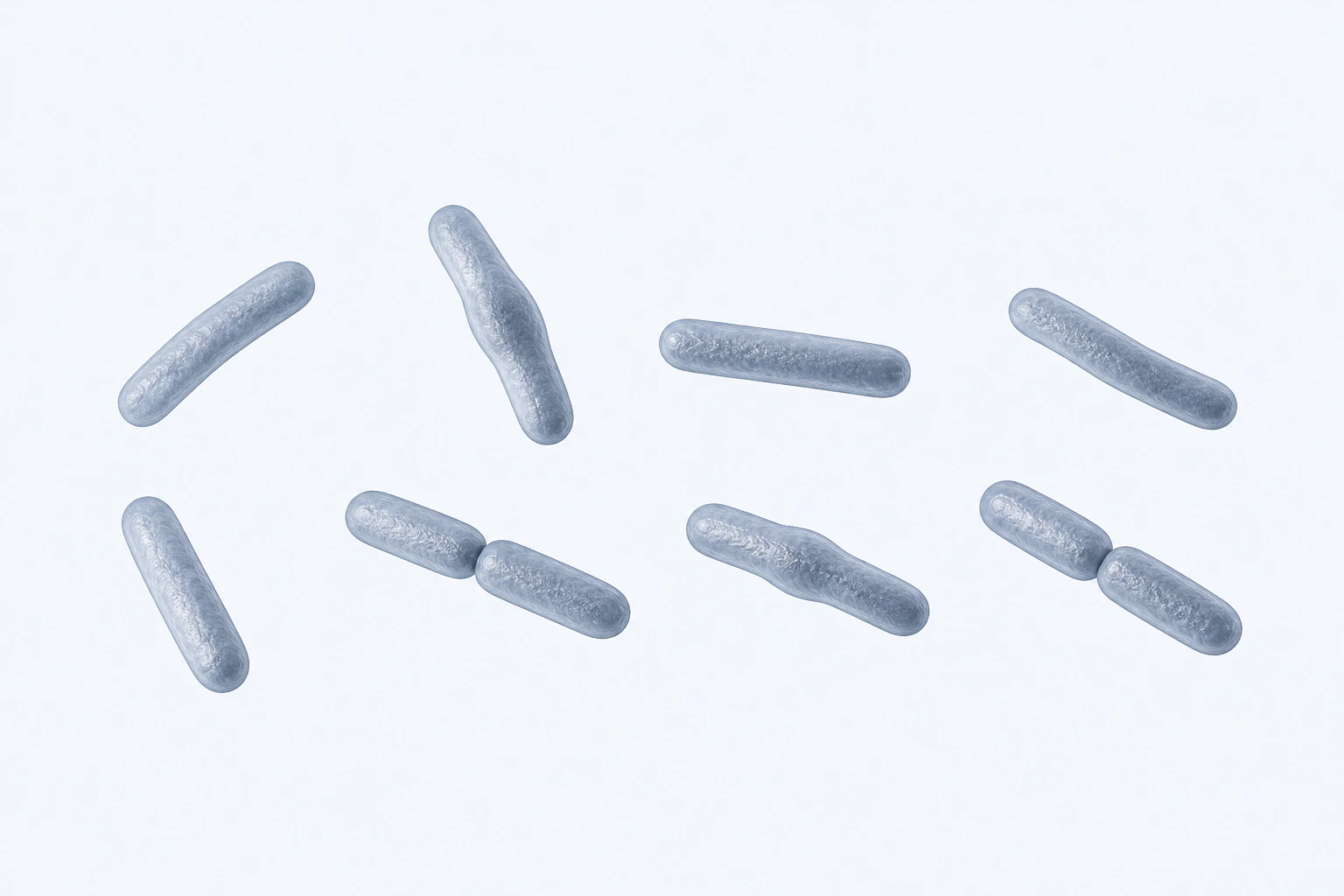
Current-name Lachnospira eligens rods, shown as ten bodies in six single and two paired groupings. This scientific reconstruction is representative, non-diagnostic, not a micrograph, and does not turn historical Eubacterium naming or variable motility structures into a visual identity claim.
Scientific media record1 verified identifier
- Subject
- Lachnospira eligenstaxon · species
- Identifiers
- NCBITaxon:39485
- Review
- Editorial review completeIdentifiers authority-verified · Accessibility validated · · lachnospira-eligens|lachnospira-eligens-morphology-v1.webp
- Digital source
- Trained-algorithmic mediaCreated with a trained generative algorithm and reviewed by WikiBiome for subject identity, scientific framing, identifiers, provenance, and accessibility.
- Scientific basis
- Lachnospira eligens — NCBI TaxonomyLachnospira eligens — LPSNEubacterium eligens original species descriptionLachnospira eligens type strain
- License
- CC BY-SA 4.0Created
Lachnospira eligens (Holdeman and Moore 1974) García-López et al. 2020 is the selected current name for NCBITaxon:39485.
NCBI Taxonomy lists Eubacterium eligens as its basionym, and LPSN treats the two combinations as homotypic synonyms based on the same type strain, ATCC 27750 = DSM 3376 = VPI C15-48.[1]NCBI Taxonomy — Lachnospira eligens (NCBITaxon:39485)Author information pendingOpen reference 1 ↓[2]LPSN — Lachnospira eligensAuthor information pendingOpen reference 2 ↓
García-López and colleagues proposed the transfer after phylogenomic analysis of type-strain genomes; the combination was subsequently validly published.[3]García-López 2019 — Analysis of 1,000 Type-Strain Genomes Improves Taxonomic Classification of BacteroidetesMarina García-López, Jan P. Meier-Kolthoff, Brian J. Tindall et al. · 2019Open reference 3 ↓[2]LPSN — Lachnospira eligensAuthor information pendingOpen reference 2 ↓
Evidence map4 cited passagesInspect provenance +
Lachnospira eligens (Holdeman and Moore 1974) García-López et al. 2020 is the selected current name for NCBITaxon:39485. NCBI Taxonomy lists Eubacterium eligens as its basionym, and LPSN treats the two combinations as homotypic synonyms based on the same type strain, ATCC 27750 = DSM 3376 = VPI C15-48. García-López and colleagues proposed the transfer after
In a prospective cohort of 307 adult men, Ma and colleagues associated greater fruit-fiber intake with increased source-labeled Eubacterium eligens and with pectinase PL9 expression to which that taxon contributed. This supports a cohort-specific diet and carbohydrate-utilization association; it does not establish a universal clinical effect or a metal depen
Luo and colleagues reported that the source-labeled “Eubacterium eligens group” was associated with lower type 1 diabetes risk in their two-sample Mendelian-randomization analysis (IVW OR 0.64, 95% CI 0.50–0.81; FDR-adjusted P = 0.031). A separate CKD Mendelian-randomization study reported a nominal risk-increasing association for the same group label (IVW O
Other cited cohort and classifier records retain their authors' historical Eubacterium eligens or group wording for traceability. Those associations do not by themselves establish causation, a disease-wide direction of effect, or species-level therapeutic benefit.
Contents
1. Nomenclature and Source-Label Boundary2. Reported Human-Microbiome Evidence3. Cross-ReferencesNomenclature and Source-Label Boundary#
WikiBiome uses Lachnospira eligens for the canonical species while preserving “Eubacterium eligens” wherever an older paper used that name. Several microbiome-wide association and Mendelian-randomization datasets report an “Eubacterium eligens group.”
That source-era group label is broader than a verified species assignment and must not be silently rewritten as a measurement of L. eligens alone.
Reported Human-Microbiome Evidence#
In a prospective cohort of 307 adult men, Ma and colleagues associated greater fruit-fiber intake with increased source-labeled Eubacterium eligens and with pectinase PL9 expression to which that taxon contributed.[4]Dietary fiber intake, the gut microbiome, and chronic systemic inflammation in a cohort of adult menWenjie Ma, Long H. Nguyen, Mingyang Song et al. · 2021Open reference 4 ↓
This supports a cohort-specific diet and carbohydrate-utilization association; it does not establish a universal clinical effect or a metal dependency.
Luo and colleagues reported that the source-labeled “Eubacterium eligens group” was associated with lower type 1 diabetes risk in their two-sample Mendelian-randomization analysis (IVW OR 0.64, 95% CI 0.50–0.81; FDR-adjusted P = 0.031).[5]Luo 2023 — Gut microbiota and type 1 diabetes: a two-sample bidirectional Mendelian randomization studyLuo M, Sun M, Wang T et al. · 2023Open reference 5 ↓
A separate CKD Mendelian-randomization study reported a nominal risk-increasing association for the same group label (IVW OR 1.19, 95% CI 1.05–1.35; P = 0.006), while only the order Desulfovibrionales met that study's Bonferroni threshold.[6]Luo 2023 — Causal Effects of Gut Microbiota on the Risk of Chronic Kidney Disease: A Mendelian Randomization StudyMingli Luo, Jiahao Cai, Shulu Luo et al. · 2023Open reference 6 ↓
These results concern genetically proxied group-level abundance in predominantly European-ancestry datasets; they neither demonstrate an intervention effect nor resolve which organisms within the legacy group drove the signals.
Other cited cohort and classifier records retain their authors' historical Eubacterium eligens or group wording for traceability.[7]Eggers 2023 — Prenatal lead exposure is negatively associated with gut microbiome in childhood (PROGRESS cohort)Shoshannah Eggers, Vishal Midya, Moira Bixby et al. · 2023Open reference 7 ↓[8]Prenatal Lead Exposure is Negatively Associated with the Gut Microbiome in ChildhoodEggers S, Midya V, Bixby M et al. · 2023Open reference 8 ↓[9]Latorre-Pérez 2021 — The Spanish Gut Microbiome Reveals Links Between Microorganisms and Mediterranean DietAdriel Latorre-Pérez, Marta Hernández, Jose Ramón Iglesias et al. · 2021Open reference 9 ↓[10]Peralta-Marzal 2024 — A Robust Microbiome Signature for Autism Spectrum Disorder Across Different Studies Using Machine LearningLucia N. Peralta-Marzal, David Rojas-Velazquez, Douwe Rigters et al. · 2024Open reference 10 ↓[11]Yao 2024 — Gut Microbiota and Menstrual Disorders: Two-Sample MR StudyYufan Yao, Haoran Hu, Longhao Chen et al. · 2024Open reference 11 ↓[12]He 2023 — Altered Gut Microbiota and Short-Chain Fatty Acids in Chinese Children with Constipated Autism Spectrum DisorderJianquan He, Xiuhua Gong, Bing Hu et al. · 2023Open reference 12 ↓
Those associations do not by themselves establish causation, a disease-wide direction of effect, or species-level therapeutic benefit.
Cross-References#
- Lachnospiraceae—parent family
- Lachnospira—current genus
- Dietary Fiber (Cross-Condition)—cited diet association
- Type 1 Diabetes—group-level Mendelian-randomization association
- Chronic Kidney Disease—group-level Mendelian-randomization association with a different direction
References 12
Numbered by first appearance in the article, then reconciled with its declared source list.
- 1
Author information pending. NCBI Taxonomy — Lachnospira eligens (NCBITaxon:39485). NCBI Taxonomy.
- 2
Author information pending. LPSN — Lachnospira eligens. List of Prokaryotic names with Standing in Nomenclature.
- 3
Marina García-López, Jan P. Meier-Kolthoff, Brian J. Tindall et al. (2019). García-López 2019 — Analysis of 1,000 Type-Strain Genomes Improves Taxonomic Classification of Bacteroidetes. Frontiers in Microbiology.
- 4
Wenjie Ma, Long H. Nguyen, Mingyang Song et al. (2021). Dietary fiber intake, the gut microbiome, and chronic systemic inflammation in a cohort of adult men. Genome Medicine.
- 5
Luo M, Sun M, Wang T et al. (2023). Luo 2023 — Gut microbiota and type 1 diabetes: a two-sample bidirectional Mendelian randomization study. Frontiers in Cellular and Infection Microbiology.
- 6
Mingli Luo, Jiahao Cai, Shulu Luo et al. (2023). Luo 2023 — Causal Effects of Gut Microbiota on the Risk of Chronic Kidney Disease: A Mendelian Randomization Study. Frontiers in Cellular and Infection Microbiology.
- 7
Shoshannah Eggers, Vishal Midya, Moira Bixby et al. (2023). Eggers 2023 — Prenatal lead exposure is negatively associated with gut microbiome in childhood (PROGRESS cohort). Frontiers in Microbiology.
- 8
Eggers S, Midya V, Bixby M et al. (2023). Prenatal Lead Exposure is Negatively Associated with the Gut Microbiome in Childhood. Frontiers in Microbiology.
- 9
Adriel Latorre-Pérez, Marta Hernández, Jose Ramón Iglesias et al. (2021). Latorre-Pérez 2021 — The Spanish Gut Microbiome Reveals Links Between Microorganisms and Mediterranean Diet. Scientific Reports.
- 10
Lucia N. Peralta-Marzal, David Rojas-Velazquez, Douwe Rigters et al. (2024). Peralta-Marzal 2024 — A Robust Microbiome Signature for Autism Spectrum Disorder Across Different Studies Using Machine Learning. Scientific Reports.
- 11
Yufan Yao, Haoran Hu, Longhao Chen et al. (2024). Yao 2024 — Gut Microbiota and Menstrual Disorders: Two-Sample MR Study. Frontiers in Microbiology.
- 12
Jianquan He, Xiuhua Gong, Bing Hu et al. (2023). He 2023 — Altered Gut Microbiota and Short-Chain Fatty Acids in Chinese Children with Constipated Autism Spectrum Disorder. Scientific Reports.
Article network
Mentioned here 5
Pages linking here 3
Connect the evidence
Publicly readable discussion by ORCID-authenticated researchers. Questions, interpretation, methods, corrections, and new evidence stay attached to this record.
No discussion yet. Start with a precise question or a source-backed observation.
Published page changes
This record shows only material changes published on this page, including changes to its content, evidence, conclusions, or author context. Internal processes and discussion activity are excluded. Pending, declined, and withdrawn proposals remain private.
- published revision
Created “Lachnospira eligens”: Lachnospira eligens (Holdeman and Moore 1974) García-López et al. 2020 is the selected current name for NCBITaxon:39485. NCBI Taxonomy lists Eubacterium eligens as its basionym, and LPSN treats the…
Created “Lachnospira eligens”: Lachnospira eligens (Holdeman and Moore 1974) García-López et al. 2020 is the selected current name for NCBITaxon:39485. NCBI Taxonomy lists Eubacterium eligens as its basionym, and LPSN treats the… Published sections: Lachnospira eligens; Nomenclature and Source-Label Boundary; Reported Human-Microbiome Evidence; Cross-References. · Karen Pendergrass · +59 −0
Inspect exact Git diff ↗ - published revision
Added references: eggers-2023-prenatal-lead-childhood-gut-microbiome-progress; peralta-marzal-2024-robust-microbiome-signature-asd-machine-learning; latorre-perez-2021-spanish-gut-microbiome-mediterranean-diet; eggers-2023-prenatal-lead-exposure-gut-microbiome-childhood;…
Added references: eggers-2023-prenatal-lead-childhood-gut-microbiome-progress; peralta-marzal-2024-robust-microbiome-signature-asd-machine-learning; latorre-perez-2021-spanish-gut-microbiome-mediterranean-diet; eggers-2023-prenatal-lead-exposure-gut-microbiome-childhood; ma-2021-dietary-fiber-gut-microbiome-inflammation-men; yao-2024-gut-microbiota-menstrual-disorders-mr; luo-2023-causal-effects-gut-microbiota-ckd-mr; he-2023-altered-gut-microbiota-scfa-constipated-asd-chinese. Removed references: luo-2023-gut-microbiota-t1d-bidirectional-mendelian-randomization. · WikiBiome Deploy Bot · +16 −11
Inspect exact Git diff ↗ - published revision
Created “Eubacterium eligens”: Eubacterium eligens is a Gram-positive, obligate anaerobic bacterium within the lachnospiraceae family and a significant butyrate producer in the human colon. While less well-known than…
Created “Eubacterium eligens”: Eubacterium eligens is a Gram-positive, obligate anaerobic bacterium within the lachnospiraceae family and a significant butyrate producer in the human colon. While less well-known than… Published sections: Overview; Metal Dependencies; Key Enzymes and Virulence Factors; Ecological Role; Type 1 Diabetes — Causal Protection; Chronic Kidney Disease — Context-Dependent; Interkingdom Relationships; Cross-References. · WikiBiome Deploy Bot · +98 −0
Inspect exact Git diff ↗