

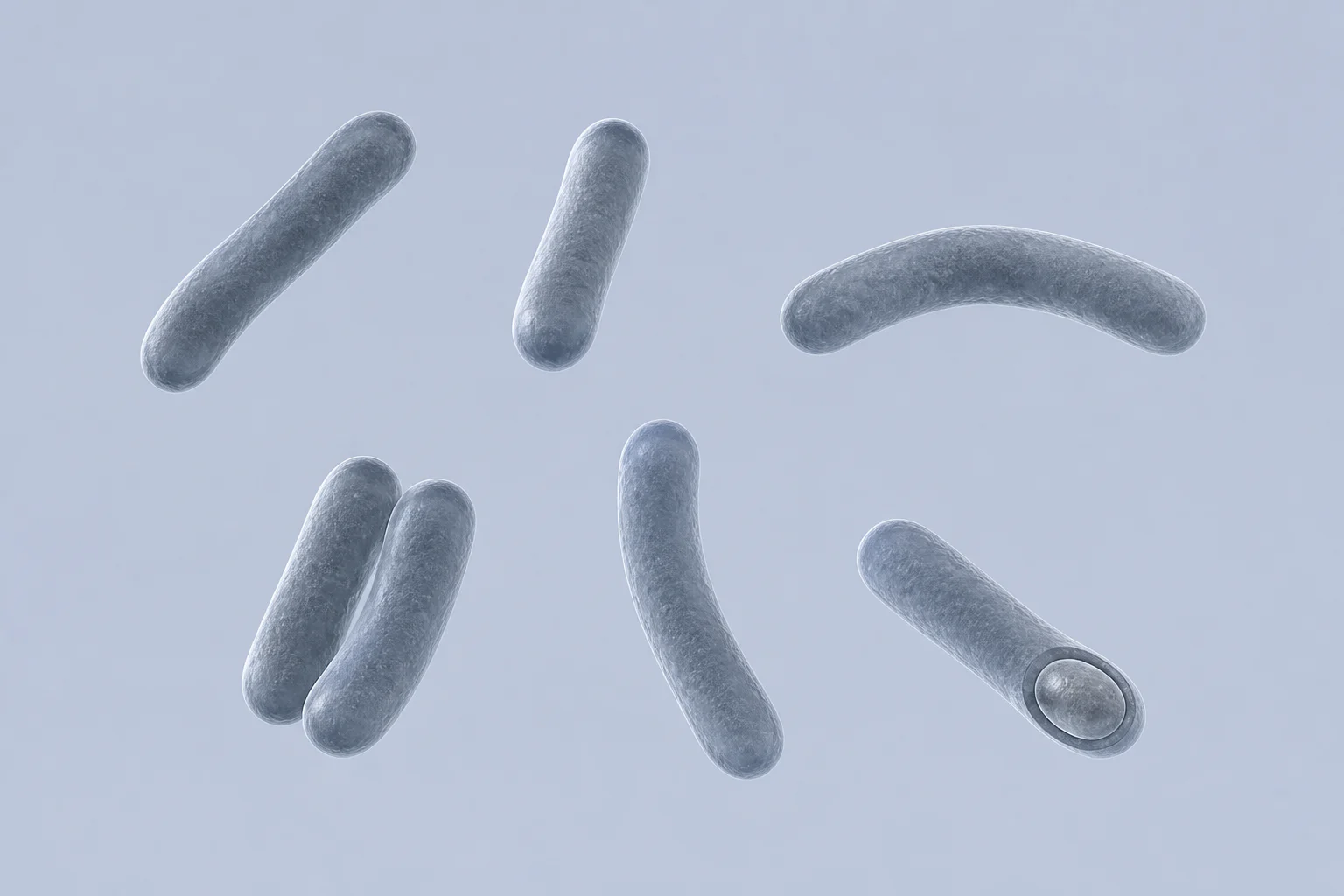
Representative Anaerotruncus morphology. A. colihominis is a nonmotile pleomorphic bacillus whose emended description reports occasional oval terminal spores; this reconstruction is not diagnostic.
Scientific media record1 verified identifier
- Subject
- Anaerotruncustaxon · genus
- Identifiers
- NCBITaxon:244127
- Review
- Editorial review completeIdentifiers authority-verified · Accessibility validated · · anaerotruncus|anaerotruncus-morphology-v1.webp
- Digital source
- Trained-algorithmic mediaCreated with a trained generative algorithm and reviewed by WikiBiome for subject identity, scientific framing, identifiers, provenance, and accessibility.
- Scientific basis
- Anaerotruncus — NCBI TaxonomyAnaerotruncus colihominis gen. nov., sp. nov.Emended Anaerotruncus colihominis description
- License
- CC BY-SA 4.0Created
Anaerotruncus is a Gram-positive obligate anaerobic genus within the Ruminococcaceae (Firmicutes). First isolated from human feces, it is a minor member of the healthy gut community that has attracted attention for its consistent enrichment in aging-related conditions and neurodegenerative disease.
Metal Dependencies#
Anaerotruncus species require iron for anaerobic metabolism. Their expansion in elderly populations may reflect the broader age-related shift in gut iron handling—increased systemic Metal-Driven Inflammation raises hepcidin, altering luminal iron pools in ways that reshape the competitive landscape among strict anaerobes.
Ecological Role#
In healthy adults, Anaerotruncus occupies a low-abundance niche. Its enrichment in elderly cohorts correlates with reduced microbial diversity and declining Butyrate-producing communities. Unlike beneficial Ruminococcaceae members such as Faecalibacterium prausnitzii, Anaerotruncus does not appear to produce significant butyrate, and its expansion may signal a functional shift within the family.
Conditions Associated#
Anaerotruncus is enriched in Alzheimer's Disease, age-related cognitive decline, and Clostridioides difficile infection. Its association with neurodegeneration has prompted investigation through the Gut-Brain Axis framework, though causality remains unestablished. It may serve as a biomarker for age-related gut ecosystem deterioration rather than a direct pathogenic driver.
Cross-References#
- Alzheimer's Disease—enrichment in neurodegeneration
- Iron—metabolic dependency
- Gut-Brain Axis—potential neuroinflammatory link
- aging—age-associated expansion pattern
References 8
Numbered by first appearance in the article, then reconciled with its declared source list.
- 1
Lucia N. Peralta-Marzal, David Rojas-Velazquez, Douwe Rigters et al. (2024). Peralta-Marzal 2024 — A Robust Microbiome Signature for Autism Spectrum Disorder Across Different Studies Using Machine Learning. Scientific Reports.
- 2
Yufan Yao, Haoran Hu, Longhao Chen et al. (2024). Yao 2024 — Gut Microbiota and Menstrual Disorders: Two-Sample MR Study. Frontiers in Microbiology.
- 3
Shen Lin, Hongjin Wang, Jingjing Qiu et al. (2023). Lin 2023 — Gut Microbiota in Perimenopausal Panic Disorder. Frontiers in Psychiatry.
- 4
Yimin Xue, Shirong Lin, Mingguang Chen et al. (2024). Altered colonic microflora and its metabolic profile in mice with acute viral myocarditis induced by coxsackievirus B3. Virology Journal.
- 5
Zhang M, Fang J, Zheng C et al. (2024). Gut Microbiota and Autoimmune Neurologic Disorders: A Two-Sample Bidirectional Mendelian Randomization Study. Frontiers in Microbiology.
- 6
Wang K, Wang S, Chen Y et al. (2024). Causal relationship between gut microbiota and risk of gastroesophageal reflux disease: a genetic correlation and bidirectional Mendelian randomization study. Frontiers in Immunology.
- 7
Si Xian Ho, Jia-Hao Law, Chin-Wen Png et al. (2024). Alterations in colorectal cancer virome and its persistence after surgery. Scientific Reports.
- 8
Paola Bianchimano, Graham J. Britton, David S. Wallach et al. (2022). Mining the microbiota to identify gut commensals modulating neuroinflammation in a mouse model of multiple sclerosis. Microbiome.
Article network
Connect the evidence
Publicly readable discussion by ORCID-authenticated researchers. Questions, interpretation, methods, corrections, and new evidence stay attached to this record.
No discussion yet. Start with a precise question or a source-backed observation.
Published page changes
This record shows only material changes published on this page, including changes to its content, evidence, conclusions, or author context. Internal processes and discussion activity are excluded. Pending, declined, and withdrawn proposals remain private.
- published revision
Added references: peralta-marzal-2024-robust-microbiome-signature-asd-machine-learning; yao-2024-gut-microbiota-menstrual-disorders-mr; lin-2023-gut-microbiota-perimenopausal-panic-disorder; xue-2024-colonic-microflora-metabolic-viral-myocarditis-cvb3;…
Added references: peralta-marzal-2024-robust-microbiome-signature-asd-machine-learning; yao-2024-gut-microbiota-menstrual-disorders-mr; lin-2023-gut-microbiota-perimenopausal-panic-disorder; xue-2024-colonic-microflora-metabolic-viral-myocarditis-cvb3; zhang-2024-gut-microbiota-autoimmune-neurologic-mr; wang-2024-causal-gut-microbiota-gerd-mendelian-bidirectional; ho-2024-colorectal-cancer-virome-alterations-persistence-surgery; bianchimano-2022-vancomycin-gut-commensals-neuroinflammation-eae. · WikiBiome Deploy Bot · +13 −7
Inspect exact Git diff ↗ - published revision
Created “Anaerotruncus”: Anaerotruncus is a Gram-positive obligate anaerobic genus within the Ruminococcaceae (Firmicutes). First isolated from human feces, it is a minor member of the healthy gut community that has attracted…
Created “Anaerotruncus”: Anaerotruncus is a Gram-positive obligate anaerobic genus within the Ruminococcaceae (Firmicutes). First isolated from human feces, it is a minor member of the healthy gut community that has attracted… Published sections: Overview; Metal Dependencies; Ecological Role; Conditions Associated; Cross-References. · WikiBiome Deploy Bot · +53 −0
Inspect exact Git diff ↗