

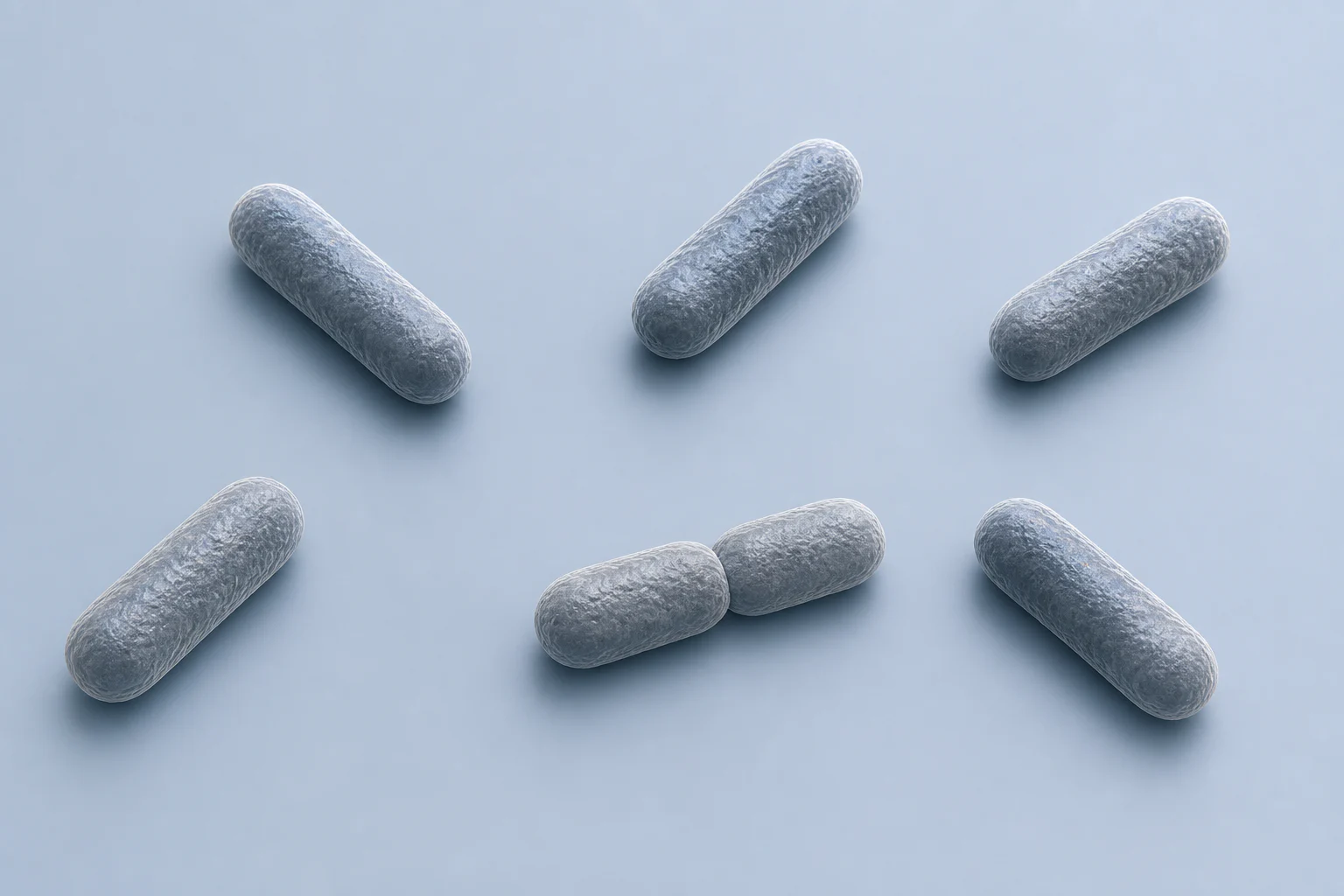
Representative Bacteroides uniformis rod morphology, shown as seven cells in six groupings. This microscopy-informed reconstruction is not diagnostic and is not a micrograph.
Scientific media record1 verified identifier
- Subject
- Bacteroides uniformistaxon · species
- Identifiers
- NCBITaxon:820
- Review
- Editorial review completeIdentifiers authority-verified · Accessibility validated · · bacteroides-uniformis|bacteroides-uniformis-morphology-v1.webp
- Digital source
- Trained-algorithmic mediaCreated with a trained generative algorithm and reviewed by WikiBiome for subject identity, scientific framing, identifiers, provenance, and accessibility.
- Scientific basis
- Bacteroides uniformis — NCBI TaxonomyBacteroides uniformis type strainThe Gram-negative intestinal flora of man
- License
- CC BY-SA 4.0Created
A Gram-negative, obligate anaerobic bacterium within the phylum Bacteroidetes and a common member of the healthy human gut microbiota. B. uniformis is a versatile polysaccharide degrader with emerging significance as an anti-inflammatory commensal whose depletion appears across multiple disease states linked to metal dyshomeostasis.
Evidence map4 cited passagesInspect provenance +
Dietary fiber intake directly increases B. uniformis abundance. In a cohort of healthy men, higher fiber consumption correlated with enrichment of B. uniformis alongside reduced systemic inflammation markers.
Chronic kidney disease (CKD): Depleted in CKD rat models, where uremic toxin accumulation and metal dyshomeostasis reshape the gut microbiome. Fecal microbiota transplantation from healthy donors restores B. uniformis abundance alongside improvements in renal function markers.
Autism spectrum disorder (ASD): Reduced in young ASD children compared to neurotypical controls. The depletion correlates with altered short chain fatty acids profiles and may contribute to the GI symptoms common in ASD.
Gastroesophageal reflux disease (GERD): Identified as a depleted taxon in GERD patients in systematic review findings, suggesting a role in upper GI homeostasis.
Contents
1. Metabolic Functions2. Immune Modulation3. Depletion in Disease States4. Metal Dependencies and Sensitivity5. Ecological Role6. Cross-ReferencesMetabolic Functions#
Possesses an extensive repertoire of polysaccharide utilization loci (PULs) enabling degradation of complex dietary fibers, resistant starches, and host-derived glycans. Produces Short-Chain Fatty Acids (SCFAs)—primarily acetate and propionate—from fiber fermentation, contributing to colonocyte energy supply and immune regulation.
Dietary fiber intake directly increases B. uniformis abundance. In a cohort of healthy men, higher fiber consumption correlated with enrichment of B. uniformis alongside reduced systemic Metal-Driven Inflammation markers.[1]Dietary fiber intake, the gut microbiome, and chronic systemic inflammation in a cohort of adult menWenjie Ma, Long H. Nguyen, Mingyang Song et al. · 2021Open reference 1 ↓
Participates in Bile Acid Metabolism through bile salt hydrolase activity, influencing the enterohepatic circulation of bile acids.
Immune Modulation#
B. uniformis has demonstrated anti-inflammatory properties in preclinical models, reducing pro-inflammatory cytokine production (TNF-alpha, IL-6) while promoting regulatory T cell differentiation. Its polysaccharide capsule components interact with the host immune system via TLR2 and Dectin-1 pathways.
Unlike some Bacteroides species (e.g., Bacteroides fragilis with its BFT toxin), B. uniformis lacks known virulence factors and is considered a beneficial commensal.
Depletion in Disease States#
B. uniformis depletion is a recurring finding across conditions with distinct metal and inflammatory profiles.
Chronic kidney disease (CKD): Depleted in CKD rat models, where uremic toxin accumulation and metal dyshomeostasis reshape the Gut Microbiome. Fecal microbiota transplantation from healthy donors restores B. uniformis abundance alongside improvements in renal function markers.[2]Liu et al. 2022 — FMT Restores Gut Microbiota in CKD RatsLiu, Viltard, Bhatt · 2022Open reference 2 ↓
Autism spectrum disorder (ASD): Reduced in young ASD children compared to neurotypical controls. The depletion correlates with altered Short-Chain Fatty Acids (SCFAs) profiles and may contribute to the GI symptoms common in ASD.[3]Coretti 2018 — Gut Microbiota Features in Young Children With Autism Spectrum DisordersLorena Coretti, Lorella Paparo, Maria Pia Riccio et al. · 2018Open reference 3 ↓
Gastroesophageal reflux disease (GERD): Identified as a depleted taxon in GERD patients in systematic review findings, suggesting a role in upper GI homeostasis.[4]Alageel 2025 — Examining the Microbiome Composition in Patients with Gastroesophageal Reflux Disease: A Systematic ReviewAlageel AA, Alomran DA, Alharbi HB et al. · 2025Open reference 4 ↓
Metal Dependencies and Sensitivity#
Like other Bacteroides, B. uniformis requires Iron for respiratory chain enzymes and Zinc for metalloprotease activity.
Its sensitivity to metal perturbation is not yet characterized at the species level, but the genus Bacteroides is known to shift in composition under heavy metal exposure, with some species expanding (e.g., B. fragilis) while commensals like B. uniformis may be outcompeted.
Ecological Role#
Functions as a primary degrader in the gut, breaking down complex polysaccharides into simpler substrates that feed secondary fermenters including Butyrate producers like Faecalibacterium prausnitzii and Agathobacter rectalis.
Its loss disrupts the fiber fermentation cascade, reducing SCFA availability and potentially contributing to the pro-inflammatory environment seen in dysbiotic states.
Cross-References#
- Bacteroides fragilis—related species with virulence factor (BFT)
- Bacteroides thetaiotaomicron—related versatile polysaccharide degrader
- Short-Chain Fatty Acids (SCFAs)—primary metabolic output
- Bile Acid Metabolism—bile salt hydrolase activity
- Chronic Kidney Disease—depleted in CKD models
- Autism Spectrum Disorder—depleted in ASD children
References 4
Numbered by first appearance in the article, then reconciled with its declared source list.
- 1
Wenjie Ma, Long H. Nguyen, Mingyang Song et al. (2021). Dietary fiber intake, the gut microbiome, and chronic systemic inflammation in a cohort of adult men. Genome Medicine.
- 2
Liu, Viltard, Bhatt (2022). Liu et al. 2022 — FMT Restores Gut Microbiota in CKD Rats. Frontiers in Microbiology.
- 3
Lorena Coretti, Lorella Paparo, Maria Pia Riccio et al. (2018). Coretti 2018 — Gut Microbiota Features in Young Children With Autism Spectrum Disorders. Frontiers in Microbiology.
- 4
Alageel AA, Alomran DA, Alharbi HB et al. (2025). Alageel 2025 — Examining the Microbiome Composition in Patients with Gastroesophageal Reflux Disease: A Systematic Review. TPM (The Primary Care Companion for CNS Disorders).
Article network
Mentioned here 13
Pages linking here 1
Connect the evidence
Publicly readable discussion by ORCID-authenticated researchers. Questions, interpretation, methods, corrections, and new evidence stay attached to this record.
No discussion yet. Start with a precise question or a source-backed observation.
Published page changes
This record shows only material changes published on this page, including changes to its content, evidence, conclusions, or author context. Internal processes and discussion activity are excluded. Pending, declined, and withdrawn proposals remain private.
- published revision
Revised “Ecological Role”: now reads “butyrate producers like faecalibacterium prausnitzii and agathobacter rectalis. - Its loss disrupts the fiber”.
Revised “Ecological Role”: changed “butyrate producers like faecalibacterium prausnitzii and eubacterium rectale. - Its loss disrupts the fiber” to “butyrate producers like faecalibacterium prausnitzii and agathobacter rectalis. - Its loss disrupts the fiber”. · Karen Pendergrass · +1 −1
Inspect exact Git diff ↗ - published revision
Created “Bacteroides uniformis”: A Gram-negative, obligate anaerobic bacterium within the phylum Bacteroidetes and a common member of the healthy human gut microbiota. B. uniformis is a versatile polysaccharide degrader with emerging…
Created “Bacteroides uniformis”: A Gram-negative, obligate anaerobic bacterium within the phylum Bacteroidetes and a common member of the healthy human gut microbiota. B. uniformis is a versatile polysaccharide degrader with emerging… Published sections: Bacteroides uniformis; Metabolic Functions; Immune Modulation; Depletion in Disease States; Metal Dependencies and Sensitivity; Ecological Role; Cross-References. · WikiBiome Deploy Bot · +65 −0
Inspect exact Git diff ↗