

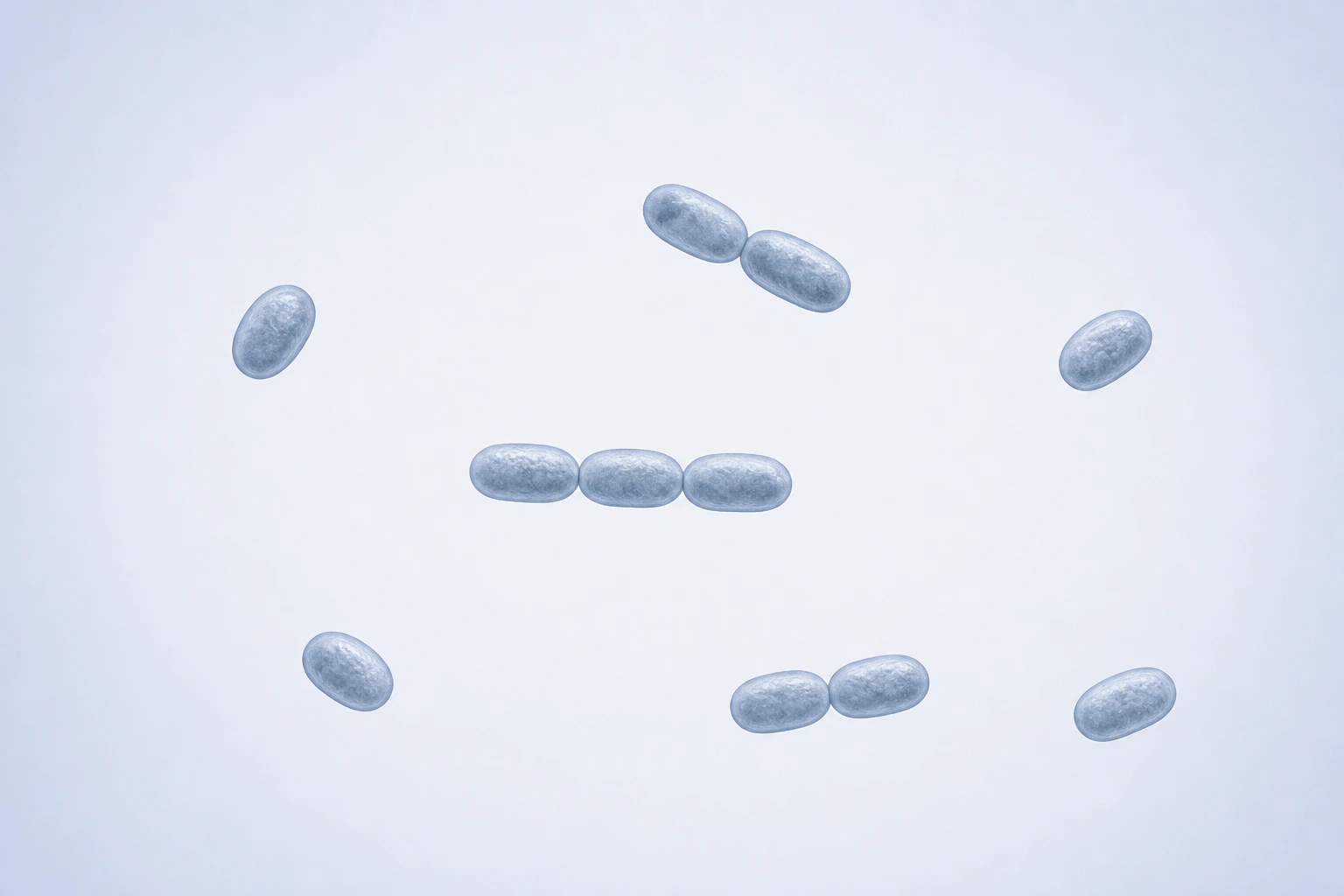
Representative Fannyhessea vaginae elliptical cocci to short coccobacilli, shown as eleven bodies in seven groupings. This scientific reconstruction is non-diagnostic, is not a micrograph, and is keyed only to the current combination—not the retired Atopobium vaginae alias.
Scientific media record1 verified identifier
- Subject
- Fannyhessea vaginaetaxon · species
- Identifiers
- NCBITaxon:82135
- Review
- Editorial review completeIdentifiers authority-verified · Accessibility validated · · fannyhessea-vaginae|fannyhessea-vaginae-morphology-v1.webp
- Digital source
- Trained-algorithmic mediaCreated with a trained generative algorithm and reviewed by WikiBiome for subject identity, scientific framing, identifiers, provenance, and accessibility.
- Scientific basis
- Fannyhessea vaginae — NCBI TaxonomyFannyhessea vaginae — LPSNAtopobium vaginae sp. nov.Atopobium vaginae primary descriptionActinobacterial phylogenomics and Fannyhessea transferFannyhessea vaginae type strain — BacDiveAtopobium vaginae primary microscopy
- License
- CC BY-SA 4.0Created
Fannyhessea vaginae is the current name for NCBITaxon:82135. The organism was originally described as Atopobium vaginae, which remains its validly published basionym and the name used by much of the clinical literature.[1]NCBI Taxonomy — Fannyhessea vaginae (NCBITaxon:82135)Author information pendingOpen reference 1 ↓[2]LPSN — Fannyhessea vaginaeAuthor information pendingOpen reference 2 ↓
Evidence map3 cited passagesInspect provenance +
Fannyhessea vaginae is the current name for NCBITaxon:82135. The organism was originally described as Atopobium vaginae, which remains its validly published basionym and the name used by much of the clinical literature.
Rodriguez Jovita and colleagues described the species from a human vaginal isolate using phenotypic testing, whole-cell protein analysis, and 16S rRNA phylogeny; their type strain CCUG 38953 is also deposited as ATCC BAA-55 and DSM 15829. Nouioui and colleagues later transferred the species to the new genus Fannyhessea in their genome-based classification of
A culture-independent study published under the historical name Atopobium vaginae found the organism abundant in disturbed vaginal microbiota and strongly associated with bacterial vaginosis, often alongside Gardnerella vaginalis. This association does not by itself establish that F. vaginae causes every case, that it translocates from the gut, or that it dr
Nomenclatural History#
Rodriguez Jovita and colleagues described the species from a human vaginal isolate using phenotypic testing, whole-cell protein analysis, and 16S rRNA phylogeny; their type strain CCUG 38953 is also deposited as ATCC BAA-55 and DSM 15829.[3]Characterization of a novel Atopobium isolate from the human vagina: description of Atopobium vaginae sp. nov.M Rodriguez Jovita, M D Collins, B Sjödén et al. · 1999Open reference 3 ↓
Nouioui and colleagues later transferred the species to the new genus Fannyhessea in their genome-based classification of Actinobacteria.[4]Genome-Based Taxonomic Classification of the Phylum ActinobacteriaImen Nouioui, Lorena Carro, Marina García-López et al. · 2018Open reference 4 ↓ NCBI and LPSN both apply Fannyhessea vaginae as the current name.[1]NCBI Taxonomy — Fannyhessea vaginae (NCBITaxon:82135)Author information pendingOpen reference 1 ↓[2]LPSN — Fannyhessea vaginaeAuthor information pendingOpen reference 2 ↓
Bacterial Vaginosis Evidence#
A culture-independent study published under the historical name Atopobium vaginae found the organism abundant in disturbed vaginal microbiota and strongly associated with bacterial vaginosis, often alongside Gardnerella vaginalis.[5]Cloning of 16S rRNA genes amplified from normal and disturbed vaginal microflora suggests a strong association between Atopobium vaginae, Gardnerella vaginalis and bacterial vaginosisRita Verhelst, Hans Verstraelen, Geert Claeys et al. · 2004Open reference 5 ↓
This association does not by itself establish that F. vaginae causes every case, that it translocates from the gut, or that it drives pelvic inflammatory disease or adverse pregnancy outcomes.
Literature Naming#
WikiBiome retains Atopobium vaginae when it is the name reported by an older study. Canonical links and current taxonomic statements resolve to this record so that the historical and current names do not create duplicate indexable pages.
References 5
Numbered by first appearance in the article, then reconciled with its declared source list.
- 1
Author information pending. NCBI Taxonomy — Fannyhessea vaginae (NCBITaxon:82135). NCBI Taxonomy.
- 2
Author information pending. LPSN — Fannyhessea vaginae. List of Prokaryotic names with Standing in Nomenclature.
- 3
M Rodriguez Jovita, M D Collins, B Sjödén et al. (1999). Characterization of a novel Atopobium isolate from the human vagina: description of Atopobium vaginae sp. nov.. International Journal of Systematic Bacteriology.
- 4
Imen Nouioui, Lorena Carro, Marina García-López et al. (2018). Genome-Based Taxonomic Classification of the Phylum Actinobacteria. Frontiers in Microbiology.
- 5
Rita Verhelst, Hans Verstraelen, Geert Claeys et al. (2004). Cloning of 16S rRNA genes amplified from normal and disturbed vaginal microflora suggests a strong association between Atopobium vaginae, Gardnerella vaginalis and bacterial vaginosis. BMC Microbiology.
Article network
Pages linking here 3
Connect the evidence
Publicly readable discussion by ORCID-authenticated researchers. Questions, interpretation, methods, corrections, and new evidence stay attached to this record.
No discussion yet. Start with a precise question or a source-backed observation.
Published page changes
This record shows only material changes published on this page, including changes to its content, evidence, conclusions, or author context. Internal processes and discussion activity are excluded. Pending, declined, and withdrawn proposals remain private.
- published revision
Created “Fannyhessea vaginae”: Fannyhessea vaginae is the current name for NCBITaxon:82135. The organism was originally described as Atopobium vaginae, which remains its validly published basionym and the name used by much of the…
Created “Fannyhessea vaginae”: Fannyhessea vaginae is the current name for NCBITaxon:82135. The organism was originally described as Atopobium vaginae, which remains its validly published basionym and the name used by much of the… Published sections: Fannyhessea vaginae; Nomenclatural History; Bacterial Vaginosis Evidence; Literature Naming. · Karen Pendergrass · +44 −0
Inspect exact Git diff ↗