

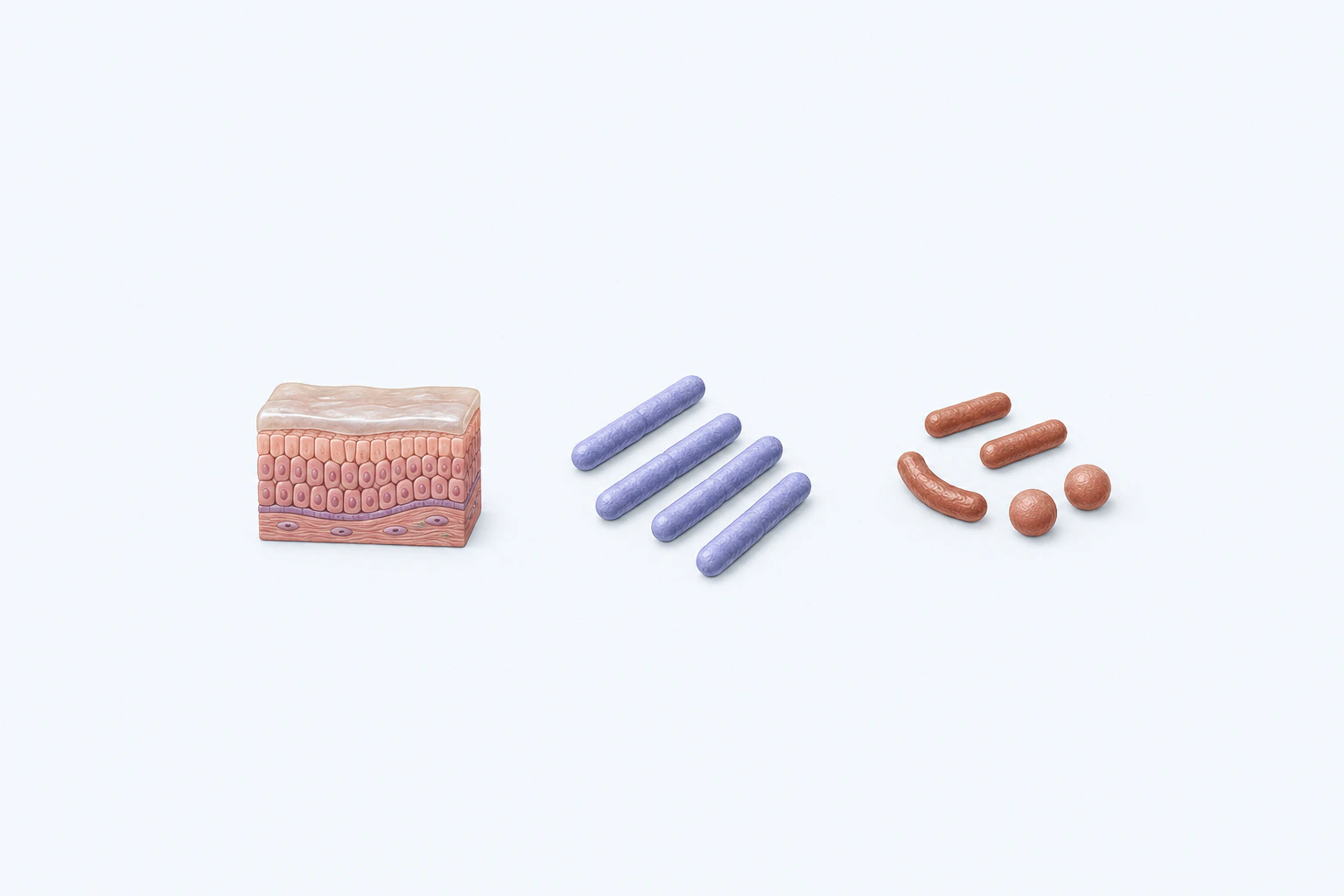
Illustrative polymicrobial community-state orientation relevant to bacterial vaginosis. Counts are layout controls, not measured abundance; this is not a specimen, microscopy result, diagnosis, or treatment claim.
Scientific media record2 verified identifiers
- Subject
- Bacterial Vaginosiscondition
- Identifiers
- MeSH:D016585WikiBiome:bacterial-vaginosis
- Review
- Editorial review completeIdentifiers authority-verified · Accessibility validated · · bacterial-vaginosis|bacterial-vaginosis-mechanism-v3.webp
- Digital source
- Trained-algorithmic mediaCreated with a trained generative algorithm and reviewed by WikiBiome for subject identity, scientific framing, identifiers, provenance, and accessibility.
- License
- CC BY-SA 4.0Created
Bacterial vaginosis (BV) is the most common vaginal infection in women of reproductive age, affecting an estimated 29% of women globally.
Rather than an infection by a single pathogen, BV represents a polymicrobial dysbiotic state—a collapse of the protective Lactobacillus-dominant community and its replacement by a consortium of anaerobic and facultatively anaerobic bacteria led by Gardnerella.
What makes BV especially relevant to the microbiome-metal axis is the emerging evidence that environmental heavy metal exposure may be a driver of the community shift that defines BV, and that iron ecology sits at the center of the dysbiotic state.
Evidence map4 cited passagesInspect provenance +
Lactoferrin concentrations increase 6.6-fold with BV and 11.5-fold with Trichomonas vaginalis infection, representing a host nutritional immunity response.
Lactoferrin is positively associated with serum hepcidin and ferritin, indicating systemic iron redistribution in response to vaginal infection.
endometriosis: Gardnerella is enriched in the endometrial microbiome of endometriosis patients, and the estrogen recirculation pathway connects BV to estrogen-dependent conditions via beta glucuronidase activity.
female infertility: Lactobacillus-dominant vaginal communities correlate with IVF success, while BV-associated taxa predict failure.
Contents
1. The Healthy Vaginal Ecosystem2. The BV Community3. Iron Ecology in BV4. Heavy Metal Associations5. BV and Reproductive Health6. The Estrobolome Connection7. Interkingdom Dynamics8. Open Questions9. Cross-ReferencesThe Healthy Vaginal Ecosystem#
A healthy vaginal microbiome is dominated by one of four community state types (CSTs), three of which are defined by a single Lactobacillus species:
- CST I: L. crispatus dominant (most stable, lowest BV risk)
- CST II: L. gasseri dominant
- CST III: L. iners dominant (transitional; associated with BV recurrence)
- CST vanadium (V): L. jensenii dominant
Lactobacillus species maintain vaginal health through lactic acid production (pH < 4.5), hydrogen peroxide generation, and bacteriocin secretion. This acidic, aerobic environment suppresses the growth of BV-associated anaerobes.
CST IV—the BV state—is defined by low or absent Lactobacillus and high diversity of anaerobic taxa.
The BV Community#
The BV-associated consortium includes:
| Organism | Role |
|---|---|
| Gardnerella | Primary biofilm architect; sialidase production degrades mucus barrier |
| Fannyhessea vaginae (reported historically as Atopobium vaginae) | Strongly associated with disturbed vaginal communities and BV in culture-independent studies |
| Prevotella bivia | Amino acid fermenter; synergistic with Gardnerella |
| Mobiluncus | Motile anaerobe; produces succinate |
| Megasphaera | SCFA producer in vaginal context |
| Sneathia | Associated with preterm birth risk |
These organisms form a polymicrobial biofilm on the vaginal epithelium that is highly resistant to antibiotic therapy, explaining the >50% recurrence rate of BV within 12 months of treatment Gardnerella.
Iron Ecology in BV#
Iron plays a central role in vaginal Dysbiosis. Lactoferrin concentrations increase 6.6-fold with BV and 11.5-fold with Trichomonas vaginalis infection, representing a host nutritional immunity response.[1]Mucosal lactoferrin response to genital tract infections is associated with iron and nutritional biomarkers in young Burkinabe womenRoberts SA, Brabin L, Diallo S et al. · 2019Open reference 1 ↓
Lactoferrin is positively associated with serum hepcidin and ferritin, indicating systemic iron redistribution in response to vaginal infection.[1]Mucosal lactoferrin response to genital tract infections is associated with iron and nutritional biomarkers in young Burkinabe womenRoberts SA, Brabin L, Diallo S et al. · 2019Open reference 1 ↓
BV-associated organisms deploy siderophores and other iron acquisition systems to overcome lactoferrin-mediated iron restriction. Menstrual blood provides periodic iron flooding that may facilitate BV recurrence by temporarily overwhelming Nutritional Immunity (Metal Sequestration) defenses.
This iron ecology parallels the Siderophore Competition dynamics seen in gut dysbiosis—the same metal-centered battle between host sequestration and microbial piracy.
Heavy Metal Associations#
Environmental heavy metal exposure is emerging as a contributor to vaginal dysbiosis. Cadmium: Environmental cadmium (Cd) exposure is associated with BV-like vaginal dysbiosis, potentially by suppressing protective Lactobacillus species Gardnerella. Lead: lead (Pb) exposure correlates with reduced Lactobacillus dominance. Mercury: mercury (Hg) exposure is linked to altered vaginal microbial communities.
The proposed mechanism: Heavy Metals selectively disadvantage Lactobacillus (which has limited metal resistance mechanisms) while BV-associated organisms—many of which are Gram-negative with outer membrane barriers and metal efflux pumps—survive and expand. This is a direct application of metals-as-selective-pressures (Karen's Brain Primitive 1) to the vaginal ecosystem.
BV and Reproductive Health#
BV has consequences far beyond vaginal symptoms. Preterm birth: BV is a leading risk factor for spontaneous preterm delivery. Pelvic inflammatory disease: Ascending infection from BV-associated organisms.
HIV acquisition: BV increases HIV susceptibility 60% due to mucosal barrier disruption.
Endometriosis: Gardnerella is enriched in the endometrial microbiome of endometriosis patients, and the estrogen recirculation pathway connects BV to estrogen-dependent conditions via Beta-Glucuronidase activity.[2]The Vaginal Microbiome as a Tool to Predict rASRM Stage of Disease in Endometriosis: a Pilot StudyPerrotta AR, Borrelli GM, Martins CO et al. · 2020Open reference 2 ↓
Female Infertility: Lactobacillus-dominant vaginal communities correlate with IVF success, while BV-associated taxa predict failure.[3]Differential enrichment of bacteria and phages in the vaginal microbiomes in PCOS and obesity: shotgun sequencing analysisZheng S, Chen H, Yang H et al. · 2024Open reference 3 ↓ Post-surgical infections: BV increases risk following gynecological procedures.
The Estrobolome Connection#
BV-associated organisms produce Beta-Glucuronidase, which deconjugates estrogen metabolites in the reproductive tract, allowing them to be reabsorbed. This connects BV to the broader Estrobolome framework and to estrogen-dependent conditions including Endometriosis and Breast Cancer.
The metalloestrogen hypothesis adds another layer: Cadmium and Nickel can activate estrogen receptors directly, potentially synergizing with estrogen recirculation from BV-associated beta-glucuronidase activity.
Interkingdom Dynamics#
BV is not purely a bacterial phenomenon. Candida albicans and BV can coexist or alternate, with antifungal treatment sometimes precipitating BV and vice versa. Vaginal bacteriophages may play a role in community transitions between CSTs, paralleling Virome dynamics in the gut.
Open Questions#
Unresolved questions identified by the current evidence record.
01Does chelation of environmental metals restore Lactobacillus dominance in BV-susceptible women?+
The current WikiBiome record identifies this as an unresolved evidence gap.
02What is the precise mechanism by which cadmium suppresses vaginal Lactobacillus?+
The current WikiBiome record identifies this as an unresolved evidence gap.
03Can iron-restriction strategies (e.g., lactoferrin supplementation) reduce BV recurrence?+
The current WikiBiome record identifies this as an unresolved evidence gap.
04Does the vaginal virome contribute to BV transitions, as gut phages contribute to NEC?+
The current WikiBiome record identifies this as an unresolved evidence gap.
Cross-References#
- Gardnerella—primary BV pathobiont with sialidase and biofilm
- Lactobacillus—protective vaginal commensal
- Iron—central to vaginal nutritional immunity and BV iron ecology
- Cadmium—environmental exposure linked to vaginal dysbiosis
- Endometriosis—BV-associated organisms enriched in endometrial tissue
- Female Infertility—vaginal microbiome composition predicts IVF outcomes
- Estrobolome—beta-glucuronidase-mediated estrogen recirculation
- Biofilm—polymicrobial BV biofilm drives antibiotic resistance and recurrence
- Nutritional Immunity (Metal Sequestration)—lactoferrin response to vaginal infection
References 3
Numbered by first appearance in the article, then reconciled with its declared source list.
- 1
Roberts SA, Brabin L, Diallo S et al. (2019). Mucosal lactoferrin response to genital tract infections is associated with iron and nutritional biomarkers in young Burkinabe women. European Journal of Clinical Nutrition.
- 2
Perrotta AR, Borrelli GM, Martins CO et al. (2020). The Vaginal Microbiome as a Tool to Predict rASRM Stage of Disease in Endometriosis: a Pilot Study. Reproductive Sciences.
- 3
Zheng S, Chen H, Yang H et al. (2024). Differential enrichment of bacteria and phages in the vaginal microbiomes in PCOS and obesity: shotgun sequencing analysis. Frontiers in Microbiomes.
Article network
Mentioned here 18
Pages linking here 10
Connect the evidence
Publicly readable discussion by ORCID-authenticated researchers. Questions, interpretation, methods, corrections, and new evidence stay attached to this record.
No discussion yet. Start with a precise question or a source-backed observation.
Published page changes
This record shows only material changes published on this page, including changes to its content, evidence, conclusions, or author context. Internal processes and discussion activity are excluded. Pending, declined, and withdrawn proposals remain private.
- published revision
Revised “The BV Community”: now reads “production degrades mucus barrier | | fannyhessea vaginae (reported historically as Atopobium vaginae) | Strongly associated with disturbed vaginal communities and BV in culture-independent studies |…”.
Revised “The BV Community”: changed “production degrades mucus barrier | | Atopobium vaginae | Biofilm co-resident; produces lactic acid isomer (D-lactate) that does not protect against BV | | Prevotella bivia | Amino” to “production degrades mucus barrier | | fannyhessea vaginae (reported historically as Atopobium vaginae) | Strongly associated with disturbed vaginal communities and BV in culture-independent studies |…”. · Karen Pendergrass · +1 −1
Inspect exact Git diff ↗ - published revision
Revised “Heavy Metal Associations”: now reads “This is a direct application of metals-as-selective-pressures (Karen's Brain Primitive 1) to the”.
Revised “Heavy Metal Associations”: changed “This is a direct application of metals as selective pressures (Karen's Brain Primitive 1) to the” to “This is a direct application of metals-as-selective-pressures (Karen's Brain Primitive 1) to the”. · WikiBiome Deploy Bot · +1 −1
Inspect exact Git diff ↗ - published revision
Created “Bacterial Vaginosis”: Bacterial vaginosis (BV) is the most common vaginal infection in women of reproductive age, affecting an estimated 29% of women globally. Rather than an infection by a single pathogen, BV represents a…
Created “Bacterial Vaginosis”: Bacterial vaginosis (BV) is the most common vaginal infection in women of reproductive age, affecting an estimated 29% of women globally. Rather than an infection by a single pathogen, BV represents a… Published sections: Bacterial Vaginosis; The Healthy Vaginal Ecosystem; The BV Community; Iron Ecology in BV; Heavy Metal Associations; BV and Reproductive Health; The Estrobolome Connection; Interkingdom Dynamics; Open Questions; Cross-References. · WikiBiome Deploy Bot · +111 −0
Inspect exact Git diff ↗