

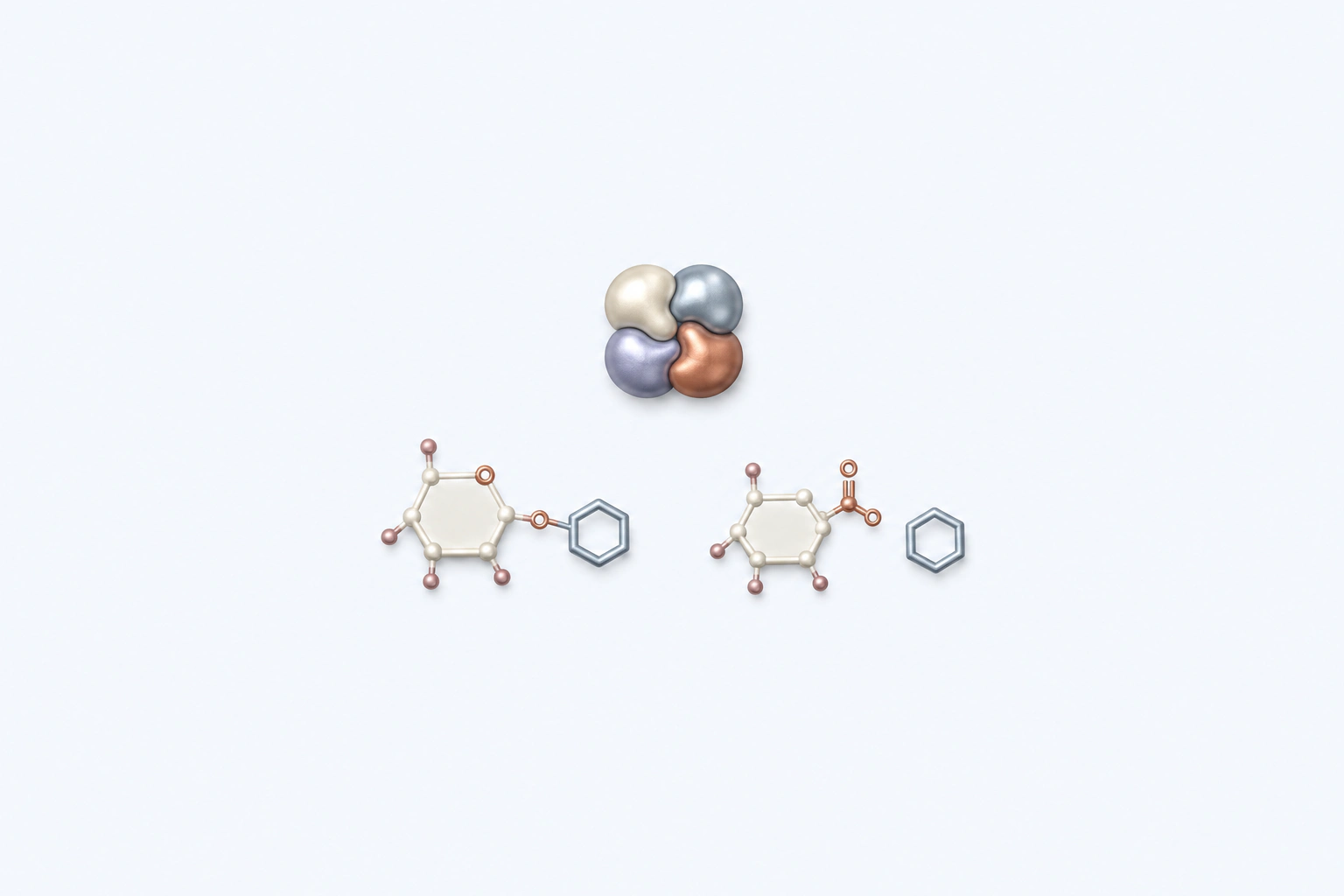
Generic enzyme-class and hydrolysis-context orientation for beta-glucuronidase. This reconstruction does not show a measured structure, species assignment, clinical substrate, catalytic event, pathway flux, biomarker, diagnosis, prognosis, or treatment claim.
Scientific media record2 verified identifiers
- Subject
- Beta-glucuronidasebiological-process
- Identifiers
- WikiBiome:beta-glucuronidaseEC:3.2.1.31
- Review
- Editorial review completeIdentifiers authority-verified · Accessibility validated · · beta-glucuronidase|beta-glucuronidase-mechanism-v4.webp
- Digital source
- Trained-algorithmic mediaCreated with a trained generative algorithm and reviewed by WikiBiome for subject identity, scientific framing, identifiers, provenance, and accessibility.
- License
- CC BY-SA 4.0Created
Beta-glucuronidase (β-glucuronidase, EC 3.2.1.31) is an enzyme that catalyzes the hydrolysis of glucuronidated compounds, cleaving the β-1,4-glycosidic bond between a sugar and a glucuronic acid group.
In the microbiome, beta-glucuronidase is the key enzyme of the Estrobolome—the subset of microbial genes encoding enzymes that deconjugate glucuronidated estrogen metabolites, enabling estrogen reabsorption and recirculation.
Beta-glucuronidase is produced by a wide range of Gram-positive and Gram-negative bacteria, but certain pathogens (E. coli, B. fragilis, E. lenta) express particularly high levels, creating functional Dysbiosis in estrogen-dependent conditions.
Mechanism#
Estrogen conjugation and deconjugation cycle. Host phase II metabolism: Estrogens (estradiol, estrone) undergo hepatic conjugation by UDP-glucuronosyltransferases (UGTs) → estrogen-glucuronide or estrogen-sulfate (more polar, excreted in bile). Biliary secretion: Conjugated estrogens are secreted into bile and reach the colon intact.
Microbial deconjugation: Beta-glucuronidase (from gut bacteria) cleaves estrogen-glucuronides → free estrogen → reabsorbed across colonic epithelium via passive diffusion. Enterohepatic recirculation: Free estrogen is reabsorbed, returned to liver via portal blood, re-enters systemic circulation.
Recycling effect: Estrogen levels remain elevated longer than they would otherwise—multiple passes through the liver instead of single excretion.
Enzyme kinetics: Beta-glucuronidase has broad substrate specificity; it deconjugates not only estrogens but also. Bilirubin-glucuronides (elevated unconjugated bilirubin = jaundice). Drugs (acetaminophen, NSAIDs).
Xenobiotic metabolites.
Dietary polyphenols (e.g., from tea, red wine).
Role in Disease#
Elevated estrobolome activity correlates with estrogen-dependent conditions. Endometriosis: Peritoneal lesions produce their own estrogen via local aromatase expression; elevated estrobolome activity maintains high estrogen levels systemically and locally. Breast Cancer: Prolonged estrogen exposure (especially estradiol) increases breast tissue proliferation; estrobolome dysbiosis with high beta-glucuronidase is associated with tamoxifen resistance.
Polycystic Ovary Syndrome: Elevated serum estrogen linked to estrobolome dysbiosis; beta-glucuronidase-rich dysbiosis observed in PCOS patient cohorts. Obesity: Estrogen dysbiosis contributes to weight gain and metabolic dysfunction; elevated estrogen promotes fat storage and insulin resistance.
vulvovaginitis-recurrent: High vaginal beta-glucuronidase enables recurrent yeast overgrowth by maintaining estrogen levels that promote C. albicans hyphal formation.
Key pathogens with high beta-glucuronidase. E. coli: Pathogenic strains (uropathogenic E. coli, AIEC) have beta-glucuronidase activity as a virulence factor. B. fragilis: Constitutively high beta-glucuronidase; dominant in dysbiotic endometriosis signatures. E. lenta: Gram-positive anaerobe; particularly high beta-glucuronidase activity; enriched in Endometriosis lesions.
Metal Connections#
Beta-glucuronidase is a glycosidic hydrolase—its activity is not directly metal-dependent, but it is regulated by metal bioavailability. Iron and enzymatic efficiency: Bacterial growth rate (and thus enzyme expression rate) is limited by iron under nutritional immunity; high-iron dysbiosis → high beta-glucuronidase expression.
Zinc and immune control: Zinc deficiency impairs Th1 differentiation and favor Th2 responses (IL-4, IL-5); Th2 dominance allows estrogen-dependent pathobionts to proliferate; estrobolome dysbiosis perpetuates low Zinc availability.
Estrogen-mediated metal dysbiosis: High estrogen (from high beta-glucuronidase activity) can suppress Hepcidin expression → elevated iron availability → selects for iron-dependent pathogens → further elevates beta-glucuronidase.
Calcium dysregulation: Some estrobolome pathogens (e.g., E. lenta) also deconjugate cholesterol and promote dysbiotic Mis-Metallation wasting.
Connections#
Related pathways. Estrobolome—the metabolic pathway of which beta-glucuronidase is the rate-limiting enzyme.—the mechanism enabling estrogen re-absorption.—encodes estrogen synthesis; local aromatase in endometriosis lesions creates a feed-forward loop with high estrobolome activity.
Related organisms. E. coli—produces beta-glucuronidase; enriched in endometriosis and other estrogen-dependent dysbiosis. B. fragilis—high beta-glucuronidase activity; key in endometriosis signatures. E. lenta—the most beta-glucuronidase-rich pathobiont; nearly always present in endometriosis.
Related concepts. Nutritional Immunity (Metal Sequestration)—high Iron or low Zinc creates permissive conditions for high-beta-glucuronidase dysbiosis.—tight-junction disruption allows bacterial lipopolysaccharides to trigger estrogen-suppressive Th2 shifts.—overview of conjugation/deconjugation.
Disease pages. Endometriosis, Breast Cancer, Polycystic Ovary Syndrome, Obesity,—estrogen-dependent conditions with estrobolome dysbiosis.
References 7
Numbered by first appearance in the article, then reconciled with its declared source list.
- 1
Fabian Mermans, Evelien Heiremans, Maud Van Belleghem et al. (2019). Nonsteroidal Anti-Inflammatory Drugs as Therapeutic Allies of the Gut Microbiome on Chronic Inflammation. Facta Universitatis Series Medicine and Biology.
- 2
Georgina Quaranta, Mauro Pittiruti, Brunella Posteraro et al. (2019). Quaranta 2019 — FMT as a Potential Tool for Female Reproductive Tract Diseases (Review). Frontiers in Immunology.
- 3
Kanakaraju Kaliannan, Ruairi C. Robertson, Kiera Murphy et al. (2018). Kaliannan et al. 2018 — Estrogen-Mediated Gut Microbiome Alterations Influence Sexual Dimorphism in Metabolic Syndrome in Mice. Microbiome.
- 4
Uzuner C, Mak J, El-Assaad F et al. (2023). The bidirectional relationship between endometriosis and microbiome. Frontiers in Endocrinology.
- 5
Perez-Prieto I, Vargas E, Salas-Espejo E et al. (2024). Gut microbiome in endometriosis: a cohort study on 1000 individuals. BMC Medicine.
- 6
Asangba AE, Chen J, Goergen KM et al. (2023). Asangba 2023 — Diagnostic and prognostic potential of the microbiome in ovarian cancer treatment response. Scientific Reports.
- 7
Shuya Lv, Jingrong Huang, Yadan Luo et al. (2024). Lv 2024 — Gut Microbiota Is Involved in Male Reproductive Function: A Review. Frontiers in Microbiology.
Article network
Mentioned here 16
Pages linking here 35
Connect the evidence
Publicly readable discussion by ORCID-authenticated researchers. Questions, interpretation, methods, corrections, and new evidence stay attached to this record.
No discussion yet. Start with a precise question or a source-backed observation.
Activity and accepted changes
Accepted researcher context, editorial status, public discussion, and upstream Git revisions are shown together. Pending, declined, and withdrawn proposals remain private.
- published revision
Complete corpus-wide Dysbiosis linking
Karen Pendergrass · +1 −1
Inspect exact Git diff ↗ - published revision
massive wiki expansion: 149 stubs fixed, 100+ new pages, Rule 15 scan, keystone papers
WikiBiome Deploy Bot · +31 −26
Inspect exact Git diff ↗ - published revision
ingest: 87 papers (17 endometriosis, 67 erectile dysfunction, 3 cross-condition)
WikiBiome Deploy Bot · +1 −1
Inspect exact Git diff ↗ - published revision
nightly maintenance: 94 stub demotions, 181 source_count fixes, 22 auto-discovered stubs, 5 adversarial audits, 3 boundary fixes, 3 evidence-level corrections
WikiBiome Deploy Bot · +3 −0
Inspect exact Git diff ↗ - published revision
pre-overnight checkpoint 2026-04-18
WikiBiome Deploy Bot · +3 −1
Inspect exact Git diff ↗ - published revision
WikiBiome update — 2026-04-15 17:23
WikiBiome Deploy Bot · +6 −6
Inspect exact Git diff ↗ - published revision
WikiBiome update — integrity fixes, metallomic diet pages, cross-condition analyses
WikiBiome Deploy Bot · +23 −21
Inspect exact Git diff ↗ - published revision
WikiBiome update — 2026-04-10 17:16
WikiBiome Deploy Bot · +76 −0
Inspect exact Git diff ↗