

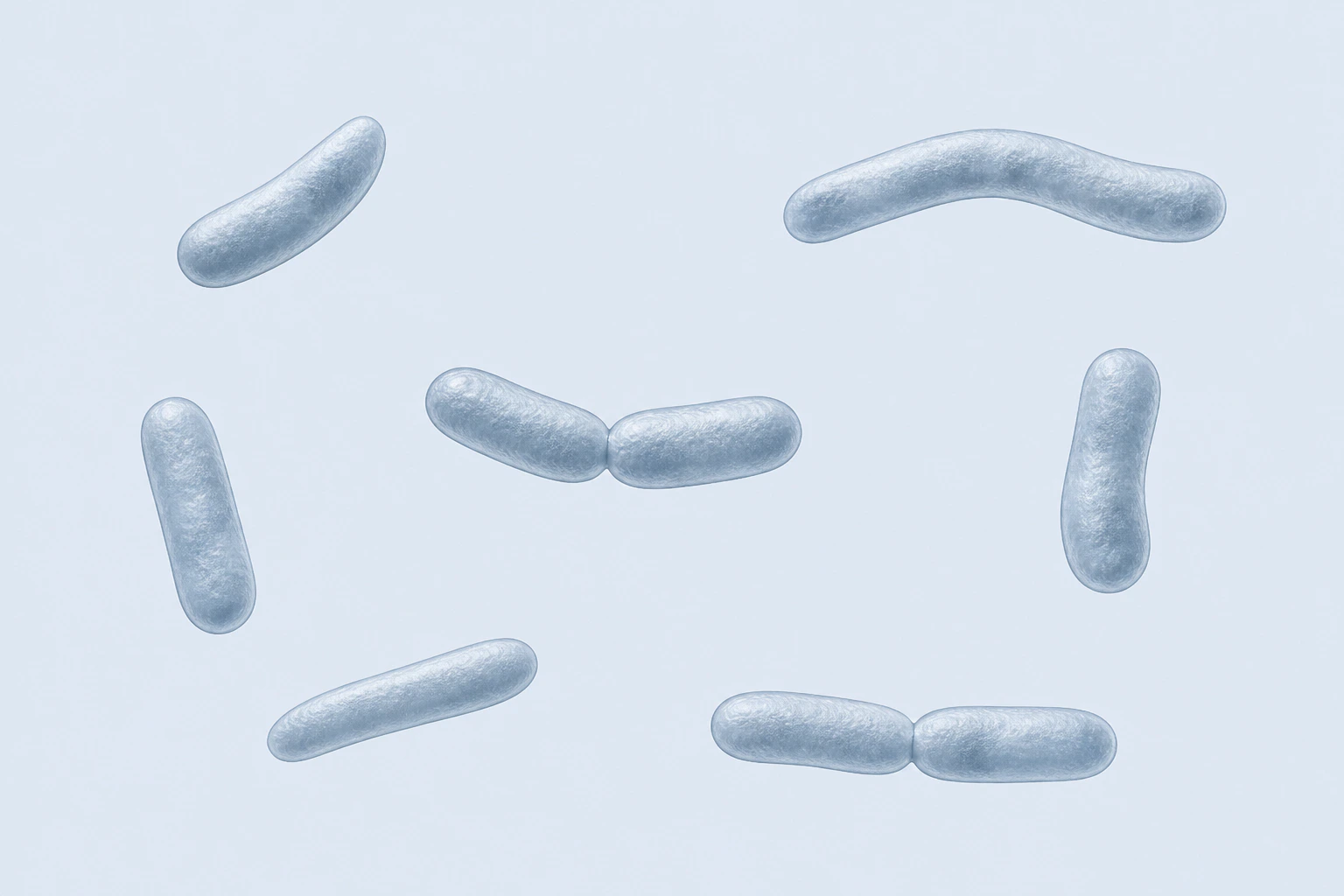
Representative Bifidobacterium longum subsp. infantis rod-level morphology, shown as eight bodies in six groupings. The subspecies is not visually diagnostic from this reconstruction, which is not a micrograph.
Scientific media record1 verified identifier
- Subject
- Bifidobacterium longum subsp. infantistaxon · subspecies
- Identifiers
- NCBITaxon:1682
- Review
- Editorial review completeIdentifiers authority-verified · Accessibility validated · · bifidobacterium-longum-subsp-infantis|bifidobacterium-longum-subsp-infantis-morphology-v1.webp
- Digital source
- Trained-algorithmic mediaCreated with a trained generative algorithm and reviewed by WikiBiome for subject identity, scientific framing, identifiers, provenance, and accessibility.
- Scientific basis
- Bifidobacterium longum subsp. infantis — NCBI TaxonomyBifidobacterium longum subsp. infantis type strain
- License
- CC BY-SA 4.0Created
Bifidobacterium longum subsp. infantis is the current, validly published name for NCBITaxon:1682. Bifidobacterium infantis Reuter 1963 is its basionym, not a separate current species.[1]NCBI Taxonomy — Bifidobacterium longum subsp. infantis (NCBITaxon:1682)Author information pendingOpen reference 1 ↓[2]LPSN — Bifidobacterium longum subsp. infantisAuthor information pendingOpen reference 2 ↓
Mattarelli and colleagues established the current combination in 2008 and designated S12 (ATCC 15697; DSM 20088) as its type strain.[3]Proposal to reclassify the three biotypes of Bifidobacterium longum as three subspeciesPaola Mattarelli, Claudia Bonaparte, Bruno Pot et al. · 2008Open reference 3 ↓
Evidence map4 cited passagesInspect provenance +
Bifidobacterium longum subsp. infantis is the current, validly published name for NCBITaxon:1682. Bifidobacterium infantis Reuter 1963 is its basionym, not a separate current species. Mattarelli and colleagues established the current combination in 2008 and designated S12 (ATCC 15697; DSM 20088) as its type strain.
WikiBiome preserves “B. infantis” or “Bifidobacterium infantis” when a cited paper or product formulation used that historical or shorthand label. Such wording does not establish that an incompletely identified formulation contained the current subspecies. The thyroidectomy probiotic trial, the VSL3 hypothyroidism trial, and the five-strain case report each
Strain 35624 must not be treated as evidence for this subspecies. Although older clinical literature called it “B. infantis 35624,” comparative core-genome analysis assigned it to Bifidobacterium longum subsp. longum. Clinical findings reported under the historical label remain findings about strain 35624; they do not transfer to NCBITaxon:1682 or to other s
Source-level mentions of an infantis label in gestational-diabetes, ovarian-cancer, thyroid, or metabolic literature are retained for traceability. They do not establish a strain-specific clinical effect, causal disease role, or current subspecies assignment unless the cited work identifies and verifies a strain belonging to B. longum subsp. infantis.
Literature and Product Labels#
WikiBiome preserves “B. infantis” or “Bifidobacterium infantis” when a cited paper or product formulation used that historical or shorthand label. Such wording does not establish that an incompletely identified formulation contained the current subspecies.
The thyroidectomy probiotic trial, the VSL#3 hypothyroidism trial, and the five-strain case report each used an infantis label without providing enough strain-level taxonomic evidence in the WikiBiome source record to independently assign that component to NCBITaxon:1682.[4]Lin 2022 — Probiotics alleviate oral-gut microbiota dysbiosis in thyroid cancer patients after thyroidectomy: RCTBaiqiang Lin, Fuya Zhao, Yang Liu et al. · 2022Open reference 4 ↓[5]Spaggiari 2017 — Probiotics (VSL#3) do not directly affect thyroid hormonal parameters in levothyroxine-treated hypothyroid patientsGiorgia Spaggiari, Giulia Brigante, Sara De Vincentis et al. · 2017Open reference 5 ↓[6]Griffith 2026 — Lifestyle Changes and Probiotic Supplementation for Improving Longstanding Type 2 Diabetes in a Male Undergoing Testosterone Replacement TherapyAnna Griffith, Adam Perlman, Tara Karr et al. · 2026Open reference 6 ↓
Strain Boundary#
Strain 35624 must not be treated as evidence for this subspecies. Although older clinical literature called it “B. infantis 35624,” comparative core-genome analysis assigned it to Bifidobacterium longum subsp. longum.[7]Genome Analysis and Characterisation of the Exopolysaccharide Produced by Bifidobacterium longum subsp. longum 35624Friedrich Altmann, Paul Kosma, Amy O'Callaghan et al. · 2016Open reference 7 ↓
Clinical findings reported under the historical label remain findings about strain 35624; they do not transfer to NCBITaxon:1682 or to other strains bearing an infantis label.
Evidence Boundary#
Source-level mentions of an infantis label in gestational-diabetes, ovarian-cancer, thyroid, or metabolic literature are retained for traceability.[8]Wei 2022 — 16S rRNA Gene Amplicon Sequencing of Gut Microbiota in Gestational Diabetes MellitusJ. Wei, Y. Qing, H. Zhou et al. · 2022Open reference 8 ↓[9]Asangba 2023 — Diagnostic and prognostic potential of the microbiome in ovarian cancer treatment responseAsangba AE, Chen J, Goergen KM et al. · 2023Open reference 9 ↓
They do not establish a strain-specific clinical effect, causal disease role, or current subspecies assignment unless the cited work identifies and verifies a strain belonging to B. longum subsp. infantis.
Cross-References#
- Bifidobacterium longum—parent species
- Bifidobacterium—genus page
- Bifidobacteriaceae—family context
References 9
Numbered by first appearance in the article, then reconciled with its declared source list.
- 1
Author information pending. NCBI Taxonomy — Bifidobacterium longum subsp. infantis (NCBITaxon:1682). NCBI Taxonomy.
- 2
Author information pending. LPSN — Bifidobacterium longum subsp. infantis. List of Prokaryotic names with Standing in Nomenclature.
- 3
Paola Mattarelli, Claudia Bonaparte, Bruno Pot et al. (2008). Proposal to reclassify the three biotypes of Bifidobacterium longum as three subspecies. International Journal of Systematic and Evolutionary Microbiology.
- 4
Baiqiang Lin, Fuya Zhao, Yang Liu et al. (2022). Lin 2022 — Probiotics alleviate oral-gut microbiota dysbiosis in thyroid cancer patients after thyroidectomy: RCT. Frontiers in Endocrinology.
- 5
Giorgia Spaggiari, Giulia Brigante, Sara De Vincentis et al. (2017). Spaggiari 2017 — Probiotics (VSL#3) do not directly affect thyroid hormonal parameters in levothyroxine-treated hypothyroid patients. Frontiers in Endocrinology.
- 6
Anna Griffith, Adam Perlman, Tara Karr et al. (2026). Griffith 2026 — Lifestyle Changes and Probiotic Supplementation for Improving Longstanding Type 2 Diabetes in a Male Undergoing Testosterone Replacement Therapy. Frontiers in Endocrinology.
- 7
Friedrich Altmann, Paul Kosma, Amy O'Callaghan et al. (2016). Genome Analysis and Characterisation of the Exopolysaccharide Produced by Bifidobacterium longum subsp. longum 35624. PLOS ONE.
- 8
J. Wei, Y. Qing, H. Zhou et al. (2022). Wei 2022 — 16S rRNA Gene Amplicon Sequencing of Gut Microbiota in Gestational Diabetes Mellitus. Journal of Endocrinological Investigation.
- 9
Asangba AE, Chen J, Goergen KM et al. (2023). Asangba 2023 — Diagnostic and prognostic potential of the microbiome in ovarian cancer treatment response. Scientific Reports.
Article network
Mentioned here 3
Pages linking here 2
Connect the evidence
Publicly readable discussion by ORCID-authenticated researchers. Questions, interpretation, methods, corrections, and new evidence stay attached to this record.
No discussion yet. Start with a precise question or a source-backed observation.
Published page changes
This record shows only material changes published on this page, including changes to its content, evidence, conclusions, or author context. Internal processes and discussion activity are excluded. Pending, declined, and withdrawn proposals remain private.
- published revision
Created “Bifidobacterium longum subsp. infantis”: Bifidobacterium longum subsp. infantis is the current, validly published name for NCBITaxon:1682. Bifidobacterium infantis Reuter 1963 is its basionym, not a separate current species. Mattarelli and…
Created “Bifidobacterium longum subsp. infantis”: Bifidobacterium longum subsp. infantis is the current, validly published name for NCBITaxon:1682. Bifidobacterium infantis Reuter 1963 is its basionym, not a separate current species. Mattarelli and… Published sections: Bifidobacterium longum subsp. infantis; Literature and Product Labels; Strain Boundary; Evidence Boundary; Cross-References. · Karen Pendergrass · +54 −0
Inspect exact Git diff ↗