
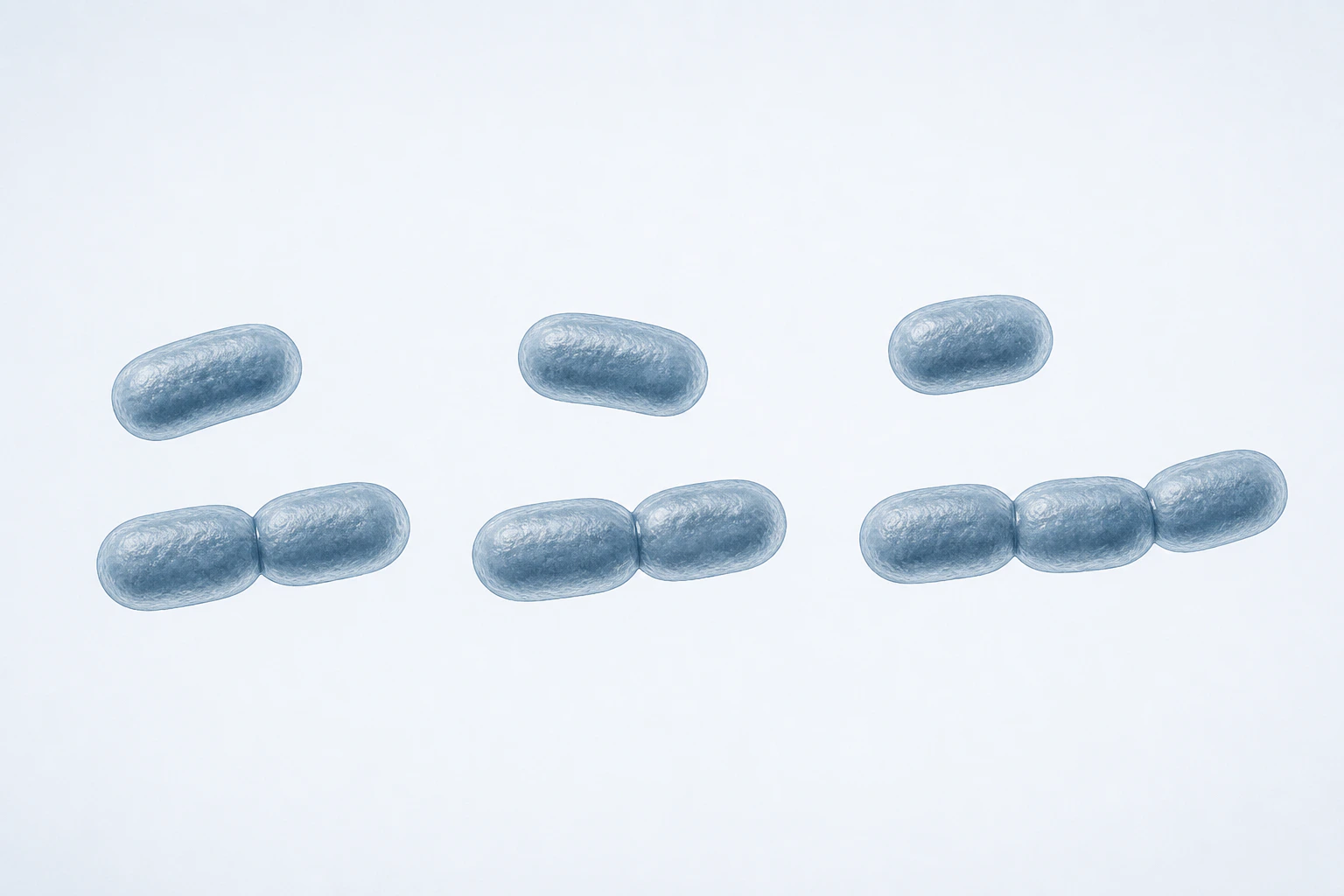
Type-species-anchored Holdemanella short ovoid rods, shown as ten bodies in three single, two paired, and one three-body chain grouping. This genus-level scientific reconstruction is representative, non-diagnostic, and not a universal genus arrangement or a micrograph.
Scientific media record1 verified identifier
- Subject
- Holdemanellataxon · genus
- Identifiers
- NCBITaxon:1573535
- Review
- Editorial review completeIdentifiers authority-verified · Accessibility validated · · holdemanella|holdemanella-morphology-v1.webp
- Digital source
- Trained-algorithmic mediaCreated with a trained generative algorithm and reviewed by WikiBiome for subject identity, scientific framing, identifiers, provenance, and accessibility.
- Scientific basis
- Holdemanella — NCBI TaxonomyHoldemanella — LPSNHoldemanella biformis — LPSNHoldemanella gen. nov.Holdemanella biformis type strain
- License
- CC BY-SA 4.0Created
A genus of Gram-positive, strictly anaerobic bacteria in the family Erysipelotrichaceae (phylum Firmicutes) that is emerging as one of the most consistently protective gut commensals in human disease.
Holdemanella is depleted across a striking range of conditions—inflammatory bowel disease, postpartum depression, thyroid disorders, and neurodevelopmental conditions—and Mendelian randomization studies provide evidence that this depletion is not merely a consequence of disease but may be causally related to disease risk.
Its consistent loss across multiple unrelated conditions marks it as a candidate keystone commensal whose absence destabilizes the gut ecosystem.
Evidence map11 cited passagesInspect provenance +
Holdemanella belongs to the healthy core microbiota. In a study of inflammatory bowel disease in Western China, Holdemanella was identified alongside Christensenellaceae R-7 group and Fusicatenibacter as part of the core commensal community consistently depleted in both Crohn's disease and ulcerative colitis (, case-control, n=36). This shared depletion acro
Consuming omega-3-rich fish is associated with increased Holdemanella abundance (, computational-prediction), suggesting a dietary-microbiome-mood axis where omega-3 intake supports Holdemanella colonization, which in turn may protect against depression. This positions Holdemanella as a potential mediator of the well-documented anti-depressant effects of ome
In a randomized controlled trial of probiotic supplementation during thyroid hormone withdrawal, Holdemanella increased in the probiotic group alongside improvements in constipation, energy levels, and intestinal barrier integrity (, RCT, n=39). This suggests Holdemanella benefits from the ecological restoration provided by probiotic colonization even when n
Postpartum depression—Holdemanella is causally protective: OR=0.979 (95% CI 0.961-0.997, P=0.023) via IVW Mendelian randomization. No heterogeneity or horizontal pleiotropy detected; Steiger test confirmed causal directionality (microbiome to PPD) (, computational-prediction, n=38,007).
Inflammatory bowel disease—Depleted in both Crohn's disease and ulcerative colitis as part of the healthy core microbiota (, case-control). IBD causally decreases Holdemanella abundance (, computational-prediction).
Hashimoto's thyroiditis—Depleted in autoimmune thyroid disease ()
Post-thyroidectomy dysbiosis—Restored by probiotic intervention (, RCT)
(computational-prediction, n=38,007)—Provides Mendelian randomization evidence for causal protective effect of Holdemanella against postpartum depression; links omega-3 fish consumption to Holdemanella abundance.
(case-control, n=36)—Identifies Holdemanella as part of the healthy core microbiota depleted in both CD and UC.
(computational-prediction)—MR evidence that IBD causally decreases Holdemanella; gut microbiota does not mediate IBD-to-extraintestinal manifestation pathway.
(RCT, n=39)—Probiotic restoration of Holdemanella during thyroid hormone withdrawal with clinical benefit.
Contents
1. Metal Dependencies2. Key Enzymes and Virulence Factors3. Ecological Role4. Conditions Associated5. Key Studies6. Cross-ReferencesMetal Dependencies#
Holdemanella species are obligate anaerobes with metabolic requirements typical of Firmicutes—Iron-dependent enzymes for anaerobic fermentation and Butyrate production pathways. The genus remains poorly characterized at the metallomic level, representing an important research gap given its apparent ecological importance.
Key Enzymes and Virulence Factors#
Holdemanella is not a pathogen; its biological significance lies in its beneficial metabolic contributions.
Butyrate production—As a member of Erysipelotrichaceae, Holdemanella contributes to butyrate generation, supporting gut barrier integrity, colonocyte energy supply, and anti-inflammatory signaling. Saccharolytic fermentation—Participates in carbohydrate fermentation pathways that compete with proteolytic (toxin-generating) metabolism.
Ecological Role#
A Candidate Keystone Commensal#
Holdemanella belongs to the healthy core microbiota.
In a study of inflammatory bowel disease in Western China, Holdemanella was identified alongside Christensenellaceae R-7 group and Fusicatenibacter as part of the core commensal community consistently depleted in both Crohn's disease and ulcerative colitis (,[1]Wang 2024 — Integrated 16S rRNA sequencing and metagenomics insights into microbial dysbiosis and distinct virulence factors in inflammatory bowel diseaseHaijing Wang, Yuanjun Wang, Libin Yang et al. · 2024Open reference 1 ↓ case-control, n=36).
This shared depletion across two distinct IBD subtypes suggests Holdemanella occupies a fundamental ecological niche rather than being condition-specific.
Omega-3 Association#
Consuming omega-3-rich fish is associated with increased Holdemanella abundance (,[2]Zhang 2024 — Gut Microbiota and Postpartum Depression: A Mendelian Randomization StudyJianjun Zhang, Lechuan Wei, Hongfei Tan et al. · 2024Open reference 2 ↓ computational-prediction), suggesting a dietary-microbiome-mood axis where omega-3 intake supports Holdemanella colonization, which in turn may protect against depression. This positions Holdemanella as a potential mediator of the well-documented anti-depressant effects of omega-3 fatty acids.
Restoration by Probiotics#
In a randomized controlled trial of probiotic supplementation during thyroid hormone withdrawal, Holdemanella increased in the probiotic group alongside improvements in constipation, energy levels, and intestinal barrier integrity (,[3]Lin 2022 — Probiotics alleviate oral-gut microbiota dysbiosis in thyroid cancer patients after thyroidectomy: RCTBaiqiang Lin, Fuya Zhao, Yang Liu et al. · 2022Open reference 3 ↓ RCT, n=39).
This suggests Holdemanella benefits from the ecological restoration provided by probiotic colonization even when not included in the probiotic formulation itself.
Conditions Associated#
Causal Protective Evidence (Mendelian Randomization)#
Postpartum depression—Holdemanella is causally protective: OR=0.979 (95% CI 0.961-0.997, P=0.023) via IVW Mendelian randomization. No heterogeneity or horizontal pleiotropy detected; Steiger test confirmed causal directionality (microbiome to PPD) (,[2]Zhang 2024 — Gut Microbiota and Postpartum Depression: A Mendelian Randomization StudyJianjun Zhang, Lechuan Wei, Hongfei Tan et al. · 2024Open reference 2 ↓ computational-prediction, n=38,007).
Consistent Depletion Pattern#
- Inflammatory bowel disease—Depleted in both Crohn's disease and ulcerative colitis as part of the healthy core microbiota (,[1]Wang 2024 — Integrated 16S rRNA sequencing and metagenomics insights into microbial dysbiosis and distinct virulence factors in inflammatory bowel diseaseHaijing Wang, Yuanjun Wang, Libin Yang et al. · 2024Open reference 1 ↓ case-control). IBD causally decreases Holdemanella abundance (,[4]Gut Microbiota Does Not Play a Mediating Role in the Causal Association Between Inflammatory Bowel Disease and Several Its Associated Extraintestinal ManifestationsLu W, Cen J, Dai Q et al. · 2024Open reference 4 ↓ computational-prediction).
- Hashimoto's thyroiditis—Depleted in autoimmune thyroid disease ([5]Fang et al. 2024 — Gut Microbiota and Autoimmune Thyroid Disease: A Bidirectional Mendelian Randomization Study and Mediation AnalysisFang Y, Zhang X, Huang R et al. · 2024Open reference 5 ↓)
- Post-thyroidectomy Dysbiosis—Restored by probiotic intervention (,[3]Lin 2022 — Probiotics alleviate oral-gut microbiota dysbiosis in thyroid cancer patients after thyroidectomy: RCTBaiqiang Lin, Fuya Zhao, Yang Liu et al. · 2022Open reference 3 ↓ RCT)
- Post-stroke depression—Negatively correlated with HAMD depression scores
Key Studies#
[2]Zhang 2024 — Gut Microbiota and Postpartum Depression: A Mendelian Randomization StudyJianjun Zhang, Lechuan Wei, Hongfei Tan et al. · 2024Open reference 2 ↓ (computational-prediction, n=38,007)—Provides Mendelian randomization evidence for causal protective effect of Holdemanella against postpartum depression; links omega-3 fish consumption to Holdemanella abundance.
[1]Wang 2024 — Integrated 16S rRNA sequencing and metagenomics insights into microbial dysbiosis and distinct virulence factors in inflammatory bowel diseaseHaijing Wang, Yuanjun Wang, Libin Yang et al. · 2024Open reference 1 ↓ (case-control, n=36)—Identifies Holdemanella as part of the healthy core microbiota depleted in both CD and UC.
[4]Gut Microbiota Does Not Play a Mediating Role in the Causal Association Between Inflammatory Bowel Disease and Several Its Associated Extraintestinal ManifestationsLu W, Cen J, Dai Q et al. · 2024Open reference 4 ↓ (computational-prediction)—MR evidence that IBD causally decreases Holdemanella; gut microbiota does not mediate IBD-to-extraintestinal manifestation pathway.
[3]Lin 2022 — Probiotics alleviate oral-gut microbiota dysbiosis in thyroid cancer patients after thyroidectomy: RCTBaiqiang Lin, Fuya Zhao, Yang Liu et al. · 2022Open reference 3 ↓ (RCT, n=39)—Probiotic restoration of Holdemanella during thyroid hormone withdrawal with clinical benefit.
Cross-References#
- Inflammatory Bowel Disease (IBD)—Consistently depleted core commensal
- Postpartum Depression—Causal MR protective evidence
- butyrate—Primary beneficial metabolite
- Hashimoto's Thyroiditis—Depleted in autoimmune thyroid disease
- Lachnospiraceae—cobalt (Co)-depleted in IBD; fellow keystone commensal candidate
- dysbiosis—Holdemanella loss as a marker of ecological destabilization
- Gut-Brain Axis—Potential mediator of omega-3 anti-depressant effects
References 7
Numbered by first appearance in the article, then reconciled with its declared source list.
- 1
Haijing Wang, Yuanjun Wang, Libin Yang et al. (2024). Wang 2024 — Integrated 16S rRNA sequencing and metagenomics insights into microbial dysbiosis and distinct virulence factors in inflammatory bowel disease. Frontiers in Microbiology.
- 2
Jianjun Zhang, Lechuan Wei, Hongfei Tan et al. (2024). Zhang 2024 — Gut Microbiota and Postpartum Depression: A Mendelian Randomization Study. Frontiers in Psychiatry.
- 3
Baiqiang Lin, Fuya Zhao, Yang Liu et al. (2022). Lin 2022 — Probiotics alleviate oral-gut microbiota dysbiosis in thyroid cancer patients after thyroidectomy: RCT. Frontiers in Endocrinology.
- 4
Lu W, Cen J, Dai Q et al. (2024). Gut Microbiota Does Not Play a Mediating Role in the Causal Association Between Inflammatory Bowel Disease and Several Its Associated Extraintestinal Manifestations. Frontiers in Immunology.
- 5
Fang Y, Zhang X, Huang R et al. (2024). Fang et al. 2024 — Gut Microbiota and Autoimmune Thyroid Disease: A Bidirectional Mendelian Randomization Study and Mediation Analysis. Frontiers in Microbiology.
- 6
Simeng Liu, Enyao Li, Zhenyu Sun et al. (2019). Liu 2019 — Altered Gut Microbiota and Short Chain Fatty Acids in Chinese Children with Autism Spectrum Disorder. Scientific Reports.
- 7
Jianjun Zhang, Lechuan Wei, Hongfei Tan et al. (2024). Zhang 2024 — Gut Microbiota and Postpartum Depression: A Mendelian Randomization Study. Frontiers in Psychiatry.
Article network
Connect the evidence
Publicly readable discussion by ORCID-authenticated researchers. Questions, interpretation, methods, corrections, and new evidence stay attached to this record.
No discussion yet. Start with a precise question or a source-backed observation.
Published page changes
This record shows only material changes published on this page, including changes to its content, evidence, conclusions, or author context. Internal processes and discussion activity are excluded. Pending, declined, and withdrawn proposals remain private.
- published revision
Created “Holdemanella”: A genus of Gram-positive, strictly anaerobic bacteria in the family Erysipelotrichaceae (phylum Firmicutes) that is emerging as one of the most consistently protective gut commensals in human disease.…
Created “Holdemanella”: A genus of Gram-positive, strictly anaerobic bacteria in the family Erysipelotrichaceae (phylum Firmicutes) that is emerging as one of the most consistently protective gut commensals in human disease.… Published sections: Holdemanella; Metal Dependencies; Key Enzymes and Virulence Factors; A Candidate Keystone Commensal; Omega-3 Association; Restoration by Probiotics; Causal Protective Evidence (Mendelian Randomization); Consistent Depletion Pattern; Key Studies; Cross-References. · WikiBiome Deploy Bot · +80 −0
Inspect exact Git diff ↗