

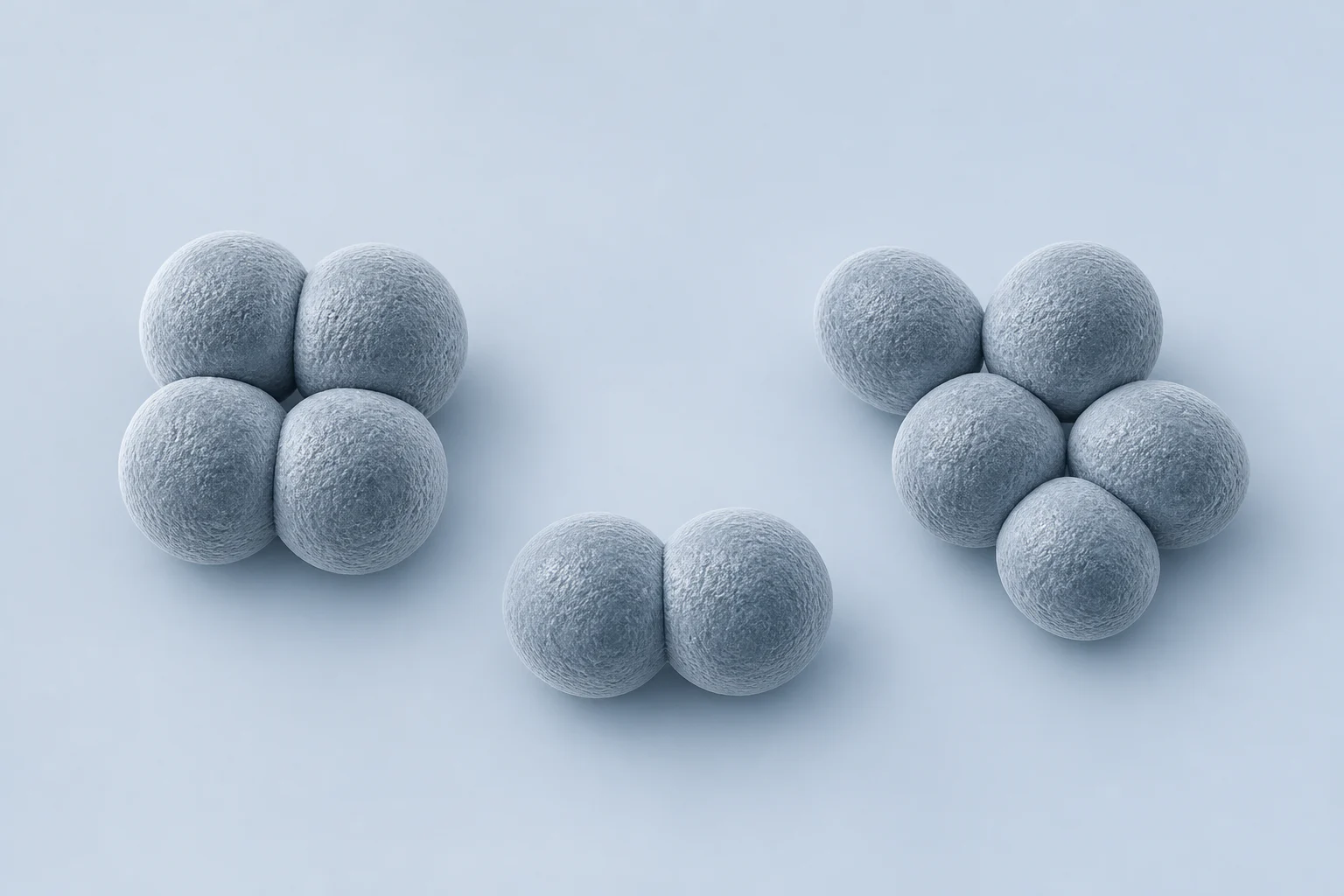
Representative Aerococcus cellular arrangements. Members are cocci that may occur in pairs, tetrads, and clusters; this reconstruction is genus-level and not diagnostic.
Scientific media record1 verified identifier
- Subject
- Aerococcustaxon · genus
- Identifiers
- NCBITaxon:1375
- Review
- Editorial review completeIdentifiers authority-verified · Accessibility validated · · aerococcus|aerococcus-morphology-v1.webp
- Digital source
- Trained-algorithmic mediaCreated with a trained generative algorithm and reviewed by WikiBiome for subject identity, scientific framing, identifiers, provenance, and accessibility.
- License
- CC BY-SA 4.0Created
Aerococcus is a genus of Gram-positive, alpha-hemolytic, catalase-negative cocci. The primary species of clinical relevance are A. urinae (a cause of urinary tract infections, particularly in elderly men) and A. christensenii (a vaginal commensal).
In the WikiBiome vault, Aerococcus appears across 15 sources spanning both male and female reproductive tract microbiome studies.
Evidence map7 cited passagesInspect provenance +
Aerococcus is a member of the core seminal fluid microbiome, identified in multiple studies of male reproductive tract bacteria. Environmental metal exposure may affect Aerococcus abundance in semen.
Present in prostate microbiome studies, with abundance patterns associated with testosterone levels.
Present in vaginal microbiomes as a minor community member; abundance shifts in cervical cancer/HPV contexts.
Part of the endometriosis-associated vaginal microbiome signature.
Mucosal lactoferrin levels influence Aerococcus colonization dynamics.
Aerococcus is discussed in the context of male infertility and reproductive microbiome composition.
Part of the reproductive tract microbiome signature in ovarian cancer studies.
Reproductive Tract Ecology#
Seminal Fluid#
Aerococcus is a member of the core seminal fluid microbiome, identified in multiple studies of male reproductive tract bacteria.[1]Molina Morales 2023 — The Microbiome of the Male Reproductive Tract: Uncovering Its Composition and OriginsNerea Molina Morales · 2023Open reference 1 ↓[2]Javurek 2016 — Discovery of a Novel Seminal Fluid Microbiome and Influence of Estrogen Receptor Alpha Genetic StatusAngela B. Javurek, William G. Spollen, Amber M. Mann Ali et al. · 2016Open reference 2 ↓[3]Neto 2024 — Effect of Environmental Factors on Seminal Microbiome and Impact on Sperm QualityFilipe T. Lira Neto, Marina C. Viana, Federica Cariati et al. · 2024Open reference 3 ↓
Environmental metal exposure may affect Aerococcus abundance in semen.[3]Neto 2024 — Effect of Environmental Factors on Seminal Microbiome and Impact on Sperm QualityFilipe T. Lira Neto, Marina C. Viana, Federica Cariati et al. · 2024Open reference 3 ↓
Prostate#
Present in prostate microbiome studies, with abundance patterns associated with testosterone levels.[4]Trecarten 2025 — Obesity, Dietary Interventions and Microbiome Alterations in Prostate CancerShaun Trecarten, Michael A. Liss, Jill Hamilton-Reeves et al. · 2025Open reference 4 ↓
Vaginal Microbiome#
Present in vaginal microbiomes as a minor community member; abundance shifts in cervical cancer/HPV contexts.[5]Yang 2020 — Vaginal Microbiome Alterations in HPV16 Infection by Shotgun MetagenomicsQian Yang, Yaping Wang, Xinyi Wei et al. · 2020Open reference 5 ↓[6]Rashwan et al. 2025 — Insights into the Tripartite Relationship between Cervical Cancer, HPV, and the Vaginal Microbiome: A Mega-AnalysisRashwan HH, Ali MH, Mostafa MM et al. · 2025Open reference 6 ↓
Part of the endometriosis-associated vaginal microbiome signature.[7]Ser 2023 — Current Updates on the Role of Microbiome in Endometriosis: A Narrative ReviewHooi-Leng Ser, Siu-Jung Au Yong, Mohamad Nasir Shafiee et al. · 2023Open reference 7 ↓[8]Shen 2022 — Vaginal Microecological Characteristics of Women in Different Physiological and Pathological PeriodsLiping Shen, Wei Zhang, Yi Yuan et al. · 2022Open reference 8 ↓[9]Hernandes 2020 — Microbiome Profile of Deep Endometriosis Patients: Comparison of Vaginal Fluid, Endometrium and LesionCamila Hernandes, Paola Silveira, Aline Fernanda Rodrigues Sereia et al. · 2020Open reference 9 ↓[10]MacSharry 2024 — Endometriosis Specific Vaginal Microbiota Links to Urine and Serum N-GlycomeJohn MacSharry, Zsuzsanna Kovacs, Yongjing Xie et al. · 2024Open reference 10 ↓[11]The Vaginal Microbiome as a Tool to Predict rASRM Stage of Disease in Endometriosis: a Pilot StudyPerrotta AR, Borrelli GM, Martins CO et al. · 2020Open reference 11 ↓
Mucosal lactoferrin levels influence Aerococcus colonization dynamics.[12]Roberts 2019 — Mucosal Lactoferrin Response to Genital Tract Infections Is Associated with Iron and Nutritional BiomarkersS. A. Roberts, L. Brabin, S. Diallo et al. · 2019Open reference 12 ↓
Male Infertility#
Aerococcus is discussed in the context of male infertility and reproductive microbiome composition.[13]Magill 2023 — Male Infertility and the Human MicrobiomeMagill RG, MacDonald SM · 2023Open reference 13 ↓
Ovarian Cancer#
Part of the reproductive tract microbiome signature in ovarian cancer studies.[14]Asangba 2023 — Diagnostic and prognostic potential of the microbiome in ovarian cancer treatment responseAsangba AE, Chen J, Goergen KM et al. · 2023Open reference 14 ↓
Cross-References#
- Corynebacterium—co-member of the seminal fluid core microbiome
- Endometriosis—vaginal microbiome associations
- Lactoferrin—mucosal iron sequestration affects colonization
References 14
Numbered by first appearance in the article, then reconciled with its declared source list.
- 1
Nerea Molina Morales (2023). Molina Morales 2023 — The Microbiome of the Male Reproductive Tract: Uncovering Its Composition and Origins. Doctoral Thesis, Universidad de Granada.
- 2
Angela B. Javurek, William G. Spollen, Amber M. Mann Ali et al. (2016). Javurek 2016 — Discovery of a Novel Seminal Fluid Microbiome and Influence of Estrogen Receptor Alpha Genetic Status. Scientific Reports.
- 3
Filipe T. Lira Neto, Marina C. Viana, Federica Cariati et al. (2024). Neto 2024 — Effect of Environmental Factors on Seminal Microbiome and Impact on Sperm Quality. Frontiers in Endocrinology.
- 4
Shaun Trecarten, Michael A. Liss, Jill Hamilton-Reeves et al. (2025). Trecarten 2025 — Obesity, Dietary Interventions and Microbiome Alterations in Prostate Cancer. Frontiers in Immunology.
- 5
Qian Yang, Yaping Wang, Xinyi Wei et al. (2020). Yang 2020 — Vaginal Microbiome Alterations in HPV16 Infection by Shotgun Metagenomics. Frontiers in Cellular and Infection Microbiology.
- 6
Rashwan HH, Ali MH, Mostafa MM et al. (2025). Rashwan et al. 2025 — Insights into the Tripartite Relationship between Cervical Cancer, HPV, and the Vaginal Microbiome: A Mega-Analysis. Human Genomics.
- 7
Hooi-Leng Ser, Siu-Jung Au Yong, Mohamad Nasir Shafiee et al. (2023). Ser 2023 — Current Updates on the Role of Microbiome in Endometriosis: A Narrative Review. Microorganisms.
- 8
Liping Shen, Wei Zhang, Yi Yuan et al. (2022). Shen 2022 — Vaginal Microecological Characteristics of Women in Different Physiological and Pathological Periods. Frontiers in Cellular and Infection Microbiology.
- 9
Camila Hernandes, Paola Silveira, Aline Fernanda Rodrigues Sereia et al. (2020). Hernandes 2020 — Microbiome Profile of Deep Endometriosis Patients: Comparison of Vaginal Fluid, Endometrium and Lesion. Diagnostics.
- 10
John MacSharry, Zsuzsanna Kovacs, Yongjing Xie et al. (2024). MacSharry 2024 — Endometriosis Specific Vaginal Microbiota Links to Urine and Serum N-Glycome. Scientific Reports.
- 11
Perrotta AR, Borrelli GM, Martins CO et al. (2020). The Vaginal Microbiome as a Tool to Predict rASRM Stage of Disease in Endometriosis: a Pilot Study. Reproductive Sciences.
- 12
S. A. Roberts, L. Brabin, S. Diallo et al. (2019). Roberts 2019 — Mucosal Lactoferrin Response to Genital Tract Infections Is Associated with Iron and Nutritional Biomarkers. European Journal of Clinical Nutrition.
- 13
Magill RG, MacDonald SM (2023). Magill 2023 — Male Infertility and the Human Microbiome. Frontiers in Reproductive Health.
- 14
Asangba AE, Chen J, Goergen KM et al. (2023). Asangba 2023 — Diagnostic and prognostic potential of the microbiome in ovarian cancer treatment response. Scientific Reports.
Article network
Mentioned here 4
Connect the evidence
Publicly readable discussion by ORCID-authenticated researchers. Questions, interpretation, methods, corrections, and new evidence stay attached to this record.
No discussion yet. Start with a precise question or a source-backed observation.
Published page changes
This record shows only material changes published on this page, including changes to its content, evidence, conclusions, or author context. Internal processes and discussion activity are excluded. Pending, declined, and withdrawn proposals remain private.
- published revision
Created “Aerococcus”: Aerococcus is a genus of Gram-positive, alpha-hemolytic, catalase-negative cocci. The primary species of clinical relevance are A. urinae (a cause of urinary tract infections, particularly in elderly…
Created “Aerococcus”: Aerococcus is a genus of Gram-positive, alpha-hemolytic, catalase-negative cocci. The primary species of clinical relevance are A. urinae (a cause of urinary tract infections, particularly in elderly… Published sections: Aerococcus; Seminal Fluid; Prostate; Vaginal Microbiome; Male Infertility; Ovarian Cancer; Cross-References. · WikiBiome Deploy Bot · +69 −0
Inspect exact Git diff ↗