

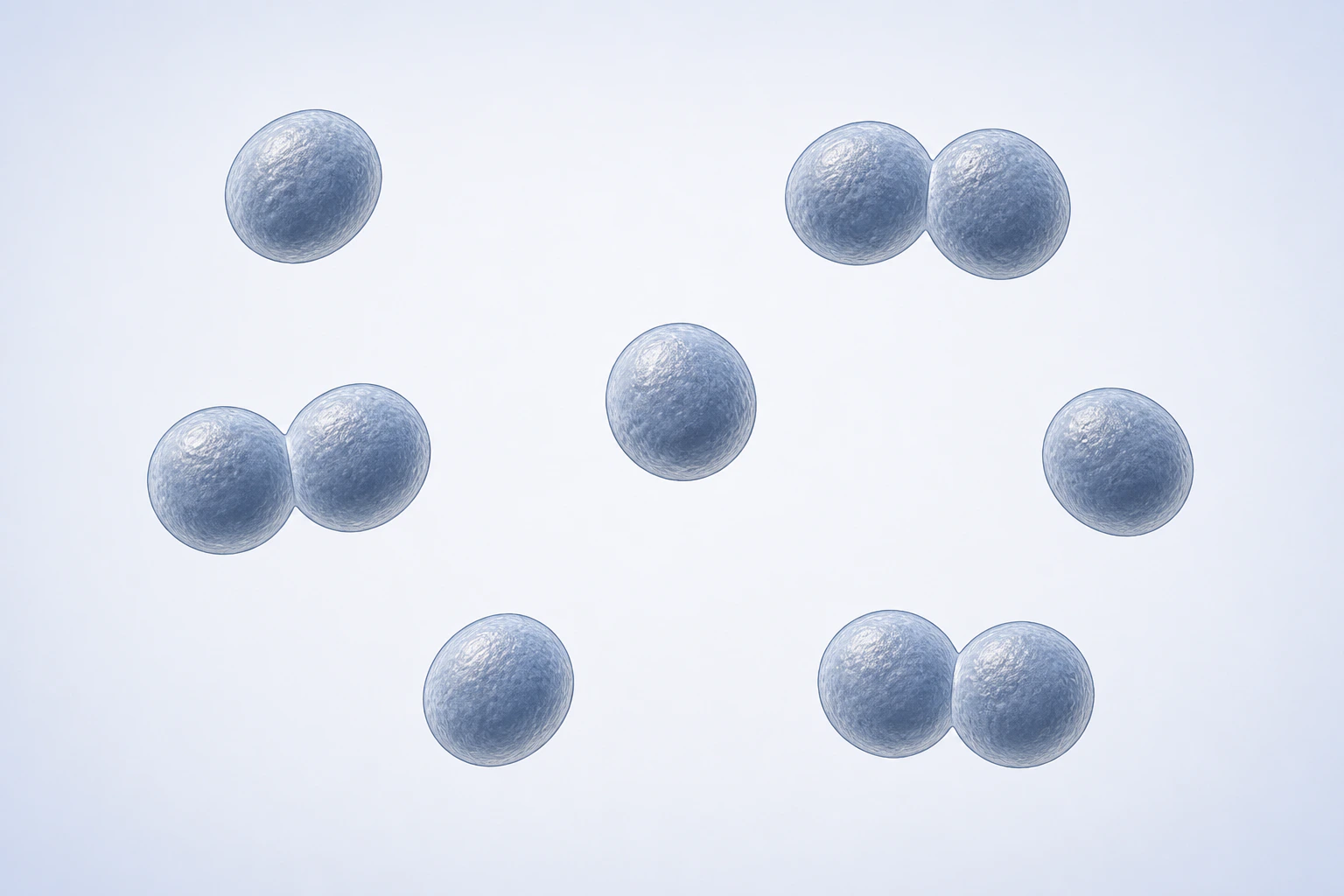
Representative Enterococcus faecalis spherical-to-ovoid forms, shown as ten bodies in four single and three paired groupings. This reconstruction is non-diagnostic, does not visually distinguish the species from other enterococci, and is not a micrograph.
Scientific media record1 verified identifier
- Subject
- Enterococcus faecalistaxon · species
- Identifiers
- NCBITaxon:1351
- Review
- Editorial review completeIdentifiers authority-verified · Accessibility validated · · enterococcus-faecalis|enterococcus-faecalis-morphology-v1.webp
- Digital source
- Trained-algorithmic mediaCreated with a trained generative algorithm and reviewed by WikiBiome for subject identity, scientific framing, identifiers, provenance, and accessibility.
- Scientific basis
- Enterococcus faecalis — NCBI TaxonomyEnterococcus faecalis — LPSNEnterococcus gen. nov. primary proposalEnterococcus faecalis type strain — BacDiveEnterococcus authoritative review
- License
- CC BY-SA 4.0Created
Enterococcus faecalis is a Gram-positive, facultatively anaerobic coccus that inhabits the gastrointestinal tract, oral cavity, and genitourinary tract of humans.
It is a commensal in the healthy gut at low abundance but is one of the most clinically significant opportunistic pathogens, causing urinary tract infections, bacteremia, endocarditis, and surgical site infections—particularly in hospital settings where vancomycin-resistant enterococci (VRE) are a critical public health threat.
From a WikiBiome perspective, E. faecalis is remarkable for two reasons that Wikipedia does not cover well: its role in an interspecies drug-degradation pathway that reduces levodopa efficacy in Parkinson's disease, and its superoxide-mediated DNA damage that contributes to colorectal carcinogenesis.
Both mechanisms illustrate how a single commensal-turned-pathogen can influence diseases far removed from traditional infectious disease.
Evidence map11 cited passagesInspect provenance +
Zinc susceptibility: E. faecalis is susceptible to zinc-enhanced antimicrobial strategies. A zinc-potentiated halogenated phenazine disrupted metal homeostasis in E. faecalis by causing intracellular zinc and iron accumulation, manganese depletion, and ultimately bacterial killing. This mis-metallation mechanism represents a novel antimicrobial approach (, i
Tyrosine decarboxylase (TyrDC): The enzyme that converts L-DOPA (levodopa) to dopamine in the gut. This is the first step of an interspecies relay where E. faecalis produces dopamine, which is then dehydroxylated to m-tyramine by Eggerthella lenta. The combined pathway significantly reduces levodopa bioavailability in Parkinson's patients. AFMT (alpha-fluoro
Extracellular superoxide: E. faecalis produces extracellular superoxide and hydrogen peroxide that generate reactive oxygen species (ROS), causing oxidative DNA damage in nearby colonocytes. This mechanism contributes to genomic instability and colorectal carcinogenesis (, expert-opinion).
Antibiotic disruption: Broad-spectrum antibiotics (especially vancomycin, paradoxically) can eliminate competing commensals and allow E. faecalis expansion. In EAE (MS model), E. faecalis did not ameliorate neuroinflammation when administered, confirming it lacks the anti-inflammatory properties of beneficial commensals (, animal-model).
Reproductive tract dysbiosis: Significantly enriched in the vaginal and intestinal microbiota of women with adenomyosis and infertility (, cross-sectional).
Colorectal cancer: Cataloged as a pro-tumor bacterium through extracellular superoxide/ROS-mediated DNA damage, contributing to genomic instability (, expert-opinion;, expert-opinion).
Adenomyosis/infertility: Enriched in vaginal and intestinal microbiota of women with adenomyosis alongside E. coli, S. epidermidis, and Candida (, cross-sectional).
Ulcerative colitis: Markedly elevated in UC patients, distinguishing UC from CD taxonomically (, cross-sectional).
Pancreatic cancer: Found in duodenal microbiota of PC patients (, expert-opinion).
Parkinson's disease (levodopa): E. faecalis TyrDC converts L-DOPA to dopamine in the gut, the first step in an interspecies pathway that can account for significant drug loss before systemic absorption. Variability in E. faecalis TyrDC gene carriage among patients explains variable levodopa responses (, in-vitro).
| Study | Finding | Evidence Level | |-------|---------|---------------| | | TyrDC converts L-DOPA to dopamine; interspecies pathway with E. lenta | In vitro | | | Zinc-potentiated phenazine kills E. faecalis via mis-metallation | In vitro | | | Superoxide/ROS-mediated DNA damage in CRC | Expert opinion | | | Enriched in adenomyosis vaginal/intestinal microb
Contents
1. Metal Dependencies2. Key Enzymes and Virulence Factors3. Ecological Role4. Conditions Associated5. Key Studies6. Cross-ReferencesMetal Dependencies#
E. faecalis has a sophisticated relationship with metals.
Manganese: Unlike most bacteria that rely primarily on iron, E. faecalis uses manganese as a key cofactor for superoxide dismutase (MnSOD) and as a substitute for iron in many metabolic enzymes. This manganese-centered metabolism makes it inherently resistant to iron limitation by the host (nutritional immunity).
Iron: Required for some redox enzymes but not as critical as for most Gram-negatives, contributing to E. faecalis resilience in iron-restricted environments.
Zinc susceptibility: E. faecalis is susceptible to zinc-enhanced antimicrobial strategies. A zinc-potentiated halogenated phenazine disrupted metal homeostasis in E. faecalis by causing intracellular zinc and iron accumulation, manganese depletion, and ultimately bacterial killing. This mis-metallation mechanism represents a novel antimicrobial approach (,[1]Kajfasz 2026 — Zinc-Enhanced Activity of an Antimicrobial Halogenated Phenazine Against Streptococcus mutans and Other Gram-Positive BacteriaJessica K Kajfasz, Hannah B Hosay, Qiwen Gao et al. · 2026Open reference 1 ↓ in-vitro).
Key Enzymes and Virulence Factors#
Tyrosine decarboxylase (TyrDC): The enzyme that converts L-DOPA (levodopa) to dopamine in the gut. This is the first step of an interspecies relay where E. faecalis produces dopamine, which is then dehydroxylated to m-tyramine by Eggerthella lenta. The combined pathway significantly reduces levodopa bioavailability in Parkinson's patients.
AFMT (alpha-fluoromethyltyrosine) can selectively inhibit bacterial TyrDC without affecting host DOPA decarboxylase (,[2]Maini Rekdal 2019 -- Discovery and Inhibition of an Interspecies Gut Bacterial Pathway for Levodopa MetabolismVayu Maini Rekdal, Emily N Bess, Jordan E Bisanz et al. · 2019Open reference 2 ↓ in-vitro).
Extracellular superoxide: E. faecalis produces extracellular superoxide and hydrogen peroxide that generate reactive oxygen species (ROS), causing oxidative DNA damage in nearby colonocytes. This mechanism contributes to genomic instability and colorectal carcinogenesis (,[3]Immune System, Microbiota, and Microbial Metabolites: The Unresolved Triad in Colorectal Cancer MicroenvironmentHanus M, Parada-Venegas D, Landskron G et al. · 2021Open reference 3 ↓ expert-opinion).
Cytolysin: A two-peptide bacteriocin/toxin that lyses eukaryotic cells and is associated with increased disease severity in enterococcal infections. Gelatinase (GelE): A metalloprotease that degrades host tissue proteins, facilitating invasion and biofilm maturation.
Biofilm formation: E. faecalis forms robust biofilms on medical devices and mucosal surfaces, contributing to antibiotic tolerance and chronic infection.
Ecological Role#
In the healthy gut, E. faecalis is a minor member of the Firmicutes community, kept in check by competitive exclusion from dominant anaerobes and antimicrobial peptides. It becomes ecologically significant when.
Antibiotic disruption: Broad-spectrum antibiotics (especially vancomycin, paradoxically) can eliminate competing commensals and allow E. faecalis expansion. In EAE (MS model), E. faecalis did not ameliorate neuroinflammation when administered, confirming it lacks the anti-inflammatory properties of beneficial commensals (,[4]Mining the microbiota to identify gut commensals modulating neuroinflammation in a mouse model of multiple sclerosisPaola Bianchimano, Graham J. Britton, David S. Wallach et al. · 2022Open reference 4 ↓ animal-model).
Metal-Driven Inflammation: Enriched in IBD, particularly UC, where disrupted barrier function and Oxidative Stress create favorable conditions.
Reproductive tract Dysbiosis: Significantly enriched in the vaginal and intestinal microbiota of women with adenomyosis and infertility (,[5]Ponomaryova 2022 — Changes in microbiota of genital tract and intestines in patients with adenomyosis and infertilityPonomaryova IG, Lisyana TO, Trokhimovych OV et al. · 2022Open reference 5 ↓ cross-sectional).
Conditions Associated#
Enriched in:#
Colorectal cancer: Cataloged as a pro-tumor bacterium through extracellular superoxide/ROS-mediated DNA damage, contributing to genomic instability (,[3]Immune System, Microbiota, and Microbial Metabolites: The Unresolved Triad in Colorectal Cancer MicroenvironmentHanus M, Parada-Venegas D, Landskron G et al. · 2021Open reference 3 ↓ expert-opinion;,[6]Antitumor Effects of Fecal Microbiota Transplantation: Implications for Microbiome Modulation in Cancer TreatmentHui Xu, Chenxi Cao, Yuqing Ren et al. · 2022Open reference 6 ↓ expert-opinion).
Adenomyosis/infertility: Enriched in vaginal and intestinal microbiota of women with adenomyosis alongside E. coli, S. epidermidis, and Candida (,[5]Ponomaryova 2022 — Changes in microbiota of genital tract and intestines in patients with adenomyosis and infertilityPonomaryova IG, Lisyana TO, Trokhimovych OV et al. · 2022Open reference 5 ↓ cross-sectional).
Ulcerative colitis: Markedly elevated in UC patients, distinguishing UC from CD taxonomically (,[7]Diagnosis of Crohn's Disease and Ulcerative Colitis Using the MicrobiomeKang DY, Park JL, Yeo MK et al. · 2023Open reference 7 ↓ cross-sectional). Pancreatic cancer: Found in duodenal microbiota of PC patients (,[8]Microbiome as a biomarker and therapeutic target in pancreatic cancerGhazaleh Pourali, Danial Kazemi, Amir Shayan Chadeganipour et al. · 2024Open reference 8 ↓ expert-opinion).
Drug interaction:#
- Parkinson's disease (levodopa): E. faecalis TyrDC converts L-DOPA to dopamine in the gut, the first step in an interspecies pathway that can account for significant drug loss before systemic absorption. Variability in E. faecalis TyrDC gene carriage among patients explains variable levodopa responses (,[2]Maini Rekdal 2019 -- Discovery and Inhibition of an Interspecies Gut Bacterial Pathway for Levodopa MetabolismVayu Maini Rekdal, Emily N Bess, Jordan E Bisanz et al. · 2019Open reference 2 ↓ in-vitro).
Key Studies#
| Study | Finding | Evidence Level |
|---|---|---|
| [2]Maini Rekdal 2019 -- Discovery and Inhibition of an Interspecies Gut Bacterial Pathway for Levodopa MetabolismVayu Maini Rekdal, Emily N Bess, Jordan E Bisanz et al. · 2019Open reference 2 ↓ | TyrDC converts L-DOPA to dopamine; interspecies pathway with E. lenta | In vitro |
| [1]Kajfasz 2026 — Zinc-Enhanced Activity of an Antimicrobial Halogenated Phenazine Against Streptococcus mutans and Other Gram-Positive BacteriaJessica K Kajfasz, Hannah B Hosay, Qiwen Gao et al. · 2026Open reference 1 ↓ | Zinc-potentiated phenazine kills E. faecalis via mis-metallation | In vitro |
| [3]Immune System, Microbiota, and Microbial Metabolites: The Unresolved Triad in Colorectal Cancer MicroenvironmentHanus M, Parada-Venegas D, Landskron G et al. · 2021Open reference 3 ↓ | Superoxide/ROS-mediated DNA damage in CRC | Expert opinion |
| [5]Ponomaryova 2022 — Changes in microbiota of genital tract and intestines in patients with adenomyosis and infertilityPonomaryova IG, Lisyana TO, Trokhimovych OV et al. · 2022Open reference 5 ↓ | Enriched in adenomyosis vaginal/intestinal microbiota | Cross-sectional |
| [4]Mining the microbiota to identify gut commensals modulating neuroinflammation in a mouse model of multiple sclerosisPaola Bianchimano, Graham J. Britton, David S. Wallach et al. · 2022Open reference 4 ↓ | Did not ameliorate EAE (negative control) | Animal model |
Cross-References#
- Eggerthella—interspecies partner in L-DOPA degradation
- Parkinson's Disease—levodopa bioavailability reduction
- Zinc—zinc-enhanced antimicrobial susceptibility
- Colorectal Cancer—superoxide-mediated carcinogenesis
- Antimicrobial Resistance—VRE as critical pathogen
- adenomyosis—reproductive tract enrichment
- Biofilm—device-associated and mucosal biofilm formation
- Manganese—manganese-centered metabolism enabling iron-limitation resistance
References 10
Numbered by first appearance in the article, then reconciled with its declared source list.
- 1
Jessica K Kajfasz, Hannah B Hosay, Qiwen Gao et al. (2026). Kajfasz 2026 — Zinc-Enhanced Activity of an Antimicrobial Halogenated Phenazine Against Streptococcus mutans and Other Gram-Positive Bacteria. mSphere.
- 2
Vayu Maini Rekdal, Emily N Bess, Jordan E Bisanz et al. (2019). Maini Rekdal 2019 -- Discovery and Inhibition of an Interspecies Gut Bacterial Pathway for Levodopa Metabolism. Science.
- 3
Hanus M, Parada-Venegas D, Landskron G et al. (2021). Immune System, Microbiota, and Microbial Metabolites: The Unresolved Triad in Colorectal Cancer Microenvironment. Frontiers in Immunology.
- 4
Paola Bianchimano, Graham J. Britton, David S. Wallach et al. (2022). Mining the microbiota to identify gut commensals modulating neuroinflammation in a mouse model of multiple sclerosis. Microbiome.
- 5
Ponomaryova IG, Lisyana TO, Trokhimovych OV et al. (2022). Ponomaryova 2022 — Changes in microbiota of genital tract and intestines in patients with adenomyosis and infertility. Medical Research Journal.
- 6
Hui Xu, Chenxi Cao, Yuqing Ren et al. (2022). Antitumor Effects of Fecal Microbiota Transplantation: Implications for Microbiome Modulation in Cancer Treatment. Frontiers in Immunology.
- 7
Kang DY, Park JL, Yeo MK et al. (2023). Diagnosis of Crohn's Disease and Ulcerative Colitis Using the Microbiome. BMC Microbiology.
- 8
Ghazaleh Pourali, Danial Kazemi, Amir Shayan Chadeganipour et al. (2024). Microbiome as a biomarker and therapeutic target in pancreatic cancer. BMC Microbiology.
- 9
Sahar S. Salem, Heba E. Elsayed, Samah Shabana et al. (2023). Salem 2023 — Phytochemical profile and antimicrobial activity of essential oils from two Syzygium species against oral pathogens. BMC Complementary Medicine and Therapies.
- 10
Baiqiang Lin, Fuya Zhao, Yang Liu et al. (2022). Lin 2022 — Probiotics alleviate oral-gut microbiota dysbiosis in thyroid cancer patients after thyroidectomy: RCT. Frontiers in Endocrinology.
Article network
Mentioned here 11
Pages linking here 6
Connect the evidence
Publicly readable discussion by ORCID-authenticated researchers. Questions, interpretation, methods, corrections, and new evidence stay attached to this record.
No discussion yet. Start with a precise question or a source-backed observation.
Activity and accepted changes
Accepted researcher context, editorial status, public discussion, and upstream Git revisions are shown together. Pending, declined, and withdrawn proposals remain private.
- published revision
Backfill oxidative stress concept links
Karen Pendergrass · +1 −1
Inspect exact Git diff ↗ - published revision
Backfill inflammation concept links
Karen Pendergrass · +1 −1
Inspect exact Git diff ↗ - published revision
Complete corpus-wide Dysbiosis linking
Karen Pendergrass · +1 −1
Inspect exact Git diff ↗ - published revision
massive wiki expansion: 149 stubs fixed, 100+ new pages, Rule 15 scan, keystone papers
WikiBiome Deploy Bot · +18 −18
Inspect exact Git diff ↗ - published revision
pre-overnight checkpoint 2026-04-18
WikiBiome Deploy Bot · +85 −0
Inspect exact Git diff ↗