
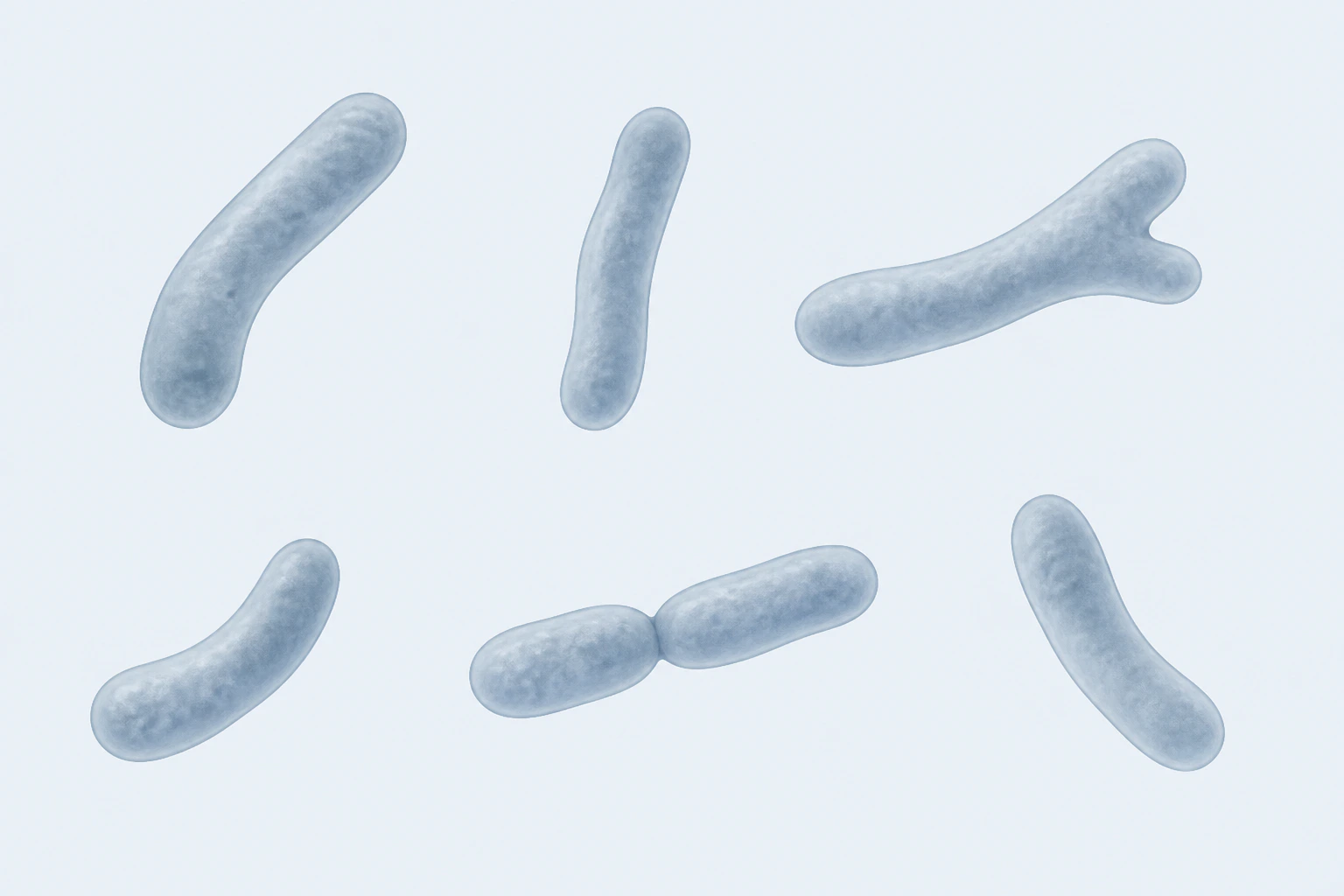
Representative non-diagnostic Bifidobacterium longum rod-level morphology, shown as seven bodies in six groupings. This reconstruction is not a micrograph.
Scientific media record1 verified identifier
- Subject
- Bifidobacterium longumtaxon · species
- Identifiers
- NCBITaxon:216816
- Review
- Editorial review completeIdentifiers authority-verified · Accessibility validated · · bifidobacterium-longum|bifidobacterium-longum-morphology-v1.webp
- Digital source
- Trained-algorithmic mediaCreated with a trained generative algorithm and reviewed by WikiBiome for subject identity, scientific framing, identifiers, provenance, and accessibility.
- License
- CC BY-SA 4.0Created
Bifidobacterium longum is a Gram-positive, obligate anaerobic bacterium and one of the most important commensal species in human health from infancy through old age.
Its subspecies—B. longum subsp. longum (adult gut), B. longum subsp. infantis (infant gut, HMO degrader), and B. longum subsp. suis—occupy distinct ecological niches.
In the WikiBiome framework, B. longum is significant for its heavy metal biosorption capacity, its sensitivity to prenatal metal exposure, and its role as a cross-condition protective organism.
Evidence map2 cited passagesInspect provenance +
Prenatal lead exposure consistently depletes B. longum in childhood gut microbiome (ages 9-11), alongside bacteroides caccae, Bifidobacterium bifidum, and Alistipes indistinctus. This represents one of the most reproducible findings in the prenatal metal-microbiome field, with B. longum exceeding the WQS importance threshold in ≥80% of repeated holdouts.
B. longum abundance correlated with good ovarian stimulation response in IVF patients; gavage in mice improved outcomes—suggesting a functional role in the gut gonadal axis.
Contents
1. Metal Dependencies2. Metal Detoxification Capacity3. Key Enzymes and Functional Features4. Ecological Role5. Conditions Associated6. Cross-ReferencesMetal Dependencies#
B. longum relies primarily on manganese and zinc rather than iron, giving it a distinct metal economy from iron-dependent pathobionts. This manganese preference contributes to its compatibility with host nutritional immunity—it does not compete for the iron that the host is actively restricting from pathogens.
Metal Detoxification Capacity#
B. longum demonstrates significant capacity to bind and sequester Heavy Metals. Cadmium biosorption—Cell wall exopolysaccharides (EPS) and peptidoglycan provide binding sites for cadmium(II) (Cd2+), reducing its bioavailability in the gut lumen and limiting intestinal absorption.
Lead binding—Similar cell wall-mediated biosorption of lead(II) (Pb2+); both live and heat-killed cells retain binding capacity, though live cells additionally maintain barrier function.
Mercury chelation—Thiol groups in surface proteins bind mercury(II) (Hg2+).
This metal-binding capacity positions B. longum alongside Lactobacillus rhamnosus as a potential bioremediation organism for dietary metal exposure.
Key Enzymes and Functional Features#
HMO glycosidases (subsp. infantis)—Sialidases, fucosidases, and N-acetylglucosaminidases that degrade human milk oligosaccharides. This HMO degradation capacity is the defining feature of the infantis subspecies and its critical role in infant gut colonization.
Bile salt hydrolase—Deconjugates bile acids, contributing to bile acid metabolism and Farnesoid X Receptor (FXR) signaling. Acetate production—Primary SCFA product via the bifid shunt (fructose-6-phosphate phosphoketolase pathway); acetate cross-feeds Butyrate producers.
Ecological Role#
In the healthy gut, B. longum provides.
Colonization resistance—Competitive exclusion of pathogens through acetate production and pH reduction. Immune programming (subsp. infantis)—Shapes neonatal immune development through HMO-derived metabolites and direct interaction with intestinal dendritic cells. Barrier maintenance—Supports tight junction integrity through SCFA production and direct epithelial cell signaling.
Cross-feeding—Acetate produced by B. longum is consumed by butyrate-producing Faecalibacterium prausnitzii and Roseburia, linking Bifidobacterium metabolism to the butyrate economy.
Conditions Associated#
Lead Sensitivity#
Prenatal lead exposure consistently depletes B. longum in childhood Gut Microbiome (ages 9-11), alongside Bacteroides caccae, Bifidobacterium bifidum, and Alistipes indistinctus.[1]Prenatal Lead Exposure is Negatively Associated with the Gut Microbiome in ChildhoodEggers S, Midya V, Bixby M et al. · 2023Open reference 1 ↓
This represents one of the most reproducible findings in the prenatal metal-microbiome field, with B. longum exceeding the WQS importance threshold in ≥80% of repeated holdouts.
Female Fertility#
B. longum abundance correlated with good ovarian stimulation response in IVF patients; gavage in mice improved outcomes—suggesting a functional role in the Gut-Gonadal Axis.[2]Metagenomic analysis revealed the association between gut microbiota and different ovary responses to controlled ovarian stimulationFo X, Pei M, Liu P et al. · 2024Open reference 2 ↓
Cross-References#
- Bifidobacterium—genus overview
- Bifidobacterium longum subsp. infantis—current record for the infantis subspecies
- Lactobacillus rhamnosus—complementary metal-detoxifying probiotic
- Lead—prenatal exposure depletes B. longum
- Cadmium—biosorbed by B. longum cell wall
- Bacteroides caccae—co-depleted under lead exposure
- Developmental Metal Vulnerability: Critical Windows of Susceptibility—B. longum as exemplar of persistent metal-microbiome programming
- Female Infertility—IVF response predictor
References 8
Numbered by first appearance in the article, then reconciled with its declared source list.
- 1
Eggers S, Midya V, Bixby M et al. (2023). Prenatal Lead Exposure is Negatively Associated with the Gut Microbiome in Childhood. Frontiers in Microbiology.
- 2
Fo X, Pei M, Liu P et al. (2024). Metagenomic analysis revealed the association between gut microbiota and different ovary responses to controlled ovarian stimulation. Scientific Reports.
- 3
Huo D, Cen C, Chang H et al. (2021). Huo et al. 2021 — Probiotic Bifidobacterium longum Supplied with Methimazole Improved the Thyroid Function of Graves' Disease Patients Through the Gut-Thyroid Axis. Communications Biology.
- 4
Shoshannah Eggers, Vishal Midya, Moira Bixby et al. (2023). Eggers 2023 — Prenatal lead exposure is negatively associated with gut microbiome in childhood (PROGRESS cohort). Frontiers in Microbiology.
- 5
Lorena Coretti, Lorella Paparo, Maria Pia Riccio et al. (2018). Coretti 2018 — Gut Microbiota Features in Young Children With Autism Spectrum Disorders. Frontiers in Microbiology.
- 6
Bao K, Lin H, Guo S (2025). Gut Microbiota and Thyroid Diseases: A Comprehensive Review of Mechanisms and Clinical Implications. X-Disciplinarity.
- 7
Zhang Ruohan, Wang Ruting, Wu Hongxi et al. (2025). Zhang 2025 — Gut Microbiota as a Novel Target for Treating Anxiety and Depression: From Mechanisms to Multimodal Interventions. Frontiers in Microbiology.
- 8
Steed H, Macfarlane GT, Blackett KL et al. (2010). Clinical Trial: The Microbiological and Immunological Effects of Synbiotic Consumption - A Randomised Double-Blind Placebo-Controlled Study in Active Crohn's Disease. Alimentary Pharmacology & Therapeutics.
Article network
Mentioned here 16
Pages linking here 3
Connect the evidence
Publicly readable discussion by ORCID-authenticated researchers. Questions, interpretation, methods, corrections, and new evidence stay attached to this record.
No discussion yet. Start with a precise question or a source-backed observation.
Published page changes
This record shows only material changes published on this page, including changes to its content, evidence, conclusions, or author context. Internal processes and discussion activity are excluded. Pending, declined, and withdrawn proposals remain private.
- published revision
Revised “Cross-References”: now reads “- bifidobacterium — genus overview - bifidobacterium longum subsp infantis — current record for the infantis subspecies - lactobacillus rhamnosus — complementary metal-detoxifying probiotic”.
Revised “Cross-References”: changed “- bifidobacterium — genus overview - lactobacillus rhamnosus — complementary metal-detoxifying probiotic” to “- bifidobacterium — genus overview - bifidobacterium longum subsp infantis — current record for the infantis subspecies - lactobacillus rhamnosus — complementary metal-detoxifying probiotic”. · Karen Pendergrass · +3 −2
Inspect exact Git diff ↗ - published revision
Added references: huo-2021-bifidobacterium-longum-methimazole-graves; eggers-2023-prenatal-lead-childhood-gut-microbiome-progress; coretti-2018-gut-microbiota-young-asd-children; bao-2025-gut-microbiota-thyroid-diseases-comprehensive-review;…
Added references: huo-2021-bifidobacterium-longum-methimazole-graves; eggers-2023-prenatal-lead-childhood-gut-microbiome-progress; coretti-2018-gut-microbiota-young-asd-children; bao-2025-gut-microbiota-thyroid-diseases-comprehensive-review; zhang-2025-gut-microbiota-anxiety-depression-multimodal; steed-2010-synbiotic-crohns-rct. Removed references: eggers-2023-prenatal-lead-exposure-gut-microbiome-childhood; fo-2024-gut-microbiota-ovarian-stimulation-response-metagenomics. · WikiBiome Deploy Bot · +19 −17
Inspect exact Git diff ↗ - published revision
Created “Bifidobacterium longum”: Bifidobacterium longum is a Gram-positive, obligate anaerobic bacterium and one of the most important commensal species in human health from infancy through old age. Its subspecies — B. longum subsp.…
Created “Bifidobacterium longum”: Bifidobacterium longum is a Gram-positive, obligate anaerobic bacterium and one of the most important commensal species in human health from infancy through old age. Its subspecies — B. longum subsp.… Published sections: Overview; Metal Dependencies; Metal Detoxification Capacity; Key Enzymes and Functional Features; Ecological Role; Lead Sensitivity; Female Fertility; Cross-References. · WikiBiome Deploy Bot · +98 −0
Inspect exact Git diff ↗