
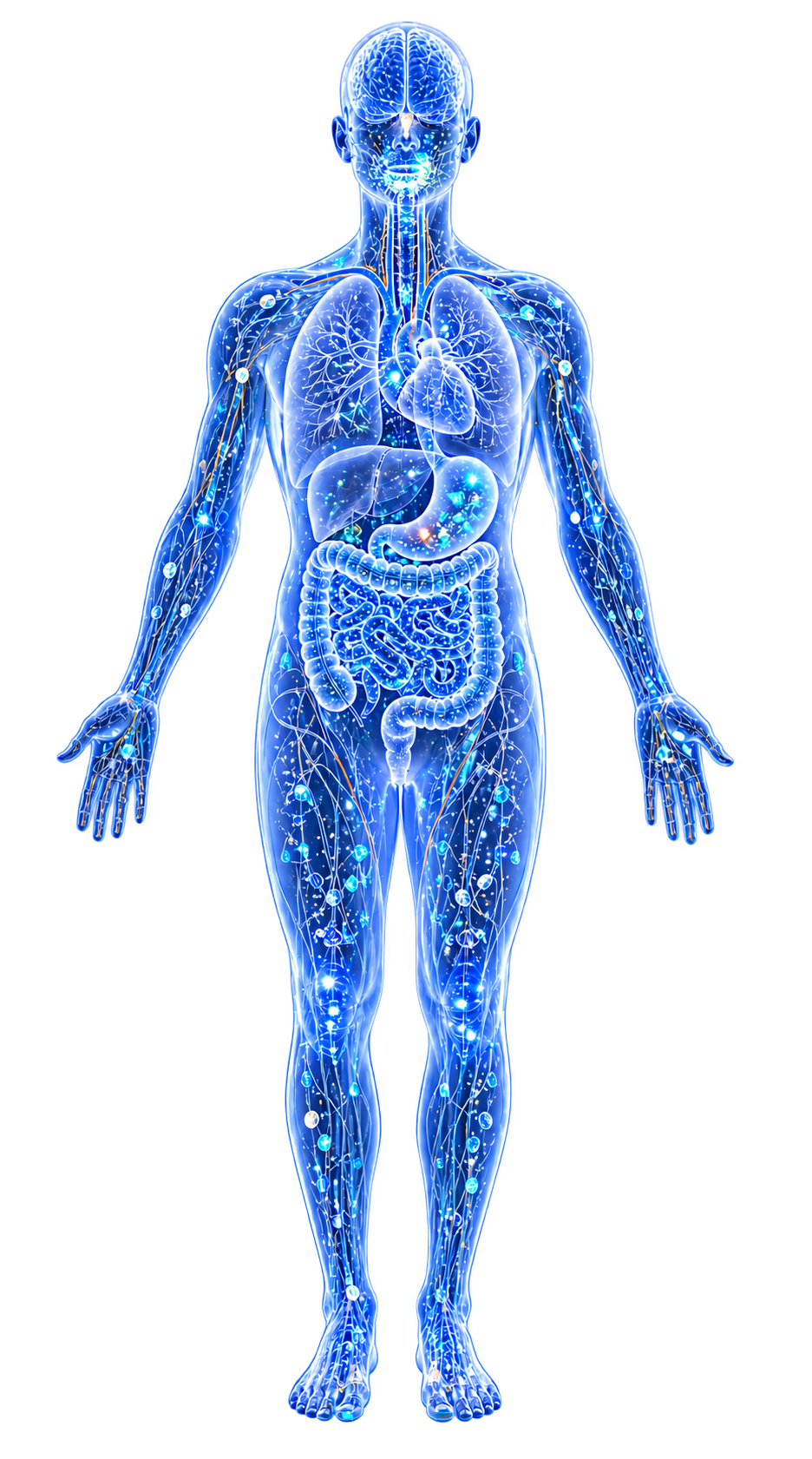
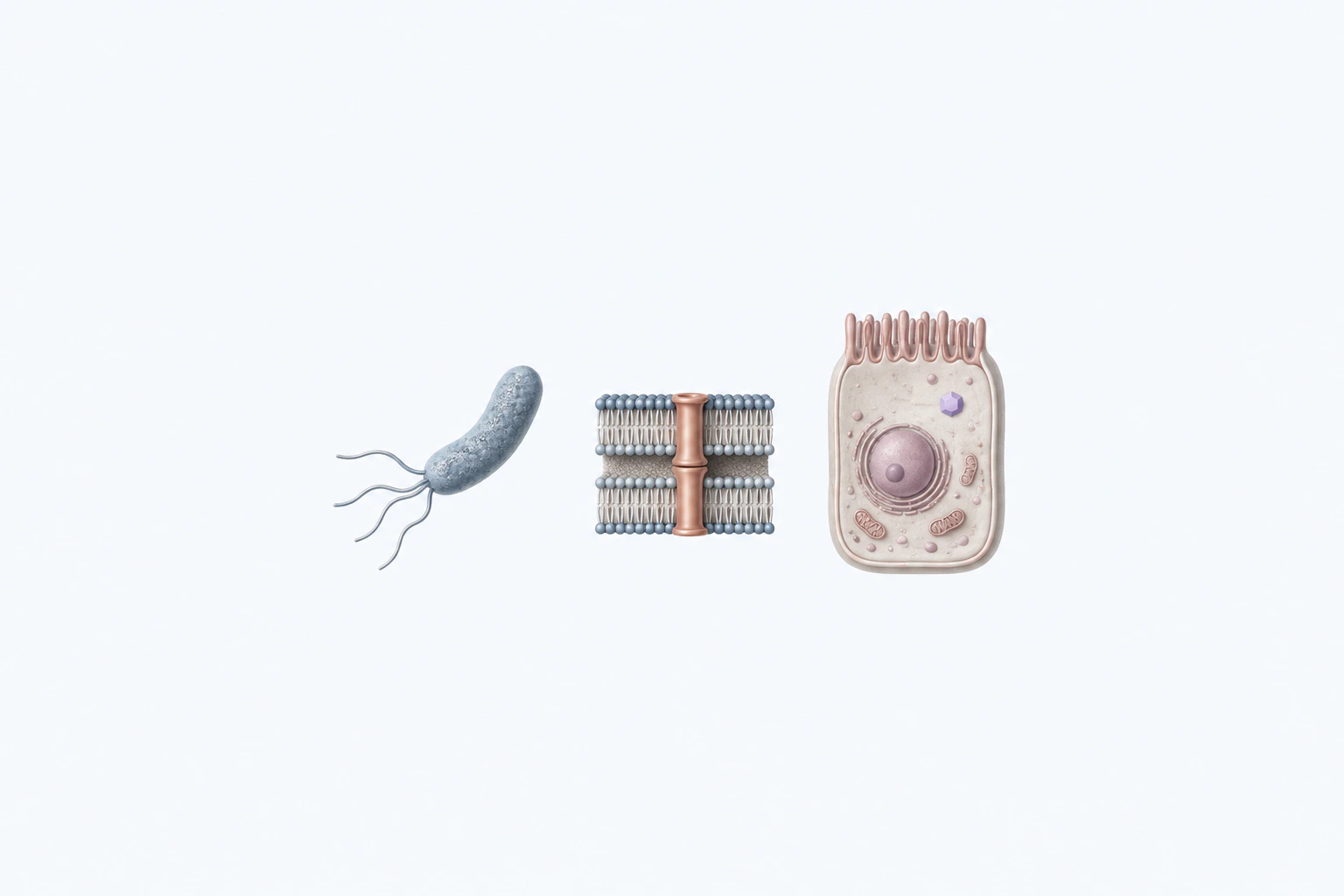
Generic orientation to CagA as a Helicobacter pylori effector associated with a type IV secretion context and gastric epithelial cells. This is not a measured protein structure, observed transfer event, biopsy, cancer model, diagnosis, or treatment claim.
Scientific media record3 verified identifiers
- Subject
- CagAbiological-process
- Identifiers
- WikiBiome:cagaUniProt:P55980NCBIfam:NF033422
- Review
- Editorial review completeIdentifiers authority-verified · Accessibility validated · · caga|caga-mechanism-v1.webp
- Digital source
- Trained-algorithmic mediaCreated with a trained generative algorithm and reviewed by WikiBiome for subject identity, scientific framing, identifiers, provenance, and accessibility.
- Scientific basis
- CagA — UniProtKB P55980CagA — NCBIfam NF033422CagA
- License
- CC BY-SA 4.0Created
CagA is an effector protein produced by some strains of Helicobacter pylori. Its name derives from “cytotoxin-associated gene A.” CagA is delivered into gastric epithelial cells through the bacterium's type IV secretion system and is therefore different from a freely secreted toxin or a host inflammatory protein.
In WikiBiome's evidence vault, it is principally represented as a carcinogenic virulence effector whose delivery links bacterial energy metabolism to host tissue injury and Gastric Cancer.[1]Role of Nickel in Microbial PathogenesisRobert J. Maier, Stéphane L. Benoit · 2019Open reference 1 ↓
The distinction between possessing CagA and delivering it matters. A strain may be described as CagA-positive because it carries or expresses the relevant bacterial determinant, while tissue-level activity additionally depends on a functioning secretion system, sufficient bacterial fitness, contact with host cells, and successful translocation.
Evidence map10 cited passagesInspect provenance +
CagA is an effector protein produced by some strains of helicobacter pylori. Its name derives from “cytotoxin-associated gene A.” CagA is delivered into gastric epithelial cells through the bacterium's type IV secretion system and is therefore different from a freely secreted toxin or a host inflammatory protein. In WikiBiome's evidence vault, it is principa
The strongest mechanistic evidence represented in the vault connects CagA translocation to H. pylori's nickel-dependent NiFe hydrogenase. Hydrogen oxidation supplies energy to the bacterium. A review of nickel in microbial pathogenesis reports that hydrogenase-deletion mutants could not translocate CagA and did not induce gastric cancer in a Mongolian-gerbil
This is an indirect metal dependency. CagA is not described in these sources as a nickel-binding protein or metalloenzyme. Rather, nickel supports hydrogenase maturation and bacterial metabolism, and that upstream system enables efficient CagA delivery. The same distinction applies to dietary nickel: a small pilot study found higher H. pylori eradication wit
CagA provides a defined route by which a microbial virulence program can contribute to host carcinogenesis. In the animal-model evidence summarized above, disrupting the bacterial energy system prevented both CagA delivery and tumor induction. This supports a pathway from nickel acquisition to hydrogenase activity, type IV secretion, CagA translocation, and
A two-sample Mendelian-randomization study tested genetically predicted antibody levels to several H. pylori proteins. It reported a very small association between overall H. pylori IgG and GERD risk, but no causal association for the CagA antibody individually. This result concerns the studied GERD outcome and serologic instrument; it does not negate CagA's
A cross-sectional gastric-microbiome study found H. pylori less often in erosive reflux disease than in comparison groups. The authors discussed reduced acid output, including proposed CagA-mediated effects on parietal cells and atrophic gastritis, as one possible explanation. Because the design was cross-sectional, it cannot establish that CagA protects aga
A pancreatic-cancer microbiome review reported stronger associations for CagA-positive H. pylori strains than for H. pylori infection considered without strain qualification. This is an epidemiologic association in a non-gastric cancer context, not evidence that CagA is delivered to pancreatic tissue or independently causes pancreatic cancer.
A gut-thyroid-axis review describes nucleotide-sequence similarity between CagA-positive H. pylori strains and thyroid peroxidase in a molecular-mimicry hypothesis. The source is a narrative review and explicitly places microbiome-to-thyroid causation and therapeutic implications in an emerging-evidence category; the proposed similarity should not be treated
Hydrogenase knockout evidence supports an upstream bacterial-energy requirement in an animal model; it does not show that CagA itself requires nickel.
Dietary nickel restriction should not be presented as an established CagA-targeted therapy. The available pilot study combined diet with antibiotic treatment and did not directly measure the proposed CagA pathway.
Contents
1. Delivery by the type IV secretion system2. Gastric carcinogenesis3. What strain status and antibodies can show4. Associations beyond gastric cancer5. Evidence interpretation6. Related pagesDelivery by the type IV secretion system#
The strongest mechanistic evidence represented in the vault connects CagA translocation to H. pylori's nickel-dependent NiFe Hydrogenase. Hydrogen oxidation supplies energy to the bacterium.
A review of nickel in microbial pathogenesis reports that hydrogenase-deletion mutants could not translocate CagA and did not induce gastric cancer in a Mongolian-gerbil model; isolates from patients with cancer also showed higher hydrogenase activity than isolates from patients with gastritis alone.[1]Role of Nickel in Microbial PathogenesisRobert J. Maier, Stéphane L. Benoit · 2019Open reference 1 ↓
This is an indirect metal dependency. CagA is not described in these sources as a nickel-binding protein or metalloenzyme. Rather, Nickel supports hydrogenase maturation and bacterial metabolism, and that upstream system enables efficient CagA delivery.
The same distinction applies to dietary nickel: a small pilot study found higher H. pylori eradication with a low-nickel diet added to antibiotic therapy, but its proposed hydrogenase–CagA explanation is mechanistic interpretation rather than a direct measurement of CagA translocation in participants.[2]Nickel Free-Diet Enhances the Helicobacter pylori Eradication Rate: A Pilot StudyCampanale M, Nucera E, Ojetti V et al. · 2014Open reference 2 ↓
Gastric carcinogenesis#
CagA provides a defined route by which a microbial virulence program can contribute to host carcinogenesis. In the animal-model evidence summarized above, disrupting the bacterial energy system prevented both CagA delivery and tumor induction.
This supports a pathway from nickel acquisition to hydrogenase activity, type IV secretion, CagA translocation, and gastric epithelial consequences.[1]Role of Nickel in Microbial PathogenesisRobert J. Maier, Stéphane L. Benoit · 2019Open reference 1 ↓
That pathway should not be reduced to a single exposure equation. CagA status is one component of H. pylori pathogenicity; colonization density, duration, gastric location, host susceptibility, Metal-Driven Inflammation, diet, and other bacterial factors can alter the outcome.
Evidence that a strain is CagA-positive does not establish that a particular person will develop cancer.
What strain status and antibodies can show#
“CagA-positive” usually classifies an H. pylori strain or infection context; “CagA antibody” refers to a host immune marker of exposure. Neither measurement directly quantifies how much protein is being delivered into gastric cells at the time of sampling.
A two-sample Mendelian-randomization study tested genetically predicted antibody levels to several H. pylori proteins. It reported a very small association between overall H. pylori IgG and GERD risk, but no causal association for the CagA antibody individually.[3]Causal relationship between Helicobacter pylori antibodies and gastroesophageal reflux disease (GERD): A mendelian studyChen J, Zhang J, Ma X et al. · 2023Open reference 3 ↓
This result concerns the studied GERD outcome and serologic instrument; it does not negate CagA's experimentally supported role in gastric virulence.
Associations beyond gastric cancer#
A cross-sectional gastric-microbiome study found H. pylori less often in erosive reflux disease than in comparison groups. The authors discussed reduced acid output, including proposed CagA-mediated effects on parietal cells and atrophic gastritis, as one possible explanation.
Because the design was cross-sectional, it cannot establish that CagA protects against reflux or that the proposed mechanism caused the observed pattern.[4]Sugihartono 2022 — Gastric Microbiota and H. pylori in GERDSugihartono · 2022Open reference 4 ↓
A pancreatic-cancer microbiome review reported stronger associations for CagA-positive H. pylori strains than for H. pylori infection considered without strain qualification.
This is an epidemiologic association in a non-gastric cancer context, not evidence that CagA is delivered to pancreatic tissue or independently causes pancreatic cancer.[5]Role of the microbiome in occurrence, development and treatment of pancreatic cancerYicheng Wang, Gang Yang, Lei You et al. · 2019Open reference 5 ↓
A gut-thyroid-axis review describes nucleotide-sequence similarity between CagA-positive H. pylori strains and thyroid peroxidase in a molecular-mimicry hypothesis.
The source is a narrative review and explicitly places microbiome-to-thyroid causation and therapeutic implications in an emerging-evidence category; the proposed similarity should not be treated as proof that CagA causes autoimmune thyroid disease.[6]Zhu et al. 2024 — Intestinal Microbiota Regulates the Gut-Thyroid Axis: The New Dawn of Improving Hashimoto ThyroiditisZhu X, Zhang C, Feng S et al. · 2024Open reference 6 ↓
Evidence interpretation#
CagA-positive strain status identifies a bacterial virulence characteristic; it does not measure active protein delivery. CagA antibody measurements indicate an immune response or genetically instrumented exposure proxy, not current gastric-cell translocation.
Hydrogenase knockout evidence supports an upstream bacterial-energy requirement in an animal model; it does not show that CagA itself requires nickel.[1]Role of Nickel in Microbial PathogenesisRobert J. Maier, Stéphane L. Benoit · 2019Open reference 1 ↓
Observational associations involving GERD, pancreatic cancer, or thyroid autoimmunity should remain separate from the stronger gastric mechanistic evidence.
Dietary nickel restriction should not be presented as an established CagA-targeted therapy. The available pilot study combined diet with antibiotic treatment and did not directly measure the proposed CagA pathway.[2]Nickel Free-Diet Enhances the Helicobacter pylori Eradication Rate: A Pilot StudyCampanale M, Nucera E, Ojetti V et al. · 2014Open reference 2 ↓
References 6
Numbered by first appearance in the article, then reconciled with its declared source list.
- 1
★Robert J. Maier, Stéphane L. Benoit (2019). Role of Nickel in Microbial Pathogenesis. Inorganics.
- 2
Campanale M, Nucera E, Ojetti V et al. (2014). Nickel Free-Diet Enhances the Helicobacter pylori Eradication Rate: A Pilot Study. Digestive Diseases and Sciences.
- 3
Chen J, Zhang J, Ma X et al. (2023). Causal relationship between Helicobacter pylori antibodies and gastroesophageal reflux disease (GERD): A mendelian study. PLoS ONE.
- 4
Sugihartono (2022). Sugihartono 2022 — Gastric Microbiota and H. pylori in GERD. Gut Pathogens.
- 5
Yicheng Wang, Gang Yang, Lei You et al. (2019). Role of the microbiome in occurrence, development and treatment of pancreatic cancer. Molecular Cancer.
- 6
Zhu X, Zhang C, Feng S et al. (2024). Zhu et al. 2024 — Intestinal Microbiota Regulates the Gut-Thyroid Axis: The New Dawn of Improving Hashimoto Thyroiditis. Clinical and Experimental Medicine.
Article network
Mentioned here 13
Pages linking here 9
Connect the evidence
Publicly readable discussion by ORCID-authenticated researchers. Questions, interpretation, methods, corrections, and new evidence stay attached to this record.
No discussion yet. Start with a precise question or a source-backed observation.
Published page changes
This record shows only material changes published on this page, including changes to its content, evidence, conclusions, or author context. Internal processes and discussion activity are excluded. Pending, declined, and withdrawn proposals remain private.
- published revision
Revised “Related pages”: now reads “gastric ulcer - virulence factors - nickel - nickel transporters - metal”.
Revised “Related pages”: changed “gastric ulcer - virulence factors - Hydrogenase - nickel - nickel transporters - metal” to “gastric ulcer - virulence factors - nickel - nickel transporters - metal”. · Karen Pendergrass · +0 −1
Inspect exact Git diff ↗ - published revision
Revised “Related pages”: now reads “gastric ulcer - virulence factors - Hydrogenase - nickel - nickel transporters -”.
Revised “Related pages”: changed “gastric ulcer - virulence factors - hydrogenase - nickel - nickel transporters -” to “gastric ulcer - virulence factors - Hydrogenase - nickel - nickel transporters -”. · Karen Pendergrass · +1 −1
Inspect exact Git diff ↗ - published revision
Created “CagA”: CagA is an effector protein produced by some strains of helicobacter pylori. Its name derives from “cytotoxin-associated gene A.” CagA is delivered into gastric epithelial cells through the…
Created “CagA”: CagA is an effector protein produced by some strains of helicobacter pylori. Its name derives from “cytotoxin-associated gene A.” CagA is delivered into gastric epithelial cells through the… Published sections: CagA; Delivery by the type IV secretion system; Gastric carcinogenesis; What strain status and antibodies can show; Associations beyond gastric cancer; Evidence interpretation; Related pages. · Karen Pendergrass · +74 −0
Inspect exact Git diff ↗