
 metals · microbes · host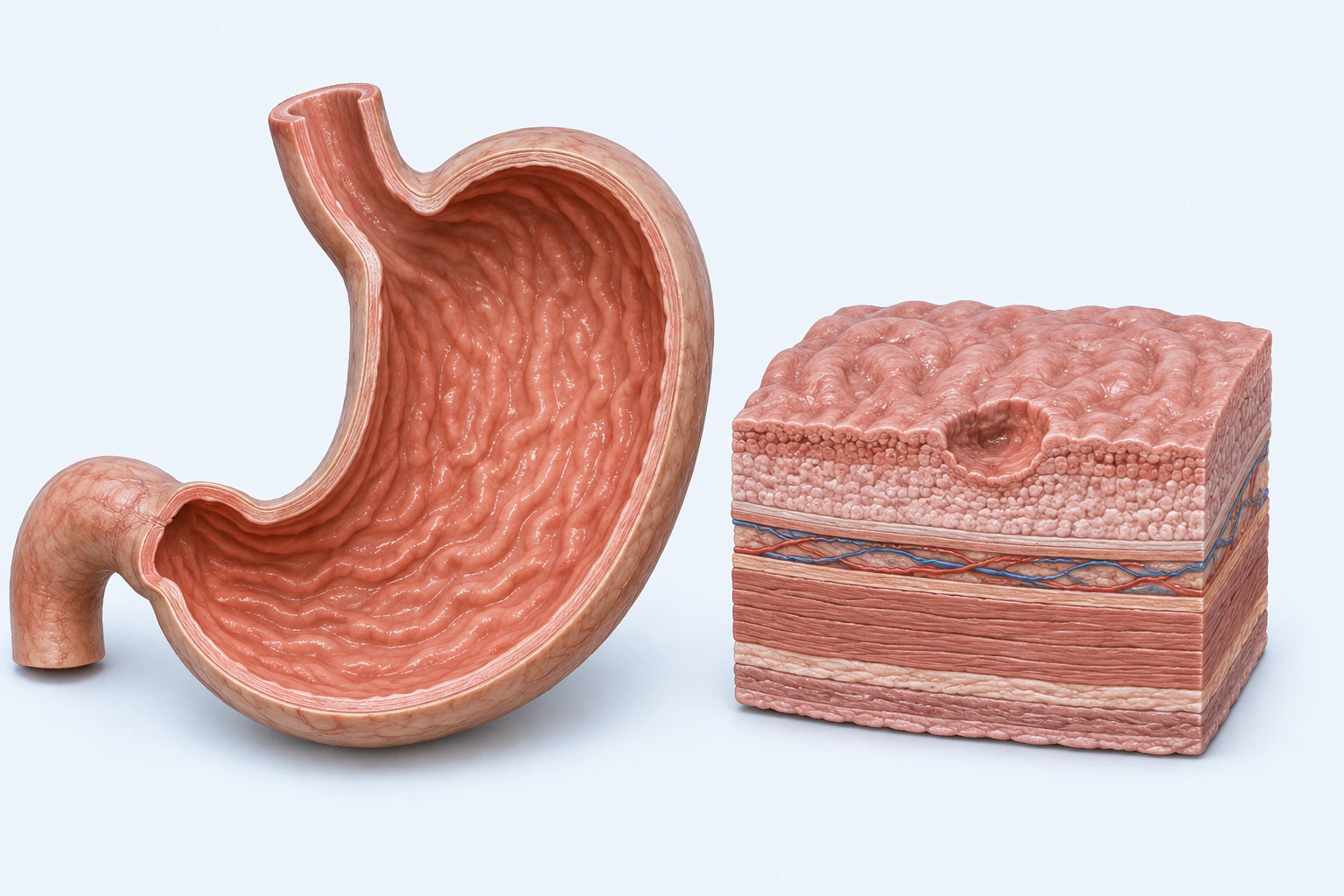
Representative non-perforated gastric mucosal ulcer orientation. The crater is an editorial reconstruction and does not establish Helicobacter pylori, NSAID use, another cause, bleeding, complication, severity, treatment response, or diagnosis.
Scientific media record1 verified identifier
- Subject
- Stomach Ulcercondition
- Identifiers
- MeSH:D013276
- Review
- Editorial review completeIdentifiers authority-verified · Accessibility validated · · gastric-ulcer|gastric-ulcer-pathology-v1.webp
- Digital source
- Trained-algorithmic mediaCreated with a trained generative algorithm and reviewed by WikiBiome for subject identity, scientific framing, identifiers, provenance, and accessibility.
- Scientific basis
- Stomach Ulcer — MeSHDefinition & Facts for Peptic Ulcers
- License
- CC BY-SA 4.0Created
A breach in the gastric mucosal lining extending through the muscularis mucosae, most commonly caused by Helicobacter pylori infection or chronic NSAID use. Gastric ulceration represents a critical node in the upper GI disease continuum, linking Gastroesophageal Reflux Disease (GERD), chronic gastritis, and Gastric Adenocarcinoma through shared microbial and metal-dependent mechanisms.
Evidence map5 cited passagesInspect provenance +
Nickel-dependent urease constitutes up to 10% of the total H. pylori proteome and catalyzes urea hydrolysis to ammonia and bicarbonate, neutralizing gastric acid in the immediate periplasmic environment.
NiFe hydrogenase provides metabolic energy by oxidizing molecular hydrogen (H2), which is chronically available in the human stomach at approximately 80 microM. This energy powers the type IV secretion system and CagA translocation.
H. pylori acquires nickel through dedicated transport systems including NixA (a high-affinity nickel permease) and NiuBDE (an ABC-type transporter). These nickel transporters represent potential therapeutic targets—blocking nickel uptake disables both urease and hydrogenase simultaneously, crippling the organism's ability to colonize the gastric niche.
Proton pump inhibitor (PPI) therapy, the standard treatment for gastric ulcers, raises gastric pH and permits colonization by oral and intestinal bacteria not normally found in the stomach.
PPI use also disrupts the gastric mycobiome, potentially promoting fungal overgrowth by Candida species.
One disease. Five evidence layers.
A generated systems view of the metals, organisms, host sequestration signals, ecological conditions, and microbial functions indexed for Gastric Ulcer.
Evidence layer
Taxonomic signature
Organisms reported as enriched or depleted, with their indexed functional context kept beside the name.No structured taxa indexed yet.
No structured taxa indexed yet.
Evidence layer
Nutritional immunity
Host metal-withholding, inflammatory, antioxidant, and microbial-metabolite signals indexed in the signature.Elevated host signals
0No structured signals indexed yet.
Depleted protective signals
0No structured signals indexed yet.
Evidence layer
Ecological state
The environmental conditions that connect the organism-level observations into a system.No structured ecological features indexed yet.
Evidence layer
Virulence functions
Microbial structures, enzymes, and acquisition systems implicated by the linked evidence.No structured virulence functions indexed yet.
The disease record, in full.
The original WikiBiome disease narrative remains intact beneath the generated signature atlas.
Helicobacter pylori and the Nickel Connection#
The dominant microbial cause of gastric ulceration is H. pylori, whose pathogenesis depends on nickel-containing enzymes that enable survival in the acidic gastric environment.
Nickel-dependent Urease constitutes up to 10% of the total H. pylori proteome and catalyzes urea hydrolysis to Ammonia and bicarbonate, neutralizing gastric acid in the immediate periplasmic environment.[1]Role of Nickel in Microbial PathogenesisRobert J. Maier, Stéphane L. Benoit · 2019Open reference 1 ↓
Beyond acid buffering, urease has non-catalytic roles: promoting angiogenesis, disrupting tight junctions, inducing apoptosis in gastric epithelial cells, and activating blood platelets—all contributing to ulcer formation and persistence.
NiFe hydrogenase provides metabolic energy by oxidizing molecular hydrogen (H2), which is chronically available in the human stomach at approximately 80 microM. This energy powers the type IV secretion system and CagA translocation.[1]Role of Nickel in Microbial PathogenesisRobert J. Maier, Stéphane L. Benoit · 2019Open reference 1 ↓
The Nickel dependency of H. pylori virulence makes this metal a selective pressure in gastric ecology: dietary and environmental nickel exposure may influence the severity of H. pylori-mediated disease.
Nickel Transport as an Achilles' Heel#
H. pylori acquires nickel through dedicated transport systems including NixA (a high-affinity nickel permease) and NiuBDE (an ABC-type transporter). These Nickel Transporters represent potential therapeutic targets—blocking nickel uptake disables both urease and hydrogenase simultaneously, crippling the organism's ability to colonize the gastric niche.[1]Role of Nickel in Microbial PathogenesisRobert J. Maier, Stéphane L. Benoit · 2019Open reference 1 ↓
Gastric Microbiome Beyond H. pylori#
While H. pylori dominates the gastric ulcer narrative, the broader gastric microbiome plays a role. The healthy stomach harbors a diverse community of Streptococcus, Prevotella, Veillonella, and Rothia species that is disrupted by H. pylori colonization.
Proton pump inhibitor (PPI) therapy, the standard treatment for gastric ulcers, raises gastric pH and permits colonization by oral and intestinal bacteria not normally found in the stomach.[2]Passing the 'Acid Test': Do Proton Pump Inhibitors Affect the Composition of the Microbiome?Dong T, Pisegna J · 2018Open reference 2 ↓
PPI use also disrupts the gastric mycobiome, potentially promoting fungal overgrowth by Candida species.[3]Shi 2023 — PPI-Induced Fungal Dysbiosis in Patients with Gastroesophageal Reflux DiseaseYichao Shi, Jianfeng Li, Shuntian Cai et al. · 2023Open reference 3 ↓
Associated Conditions#
Gastric Adenocarcinoma: Chronic H. pylori-driven gastric ulceration is a recognized precursor to gastric cancer through the Correa cascade (chronic gastritis to atrophic gastritis to intestinal metaplasia to dysplasia to carcinoma). The shared nickel-dependent virulence machinery links both conditions.
Gastroesophageal Reflux Disease (GERD): Gastric ulcers may coexist with or complicate GERD, and PPI treatment for both conditions carries similar microbiome consequences. Duodenal ulcer: Shares the H. pylori etiology but involves distinct pathophysiological mechanisms (increased acid secretion vs. decreased mucosal defense).
Environmental Factors#
Dietary nickel: Foods high in nickel (cocoa, nuts, legumes, whole grains) may modulate H. pylori virulence in colonized individuals, though direct evidence linking dietary nickel intake to ulcer risk is limited.
NSAIDs: Prostaglandin inhibition reduces mucosal defense independent of H. pylori, and the combination of NSAID use and H. pylori infection dramatically increases ulcer risk.
Cross-References#
- Helicobacter pylori—primary microbial cause
- Nickel—essential metal for H. pylori virulence enzymes
- Nickel Transporters—NixA and NiuBDE as therapeutic targets
- Gastric Adenocarcinoma—downstream malignant progression
- Gastroesophageal Reflux Disease (GERD)—related upper GI condition
- Nutritional Immunity (Metal Sequestration)—host nickel sequestration as potential defense
References 8
Numbered by first appearance in the article, then reconciled with its declared source list.
- 1
★Robert J. Maier, Stéphane L. Benoit (2019). Role of Nickel in Microbial Pathogenesis. Inorganics.
- 2
Dong T, Pisegna J (2018). Passing the 'Acid Test': Do Proton Pump Inhibitors Affect the Composition of the Microbiome?. Digestive Diseases and Sciences.
- 3
Yichao Shi, Jianfeng Li, Shuntian Cai et al. (2023). Shi 2023 — PPI-Induced Fungal Dysbiosis in Patients with Gastroesophageal Reflux Disease. Frontiers in Cellular and Infection Microbiology.
- 4
Benoit, S.L., Bhatt et al. (2021). Benoit & Maier 2021 — Nickel Chelator Inhibits Amyloid-Beta Aggregation. Scientific Reports.
- 5
Zirun Jin, Yuzhuo Yang, Yalei Cao et al. (2023). Jin 2023 — Gut Metabolite 3-HPAA Rejuvenates Spermatogenic Dysfunction in Aged Mice through GPX4-Mediated Ferroptosis. Microbiome.
- 6
Riley A McFarlane, Jana N Radin, Rafat Mazgaj et al. (2025). McFarlane 2025 — A Manganese-Sparing Response Balances Competing Cellular Demands to Enable Staphylococcus aureus Infection. mBio.
- 7
Docimo G, Cangiano A, Romano RM et al. (2020). Docimo et al. 2020 — The Human Microbiota in Endocrinology: Implications for Pathophysiology, Treatment, and Prognosis in Thyroid Diseases. Frontiers in Endocrinology.
- 8
Benoit SL, Bhatt RJ, Maier RJ (2021). The nickel-chelator dimethylglyoxime inhibits human amyloid beta peptide in vitro aggregation. Scientific Reports.
Article network
Mentioned here 11
Pages linking here 6
Connect the evidence
Publicly readable discussion by ORCID-authenticated researchers. Questions, interpretation, methods, corrections, and new evidence stay attached to this record.
No discussion yet. Start with a precise question or a source-backed observation.
Activity and accepted changes
Accepted researcher context, editorial status, public discussion, and upstream Git revisions are shown together. Pending, declined, and withdrawn proposals remain private.
- published revision
Complete Ammonia contextual coverage
Karen Pendergrass · +1 −1
Inspect exact Git diff ↗ - published revision
Complete Hydrogenase contextual coverage
Karen Pendergrass · +1 −1
Inspect exact Git diff ↗ - published revision
Complete Tight junctions contextual coverage
Karen Pendergrass · +1 −1
Inspect exact Git diff ↗ - published revision
Complete reviewed Urease contextual coverage
Karen Pendergrass · +1 −1
Inspect exact Git diff ↗ - published revision
Add CagA concept and contextual links
Karen Pendergrass · +1 −1
Inspect exact Git diff ↗ - published revision
massive wiki expansion: 149 stubs fixed, 100+ new pages, Rule 15 scan, keystone papers
WikiBiome Deploy Bot · +20 −16
Inspect exact Git diff ↗ - published revision
nightly maintenance: 94 stub demotions, 181 source_count fixes, 22 auto-discovered stubs, 5 adversarial audits, 3 boundary fixes, 3 evidence-level corrections
WikiBiome Deploy Bot · +2 −0
Inspect exact Git diff ↗ - published revision
pre-overnight checkpoint 2026-04-18
WikiBiome Deploy Bot · +66 −0
Inspect exact Git diff ↗