
 metals · microbes · host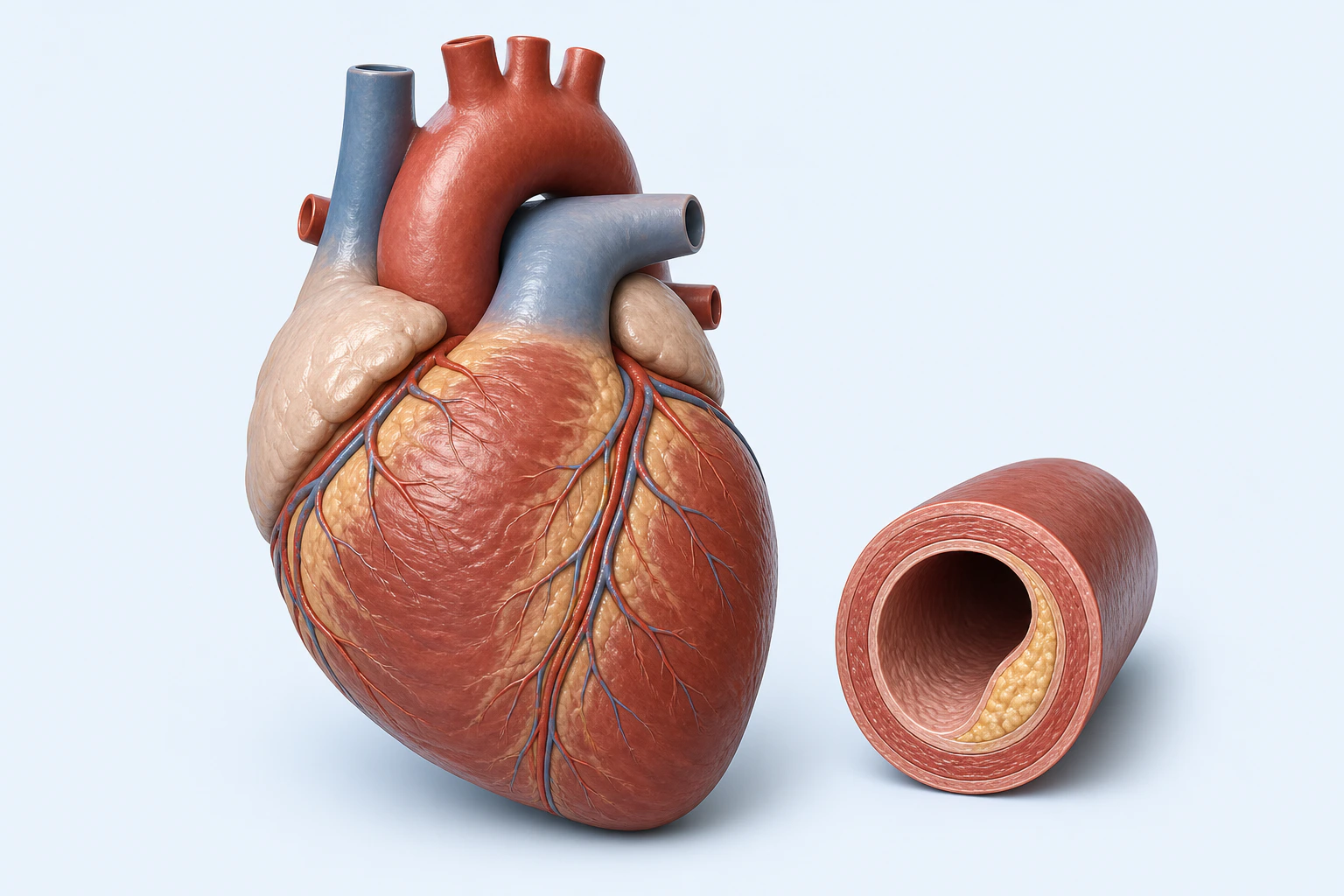
Coronary anatomy with one representative atherosclerotic arterial-wall process. Coronary artery disease also includes congenital and non-atherosclerotic processes; this reconstruction does not show occlusion, infarction, severity, or diagnosis.
Scientific media record1 verified identifier
- Subject
- Coronary Artery Diseasecondition
- Identifiers
- MeSH:D003324
- Review
- Editorial review completeIdentifiers authority-verified · Accessibility validated · · coronary-artery-disease|coronary-artery-disease-pathology-v1.webp
- Digital source
- Trained-algorithmic mediaCreated with a trained generative algorithm and reviewed by WikiBiome for subject identity, scientific framing, identifiers, provenance, and accessibility.
- License
- CC BY-SA 4.0Created
Coronary artery disease (CAD)—the progressive narrowing of coronary arteries by atherosclerotic plaque—is the single leading cause of death globally, responsible for approximately 9 million deaths annually. CAD encompasses stable angina, unstable angina, and myocardial infarction (heart attack).
While conventional risk factors (hypertension, dyslipidemia, smoking, diabetes) are well established, the Gut Microbiome adds an underappreciated dimension: microbial metabolites directly promote plaque formation, bacteria translocate into arterial plaques, and the metal environment modulates both microbial and vascular pathology.
CAD is closely related to the broader Cardiovascular Disease and Atherosclerosis pages in this wiki, but is distinguished by its focus on coronary-specific pathology and the increasingly detailed metabolomic-microbiome data linking gut bacteria to plaque severity.
Evidence map4 cited passagesInspect provenance +
CAD patients have distinct gut microbial communities compared to healthy controls:
A critical observation: gut microbiome metabolic capacity correlates with CAD severity:
gut microbiome composition in CAD
metabolomic correlation with stenosis severity
One disease. Five evidence layers.
A generated systems view of the metals, organisms, host sequestration signals, ecological conditions, and microbial functions indexed for Coronary Artery Disease.
Evidence layer
Taxonomic signature
Organisms reported as enriched or depleted, with their indexed functional context kept beside the name.No structured taxa indexed yet.
No structured taxa indexed yet.
Evidence layer
Nutritional immunity
Host metal-withholding, inflammatory, antioxidant, and microbial-metabolite signals indexed in the signature.Elevated host signals
0No structured signals indexed yet.
Depleted protective signals
0No structured signals indexed yet.
Evidence layer
Ecological state
The environmental conditions that connect the organism-level observations into a system.No structured ecological features indexed yet.
Evidence layer
Virulence functions
Microbial structures, enzymes, and acquisition systems implicated by the linked evidence.No structured virulence functions indexed yet.
The disease record, in full.
The original WikiBiome disease narrative remains intact beneath the generated signature atlas.
Metallomic Signature#
CAD shares the metallomic profile described for acute cardiovascular events (see Cardiovascular Disease):
| Metal | Direction | Mechanism |
|---|---|---|
| Copper | Elevated | Ceruloplasmin acute-phase response; oxidative damage to LDL |
| Selenium | Depleted | Impaired selenoprotein antioxidant defense (GPX1, GPX4) |
| Iron | Dysregulated | Free iron catalyzes LDL oxidation; heme iron from dietary red meat |
| Lead | Chronic elevation | Hypertension, endothelial dysfunction, accelerated atherosclerosis |
| Cadmium | Chronic elevation | Smoking-associated; vascular endothelial toxicity |
Cu/Se Ratio#
The copper (Cu)/selenium (Se) ratio is the most discriminating metallomic marker for acute coronary events, capturing both copper elevation and selenium depletion in a single metric. This ratio, combined with iron (Fe)/copper, achieves an AUC of 0.942 for AMI prediction in random forest modeling.
Microbiome Associations#
Gut Microbiome in CAD#
CAD patients have distinct gut microbial communities compared to healthy controls:[1]Coronary artery disease is associated with an altered gut microbiome compositionTakumi Toya, Michel T. Corban, Eric Marrietta et al. · 2020Open reference 1 ↓
- Enriched: Enterobacteriaceae, Escherichia coli, Streptococcus, Lactobacillales
- Depleted: Roseburia, Faecalibacterium prausnitzii, Coprococcus, Eubacterium—Butyrate producers
- Functional: Increased TMAO production, reduced SCFA biosynthesis, altered bile acid metabolism
Metabolomic Correlation with Stenosis Severity#
A critical observation: gut microbiome metabolic capacity correlates with CAD severity.[2]Alterations in the gut microbiome and metabolism with coronary artery disease severityHonghong Liu, Xi Chen, Xiaomin Hu et al. · 2019Open reference 2 ↓ Patients with more severe coronary stenosis (higher Gensini scores) show more pronounced Dysbiosis. TMAO-producing bacterial pathways are enriched in proportion to plaque burden.
SCFA-producing pathways are depleted in proportion to disease severity.
This suggests a dose-response relationship between microbial metabolic output and coronary pathology.
TMAO: The Microbial Metabolite Driving Plaque#
Trimethylamine N-oxide (TMAO) is the most direct metabolite link between gut bacteria and CAD:
1. Dietary choline, carnitine, and betaine (red meat, eggs, dairy) are metabolized by gut bacteria to trimethylamine (TMA) 2. TMA is absorbed and oxidized to TMAO by hepatic FMO3 3. TMAO promotes atherosclerosis through: - Enhanced macrophage foam cell formation (cholesterol uptake, impaired efflux) - Increased platelet hyperreactivity and thrombosis risk - Promotion of endothelial Metal-Driven Inflammation - Altered bile acid and cholesterol metabolism
TMAO levels predict cardiovascular events independent of traditional risk factors, and the TMAO-producing capacity of an individual's microbiome is a modifiable risk factor.
Oral-to-Coronary Bacterial Translocation#
Oral bacteria, particularly Porphyromonas gingivalis and other periodontal pathogens, have been detected within coronary atherosclerotic plaques.
Periodontal disease is an independent CAD risk factor. Oral bacteria reach coronary arteries via transient bacteremia during dental procedures, eating, and tooth brushing. Within plaques, bacteria sustain local inflammation and may contribute to plaque instability.
The oral microbiome is therefore a direct contributor to coronary pathology, not merely a systemic inflammation marker.
SCFA Protection#
Butyrate and propionate from gut commensals protect against CAD through:
- Anti-inflammatory signaling: Butyrate suppresses NF-kB in vascular endothelial cells
- Blood pressure regulation: Propionate activates Olfr78 and GPR41 receptors, modulating renin secretion
- Barrier integrity: SCFAs maintain intestinal barrier, preventing LPS-driven endothelial activation
- Cholesterol metabolism: SCFAs influence hepatic cholesterol synthesis
The depletion of SCFA-producing bacteria in CAD removes these protective effects.
Associated Conditions#
| Condition | Relationship | Shared Metallomic/Microbiome Features |
|---|---|---|
| Atherosclerosis | CAD is atherosclerosis of the coronary arteries | Same process, same taxa, same metals |
| Type 2 Diabetes | Major risk factor; 2-4x CAD risk | Cadmium, Enterobacteriaceae enrichment, SCFA depletion |
| Hypertension | Major risk factor | Lead, cadmium vascular toxicity |
| Chronic Kidney Disease | Bidirectional risk | Lead/cadmium retention, uremic toxins, TMAO |
| Erectile Dysfunction | Sentinel marker (ED precedes CAD by 3-5 years) | Shared endothelial dysfunction, same gut-vascular axis |
Open Questions#
Unresolved questions identified by the current evidence record.
01Can TMAO-lowering interventions (dietary or microbial) reduce coronary events in clinical trials?+
The current WikiBiome record identifies this as an unresolved evidence gap.
02Does the oral microbiome composition predict CAD independent of periodontal disease severity?+
The current WikiBiome record identifies this as an unresolved evidence gap.
03Can the copper (Cu)/selenium (Se) ratio serve as a screening biomarker for subclinical CAD?+
The current WikiBiome record identifies this as an unresolved evidence gap.
04Do statin-microbiome interactions (see Statins) contribute to cardiovascular protection beyond cholesterol lowering?+
The current WikiBiome record identifies this as an unresolved evidence gap.
05Can precision probiotics targeting butyrate production reduce CAD progression?+
The current WikiBiome record identifies this as an unresolved evidence gap.
Key Studies#
- [1]Coronary artery disease is associated with an altered gut microbiome compositionTakumi Toya, Michel T. Corban, Eric Marrietta et al. · 2020Open reference 1 ↓—gut microbiome composition in CAD
- [2]Alterations in the gut microbiome and metabolism with coronary artery disease severityHonghong Liu, Xi Chen, Xiaomin Hu et al. · 2019Open reference 2 ↓—metabolomic correlation with stenosis severity
Cross-References#
- Cardiovascular Disease—broader CVD context
- Atherosclerosis—underlying pathological process
- Trimethylamine N-Oxide (TMAO)—microbial metabolite driving plaque
- butyrate—protective SCFA depleted in CAD
- Copper—elevated acute-phase metal
- Selenium—depleted antioxidant cofactor
- Erectile Dysfunction—sentinel marker condition
- Statins—primary pharmacotherapy
References 8
Numbered by first appearance in the article, then reconciled with its declared source list.
- 1
Takumi Toya, Michel T. Corban, Eric Marrietta et al. (2020). Coronary artery disease is associated with an altered gut microbiome composition. PLOS ONE.
- 2
Honghong Liu, Xi Chen, Xiaomin Hu et al. (2019). Alterations in the gut microbiome and metabolism with coronary artery disease severity. Microbiome.
- 3
Kevin T. McVary (2007). McVary 2007 — Erectile Dysfunction Clinical Practice Review. New England Journal of Medicine.
- 4
Md. Mominur Rahman, Fahadul Islam, Md. Harun-Or-Rashid et al. (2022). The Gut Microbiota (Microbiome) in Cardiovascular Disease and Its Therapeutic Regulation. Frontiers in Cellular and Infection Microbiology.
- 5
Andrea Tonelli, Evelyn N. Lumngwena, Ntobeko A. B. Ntusi (2023). The oral microbiome in the pathophysiology of cardiovascular disease. Nature Reviews Cardiology.
- 6
Xiao-Ce Dai, Yi Yu, Si-Yu Zhou et al. (2024). Assessment of the causal relationship between gut microbiota and cardiovascular diseases: a bidirectional Mendelian randomization analysis. BioData Mining.
- 7
Dan Wang, Xiaoyan Chen, Zhen Li et al. (2023). Association of the Gut Microbiota with Coronary Artery Disease and Myocardial Infarction: A Mendelian Randomization Study. Frontiers in Genetics.
- 8
Jing Zhen, Zhou Zhou, Meng He et al. (2023). The gut microbial metabolite trimethylamine N-oxide and cardiovascular diseases. Frontiers in Endocrinology.
Article network
Connect the evidence
Publicly readable discussion by ORCID-authenticated researchers. Questions, interpretation, methods, corrections, and new evidence stay attached to this record.
No discussion yet. Start with a precise question or a source-backed observation.
Activity and accepted changes
Accepted researcher context, editorial status, public discussion, and upstream Git revisions are shown together. Pending, declined, and withdrawn proposals remain private.
- published revision
Consolidate microbial metabolite knowledge
Karen Pendergrass · +1 −1
Inspect exact Git diff ↗ - published revision
Backfill gut microbiome concept links
Karen Pendergrass · +1 −1
Inspect exact Git diff ↗ - published revision
Backfill inflammation concept links
Karen Pendergrass · +1 −1
Inspect exact Git diff ↗ - published revision
Complete corpus-wide Dysbiosis linking
Karen Pendergrass · +1 −1
Inspect exact Git diff ↗ - published revision
massive wiki expansion: 149 stubs fixed, 100+ new pages, Rule 15 scan, keystone papers
WikiBiome Deploy Bot · +30 −24
Inspect exact Git diff ↗ - published revision
nightly maintenance: 94 stub demotions, 181 source_count fixes, 22 auto-discovered stubs, 5 adversarial audits, 3 boundary fixes, 3 evidence-level corrections
WikiBiome Deploy Bot · +2 −0
Inspect exact Git diff ↗ - published revision
pre-overnight checkpoint 2026-04-18
WikiBiome Deploy Bot · +130 −0
Inspect exact Git diff ↗