

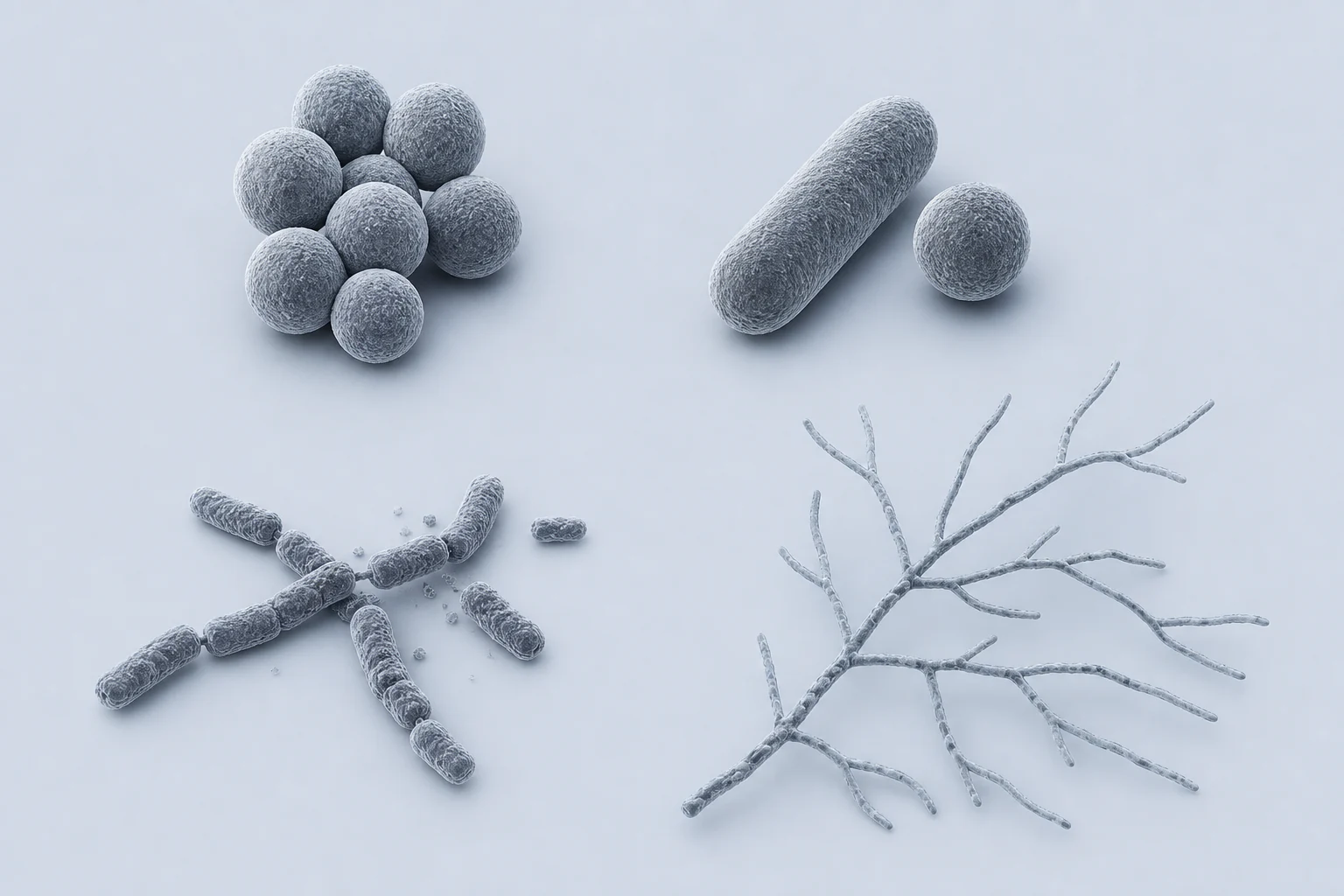
Representative morphological breadth within Actinomycetota, including coccoid, rod-coccoid, fragmenting hyphal, and branched mycelial forms. A phylum has no single diagnostic morphology, and relative scale here is illustrative.
Scientific media record1 verified identifier
- Subject
- Actinomycetotataxon · phylum
- Identifiers
- NCBITaxon:201174
- Review
- Editorial review completeIdentifiers authority-verified · Accessibility validated · · actinobacteria|actinobacteria-microbial-community-v1.webp
- Digital source
- Trained-algorithmic mediaCreated with a trained generative algorithm and reviewed by WikiBiome for subject identity, scientific framing, identifiers, provenance, and accessibility.
- Scientific basis
- Actinomycetota — NCBI TaxonomyTaxonomy, Physiology, and Natural Products of Actinobacteria
- License
- CC BY-SA 4.0Created
Actinobacteria (reclassified as Actinomycetota in 2021) is a major Gram-positive, high-GC-content bacterial phylum with remarkable ecological breadth. In the gut, it typically comprises 1-10% of the community—a distant third behind Firmicutes (Bacillota) and Bacteroidetes (Bacteroidota)—but its functional importance far exceeds its abundance.
The phylum contains both cornerstone commensals (Bifidobacterium, the most widely used probiotic genus) and formidable pathogens (Mycobacterium tuberculosis, the world's deadliest bacterial pathogen).
Mendelian randomization studies in the vault consistently identify Actinobacteria as causally protective against multiple conditions—a striking finding given the phylum's relatively modest abundance.
Evidence map2 cited passagesInspect provenance +
| Condition | MR Effect | Source | |-----------|-----------|--------| | postpartum depression | Protective (OR=0.971, P=0.014) | | | gerd | Protective (OR=0.93) | | | hashimotos thyroiditis | Protective (OR=0.91); mediated via CCR2 on myeloid DCs | | | Diabetic kidney disease (T1D) | Protective (OR=0.445) | | | Breast and lung cancer | Causal associations |
| Condition | Actinobacteria Change | Key Finding | |-----------|----------------------|-------------| | autism spectrum disorder | Dramatically depleted | 12.18% vs 47.30% in controls (Bifidobacterium, Collinsella decreased) | | cardiovascular disease | Enriched (blood) | Actinobacteria dominated CVD blood circulating DNA samples | | Heart failure | Enriche
Contents
1. Key Genera with WikiBiome Entity Pages2. Metal Biology Across the Phylum3. Causal Protection (Mendelian Randomization Evidence)4. Disease Associations5. Ecological Roles6. Cross-ReferencesKey Genera with WikiBiome Entity Pages#
Commensals#
| Genus | Key Function | Metal Biology |
|---|---|---|
| Bifidobacterium | Premier probiotic; SCFA production; immune education | Metal-binding cell surfaces; nickel-dependent Urease in some species |
| Gordonibacter urolithinfaciens | Urolithin production from ellagitannins | Specialized secondary metabolism |
Pathobionts / Context-Dependent#
| Genus | Key Function | Metal Biology |
|---|---|---|
| Collinsella | Bile acid deconjugation; enriched by Heavy Metals; atherosclerosis | Coriobacteriaceae member |
| Eggerthella lenta | Beta-Glucuronidase (estrogen deconjugation); drug metabolism | Iron and molybdenum dependent |
| Actinomyces | Oral pathobiont; enriched in CRC, MS, endometriosis | Nickel-urease for acid tolerance |
Pathogens#
| Genus | Key Function | Metal Biology |
|---|---|---|
| Mycobacterium tuberculosis | TB pathogen; intracellular survival | NiFe Hydrogenase; nickel (Ni)-urease; mycobactin siderophores |
Members Without Dedicated Pages#
- Gardnerella—vaginal pathobiont; bacterial vaginosis
- Corynebacterium—skin/mucosal commensal; some pathogenic
- Rothia—oral commensal; opportunistic
- Streptomyces—soil bacteria; nickel (Ni)-SOD producers (the only known nickel-dependent SOD)
- Cutibacterium (C. acnes)—skin commensal/acne pathogen
Metal Biology Across the Phylum#
Actinobacteria display unusually diverse metal biology within a single phylum:
| Metal System | Genera | Function |
|---|---|---|
| Nickel-urease | Actinomyces, Bifidobacterium spp., Mycobacterium | Acid tolerance; nitrogen metabolism |
| nickel (Ni)-SOD | Streptomyces | Unique nickel-dependent Superoxide Dismutase (only known in prokaryotes) |
| NiFe-hydrogenase | Mycobacterium | H2 oxidation for energy in macrophage phagosome |
| Iron/Molybdenum enzymes | Eggerthella | Specialized oxidoreductases |
| Metal-binding surfaces | Bifidobacterium | Cell surface metal sequestration |
| Mycobactin siderophores | Mycobacterium | High-affinity iron acquisition |
Causal Protection (Mendelian Randomization Evidence)#
MR studies in the vault consistently show Actinobacteria as causally protective:
| Condition | MR Effect | Source |
|---|---|---|
| Postpartum Depression | Protective (OR=0.971, P=0.014) | [1]Zhang 2024 — Gut Microbiota and Postpartum Depression: A Mendelian Randomization StudyJianjun Zhang, Lechuan Wei, Hongfei Tan et al. · 2024Open reference 1 ↓ |
| Gastroesophageal Reflux Disease (GERD) | Protective (OR=0.93) | [2]Wang K 2024 — Causal Gut Microbiota-GERD Associations via Bidirectional Mendelian RandomizationKui Wang, Suijian Wang, Yuhua Chen et al. · 2024Open reference 2 ↓ |
| Hashimoto's Thyroiditis | Protective (OR=0.91); mediated via CCR2 on myeloid DCs | [3]Fang et al. 2024 — Gut Microbiota and Autoimmune Thyroid Disease: A Bidirectional Mendelian Randomization Study and Mediation AnalysisFang Y, Zhang X, Huang R et al. · 2024Open reference 3 ↓ |
| Diabetic kidney disease (T1D) | Protective (OR=0.445) | [4]Liu 2024 — Causal relationship between gut microbiota and diabetic complications: a two-sample Mendelian randomization studyLiu J, Chen Y, Peng C · 2024Open reference 4 ↓ |
| Breast and lung cancer | Causal associations | [5]Causal Relationship between Gut Microbiota and Cancers: A Two-Sample Mendelian Randomisation StudyLong Y, Tang L, Zhou Y et al. · 2023Open reference 5 ↓ |
The mediation via CCR2 on myeloid dendritic cells (Hashimoto's) suggests an immune-modulatory mechanism underlying the protective effect.
Disease Associations#
| Condition | Actinobacteria Change | Key Finding |
|---|---|---|
| Autism Spectrum Disorder | Dramatically depleted | 12.18% vs 47.30% in controls (Bifidobacterium, Collinsella decreased)[6]Coretti 2018 — Gut Microbiota Features in Young Children With Autism Spectrum DisordersLorena Coretti, Lorella Paparo, Maria Pia Riccio et al. · 2018Open reference 6 ↓ |
| Cardiovascular Disease | Enriched (blood) | Actinobacteria dominated CVD blood circulating DNA samples[7]Elevated Levels of Circulating DNA in Cardiovascular Disease Patients: Metagenomic Profiling of Microbiome in the CirculationVasudevan Dinakaran, Andiappan Rathinavel, Muthuirulan Pushpanathan et al. · 2014Open reference 7 ↓ |
| Heart failure | Enriched | Actinobacteria enriched in HF patients[8]Gut Microbiome and Plasma Microbiome-Related Metabolites in Patients With Decompensated and Compensated Heart FailureTomohiro Hayashi, Tomoya Yamashita, Hikaru Watanabe et al. · 2019Open reference 8 ↓ |
| Schizophrenia | Class-level associations | [9]Gut Microbiota and Psychiatric Disorders: A Two-Sample Mendelian Randomization StudyNi JJ, Xu Q, Yan SS et al. · 2022Open reference 9 ↓ |
Ecological Roles#
SCFA and Organic Acid Production#
Bifidobacterium produces acetate and lactate through the "bifid shunt" (fructose-6-phosphate phosphoketolase pathway). Acetate serves as cross-feeding substrate for Butyrate producers (Faecalibacterium prausnitzii, Roseburia).
Estrobolome#
Eggerthella lenta is a key Beta-Glucuronidase producer, deconjugating estrogen metabolites and increasing free estrogen in the enterohepatic circulation. This connects Actinobacteria to estrogen-dependent conditions (Endometriosis, Breast Cancer).
Bile Acid Metabolism#
Collinsella participates in bile acid deconjugation, linking Actinobacteria to Bile Acid Metabolism and its effects on metabolic and immune signaling.
Cross-References#
- Firmicutes (Bacillota)—Partner dominant phylum
- Bacteroidetes (Bacteroidota)—Partner dominant phylum
- Proteobacteria (Pseudomonadota)—Phylum that expands as Actinobacteria declines
- Bifidobacterium—Cornerstone commensal genus
- Nickel-urease—Metal-dependent enzyme across multiple genera
- Superoxide Dismutase—nickel (Ni)-SOD unique to Streptomyces
- Beta-Glucuronidase—Eggerthella's estrobolome role
- Mendelian Randomization—MR evidence for causal protection
- Estrobolome—Actinobacteria contribution via Eggerthella
References 10
Numbered by first appearance in the article, then reconciled with its declared source list.
- 1
Jianjun Zhang, Lechuan Wei, Hongfei Tan et al. (2024). Zhang 2024 — Gut Microbiota and Postpartum Depression: A Mendelian Randomization Study. Frontiers in Psychiatry.
- 2
Kui Wang, Suijian Wang, Yuhua Chen et al. (2024). Wang K 2024 — Causal Gut Microbiota-GERD Associations via Bidirectional Mendelian Randomization. Frontiers in Immunology.
- 3
Fang Y, Zhang X, Huang R et al. (2024). Fang et al. 2024 — Gut Microbiota and Autoimmune Thyroid Disease: A Bidirectional Mendelian Randomization Study and Mediation Analysis. Frontiers in Microbiology.
- 4
Liu J, Chen Y, Peng C (2024). Liu 2024 — Causal relationship between gut microbiota and diabetic complications: a two-sample Mendelian randomization study. Diabetology & Metabolic Syndrome.
- 5
Long Y, Tang L, Zhou Y et al. (2023). Causal Relationship between Gut Microbiota and Cancers: A Two-Sample Mendelian Randomisation Study. BMC Medicine.
- 6
Lorena Coretti, Lorella Paparo, Maria Pia Riccio et al. (2018). Coretti 2018 — Gut Microbiota Features in Young Children With Autism Spectrum Disorders. Frontiers in Microbiology.
- 7
Vasudevan Dinakaran, Andiappan Rathinavel, Muthuirulan Pushpanathan et al. (2014). Elevated Levels of Circulating DNA in Cardiovascular Disease Patients: Metagenomic Profiling of Microbiome in the Circulation. PLOS ONE.
- 8
Tomohiro Hayashi, Tomoya Yamashita, Hikaru Watanabe et al. (2019). Gut Microbiome and Plasma Microbiome-Related Metabolites in Patients With Decompensated and Compensated Heart Failure. Circulation Journal.
- 9
Ni JJ, Xu Q, Yan SS et al. (2022). Gut Microbiota and Psychiatric Disorders: A Two-Sample Mendelian Randomization Study. Frontiers in Microbiology.
- 10
Lucia N. Peralta-Marzal, David Rojas-Velazquez, Douwe Rigters et al. (2024). Peralta-Marzal 2024 — A Robust Microbiome Signature for Autism Spectrum Disorder Across Different Studies Using Machine Learning. Scientific Reports.
Article network
Mentioned here 18
Pages linking here 8
Connect the evidence
Publicly readable discussion by ORCID-authenticated researchers. Questions, interpretation, methods, corrections, and new evidence stay attached to this record.
No discussion yet. Start with a precise question or a source-backed observation.
Published page changes
This record shows only material changes published on this page, including changes to its content, evidence, conclusions, or author context. Internal processes and discussion activity are excluded. Pending, declined, and withdrawn proposals remain private.
- published revision
Revised “Pathogens”: now reads “| TB pathogen; intracellular survival | NiFe hydrogenase; Ni-urease; mycobactin siderophores |”.
Revised “Pathogens”: changed “| TB pathogen; intracellular survival | NiFe-hydrogenase; Ni-urease; mycobactin siderophores |” to “| TB pathogen; intracellular survival | NiFe hydrogenase; Ni-urease; mycobactin siderophores |”. · Karen Pendergrass · +1 −1
Inspect exact Git diff ↗ - published revision
Revised “Commensals”: now reads “immune education | Metal-binding cell surfaces; nickel-dependent urease in some species | | gordonibacter”.
Revised “Commensals”: changed “immune education | Metal-binding cell surfaces; Ni-urease in some species | | gordonibacter” to “immune education | Metal-binding cell surfaces; nickel-dependent urease in some species | | gordonibacter”. Revised “Pathobionts / Context-Dependent”: changed “enriched in CRC, MS, endometriosis | nickel urease for acid tolerance |” to “enriched in CRC, MS, endometriosis | Nickel-urease for acid tolerance |”. Revised “Metal Biology Across the Phylum”: changed “Genera | Function | |---|---|---| | nickel urease | Actinomyces, Bifidobacterium spp., Mycobacterium |” to “Genera | Function | |---|---|---| | Nickel-urease | Actinomyces, Bifidobacterium spp., Mycobacterium |”. Revised “Cross-References”: changed “bifidobacterium -- Cornerstone commensal genus - nickel urease -- Metal-dependent enzyme across multiple genera” to “bifidobacterium -- Cornerstone commensal genus - Nickel-urease -- Metal-dependent enzyme across multiple genera”. · Karen Pendergrass · +4 −4
Inspect exact Git diff ↗ - published revision
Created “Actinobacteria (Actinomycetota)”: Actinobacteria (reclassified as Actinomycetota in 2021) is a major Gram-positive, high-GC-content bacterial phylum with remarkable ecological breadth. In the gut, it typically comprises 1-10% of the…
Created “Actinobacteria (Actinomycetota)”: Actinobacteria (reclassified as Actinomycetota in 2021) is a major Gram-positive, high-GC-content bacterial phylum with remarkable ecological breadth. In the gut, it typically comprises 1-10% of the… Published sections: Overview; Commensals; Pathobionts / Context-Dependent; Pathogens; Members Without Dedicated Pages; Metal Biology Across the Phylum; Causal Protection (Mendelian Randomization Evidence); Disease Associations; SCFA and Organic Acid Production; Estrobolome; Bile Acid Metabolism; Cross-References. · WikiBiome Deploy Bot · +118 −0
Inspect exact Git diff ↗