
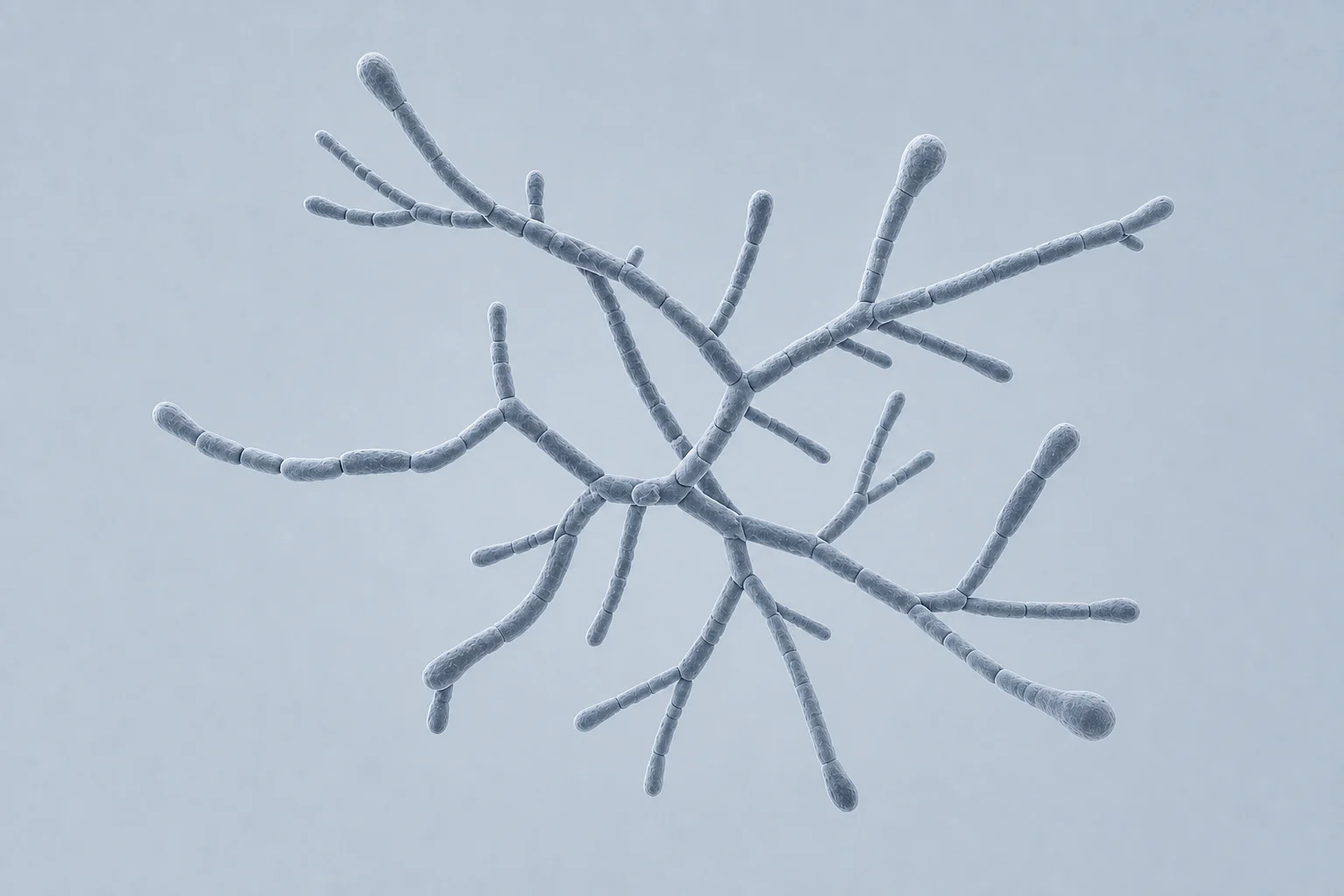
Representative Actinomyces filamentous rods with straight and wavy branches and occasional clubbed ends. Morphology varies among species; these are bacterial filaments, not fungal hyphae.
Scientific media record1 verified identifier
- Subject
- Actinomycestaxon · genus
- Identifiers
- NCBITaxon:1654
- Review
- Editorial review completeIdentifiers authority-verified · Accessibility validated · · actinomyces|actinomyces-morphology-v1.webp
- Digital source
- Trained-algorithmic mediaCreated with a trained generative algorithm and reviewed by WikiBiome for subject identity, scientific framing, identifiers, provenance, and accessibility.
- Scientific basis
- Actinomyces — Medical Subject HeadingsActinomyces, Propionibacterium propionicus, and Streptomyces
- License
- CC BY-SA 4.0Created
A genus of Gram-positive, facultatively anaerobic, filamentous bacteria that are among the most abundant colonizers of the human oral cavity. Actinomyces species, particularly A. naeslundii, play dual roles as early dental plaque colonizers and as opportunistic pathogens capable of causing actinomycosis and contributing to oral-gut translocation in disease.
Evidence map4 cited passagesInspect provenance +
Actinomyces is enriched in intramucosal CRC tissue alongside Parvimonas, Peptostreptococcus, and Fusobacterium.
Enriched in faecal microbiota of RRMS patients alongside other inflammation-associated bacteria.
Oral dysbiosis in MS involves altered Actinomyces abundance as part of breakdown in oral-gut compartmentalization.
Detected in peritoneal and endometriotic lesion microbiota, suggesting translocation from oral or gut sites.
Contents
1. Metal Dependencies: Nickel-Urease System2. Role in Oral Ecosystem3. Disease Associations4. ConnectionsMetal Dependencies: Nickel-Urease System#
A. naeslundii harbors a Nickel-dependent Urease that is critical for its survival in acidic oral environments.
The nickel (Ni)-urease hydrolyzes urea to Ammonia and CO2, raising local pH in dental plaque and enabling acid-tolerant biofilm persistence. This enzyme requires two nickel(II) ions per active site, making A. naeslundii dependent on nickel availability for its acid-survival strategy.
In nickel-replete environments (e.g., from Dietary Nickel Exposure or nickel-containing dental prosthetics), Actinomyces urease activity may be enhanced, promoting more robust plaque formation. The nickel-urease of oral bacteria is mechanistically related to that of Helicobacter pylori, though operating in a different anatomical niche.
Role in Oral Ecosystem#
Early colonizer: Actinomyces species are among the first bacteria to adhere to tooth surfaces, forming the foundational layer of dental Biofilm (plaque). cobalt (Co)-aggregation partner: provides attachment sites for secondary colonizers including Fusobacterium nucleatum, bridging early and late plaque communities.
Dental caries: contributes to root surface caries through acid production from carbohydrate fermentation. Periodontal health: A. naeslundii is present in both health and disease, with its pathogenic potential dependent on community context.
Disease Associations#
Actinomycosis#
Chronic granulomatous infection caused by Actinomyces israelii and related species. Typically involves cervicofacial, thoracic, or abdominal sites following mucosal barrier breach. Characterized by sulfur granules and requires prolonged antibiotic therapy.
Colorectal Cancer#
Actinomyces is enriched in intramucosal CRC tissue alongside Parvimonas, Peptostreptococcus, and Fusobacterium.[1]Metagenomic Analyses of the Gut Microbiota Associated with Colorectal AdenomaSaito K, Koido S, Odamaki T et al. · 2019Open reference 1 ↓ Part of the oral-origin bacteria that translocate to gut tumors as components of the CRC-associated microbiome signature.
Multiple Sclerosis#
Enriched in faecal microbiota of RRMS patients alongside other Metal-Driven Inflammation-associated bacteria.[2]Investigating the metabolite signature of an altered oral microbiota as a discriminant factor for multiple sclerosis: a pilot studyLéo Boussamet, Emmanuel Montassier, Camille Mathé et al. · 2024Open reference 2 ↓ Oral Dysbiosis in MS involves altered Actinomyces abundance as part of breakdown in oral-gut compartmentalization.[3]Multiple Sclerosis Patients Exhibit Oral Dysbiosis with Decreased Early Colonizers and Lower Hypotaurine LevelRachel L. Fitzjerrells, Leeann Aguilar Meza, Meeta Yadav et al. · 2025Open reference 3 ↓
Endometriosis#
- Detected in peritoneal and endometriotic lesion microbiota, suggesting translocation from oral or gut sites.[4]Altered Composition of Microbiota in Women with Ovarian Endometrioma: Microbiome Analyses of Extracellular Vesicles in the Peritoneal FluidLee SR, Lee JC, Kim SH et al. · 2021Open reference 4 ↓
Connections#
- Nickel—nickel (Ni)-dependent urease enables acid tolerance in oral biofilms
- Urease—shares nickel-urease mechanism with H. pylori in distinct anatomical niche
- Biofilm—foundational early colonizer of dental plaque
- Fusobacterium nucleatum—co-aggregation partner in oral biofilm succession
- Colorectal Cancer—oral-origin translocator enriched in CRC tissue
- Multiple Sclerosis—enriched in MS faecal and oral microbiota
- Dietary Nickel Exposure—oral nickel availability may enhance urease-dependent plaque formation
References 8
Numbered by first appearance in the article, then reconciled with its declared source list.
- 1
Saito K, Koido S, Odamaki T et al. (2019). Metagenomic Analyses of the Gut Microbiota Associated with Colorectal Adenoma. PLOS ONE.
- 2
Léo Boussamet, Emmanuel Montassier, Camille Mathé et al. (2024). Investigating the metabolite signature of an altered oral microbiota as a discriminant factor for multiple sclerosis: a pilot study. Scientific Reports.
- 3
Rachel L. Fitzjerrells, Leeann Aguilar Meza, Meeta Yadav et al. (2025). Multiple Sclerosis Patients Exhibit Oral Dysbiosis with Decreased Early Colonizers and Lower Hypotaurine Level. npj Biofilms and Microbiomes.
- 4
Lee SR, Lee JC, Kim SH et al. (2021). Altered Composition of Microbiota in Women with Ovarian Endometrioma: Microbiome Analyses of Extracellular Vesicles in the Peritoneal Fluid. International Journal of Molecular Sciences.
- 5
Chloe Hicks, Mathew Leonardi, Xin-Yi Chua et al. (2025). Hicks et al. 2025 — Oral, Vaginal, and Stool Microbial Signatures in Patients With Endometriosis as Potential Diagnostic Non-Invasive Biomarkers. BJOG: An International Journal of Obstetrics and Gynaecology.
- 6
Zangeneh Z, Abdi-Ali A, Khamooshian K et al. (2021). Bacterial Variation in the Oral Microbiota in Multiple Sclerosis Patients. PLoS ONE.
- 7
Yu L, Zhao G, Wang L et al. (2022). A Systematic Review of Microbial Markers for Risk Prediction of Colorectal Neoplasia. British Journal of Cancer.
- 8
Lin Q, Dorsett Y, Mirza A et al. (2024). Meta-Analysis Identifies Common Gut Microbiota Associated with Multiple Sclerosis. Genome Medicine.
Article network
Connect the evidence
Publicly readable discussion by ORCID-authenticated researchers. Questions, interpretation, methods, corrections, and new evidence stay attached to this record.
No discussion yet. Start with a precise question or a source-backed observation.
Activity and accepted changes
Accepted researcher context, editorial status, public discussion, and upstream Git revisions are shown together. Pending, declined, and withdrawn proposals remain private.
- published revision
Backfill inflammation concept links
Karen Pendergrass · +1 −1
Inspect exact Git diff ↗ - published revision
Complete corpus-wide Dysbiosis linking
Karen Pendergrass · +1 −1
Inspect exact Git diff ↗ - published revision
Complete Ammonia contextual coverage
Karen Pendergrass · +1 −1
Inspect exact Git diff ↗ - published revision
massive wiki expansion: 149 stubs fixed, 100+ new pages, Rule 15 scan, keystone papers
WikiBiome Deploy Bot · +5 −5
Inspect exact Git diff ↗ - published revision
nightly maintenance: 94 stub demotions, 181 source_count fixes, 22 auto-discovered stubs, 5 adversarial audits, 3 boundary fixes, 3 evidence-level corrections
WikiBiome Deploy Bot · +1 −0
Inspect exact Git diff ↗ - published revision
WikiBiome update — 2026-04-15 17:23
WikiBiome Deploy Bot · +0 −1
Inspect exact Git diff ↗ - published revision
wiki: bulk entity upgrades, new article pages, and site regeneration
WikiBiome Deploy Bot · +6 −0
Inspect exact Git diff ↗ - published revision
WikiBiome update — integrity fixes, metallomic diet pages, cross-condition analyses
WikiBiome Deploy Bot · +14 −4
Inspect exact Git diff ↗ - published revision
WikiBiome update — 2026-04-10 13:49
WikiBiome Deploy Bot · +58 −0
Inspect exact Git diff ↗