
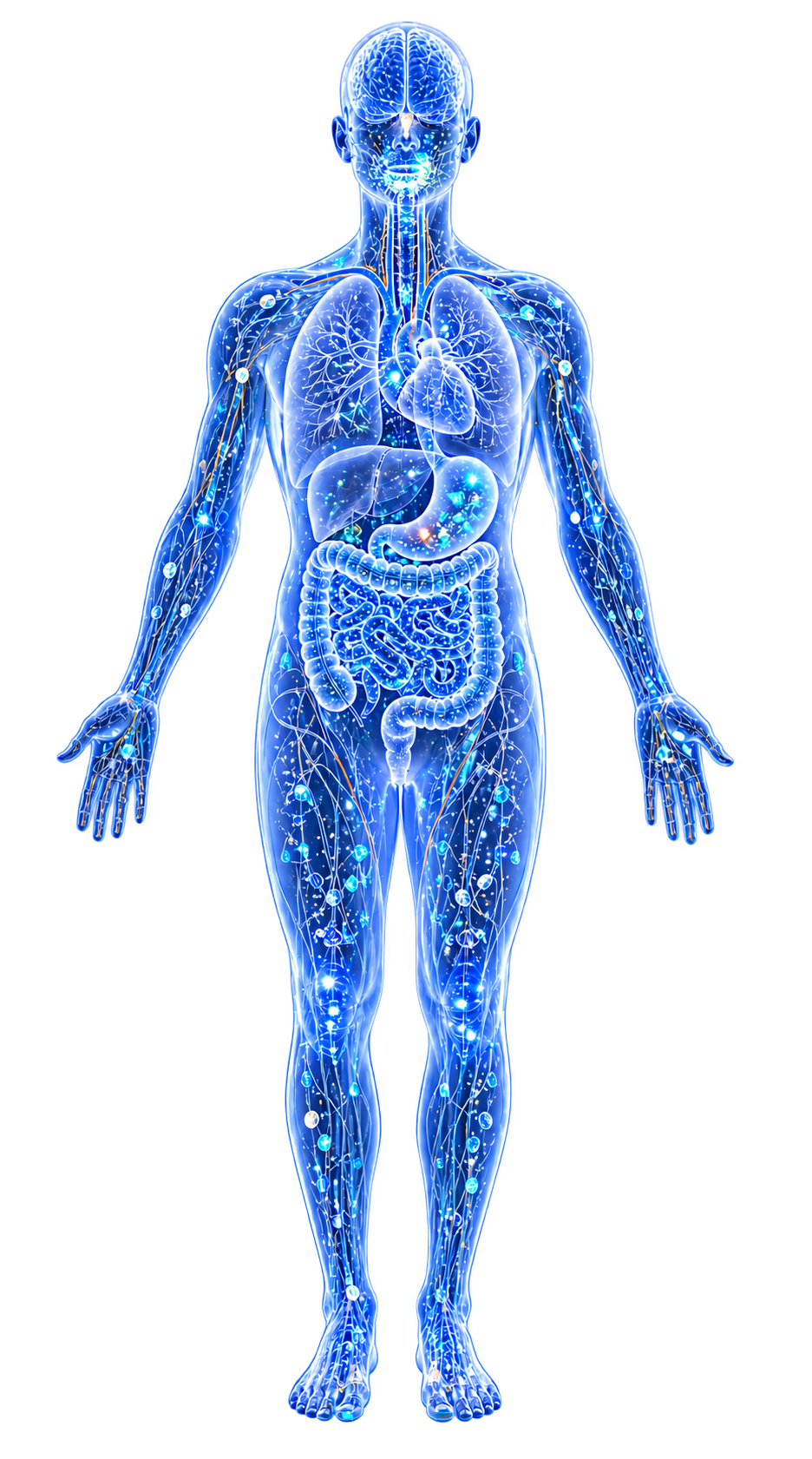
Iron occupies a unique position among dietary metals: it is both an essential nutrient and a selective pressure that shapes the gut microbial ecosystem.
The form, quantity, and bioavailability of dietary iron determines which microbes thrive and which are competitively excluded—making iron intake one of the most powerful dietary forces acting on gut ecology.
Evidence map4 cited passagesInspect provenance +
Gut iron availability determines which microbes dominate the ecosystem:
Iron-fortified processed foods—deliver non-heme iron in highly bioavailable forms (ferrous sulfate, ferrous fumarate) that flood the gut lumen. In populations with pre-existing dysbiosis, iron fortification can amplify pathobiont populations.
High-fat + low-fiber diet—creates the worst combination: high-fat diet increases iron absorption into liver and kidney, while low fiber starves butyrate-producing commensals. The resulting dysbiosis amplifies iron's pathogenic-selection effect.
Certain probiotic species can modify gut iron ecology:
Contents
1. Two Forms, Two Ecological Effects2. Iron as Microbial Selective Pressure3. The Siderophore Arms Race4. Diet Patterns and Iron Ecology5. Probiotics and Iron Ecology6. ConnectionsTwo Forms, Two Ecological Effects#
Dietary iron comes in two fundamentally different forms with different Gut Microbiome consequences:
Heme Iron (Animal Sources)#
Found in red meat, organ meats, poultry, and fish. Absorbed through the HCP1 receptor at 15-35% efficiency, largely independent of gut conditions.
High bioavailability means more iron reaches the systemic circulation. Heme iron is absorbed intact by enterocytes, bypassing the luminal competition between host and microbes. Less iron remains in the gut lumen for microbial use.
However, unabsorbed heme is metabolized by gut bacteria into cytotoxic free iron and reactive intermediates.
Non-Heme Iron (Plant Sources & Supplements)#
Found in legumes, grains, leafy greens, fortified foods, and iron supplements. Absorbed through DMT1 at 2-20% efficiency, heavily modified by meal composition.
Lower bioavailability means more iron remains in the gut lumen. Gut luminal iron becomes directly available to microbes. Non-heme iron absorption is enhanced by vitamin C, meat factor, and organic acids—and inhibited by phytates, polyphenols, calcium, and tannins.
Iron supplements deliver supraphysiological iron to the gut, dramatically shifting the microbial selective landscape.
Iron as Microbial Selective Pressure#
Gut iron availability determines which microbes dominate the ecosystem:[1]Mechanism of Iron Ion Homeostasis in Intestinal Immunity and Gut Microbiota RemodelingHonghong Bao, Yi Wang, Hanlin Xiong et al. · 2024Open reference 1 ↓
Iron-rich environment selects for. E. coli and Enterobacteriaceae—express siderophores (enterobactin, aerobactin, yersiniabactin) for aggressive iron acquisition. Bacteroides fragilis—iron piracy through heme-binding proteins. Salmonella—siderophore-dependent virulence.
Klebsiella—siderophore production linked to pathogenic potential.
Iron-restricted environment selects for. Lactobacillus species—iron-independent metabolism; dominate when iron is scarce. Bifidobacterium—adapted to low-iron niches; use lactoferrin-bound iron efficiently. Faecalibacterium prausnitzii—Butyrate producer favored in iron-restricted conditions.
This is Primitive 1 in action: dietary iron patterns select for tolerant/dependent organisms and reshape the entire gut community.
The Siderophore Arms Race#
When the host restricts iron (via Hepcidin, Lactoferrin, Calprotectin (S100A8/A9), Lipocalin-2), pathogenic bacteria respond with Siderophores—small molecules with extraordinary iron-binding affinity:
| Siderophore | Producing Organism | Iron Binding Affinity |
|---|---|---|
| Enterobactin | E. coli | 10⁵² M⁻¹ (strongest known) |
| Aerobactin | E. coli, Klebsiella | Lower affinity but secreted in higher quantities |
| Yersiniabactin | Yersinia, pathogenic E. coli | Also binds copper and zinc |
| Pyoverdine | Pseudomonas | Fluorescent; used for iron scavenging in biofilms |
The host counters with lipocalin-2, which specifically sequesters enterobactin. But pathogenic E. coli have evolved stealth siderophores (salmochelin—glucosylated enterobactin) that lipocalin-2 cannot recognize. This is an active evolutionary arms race playing out in the gut lumen.
Dietary iron tips the balance. Abundant luminal iron reduces the advantage of siderophore-producing organisms (iron is freely available, no need to scavenge). Iron restriction activates the arms race and gives siderophore-producers a competitive advantage—but also activates host counter-measures.
Oral iron supplementation provides abundant iron that bypasses host restriction mechanisms, giving pathobionts free substrate without triggering proportional host defenses.
Diet Patterns and Iron Ecology#
Different dietary patterns create distinct iron ecologies in the gut:
High red meat diet—delivers heme iron efficiently to the host but also provides unabsorbed heme to the gut lumen. Heme catabolism by gut bacteria generates free iron and N-nitroso compounds. Associated with increased Enterobacteriaceae and decreased F. prausnitzii.
High-fiber plant-based diet—delivers non-heme iron bound in phytate matrices that reduce bioavailability to both host and microbes. The fiber feeds butyrate producers (Lachnospiraceae, Roseburia) that thrive in low-iron conditions. This dietary pattern tends to favor a more diverse, commensal-dominated gut ecology.
Iron-fortified processed foods—deliver non-heme iron in highly bioavailable forms (ferrous sulfate, ferrous fumarate) that flood the gut lumen. In populations with pre-existing Dysbiosis, iron fortification can amplify pathobiont populations.[2]Gut Microbiota: A Target for Heavy Metal Toxicity and a Probiotic Protective StrategyHui Duan, Leilei Yu, Fengwei Tian et al. · 2020Open reference 2 ↓
High-fat + low-fiber diet—creates the worst combination: high-fat diet increases iron absorption into liver and kidney, while low fiber starves butyrate-producing commensals. The resulting dysbiosis amplifies iron's pathogenic-selection effect.[3]High-fat diet affects heavy metal accumulation and toxicity to mice liver and kidney probably via gut microbiotaLiu T, Liang X, Lei C et al. · 2020Open reference 3 ↓
Probiotics and Iron Ecology#
Certain probiotic species can modify gut iron ecology.[4]Heavy Metal-Gut Microbiota Interactions: Probiotics Modulation and Biosensors DetectionLiliana Anchidin-Norocel, Oana C. Iatcu, Andrei Lobiuc et al. · 2025Open reference 4 ↓
Lactobacillus species can reduce free iron availability through surface binding and intracellular sequestration. Bifidobacterium species compete effectively in low-iron niches, potentially displacing siderophore-producing pathogens. Saccharomyces species can bind Heavy Metals including iron at the cell wall.
These organisms provide competitive exclusion (Primitive 5)—suppressing pathogens not by killing them but by denying them resources.
Connections#
- Iron—the metal entity page
- Nutritional Immunity (Metal Sequestration)—host iron restriction as defense strategy
- —microbial iron acquisition systems
- Hepcidin—master iron regulator; elevated in disease states
- Lactoferrin—iron-chelating host defense protein
- Lipocalin-2—host counter-measure against bacterial siderophores
- Gut-Metal-Microbiome Interactions—metals as ecological determinants of gut composition
- Dietary Cadmium Exposure—iron deficiency increases cadmium absorption
- Dietary Lead Exposure—iron deficiency increases lead absorption
References 4
Numbered by first appearance in the article, then reconciled with its declared source list.
- 1
★Honghong Bao, Yi Wang, Hanlin Xiong et al. (2024). Mechanism of Iron Ion Homeostasis in Intestinal Immunity and Gut Microbiota Remodeling. International Journal of Molecular Sciences.
- 2
★Hui Duan, Leilei Yu, Fengwei Tian et al. (2020). Gut Microbiota: A Target for Heavy Metal Toxicity and a Probiotic Protective Strategy. Science of the Total Environment.
- 3
Liu T, Liang X, Lei C et al. (2020). High-fat diet affects heavy metal accumulation and toxicity to mice liver and kidney probably via gut microbiota. Frontiers in Microbiology.
- 4
★Liliana Anchidin-Norocel, Oana C. Iatcu, Andrei Lobiuc et al. (2025). Heavy Metal-Gut Microbiota Interactions: Probiotics Modulation and Biosensors Detection. Biosensors.
Article network
Mentioned here 18
Pages linking here 4
Connect the evidence
Publicly readable discussion by ORCID-authenticated researchers. Questions, interpretation, methods, corrections, and new evidence stay attached to this record.
No discussion yet. Start with a precise question or a source-backed observation.
Activity and accepted changes
Accepted researcher context, editorial status, public discussion, and upstream Git revisions are shown together. Pending, declined, and withdrawn proposals remain private.
- published revision
Backfill heavy metals concept links
Karen Pendergrass · +1 −1
Inspect exact Git diff ↗ - published revision
Backfill gut microbiome concept links
Karen Pendergrass · +1 −1
Inspect exact Git diff ↗ - published revision
Complete corpus-wide Dysbiosis linking
Karen Pendergrass · +1 −1
Inspect exact Git diff ↗ - published revision
massive wiki expansion: 149 stubs fixed, 100+ new pages, Rule 15 scan, keystone papers
WikiBiome Deploy Bot · +27 −27
Inspect exact Git diff ↗ - published revision
nightly maintenance: 94 stub demotions, 181 source_count fixes, 22 auto-discovered stubs, 5 adversarial audits, 3 boundary fixes, 3 evidence-level corrections
WikiBiome Deploy Bot · +1 −0
Inspect exact Git diff ↗ - published revision
pre-overnight checkpoint 2026-04-18
WikiBiome Deploy Bot · +3 −0
Inspect exact Git diff ↗ - published revision
WikiBiome update — 2026-04-15 17:23
WikiBiome Deploy Bot · +3 −3
Inspect exact Git diff ↗ - published revision
WikiBiome update — integrity fixes, metallomic diet pages, cross-condition analyses
WikiBiome Deploy Bot · +99 −0
Inspect exact Git diff ↗