
 metals · microbes · host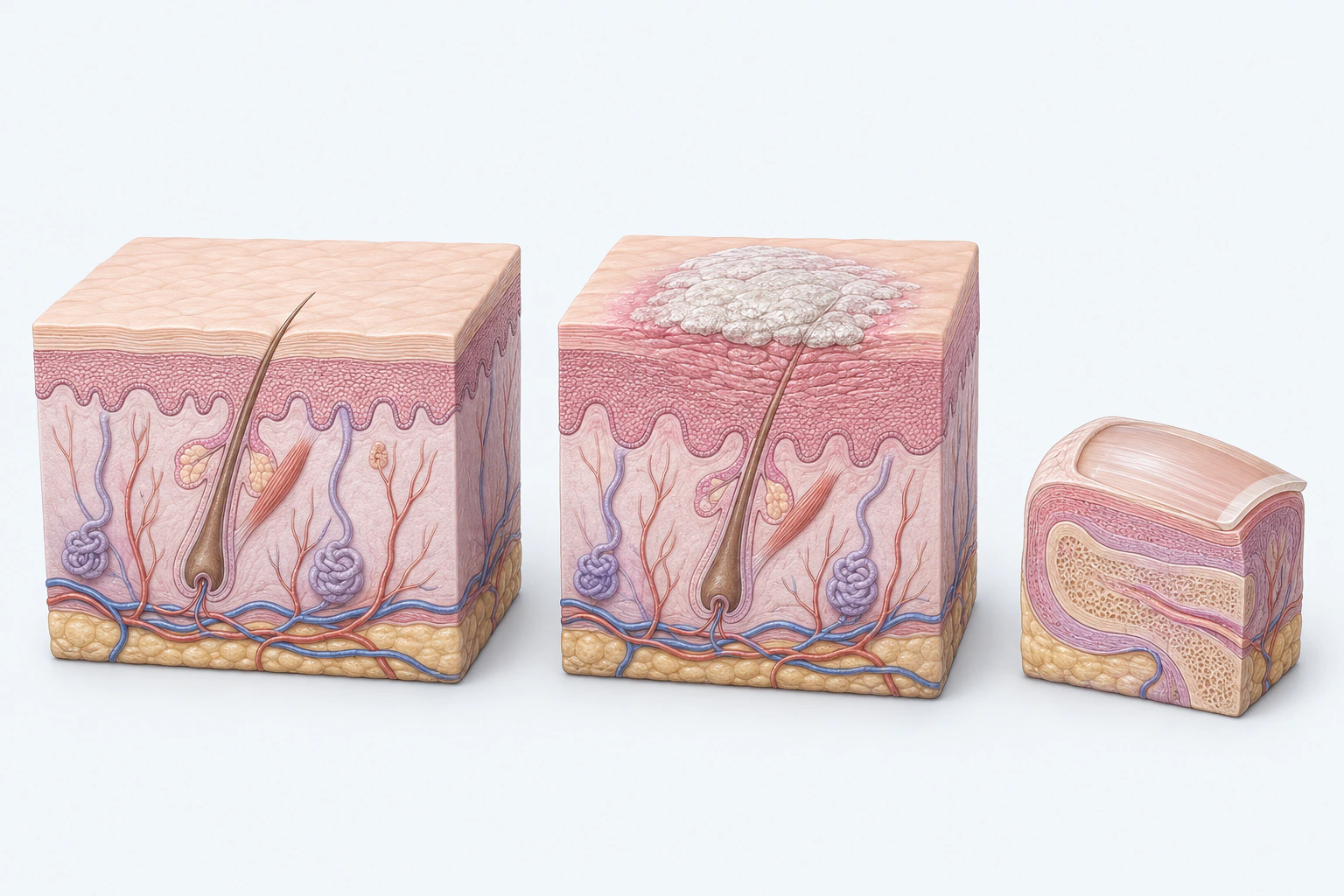
Psoriasis orientation without patient identity, skin-tone, subtype, distribution, cause, severity, prognosis, or diagnostic claims.
Scientific media record1 verified identifier
- Subject
- Psoriasiscondition
- Identifiers
- MeSH:D011565
- Review
- Editorial review completeIdentifiers authority-verified · Accessibility validated · · psoriasis|psoriasis-pathology-v1.webp
- Digital source
- Trained-algorithmic mediaCreated with a trained generative algorithm and reviewed by WikiBiome for subject identity, scientific framing, identifiers, provenance, and accessibility.
- Scientific basis
- Psoriasis — MeSHPsoriasis
- License
- CC BY-SA 4.0Created
Psoriasis is a chronic, immune-mediated inflammatory skin disease characterized by keratinocyte hyperproliferation, resulting in well-demarcated erythematous plaques with silvery scales.
Affecting approximately 2-3% of the global population, psoriasis is now understood as a systemic inflammatory condition rather than merely a skin disease—it associates strongly with Cardiovascular Disease, Type 2 Diabetes, Depression, and Inflammatory Bowel Disease (IBD), sharing inflammatory pathways and microbiome signatures with all of these conditions.
The IL-17/IL-23 axis is the central immunological driver, with Th17 cells producing IL-17A/F that stimulates keratinocyte proliferation and recruits neutrophils to the epidermis.
What WikiBiome adds to this picture is the recognition that the Gut Microbiome regulates Th17/Treg balance, that metals modulate immune polarization, and that the gut-skin axis creates a systemic inflammatory circuit.
Evidence map3 cited passagesInspect provenance +
Blood DNA virome analysis reveals altered viral signatures in autoimmune diseases including psoriasis, suggesting viral components of the microbiome may contribute to immune dysregulation.
host-microbiome interactions across immune-mediated conditions
virome alterations in autoimmune disease
One disease. Five evidence layers.
A generated systems view of the metals, organisms, host sequestration signals, ecological conditions, and microbial functions indexed for Psoriasis.
Evidence layer
Taxonomic signature
Organisms reported as enriched or depleted, with their indexed functional context kept beside the name.No structured taxa indexed yet.
No structured taxa indexed yet.
Evidence layer
Nutritional immunity
Host metal-withholding, inflammatory, antioxidant, and microbial-metabolite signals indexed in the signature.Elevated host signals
0No structured signals indexed yet.
Depleted protective signals
0No structured signals indexed yet.
Evidence layer
Ecological state
The environmental conditions that connect the organism-level observations into a system.No structured ecological features indexed yet.
Evidence layer
Virulence functions
Microbial structures, enzymes, and acquisition systems implicated by the linked evidence.No structured virulence functions indexed yet.
The disease record, in full.
The original WikiBiome disease narrative remains intact beneath the generated signature atlas.
The Gut-Skin Axis#
Psoriasis demonstrates a robust gut-skin axis—a bidirectional communication pathway linking intestinal and cutaneous Metal-Driven Inflammation:
Gut to Skin#
- Gut Dysbiosis reduces SCFA production and Butyrate-mediated Treg induction
- Impaired barrier allows LPS and microbial antigens to reach systemic circulation
- Systemic IL-17/IL-23 activation—gut-primed Th17 cells migrate to skin via CCR6/CCL20 homing
- Keratinocyte activation—IL-17A drives keratinocyte proliferation, antimicrobial peptide production, and neutrophil recruitment
- Plaque formation—the visible manifestation of systemic immune dysregulation
Skin to Gut#
Psoriatic skin lesions produce systemic cytokines (TNF-alpha, IL-6) that alter gut permeability. Biologic therapies targeting TNF-alpha or IL-17 improve both skin and gut symptoms, confirming shared pathways.
Microbiome Associations#
Gut Microbiome#
Psoriasis patients show gut microbiome changes that overlap with other inflammatory conditions:
- Depleted: Faecalibacterium prausnitzii, Bifidobacterium, Akkermansia—anti-inflammatory, SCFA-producing taxa
- Enriched: Escherichia coli, certain Bacteroides species, Proteobacteria
- Functional: Reduced butyrate production, increased LPS biosynthesis, altered tryptophan metabolism
The depletion of F. prausnitzii is shared with Inflammatory Bowel Disease (IBD), Depression, and Cardiovascular Disease—suggesting a common anti-inflammatory "anchor species" whose loss enables Th17-dominant inflammation.
Skin Microbiome#
Psoriatic plaques have a distinct cutaneous microbiome. Enriched: Streptococcus, Staphylococcus aureus, Corynebacterium. Depleted: Cutibacterium (formerly Propionibacterium) acnes—a paradox since C. acnes is associated with acne but appears protective in psoriasis.
Streptococcal throat infections are well-known triggers of guttate psoriasis, linking the pharyngeal microbiome to skin flares.
Virome#
Blood DNA virome analysis reveals altered viral signatures in autoimmune diseases including psoriasis,[1]Blood DNA Virome Associates with Autoimmune Diseases and COVID-19Parrish NF, Okada Y, et al. · 2025Open reference 1 ↓ suggesting viral components of the microbiome may contribute to immune dysregulation.
Metal Associations#
Nickel and the Koebner Phenomenon#
The Koebner phenomenon—development of psoriatic lesions at sites of skin trauma—has a metal-immune dimension.
Nickel contact can trigger psoriatic flares in sensitized individuals. Nickel directly activates TLR4 (human-specific), which feeds into the NF-kB → IL-23 → IL-17 cascade. Nickel allergy prevalence is elevated in psoriasis patients compared to controls.
Occupational nickel exposure may be an underrecognized trigger.
Copper/Zinc Ratio#
Copper is often elevated in psoriasis, reflecting systemic inflammation (ceruloplasmin is an acute-phase reactant). Zinc is frequently depleted; zinc deficiency impairs keratinocyte differentiation and wound healing. The copper (Cu)/zinc (Zn) ratio is elevated, similar to the pattern in Schizophrenia, Bipolar Disorder, and other inflammatory conditions.
Zinc is a cofactor for the nuclear hormone receptors (VDR, RAR) targeted by psoriasis treatments (vitamin D analogs, retinoids).
Iron#
- Iron dysregulation with elevated ferritin (acute-phase response) is common
- The Th17-dominant immune state can drive hepcidin production, creating functional iron deficiency
- This mirrors the Nutritional Immunity (Metal Sequestration) response seen in infectious conditions
Associated Conditions#
Psoriasis has extensive comorbidity that shares microbiome and metallomic features:
| Condition | Shared Pathway | Prevalence in Psoriasis |
|---|---|---|
| Psoriatic arthritis | IL-17/IL-23 axis | 30% of psoriasis patients |
| Cardiovascular Disease | Systemic inflammation, Faecalibacterium depletion | 1.5-2x risk |
| Type 2 Diabetes | Insulin resistance, gut dysbiosis | 2x risk |
| Depression | Gut-brain axis, tryptophan diversion | 20-30% comorbidity |
| Inflammatory Bowel Disease (IBD) | Shared Th17 pathway, Faecalibacterium loss | 3-4x risk |
Open Questions#
Unresolved questions identified by the current evidence record.
01Can gut microbiome restoration reduce psoriasis severity (FMT or targeted probiotics)?+
The current WikiBiome record identifies this as an unresolved evidence gap.
02Does nickel avoidance improve outcomes in nickel-sensitized psoriasis patients?+
The current WikiBiome record identifies this as an unresolved evidence gap.
03Is the copper (Cu)/zinc (Zn) ratio a useful biomarker for psoriasis disease activity?+
The current WikiBiome record identifies this as an unresolved evidence gap.
04Can zinc supplementation enhance response to biologic therapy?+
The current WikiBiome record identifies this as an unresolved evidence gap.
05Does the blood virome normalize with effective psoriasis treatment?+
The current WikiBiome record identifies this as an unresolved evidence gap.
Key Studies#
- [2]Emerging Role of the Host Microbiome in Neuropsychiatric Disorders: Overview and Future DirectionsHashimoto K · 2023Open reference 2 ↓—host-microbiome interactions across immune-mediated conditions
- [1]Blood DNA Virome Associates with Autoimmune Diseases and COVID-19Parrish NF, Okada Y, et al. · 2025Open reference 1 ↓—virome alterations in autoimmune disease
Cross-References#
- Inflammatory Bowel Disease (IBD)—shared Th17 pathway and taxa depletion
- Cardiovascular Disease—shared systemic inflammation
- Nickel Allergy and Allergic Contact Dermatitis—TLR4-mediated immune trigger
- Toll-Like Receptors—innate immune activation
- butyrate—depleted anti-inflammatory SCFA
- Immune Balance—Th17/Treg dysregulation
References 4
Numbered by first appearance in the article, then reconciled with its declared source list.
- 1
Parrish NF, Okada Y, et al. (2025). Blood DNA Virome Associates with Autoimmune Diseases and COVID-19. Nature Genetics.
- 2
Hashimoto K (2023). Emerging Role of the Host Microbiome in Neuropsychiatric Disorders: Overview and Future Directions. Molecular Psychiatry.
- 3
Calabrese L (2025). Remission of OCD and Ulcerative Colitis with a Ketogenic Diet: Case Report. Frontiers in Psychiatry.
- 4
Gellan K Ahmed, Haidi Karam-Allah Ramadan, Khaled Elbeh et al. (2024). Ahmed 2024 — The Role of Infections and Inflammation in Schizophrenia: Review of the Evidence. Middle East Current Psychiatry.
Article network
Mentioned here 18
Connect the evidence
Publicly readable discussion by ORCID-authenticated researchers. Questions, interpretation, methods, corrections, and new evidence stay attached to this record.
No discussion yet. Start with a precise question or a source-backed observation.
Activity and accepted changes
Accepted researcher context, editorial status, public discussion, and upstream Git revisions are shown together. Pending, declined, and withdrawn proposals remain private.
- published revision
Backfill gut microbiome concept links
Karen Pendergrass · +1 −1
Inspect exact Git diff ↗ - published revision
Backfill inflammation concept links
Karen Pendergrass · +1 −1
Inspect exact Git diff ↗ - published revision
Complete corpus-wide Dysbiosis linking
Karen Pendergrass · +1 −1
Inspect exact Git diff ↗ - published revision
massive wiki expansion: 149 stubs fixed, 100+ new pages, Rule 15 scan, keystone papers
WikiBiome Deploy Bot · +26 −24
Inspect exact Git diff ↗ - published revision
nightly maintenance: 94 stub demotions, 181 source_count fixes, 22 auto-discovered stubs, 5 adversarial audits, 3 boundary fixes, 3 evidence-level corrections
WikiBiome Deploy Bot · +2 −0
Inspect exact Git diff ↗ - published revision
pre-overnight checkpoint 2026-04-18
WikiBiome Deploy Bot · +124 −0
Inspect exact Git diff ↗