
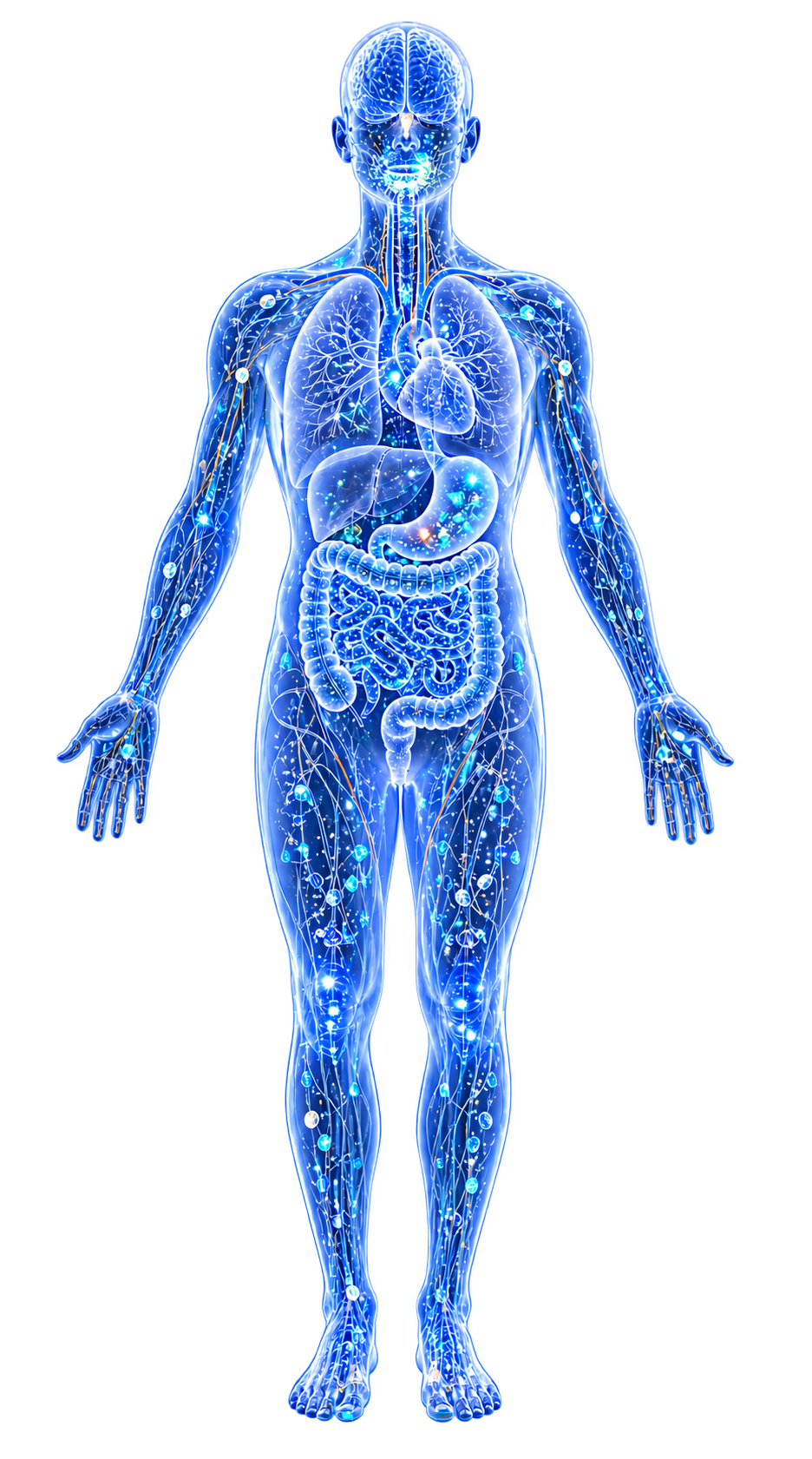
Toll-like receptors (TLRs) are a family of pattern recognition receptors (PRRs) that form the front line of the innate immune system. They detect conserved molecular patterns from microbes—pathogen-associated molecular patterns (PAMPs)—and damage-associated molecular patterns (DAMPs) from injured host tissue.
In the gut, TLRs are the molecular interface between the microbiome and the immune system, continuously sampling luminal contents and calibrating inflammatory responses.
What makes TLRs distinctive in the WikiBiome framework is their dual role as microbe sensors and metal responders. Nickel directly activates TLR4 in a human-specific manner, and metal-induced tissue damage generates DAMPs that trigger TLR signaling. This positions TLRs at the intersection of metallomics, microbiology, and immunology.
Evidence map4 cited passagesInspect provenance +
| Receptor | Location | Ligand | Microbial Source | Metal Connection | |----------|----------|--------|-----------------|-----------------| | TLR1/2 | Cell surface | Triacyl lipopeptides | Gram-positive bacteria |—| | TLR2 | Cell surface | Lipoteichoic acid, zymosan | Gram-positives, fungi | Barrier integrity in esophageal dysbiosis | | TLR3 | Endosomal |
TLR4 is covered in depth on its own page, but its significance warrants summary here. TLR4 is the canonical receptor for many forms of bacterial lipopolysaccharide (LPS) and is directly activated by nickel through histidine residues (H456, H458) unique to the human receptor. This means:
TLR2 plays a protective role in maintaining epithelial barrier integrity. In the esophagus, dysbiosis with loss of normal flora disrupts TLR2 signaling, contributing to barrier breakdown in gastroesophageal reflux disease. This is a counterpoint to the pro-inflammatory reputation of TLRs: TLR2 activation by commensal-derived lipoteichoic acid actually streng
The Parkinson's disease gut-brain connection is partially mediated through TLR signaling:
Contents
1. The TLR Family2. TLR4: The Metal-Responsive Sentinel3. TLR2: Barrier Integrity and Esophageal Dysbiosis4. TLRs in the Gut-Brain Axis5. Metal Activation of TLRs6. TLR Signaling Downstream7. TLR Modulators from the Microbiome8. Open Questions9. Cross-ReferencesThe TLR Family#
| Receptor | Location | Ligand | Microbial Source | Metal Connection |
|---|---|---|---|---|
| TLR1/2 | Cell surface | Triacyl lipopeptides | Gram-positive bacteria | — |
| TLR2 | Cell surface | Lipoteichoic acid, zymosan | Gram-positives, fungi | Barrier integrity in esophageal Dysbiosis[1]Esophageal microbial dysbiosis impairs mucosal barrier integrity via toll-like receptor 2 pathway in patients with gastroesophageal reflux symptomsChen S, Jiang D, Zhuang Q et al. · 2024Open reference 1 ↓ |
| TLR3 | Endosomal | dsRNA | Viruses | — |
| TLR4 | Cell surface | LPS | Gram-negative bacteria | Nickel direct activation (human-specific)[2]Nickel Allergy and Allergic Contact Dermatitis: A Clinical ReviewAhlström MG, Thyssen JP, Wennervaldt M et al. · 2019Open reference 2 ↓ |
| TLR5 | Cell surface | Flagellin | Motile bacteria | — |
| TLR7/8 | Endosomal | ssRNA | Viruses | — |
| TLR9 | Endosomal | CpG DNA | Bacteria, viruses | — |
TLR4: The Metal-Responsive Sentinel#
TLR4 is covered in depth on its own page, but its significance warrants summary here. TLR4 is the canonical receptor for many forms of bacterial lipopolysaccharide (LPS) and is directly activated by nickel through Histidine residues (H456, H458) unique to the human receptor.[2]Nickel Allergy and Allergic Contact Dermatitis: A Clinical ReviewAhlström MG, Thyssen JP, Wennervaldt M et al. · 2019Open reference 2 ↓ This means.
Dietary nickel can trigger innate immune activation without any microbial involvement. Mouse models fail to recapitulate nickel-driven Metal-Driven Inflammation because murine TLR4 lacks these histidine residues. Nickel allergy (affecting ~15% of humans) is fundamentally a TLR4-mediated response.
The combination of nickel exposure and Gram-negative dysbiosis (LPS source) creates additive TLR4 activation.
TLR2: Barrier Integrity and Esophageal Dysbiosis#
TLR2 plays a protective role in maintaining epithelial barrier integrity. In the esophagus, dysbiosis with loss of normal flora disrupts TLR2 signaling, contributing to barrier breakdown in gastroesophageal reflux disease.[1]Esophageal microbial dysbiosis impairs mucosal barrier integrity via toll-like receptor 2 pathway in patients with gastroesophageal reflux symptomsChen S, Jiang D, Zhuang Q et al. · 2024Open reference 1 ↓
This is a counterpoint to the pro-inflammatory reputation of TLRs: TLR2 activation by commensal-derived lipoteichoic acid actually strengthens tight junctions.
TLRs in the Gut-Brain Axis#
The Parkinson's disease gut-brain connection is partially mediated through TLR signaling:[3]Perez-Pardo 2022 -- How Toll-Like Receptors Influence Parkinson's Disease in the Microbiome-Gut-Brain AxisPaula Perez-Pardo, Mitch Hartog, Aletta D Kraneveld · 2022Open reference 3 ↓
- Gut dysbiosis increases luminal LPS and other TLR ligands
- Enteric TLR activation drives local inflammation and barrier dysfunction
- Alpha-Synuclein aggregation in the enteric nervous system
- Vagal nerve transmission of inflammatory signals to the brainstem
- Microglial TLR4 activation by alpha-synuclein aggregates in the brain
- Neuroinflammation and dopaminergic neuron death
This cascade illustrates how TLRs function as relay stations in the gut-brain axis, converting microbial signals into neural and immune responses.
Metal Activation of TLRs#
Beyond nickel's direct TLR4 activation, metals influence TLR signaling through several mechanisms. Cadmium aggravates TLR4/NF-kB signaling in diabetic nephropathy, attenuated by zinc + curcumin. Iron overload generates DAMPs (HMGB1, free heme) that activate TLR4.
Zinc deficiency impairs TLR-mediated immune responses and increases susceptibility to infection.
Copper excess generates ROS that produce DAMPs activating TLR2 and TLR4.
TLR Signaling Downstream#
All TLRs signal through two major pathways:
MyD88-Dependent (All TLRs except TLR3)#
- IRAK1/4 → TRAF6 → TAK1 → NF-kB activation
- Produces TNF-alpha, IL-1beta, IL-6, IL-8, COX-2
- Rapid inflammatory response (minutes to hours)
TRIF-Dependent (TLR3, TLR4)#
- TRIF → TRAF3 → IRF3 activation
- Produces Type I interferons (IFN-alpha, IFN-beta)
- Antiviral defense and adaptive immune priming
The NF-kB pathway is the critical node: it is the convergence point for TLR signaling, metal-induced stress, and Oxidative Stress, making it the master switch for inflammation in conditions throughout the WikiBiome knowledge graph.
TLR Modulators from the Microbiome#
The microbiome itself produces both TLR activators and suppressors:
| Modulator | Source | TLR Target | Effect |
|---|---|---|---|
| LPS | Proteobacteria (Pseudomonadota) | TLR4 | Pro-inflammatory activation |
| Lipoteichoic acid | Gram-positive commensals | TLR2 | Barrier-protective |
| Butyrate | Clostridia, Firmicutes | TLR4/MyD88 | Suppresses signaling |
| Polysaccharide A | Bacteroides fragilis | TLR2 | Anti-inflammatory (IL-10 induction) |
| Flagellin | Motile bacteria | TLR5 | Context-dependent |
Open Questions#
Unresolved questions identified by the current evidence record.
01Does chronic low-level nickel exposure (dietary) cause subclinical TLR4 activation measurable as elevated inflammatory markers?+
The current WikiBiome record identifies this as an unresolved evidence gap.
02Can TLR2-activating probiotics restore esophageal barrier integrity in GERD?+
The current WikiBiome record identifies this as an unresolved evidence gap.
03How do metal mixtures (nickel (Ni) + cadmium (Cd) + lead (Pb)) interact at the TLR4 level—additive or synergistic?+
The current WikiBiome record identifies this as an unresolved evidence gap.
04Is TLR expression in the gut a biomarker for microbiome-driven inflammation?+
The current WikiBiome record identifies this as an unresolved evidence gap.
Cross-References#
- TLR4—detailed receptor biology and disease connections
- Nickel Allergy and Allergic Contact Dermatitis—TLR4-mediated contact allergy
- Neuroinflammation—TLR-driven brain inflammation
- Bacterial Contamination Hypothesis—TLR4/LPS in endometriosis
- inflammation—NF-kB as convergence node
- Alpha-Synuclein—TLR4 ligand in neurodegeneration
References 3
Numbered by first appearance in the article, then reconciled with its declared source list.
- 1
Chen S, Jiang D, Zhuang Q et al. (2024). Esophageal microbial dysbiosis impairs mucosal barrier integrity via toll-like receptor 2 pathway in patients with gastroesophageal reflux symptoms. Journal of Translational Medicine.
- 2
Ahlström MG, Thyssen JP, Wennervaldt M et al. (2019). Nickel Allergy and Allergic Contact Dermatitis: A Clinical Review. Contact Dermatitis.
- 3
Paula Perez-Pardo, Mitch Hartog, Aletta D Kraneveld (2022). Perez-Pardo 2022 -- How Toll-Like Receptors Influence Parkinson's Disease in the Microbiome-Gut-Brain Axis. Frontiers in Immunology.
Article network
Mentioned here 15
Pages linking here 6
Connect the evidence
Publicly readable discussion by ORCID-authenticated researchers. Questions, interpretation, methods, corrections, and new evidence stay attached to this record.
No discussion yet. Start with a precise question or a source-backed observation.
Published page changes
This record shows only material changes published on this page, including changes to its content, evidence, conclusions, or author context. Internal processes and discussion activity are excluded. Pending, declined, and withdrawn proposals remain private.
- published revision
Revised “TLR4: The Metal-Responsive Sentinel”: now reads “covered in depth on its own page, but its significance warrants summary here. TLR4 is the canonical receptor for many forms of bacterial lipopolysaccharide (LPS) and is directly”.
Revised “TLR4: The Metal-Responsive Sentinel”: changed “covered in depth on its own page (tlr4), but its significance warrants summary here. TLR4 is the primary receptor for bacterial lipopolysaccharide (LPS) and is directly” to “covered in depth on its own page, but its significance warrants summary here. TLR4 is the canonical receptor for many forms of bacterial lipopolysaccharide (LPS) and is directly”. Revised “Cross-References”: changed “- tlr4 -- detailed TLR4 biology and disease connections - nickel” to “- TLR4 -- detailed receptor biology and disease connections - nickel”. · Karen Pendergrass · +4 −4
Inspect exact Git diff ↗ - published revision
Created “Toll-Like Receptors”: Toll-like receptors (TLRs) are a family of pattern recognition receptors (PRRs) that form the front line of the innate immune system. They detect conserved molecular patterns from microbes --…
Created “Toll-Like Receptors”: Toll-like receptors (TLRs) are a family of pattern recognition receptors (PRRs) that form the front line of the innate immune system. They detect conserved molecular patterns from microbes --… Published sections: Overview; The TLR Family; TLR4: The Metal-Responsive Sentinel; TLR2: Barrier Integrity and Esophageal Dysbiosis; TLRs in the Gut-Brain Axis; Metal Activation of TLRs; TLR Signaling Downstream; MyD88-Dependent (All TLRs except TLR3); TRIF-Dependent (TLR3, TLR4); TLR Modulators from the Microbiome; Open Questions; Cross-References. · WikiBiome Deploy Bot · +112 −0
Inspect exact Git diff ↗