

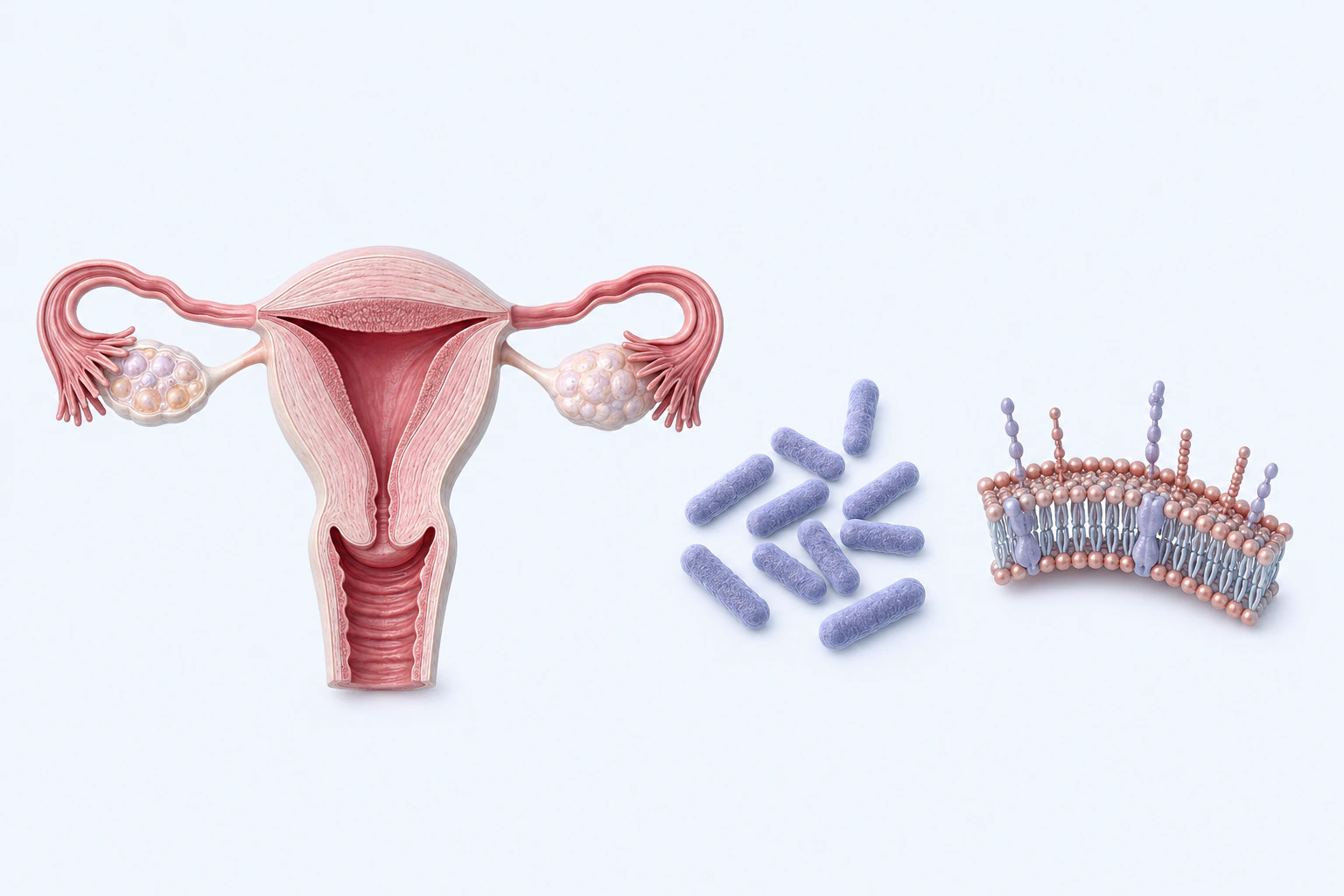
Components discussed by the bacterial contamination hypothesis in endometriosis. Their separation does not prove contamination, identify a bacterial species, show an anatomical route, establish signaling or causation, or provide diagnostic or treatment guidance.
Scientific media record2 verified identifiers
- Subject
- Bacterial Contamination Hypothesisbiological-process
- Review
- Editorial review completeIdentifiers authority-verified · Accessibility validated · · bacterial-contamination-hypothesis|bacterial-contamination-hypothesis-mechanism-v1.webp
- Digital source
- Trained-algorithmic mediaCreated with a trained generative algorithm and reviewed by WikiBiome for subject identity, scientific framing, identifiers, provenance, and accessibility.
- Scientific basis
- Bacterial contamination hypothesis: a new concept in endometriosisBacterial Contamination Hypothesis
- License
- CC BY-SA 4.0Created
The bacterial contamination hypothesis proposes that bacterial endotoxin (LPS) contamination of menstrual blood and endometrial tissue is a key driver of endometriosis pathogenesis.
First formalized by Khan et al. (2018), this hypothesis shifts endometriosis from a purely hormonal or immunological disease to one with a significant microbial component—and connects it to WikiBiome's core themes of metal-microbe interaction and ecological disruption.
The central claim: Escherichia coli contamination of menstrual blood activates the LPS/TLR4/NF-kB inflammatory cascade in endometriotic tissue, driving growth factor production, angiogenesis, and lesion proliferation. Iron accumulation in the peritoneal environment synergizes with this bacterial contamination, creating a self-reinforcing cycle of Metal-Driven Inflammation and pathogen expansion.
Evidence map9 cited passagesInspect provenance +
LPS concentration in menstrual fluid is 4-6x higher in endometriosis patients vs. controls.
E. coli is "highly contaminated" in menstrual blood and endometrial samples from endometriosis patients.
PGE2 promotes E. coli growth in menstrual blood, creating a cyclical amplification: inflammation → PGE2 → bacterial growth → more LPS → more inflammation.
Anti-TLR4 antibody blocked LPS-stimulated endometriotic cell proliferation, confirming this pathway is functionally required for the bacterial contamination effect.
Vaginal pH shifted to 4.5 in 79.3% of endometriosis patients vs. 58.4% of controls, indicating loss of Lactobacillus dominance and shift toward a polymicrobial state.
Multi-site microbial signatures (oral, vaginal, stool) distinguish endometriosis patients from controls.
GnRHa treatment (a standard endometriosis therapy) worsened intrauterine microbial colonization, suggesting some treatments may exacerbate the contamination problem.
Peritoneal fluid and ovarian endometrioma tissue harbor distinct microbial communities.
Inflammatory cytokines in peritoneal fluid correlate with peritoneal microbial composition.
Contents
1. Key Evidence2. The Iron-Bacterial Contamination Synergy3. Connection to the Estrobolome4. Clinical Implications5. Open Questions6. Cross-ReferencesKey Evidence#
LPS in Menstrual Blood#
LPS concentration in menstrual fluid is 4-6x higher in endometriosis patients vs. controls.[1]Bacterial contamination hypothesis: a new concept in endometriosisKhan KN, Fujishita A, Hiraki K et al. · 2018Open reference 1 ↓ E. coli is "highly contaminated" in menstrual blood and endometrial samples from endometriosis patients.[2]Molecular detection of intrauterine microbial colonization in women with endometriosisKhan KN, Fujishita A, Masumoto H et al. · 2016Open reference 2 ↓
PGE2 promotes E. coli growth in menstrual blood, creating a cyclical amplification: inflammation → PGE2 → bacterial growth → more LPS → more inflammation.[1]Bacterial contamination hypothesis: a new concept in endometriosisKhan KN, Fujishita A, Hiraki K et al. · 2018Open reference 1 ↓
LPS/TLR4/NF-kB Signaling Cascade#
LPS binding to TLR4 on endometriotic cells activates NF-kB, which drives production of. HGF (hepatocyte growth factor)—promotes cell proliferation. VEGF (vascular endothelial growth factor)—drives angiogenesis.
IL-6, IL-8, TNF-alpha—pro-inflammatory cytokines maintaining the inflammatory microenvironment.
Anti-TLR4 antibody blocked LPS-stimulated endometriotic cell proliferation, confirming this pathway is functionally required for the bacterial contamination effect.[1]Bacterial contamination hypothesis: a new concept in endometriosisKhan KN, Fujishita A, Hiraki K et al. · 2018Open reference 1 ↓
Vaginal Microbiome Dysbiosis#
Vaginal pH shifted to >4.5 in 79.3% of endometriosis patients vs. 58.4% of controls, indicating loss of Lactobacillus dominance and shift toward a polymicrobial state.[3]The Vaginal Microbiome as a Tool to Predict rASRM Stage of Disease in Endometriosis: a Pilot StudyPerrotta AR, Borrelli GM, Martins CO et al. · 2020Open reference 3 ↓
Multi-site microbial signatures (oral, vaginal, stool) distinguish endometriosis patients from controls.[4]Hicks et al. 2025 — Oral, Vaginal, and Stool Microbial Signatures in Patients With Endometriosis as Potential Diagnostic Non-Invasive BiomarkersChloe Hicks, Mathew Leonardi, Xin-Yi Chua et al. · 2025Open reference 4 ↓
GnRHa treatment (a standard endometriosis therapy) worsened intrauterine microbial colonization, suggesting some treatments may exacerbate the contamination problem.[2]Molecular detection of intrauterine microbial colonization in women with endometriosisKhan KN, Fujishita A, Masumoto H et al. · 2016Open reference 2 ↓
Peritoneal Microbiota#
Peritoneal fluid and ovarian endometrioma tissue harbor distinct microbial communities.[5]Altered Composition of Microbiota in Women with Ovarian Endometrioma: Microbiome Analyses of Extracellular Vesicles in the Peritoneal FluidLee SR, Lee JC, Kim SH et al. · 2021Open reference 5 ↓ Inflammatory cytokines in peritoneal fluid correlate with peritoneal microbial composition.[6]Inflammatory cytokines IL-6, IL-10, IL-13, TNF-alpha and peritoneal fluid flora were associated with infertility in patients with endometriosisWang XM, Ma ZY, Song N · 2018Open reference 6 ↓
The Iron-Bacterial Contamination Synergy#
This is where the bacterial contamination hypothesis connects to WikiBiome's metallomics framework. Iron accumulates in endometriotic fluid from retrograde menstruation and local hemorrhage.
Free iron in the peritoneal cavity is both directly inflammatory (Fenton reaction → ROS) and a growth factor for siderophore-producing bacteria like E. coli.
E. coli encodes high-affinity siderophore systems (enterobactin, yersiniabactin) that scavenge iron from the host environment.
The result is a self-reinforcing cycle: menstrual iron → E. coli proliferation → LPS release → inflammation → more bleeding/iron accumulation → more E. coli growth.
This synergy between iron ecology (Primitive 8) and bacterial contamination creates the conditions for persistent endometriotic lesion growth.
Connection to the Estrobolome#
The bacterial contamination hypothesis intersects with Beta-Glucuronidase activity and Estrobolome biology. Bacteroides fragilis and E. coli produce beta-glucuronidase, which deconjugates estrogen metabolites, increasing free estrogen in the local environment. Elevated local estrogen promotes endometrial cell proliferation.
This connects Primitive 7 (Estrobolome and Hormone Recirculation) to the contamination hypothesis: bacteria are not just contaminating the tissue—they are actively modifying the hormonal environment to favor disease progression.
Clinical Implications#
The bacterial contamination hypothesis has direct implications for endometriosis management:
- Antimicrobial strategies targeting E. coli in the reproductive tract may have therapeutic value.
- Iron chelation in peritoneal fluid could break the iron-bacterial growth cycle.
- Vaginal microbiome restoration (Lactobacillus-dominant eubiosis) may reduce ascending bacterial contamination.
- GnRHa treatment should be re-evaluated in light of its paradoxical effect on microbial colonization.
- Anti-TLR4 therapies could block the inflammatory cascade downstream of bacterial contamination.
Open Questions#
Unresolved questions identified by the current evidence record.
01Does the contamination originate from ascending vaginal bacteria, hematogenous spread, or retrograde menstruation carrying gut bacteria?+
The current WikiBiome record identifies this as an unresolved evidence gap.
02Which specific E. coli pathotypes are enriched in endometriosis?+
Are they AIEC (adherent-invasive) strains similar to those in Crohn's disease?
03Does the iron-LPS synergy explain why endometriosis shares microbiome features with IBD?+
The current WikiBiome record identifies this as an unresolved evidence gap.
04Can phage therapy targeting E. coli in the reproductive tract reduce endometriotic lesion growth?+
The current WikiBiome record identifies this as an unresolved evidence gap.
Cross-References#
- Endometriosis—The disease this hypothesis explains
- Escherichia coli—Primary contaminating organism
- Iron—Iron accumulation synergizes with bacterial growth
- Siderophores and Metallophores—E. coli iron acquisition in the peritoneal environment
- Beta-Glucuronidase—Estrogen deconjugation by contaminating bacteria
- Estrobolome—Hormone recirculation driven by microbial enzymes
- Biofilm—Potential biofilm formation in endometriotic lesions
- Nickel—Metalloestrogen effects relevant to endometriosis pathogenesis
References 11
Numbered by first appearance in the article, then reconciled with its declared source list.
- 1
Khan KN, Fujishita A, Hiraki K et al. (2018). Bacterial contamination hypothesis: a new concept in endometriosis. Reproductive Medicine and Biology.
- 2
Khan KN, Fujishita A, Masumoto H et al. (2016). Molecular detection of intrauterine microbial colonization in women with endometriosis. European Journal of Obstetrics and Gynecology and Reproductive Biology.
- 3
Perrotta AR, Borrelli GM, Martins CO et al. (2020). The Vaginal Microbiome as a Tool to Predict rASRM Stage of Disease in Endometriosis: a Pilot Study. Reproductive Sciences.
- 4
Chloe Hicks, Mathew Leonardi, Xin-Yi Chua et al. (2025). Hicks et al. 2025 — Oral, Vaginal, and Stool Microbial Signatures in Patients With Endometriosis as Potential Diagnostic Non-Invasive Biomarkers. BJOG: An International Journal of Obstetrics and Gynaecology.
- 5
Lee SR, Lee JC, Kim SH et al. (2021). Altered Composition of Microbiota in Women with Ovarian Endometrioma: Microbiome Analyses of Extracellular Vesicles in the Peritoneal Fluid. International Journal of Molecular Sciences.
- 6
Wang XM, Ma ZY, Song N (2018). Inflammatory cytokines IL-6, IL-10, IL-13, TNF-alpha and peritoneal fluid flora were associated with infertility in patients with endometriosis. European Review for Medical and Pharmacological Sciences.
- 7
Uzuner C, Mak J, El-Assaad F et al. (2023). The bidirectional relationship between endometriosis and microbiome. Frontiers in Endocrinology.
- 8
Akiyama K, Nishioka K, Khan KN et al. (2019). Molecular detection of microbial colonization in cervical mucus of women with and without endometriosis. American Journal of Reproductive Immunology.
- 9
Wei W, Zhang X, Tang H et al. (2020). Microbiota composition and distribution along the female reproductive tract of women with endometriosis. Annals of Clinical Microbiology and Antimicrobials.
- 10
Hernandes C, Silveira P, Sereia AFR et al. (2020). Microbiome Profile of Deep Endometriosis Patients: Comparison of Vaginal Fluid, Endometrium and Lesion. Diagnostics.
- 11
John MacSharry, Zsuzsanna Kovacs, Yongjing Xie et al. (2024). MacSharry 2024 — Endometriosis Specific Vaginal Microbiota Links to Urine and Serum N-Glycome. Scientific Reports.
Article network
Connect the evidence
Publicly readable discussion by ORCID-authenticated researchers. Questions, interpretation, methods, corrections, and new evidence stay attached to this record.
No discussion yet. Start with a precise question or a source-backed observation.
Published page changes
This record shows only material changes published on this page, including changes to its content, evidence, conclusions, or author context. Internal processes and discussion activity are excluded. Pending, declined, and withdrawn proposals remain private.
- published revision
Created “Bacterial Contamination Hypothesis”: The bacterial contamination hypothesis proposes that bacterial endotoxin (LPS) contamination of menstrual blood and endometrial tissue is a key driver of endometriosis pathogenesis. First formalized…
Created “Bacterial Contamination Hypothesis”: The bacterial contamination hypothesis proposes that bacterial endotoxin (LPS) contamination of menstrual blood and endometrial tissue is a key driver of endometriosis pathogenesis. First formalized… Published sections: Overview; LPS in Menstrual Blood; LPS/TLR4/NF-kB Signaling Cascade; Vaginal Microbiome Dysbiosis; Peritoneal Microbiota; The Iron-Bacterial Contamination Synergy; Connection to the Estrobolome; Clinical Implications; Open Questions; Cross-References. · WikiBiome Deploy Bot · +93 −0
Inspect exact Git diff ↗