
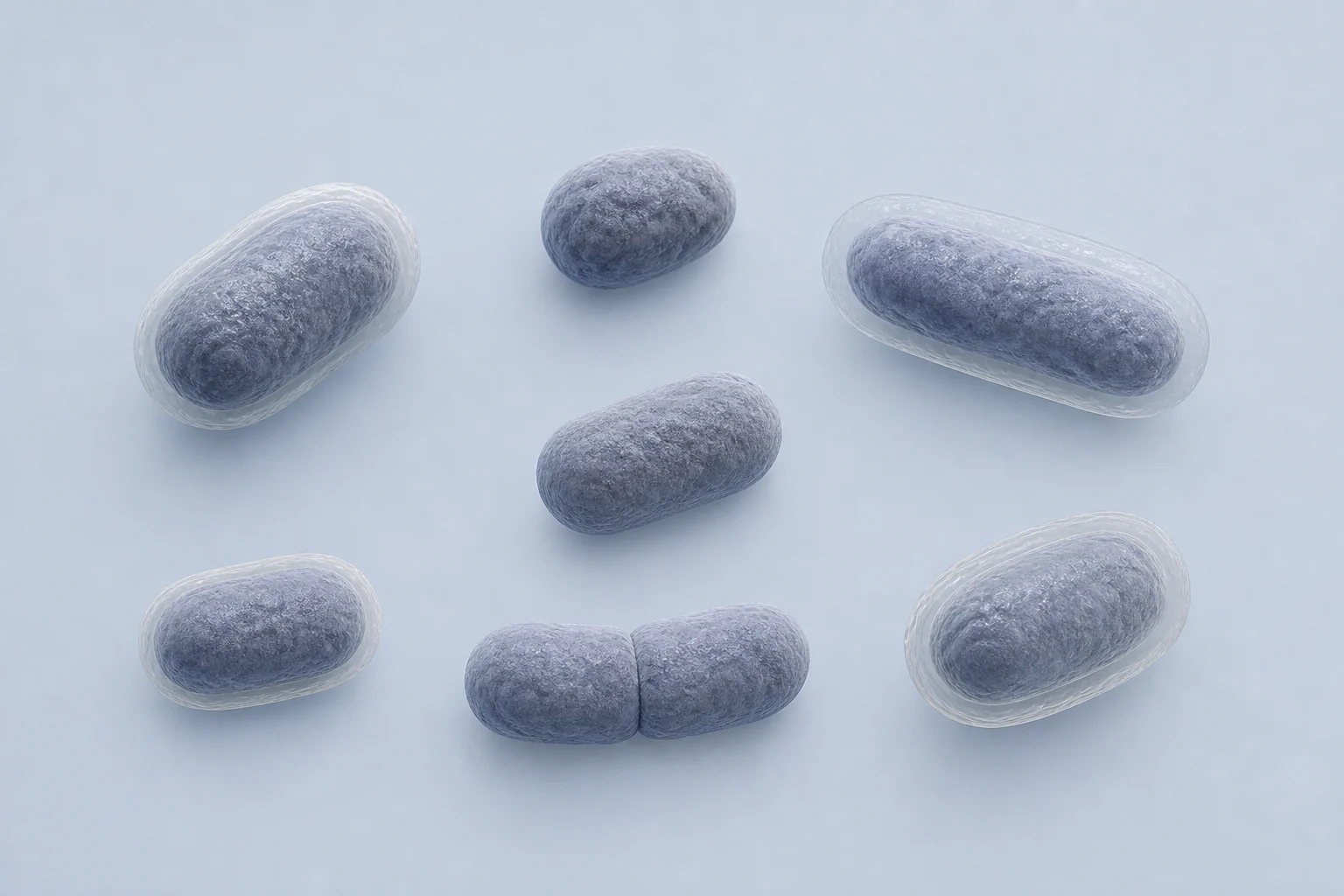
Representative Bacteroides morphology with restrained variation in cell form and visible capsule expression. Capsule appearance varies and is not uniform; this genus-level reconstruction is not diagnostic or a micrograph.
Scientific media record1 verified identifier
- Subject
- Bacteroidestaxon · genus
- Identifiers
- NCBITaxon:816
- Review
- Editorial review completeIdentifiers authority-verified · Accessibility validated · · bacteroides|bacteroides-morphology-v1.webp
- Digital source
- Trained-algorithmic mediaCreated with a trained generative algorithm and reviewed by WikiBiome for subject identity, scientific framing, identifiers, provenance, and accessibility.
- Scientific basis
- Bacteroides — NCBI TaxonomyBacteroides cell structure and surface diversityDemonstration of Bacteroides capsules
- License
- CC BY-SA 4.0Created
Bacteroides is the most abundant genus in the Western adult gut and a cornerstone of intestinal polysaccharide metabolism. As members of the Bacteroidetes (Bacteroidota) phylum, Bacteroides species encode enormous repertoires of carbohydrate-active enzymes (CAZymes) organized into polysaccharide utilization loci (PULs) that enable degradation of dietary fiber, host mucins, and complex glycans.
Despite their commensal dominance, Bacteroides species exhibit remarkable functional divergence—from the immunomodulatory Bacteroides fragilis (producing PSA, a Treg-inducing capsular polysaccharide) to the pathogenic strains producing BFT (Bacteroides fragilis toxin, a zinc-dependent metalloprotease). This genus illustrates the principle that genus-level associations obscure critical species-level and strain-level functional differences.
Evidence map3 cited passagesInspect provenance +
Bacteroides dorei—Produces TLR4-antagonist LPS that is immunoinhibitory, potentially preventing immune education. Enriched in early gut microbiomes of children who later develop type 1 diabetes.
B. dorei enrichment in infants precedes T1D development; its immunoinhibitory LPS may impair immune maturation.
The TEDDY study confirmed Bacteroides-dominant early gut microbiomes as a T1D risk factor.
Contents
1. Species with WikiBiome Entity Pages2. Other Notable Species3. The T1D-Bacteroides Connection4. Ecological Roles5. Capsular Polysaccharide Switching6. Cross-ReferencesSpecies with WikiBiome Entity Pages#
| Species | Key Function | Distinctive Feature |
|---|---|---|
| Bacteroides fragilis | Immunomodulation (PSA → Treg); zinc-dependent BFT toxin | Dual commensal/pathobiont nature |
| Bacteroides thetaiotaomicron | Premier glycan degrader; >260 glycoside hydrolases | Starch utilization system (Sus) |
| Bacteroides vulgatus | Common gut commensal; immunomodulatory | Enriched in some IBD cohorts |
Other Notable Species#
Bacteroides dorei—Produces TLR4-antagonist LPS that is immunoinhibitory, potentially preventing immune education. Enriched in early gut microbiomes of children who later develop Type 1 Diabetes.[1]Davis-Richardson & Triplett 2015 — Bacteroides dorei as a Model for T1D Microbiome PathogenesisAustin G. Davis-Richardson, Eric W. Triplett · 2015Open reference 1 ↓
Bacteroides uniformis—Mentioned in Chronic Kidney Disease context; propionate producer. Bacteroides caccae—Associated with prenatal lead exposure effects on childhood Gut Microbiome. Bacteroides ovatus—Arabinoxylan degradation specialist.
The T1D-Bacteroides Connection#
Bacteroides plays a paradoxical role in Type 1 Diabetes.
B. dorei enrichment in infants precedes T1D development; its immunoinhibitory LPS may impair immune maturation.[1]Davis-Richardson & Triplett 2015 — Bacteroides dorei as a Model for T1D Microbiome PathogenesisAustin G. Davis-Richardson, Eric W. Triplett · 2015Open reference 1 ↓ The TEDDY study confirmed Bacteroides-dominant early gut microbiomes as a T1D risk factor.[2]Vatanen et al. 2018 — The Human Gut Microbiome in Early-Onset Type 1 Diabetes from the TEDDY StudyTommi Vatanen, Eric A. Franzosa, Randall Schwager et al. · 2018Open reference 2 ↓
Mendelian Randomization suggests Bacteroidetes (phylum-level) causally increases T1D risk (OR=1.24).
Ecological Roles#
Polysaccharide Degradation#
Bacteroides are the primary degraders of complex plant polysaccharides and host mucins. B. thetaiotaomicron alone has more glycoside hydrolases than the entire human genome. This enzymatic capacity positions Bacteroides as keystone degraders that release simpler sugars for cross-feeding to other community members.
Propionate Production#
Bacteroides are major propionate producers via the succinate pathway. Propionate has hepatic effects on gluconeogenesis and cholesterol synthesis, and anti-inflammatory properties.
Bile Acid Metabolism#
Multiple Bacteroides species express bile salt hydrolases (BSH) and participate in bile acid deconjugation, connecting the genus to Bile Acid Metabolism and its downstream signaling effects.
Beta-Glucuronidase#
Several Bacteroides species express Beta-Glucuronidase, contributing to the Estrobolome through estrogen deconjugation.
Capsular Polysaccharide Switching#
Bacteroides species (particularly B. fragilis) employ capsular polysaccharide switching—they can express different surface polysaccharides by inverting promoter regions, enabling immune evasion. This is a sophisticated mechanism for maintaining colonization despite host immune responses.
Cross-References#
- Bacteroides fragilis—PSA immunomodulation and BFT toxin
- Bacteroides thetaiotaomicron—Premier glycan degrader
- Bacteroides vulgatus—Common commensal
- Bacteroidetes (Bacteroidota)—Parent phylum
- Type 1 Diabetes—B. dorei enrichment precedes T1D
- Bile Acid Metabolism—BSH activity
- Beta-Glucuronidase—Estrogen deconjugation
- Zinc-Metalloprotease—BFT toxin is zinc-dependent
- TLR4—B. dorei produces TLR4-antagonist LPS
References 4
Numbered by first appearance in the article, then reconciled with its declared source list.
- 1
Austin G. Davis-Richardson, Eric W. Triplett (2015). Davis-Richardson & Triplett 2015 — Bacteroides dorei as a Model for T1D Microbiome Pathogenesis. Diabetologia.
- 2
Tommi Vatanen, Eric A. Franzosa, Randall Schwager et al. (2018). Vatanen et al. 2018 — The Human Gut Microbiome in Early-Onset Type 1 Diabetes from the TEDDY Study. Nature.
- 3
Christopher T. Brown, Austin G. Davis-Richardson, Adriana Giongo et al. (2011). Brown et al. 2011 — Gut Metagenomics and Functional Model of T1D Autoimmunity. PLoS ONE.
- 4
Mikael Knip, Jarno Honkanen (2017). Knip & Honkanen 2017 — Modulation of Type 1 Diabetes Risk by the Intestinal Microbiome. Current Diabetes Reports.
Article network
Mentioned here 13
Pages linking here 19
Connect the evidence
Publicly readable discussion by ORCID-authenticated researchers. Questions, interpretation, methods, corrections, and new evidence stay attached to this record.
No discussion yet. Start with a precise question or a source-backed observation.
Activity and accepted changes
Accepted researcher context, editorial status, public discussion, and upstream Git revisions are shown together. Pending, declined, and withdrawn proposals remain private.
- published revision
Backfill gut microbiome concept links
Karen Pendergrass · +1 −1
Inspect exact Git diff ↗ - published revision
massive wiki expansion: 149 stubs fixed, 100+ new pages, Rule 15 scan, keystone papers
WikiBiome Deploy Bot · +11 −11
Inspect exact Git diff ↗ - published revision
pre-overnight checkpoint 2026-04-18
WikiBiome Deploy Bot · +82 −0
Inspect exact Git diff ↗