
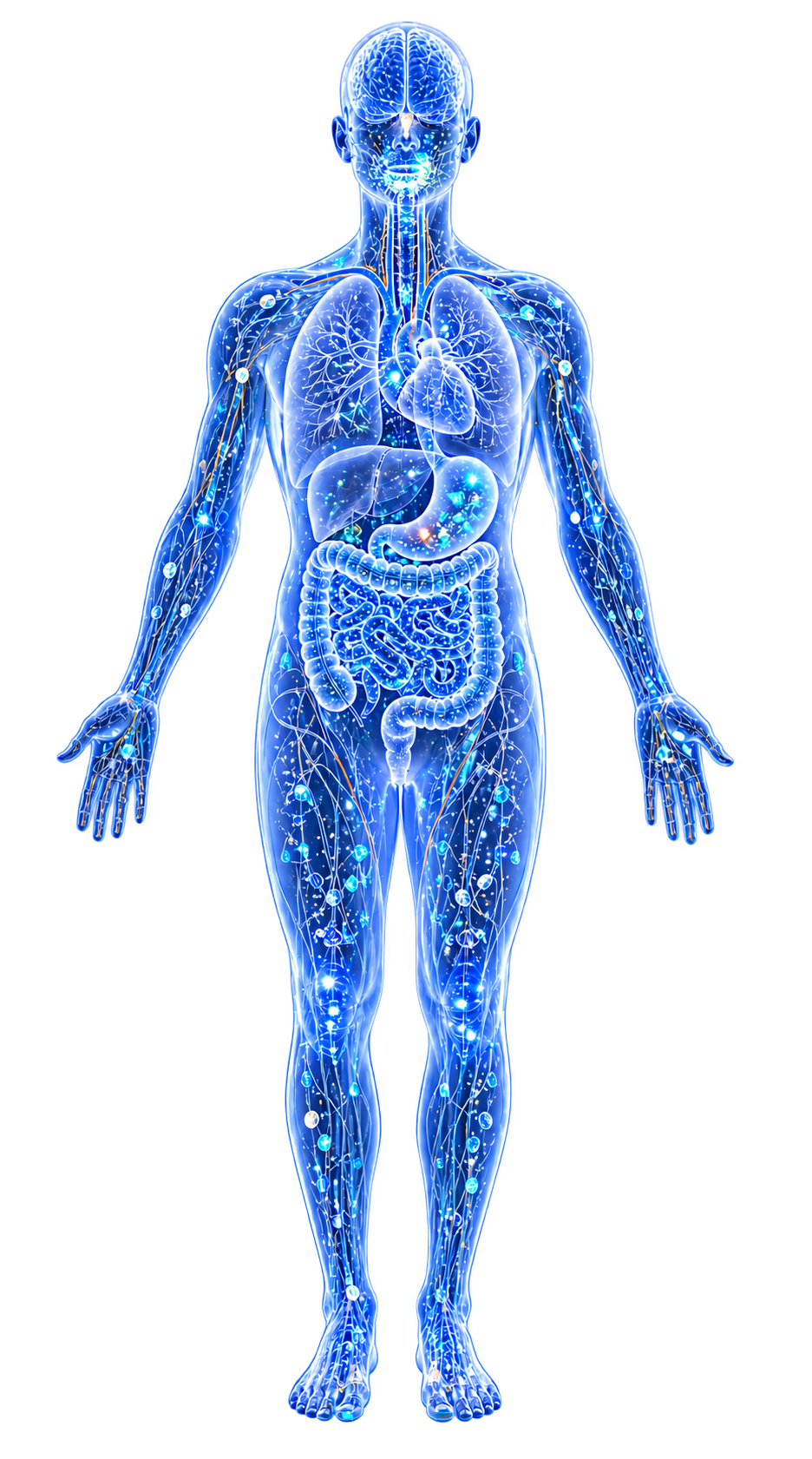
Parenteral nutrition (PN)—the delivery of nutrients directly into the bloodstream via intravenous infusion—is a life-saving intervention for patients who cannot absorb nutrition enterally.
However, PN presents unique challenges for the metal-microbiome axis: it introduces metals directly into systemic circulation (bypassing gut-mediated regulation), it starves the Gut Microbiome of substrates, and it contains documented heavy metal contaminants, most notably Aluminum.
Evidence map4 cited passagesInspect provenance +
Regulatory limits: FDA recommends a maximum of 5 ug Al/kg body weight/day. Despite this regulation, actual measured concentrations in PN solutions frequently exceed this limit.
Cognitive impact: Loss of 1 Bayley Mental Development Index point per day for each day on standard aluminum-containing PN.
15-year follow-up: Children who received standard (higher) aluminum PN had lower lumbar spine bone mineral content and lower hip bone mineral content.
This free iron feeds siderophore-producing Enterobacteriaceae, which is a risk factor for necrotizing enterocolitis in preterm infants.
Contents
1. Metal Contamination in PN2. Microbiome Impact of PN3. Clinical Populations4. Protective Strategies5. Open Questions6. Cross-ReferencesMetal Contamination in PN#
Aluminum#
Aluminum contamination of PN solutions is the best-documented metal contamination issue in clinical nutrition. Source: aluminum (Al) leaches from glass containers, rubber stoppers, and raw materials used in PN component manufacturing. Calcium gluconate, phosphate salts, and albumin are the most contaminated components.
Regulatory limits: FDA recommends a maximum of 5 ug aluminum/kg body weight/day. Despite this regulation, actual measured concentrations in PN solutions frequently exceed this limit.[1]Corkins 2019 — Aluminum Effects on Infants and ChildrenCorkins MR, AAP Committee on Nutrition · 2019Open reference 1 ↓
Preterm infant vulnerability: Preterm infants receiving PN are the highest-risk population because of their low body weight (maximizing dose per kg), immature renal excretion, and developing nervous system.
Evidence of Harm#
The Bishop et al. (1997) landmark RCT provides the strongest evidence. 90 preterm infants randomized to standard vs. aluminum-depleted PN.
Cognitive impact: Loss of 1 Bayley Mental Development Index point per day for each day on standard aluminum-containing PN.[1]Corkins 2019 — Aluminum Effects on Infants and ChildrenCorkins MR, AAP Committee on Nutrition · 2019Open reference 1 ↓
15-year follow-up: Children who received standard (higher) aluminum PN had lower lumbar spine bone mineral content and lower hip bone mineral content.[1]Corkins 2019 — Aluminum Effects on Infants and ChildrenCorkins MR, AAP Committee on Nutrition · 2019Open reference 1 ↓
This means that a typical 14-day course of standard PN in a preterm infant could produce a 14-point MDI deficit—a clinically meaningful cognitive impairment from iatrogenic aluminum exposure.
Iron in PN#
Parenteral iron presents a distinct problem. IV iron bypasses lactoferrin-mediated sequestration, providing free iron directly to the bloodstream and potentially the gut lumen. This free iron feeds siderophore-producing Enterobacteriaceae, which is a risk factor for Necrotizing Enterocolitis in preterm infants.[2]Nickel as a Catalytic Driver of Necrotizing Enterocolitis: Dietary Nickel, Microbial Metallomics, and the Activation of Nickel-Dependent Virulence Pathways in the Preterm GutKaren Pendergrass · 2026Open reference 2 ↓
The nutritional immunity framework (Karen's Brain Primitive 2) suggests that parenteral iron administration should be carefully weighed against the risk of promoting pathobiont growth.
Other Metal Contaminants#
Chromium: Present in PN trace element solutions. Manganese: Can accumulate to neurotoxic levels in long-term PN, causing manganese-induced parkinsonism. Copper: Hepatic toxicity risk in patients with cholestasis receiving standard PN copper supplementation.
Microbiome Impact of PN#
Gut Atrophy#
When the gut receives no enteral nutrition, it undergoes rapid changes. Mucosal atrophy: Villous height decreases within days, reducing absorptive surface. Tight junction loss: Barrier integrity deteriorates without luminal Butyrate stimulation. Bacterial translocation: Increased permeability allows gut bacteria to enter systemic circulation.
Microbial community shift: Without dietary substrates, saccharolytic fermenters starve while proteolytic and pathobiont populations may expand.
The PN-Dysbiosis Cycle#
`` No enteral nutrition │ ├── Gut starved of fiber/prebiotics → SCFA producer depletion ├── Mucosal atrophy → barrier failure → translocation └── Parenteral iron → feeds gut Proteobacteria via luminal diffusion │ ▼ Dysbiosis ← → Infection risk ``
Clinical Populations#
Preterm Infants#
- Highest risk from aluminum contamination
- Iron-NEC connection via siderophore-producing pathogens
- Transition to enteral feeding (especially breast milk with Human Milk Oligosaccharides (HMOs)) is critical for microbiome recovery
Short Bowel Syndrome#
- Long-term PN dependence
- Chronic metal accumulation risk (manganese (Mn) neurotoxicity, copper (Cu) hepatotoxicity)
- Progressive gut atrophy and Dysbiosis
Critically Ill Adults#
- ICU patients on PN experience rapid microbiome shifts
- Antibiotic co-administration compounds dysbiosis
- PN-associated liver disease may involve metal accumulation
Pancreatitis#
- Severe Pancreatitis patients on PN: unregulated iron may fuel pathobiont expansion (Klebsiella, E. coli, Pseudomonas) in the pancreatic infection organisms.
Protective Strategies#
Aluminum-depleted PN solutions: Available but not universally adopted despite RCT evidence. Minimize PN duration: Early transition to enteral nutrition when clinically feasible. Trophic feeding: Even minimal enteral nutrition (10-20 ml/kg/day) maintains mucosal integrity and microbiome substrate.
Iron dosing awareness: Consider the nutritional immunity framework when dosing parenteral iron in at-risk patients. Manganese monitoring: Regular blood manganese (Mn) levels in long-term PN patients.
Open Questions#
Unresolved questions identified by the current evidence record.
01Why have aluminum-depleted PN solutions not become the universal standard, given RCT evidence of harm?+
The current WikiBiome record identifies this as an unresolved evidence gap.
02Can probiotic co-administration during PN preserve microbiome health?+
The current WikiBiome record identifies this as an unresolved evidence gap.
03Does parenteral iron contribute to NEC risk in a dose-dependent manner?+
The current WikiBiome record identifies this as an unresolved evidence gap.
04Should trace element formulations in PN be individualized based on patient metal status?+
The current WikiBiome record identifies this as an unresolved evidence gap.
Cross-References#
- Aluminum—PN as primary iatrogenic aluminum (Al) exposure route
- Infant Exposure—preterm infant vulnerability to PN metals
- Necrotizing Enterocolitis—parenteral iron feeding pathobiont bloom
- Iron—parenteral iron bypassing nutritional immunity
- Nutritional Immunity (Metal Sequestration)—framework for evaluating parenteral metal delivery
- Saccharolytic Fermentation—gut starved of substrates during PN
- dysbiosis—PN-driven microbiome disruption
- Manganese—neurotoxicity risk in long-term PN
References 9
Numbered by first appearance in the article, then reconciled with its declared source list.
- 1
Corkins MR, AAP Committee on Nutrition (2019). Corkins 2019 — Aluminum Effects on Infants and Children. Pediatrics.
- 2
Karen Pendergrass (2026). Nickel as a Catalytic Driver of Necrotizing Enterocolitis: Dietary Nickel, Microbial Metallomics, and the Activation of Nickel-Dependent Virulence Pathways in the Preterm Gut. Zenodo Preprint.
- 3
★Monisha Jaishankar, Tenzin Tseten, Naresh Anbalagan et al. (2014). Toxicity, Mechanism and Health Effects of Some Heavy Metals. Interdisciplinary Toxicology.
- 4
Wu D, Xian W, Hong S et al. (2021). Graves' Disease and Rheumatoid Arthritis: A Bidirectional Mendelian Randomization Study. Frontiers in Endocrinology.
- 5
Antonelli A, Ferrari SM, Ragusa F et al. (2023). Graves' disease: Epidemiology, genetic and environmental risk factors and viruses. Best Practice & Research Clinical Endocrinology & Metabolism.
- 6
Knights D, Silverberg MS, Weersma RK et al. (2014). Complex Host Genetics Influence the Microbiome in Inflammatory Bowel Disease. Genome Medicine.
- 7
Congfu Huang, Chunuo Chu, Yuanping Peng et al. (2022). Huang 2022 — Correlations Between Gastrointestinal and Oral Microbiota in Children With Cerebral Palsy and Epilepsy. Frontiers in Pediatrics.
- 8
Xian W, Wu D, Liu B et al. (2023). Graves Disease and Inflammatory Bowel Disease: A Bidirectional Mendelian Randomization. The Journal of Clinical Endocrinology & Metabolism.
- 9
Viola N, Colleo A, Casula M et al. (2025). Viola et al. 2025 — Graves' Disease: Is It Time for Targeted Therapy? A Narrative Review. Medicina.
Article network
Connect the evidence
Publicly readable discussion by ORCID-authenticated researchers. Questions, interpretation, methods, corrections, and new evidence stay attached to this record.
No discussion yet. Start with a precise question or a source-backed observation.
Published page changes
This record shows only material changes published on this page, including changes to its content, evidence, conclusions, or author context. Internal processes and discussion activity are excluded. Pending, declined, and withdrawn proposals remain private.
- published revision
Added references: jaishankar-2014-heavy-metal-toxicity-mechanisms; chen-2024-graves-ra-bidirectional-mr; lazarova-2021-graves-disease-epidemiology-risk-factors; knights-2014-host-genetics-microbiome-ibd; huang-2022-oral-gut-microbiota-cpe-correlations;…
Added references: jaishankar-2014-heavy-metal-toxicity-mechanisms; chen-2024-graves-ra-bidirectional-mr; lazarova-2021-graves-disease-epidemiology-risk-factors; knights-2014-host-genetics-microbiome-ibd; huang-2022-oral-gut-microbiota-cpe-correlations; xian-2023-graves-disease-ibd-mendelian-randomization; kahaly-2022-graves-disease-targeted-therapy-review. Removed references: pendergrass-2026-nickel-nec-preterm-gut. · WikiBiome Deploy Bot · +31 −25
Inspect exact Git diff ↗ - published revision
Created “Parenteral Nutrition”: Parenteral nutrition (PN) -- the delivery of nutrients directly into the bloodstream via intravenous infusion -- is a life-saving intervention for patients who cannot absorb nutrition enterally.…
Created “Parenteral Nutrition”: Parenteral nutrition (PN) -- the delivery of nutrients directly into the bloodstream via intravenous infusion -- is a life-saving intervention for patients who cannot absorb nutrition enterally.… Published sections: Parenteral Nutrition; Aluminum; Evidence of Harm; Iron in PN; Other Metal Contaminants; Gut Atrophy; The PN-Dysbiosis Cycle; Preterm Infants; Short Bowel Syndrome; Critically Ill Adults; Pancreatitis; Protective Strategies; Open Questions; Cross-References. · WikiBiome Deploy Bot · +121 −0
Inspect exact Git diff ↗