
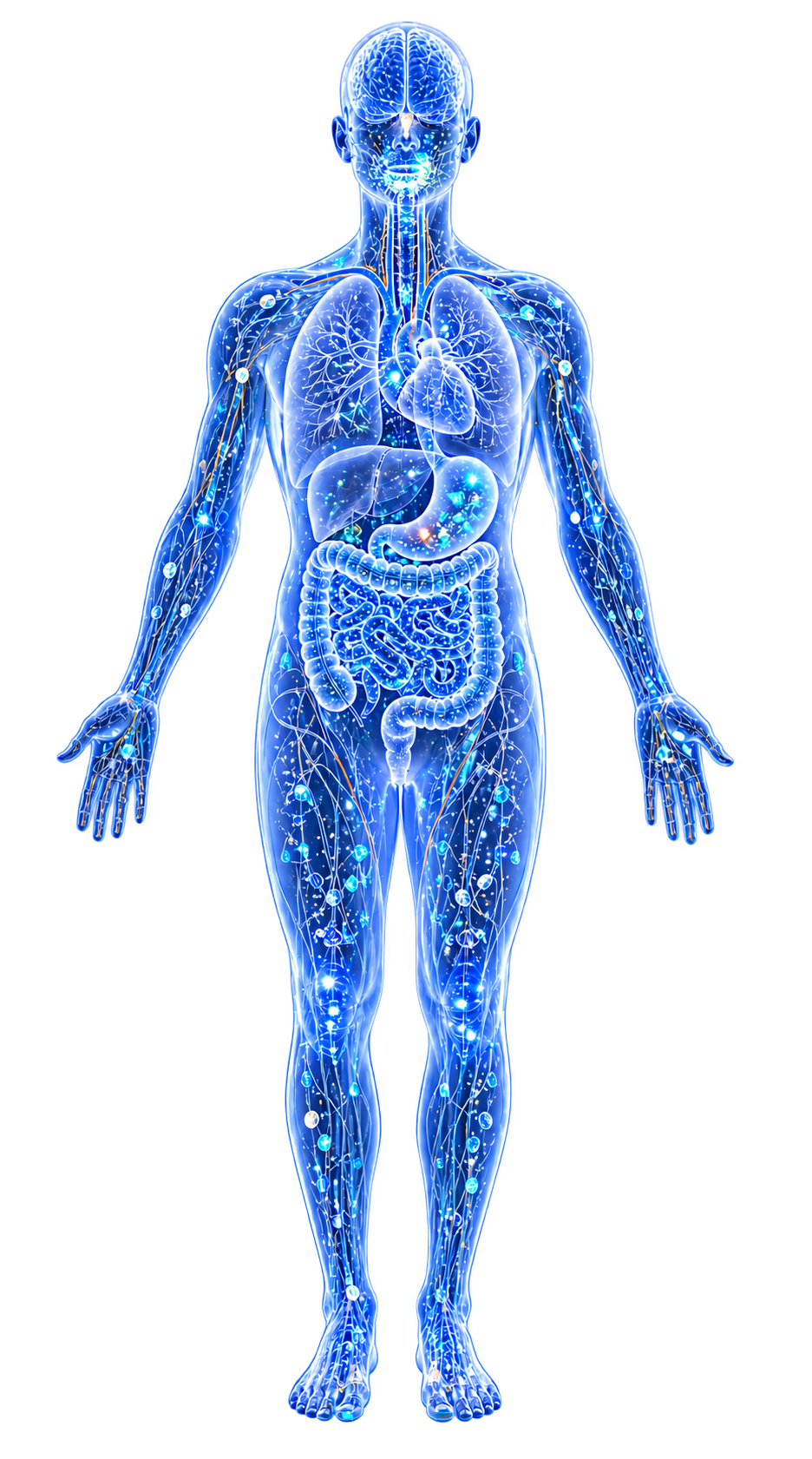
Human milk oligosaccharides are a diverse family of over 200 structurally distinct complex sugars found in breast milk. They are the third most abundant solid component of human milk (after lactose and lipids), yet they are not digestible by the infant.
Their sole purpose is to feed and shape the infant Gut Microbiome—making breast milk an evolutionary solution to the problem of microbial ecosystem assembly.
Evidence map4 cited passagesInspect provenance +
HMOs function alongside other breast milk components in a complete ecological package: lactoferrin (iron chelation), secretory IgA (pathogen neutralization), growth factors (barrier maturation), and anti-inflammatory cytokines.
Non-toxigenic Clostridium perfringens (pfoA-negative) and C. tertium metabolize HMOs and suppress pathogenic E. coli and Klebsiella by 40-90% in vitro.
Nickel pathobionts: The Proteobacteria suppressed by HMO-fed Bifidobacterium include nickel-dependent pathogens (urease-positive Klebsiella, E. coli) implicated in NEC.
Can fortifiers replicate the zinc + HMO + tryptophan stack present in natural breast milk ?
Contents
1. Structure and Diversity2. Selective Feeding of Bifidobacterium3. NEC Prevention—The Ecological Package4. Non-toxigenic Clostridia—A Paradigm Shift5. Beyond Prebiotic Function6. Metal Biology Connections7. Formula vs. Breast Milk8. Open Questions9. Cross-ReferencesStructure and Diversity#
HMOs are composed of five monosaccharide building blocks: glucose, galactose, N-acetylglucosamine, fucose, and sialic acid. The 200+ structures vary by:
- Chain length: 3 to 32 sugar residues
- Fucosylation: Presence/absence of fucose (driven by maternal FUT2/FUT3 genotype)
- Sialylation: Presence/absence of sialic acid
- Branching: Linear vs. branched architectures
This structural diversity creates a complex prebiotic landscape that selectively feeds specific bacterial species.
Selective Feeding of Bifidobacterium#
The primary ecological function of HMOs is to selectively nourish Bifidobacterium.
Bifidobacterium longum subsp. infantis possesses a complete HMO utilization gene cluster, enabling it to metabolize virtually all HMO structures. B. breve and B. bifidum metabolize subsets of HMOs through extracellular glycosidases. This selective feeding establishes Bifidobacterium dominance (60-90% of the infant gut) in breastfed infants.
The metabolic products of HMO fermentation by Bifidobacterium include. Acetate and lactate: Lower intestinal pH, directly suppressing Proteobacteria growth. Cross-feeding substrates: Support downstream Butyrate producers.
NEC Prevention—The Ecological Package#
HMOs are a critical component of breast milk's protection against Necrotizing Enterocolitis. HMOs selectively feed Bifidobacterium, establishing colonization resistance against Proteobacteria (the taxa that drive the NEC bloom). The 6-10 fold NEC risk reduction from exclusive breastfeeding is the largest single protective effect in neonatal medicine.
HMOs function alongside other breast milk components in a complete ecological package: lactoferrin (iron chelation), secretory IgA (pathogen neutralization), growth factors (barrier maturation), and anti-inflammatory cytokines.[1]Sami 2023 — Human Milk Nutrients Preventing NECSami et al. · 2023Open reference 1 ↓
Non-toxigenic Clostridia—A Paradigm Shift#
A paradigm-shifting finding overturned the assumption that only Bifidobacteria benefit from HMOs:
Non-toxigenic Clostridium perfringens (pfoA-negative) and C. tertium metabolize HMOs and suppress pathogenic E. coli and Klebsiella by 40-90% in vitro.[2]Chapman 2026 — Non-toxigenic Clostridia Metabolize HMOs and Suppress Pathobionts in NECChapman et al. · 2026Open reference 2 ↓
These strains lack the toxin genes that make C. perfringens pathogenic but retain the metabolic machinery to compete with Enterobacteriaceae. This opens a novel probiotic strategy based on competitive exclusion by a traditionally "pathogenic" genus.
Beyond Prebiotic Function#
HMOs have direct biological activities beyond feeding bacteria. Pathogen decoys: HMO structures mimic epithelial cell surface glycans, acting as soluble decoys that prevent pathogen adhesion. Immune modulation: Certain HMOs directly modulate dendritic cell and T cell function.
Barrier maturation: HMOs promote intestinal epithelial cell maturation and tight junction development.
Anti-inflammatory: Specific HMOs suppress NF-kB signaling in intestinal epithelium.
Metal Biology Connections#
HMOs intersect with metal biology at several points. Iron ecology: By establishing Bifidobacterium dominance, HMOs reduce the abundance of siderophore-producing Enterobacteriaceae that compete for iron. This complements lactoferrin's iron-chelating function.
Nickel pathobionts: The Proteobacteria suppressed by HMO-fed Bifidobacterium include nickel-dependent pathogens (Urease-positive Klebsiella, E. coli) implicated in NEC.[3]Nickel as a Catalytic Driver of Necrotizing Enterocolitis: Dietary Nickel, Microbial Metallomics, and the Activation of Nickel-Dependent Virulence Pathways in the Preterm GutKaren Pendergrass · 2026Open reference 3 ↓
Zinc and barrier function: HMO-promoted barrier maturation works alongside zinc-dependent tight junction proteins.
Formula vs. Breast Milk#
Formula lacks HMOs entirely (though some manufacturers now add 1-2 synthetic HMO structures). The absence of HMOs in formula:
- Prevents Bifidobacterium establishment
- Allows Proteobacteria to colonize without competition
- Removes the pathogen-decoy function
- Eliminates the immune-modulatory effects
This is why formula-fed infants have fundamentally different microbiome trajectories from breastfed infants—and why NEC risk is dramatically higher in formula-fed preterm infants.
Open Questions#
Unresolved questions identified by the current evidence record.
01Can synthetic HMO supplementation in formula replicate the full prebiotic effect of natural HMOs?+
The current WikiBiome record identifies this as an unresolved evidence gap.
02Which of the 200+ HMO structures are most critical for NEC prevention?+
The current WikiBiome record identifies this as an unresolved evidence gap.
03Does maternal metal exposure alter HMO composition or concentration?+
The current WikiBiome record identifies this as an unresolved evidence gap.
04Can fortifiers replicate the zinc + HMO + tryptophan stack present in natural breast milk?[1]Sami 2023 — Human Milk Nutrients Preventing NECSami et al. · 2023Open reference 1 ↓+
The current WikiBiome record identifies this as an unresolved evidence gap.
Cross-References#
- Bifidobacterium—primary HMO consumer; keystone infant colonizer
- Necrotizing Enterocolitis—HMOs as part of breast milk's NEC prevention package
- Infant Exposure—HMOs in the broader infant protection context
- Prebiotics—HMOs as the evolutionary archetype of prebiotics
- Lactobacillus—secondary HMO beneficiary
- Nutritional Immunity (Metal Sequestration)—HMOs complement lactoferrin's iron-chelating function
- Clostridium—non-toxigenic Clostridia as novel HMO metabolizers
References 5
Numbered by first appearance in the article, then reconciled with its declared source list.
- 1
Sami et al. (2023). Sami 2023 — Human Milk Nutrients Preventing NEC. Frontiers in Pediatrics.
- 2
Chapman et al. (2026). Chapman 2026 — Non-toxigenic Clostridia Metabolize HMOs and Suppress Pathobionts in NEC. Nature Microbiology.
- 3
Karen Pendergrass (2026). Nickel as a Catalytic Driver of Necrotizing Enterocolitis: Dietary Nickel, Microbial Metallomics, and the Activation of Nickel-Dependent Virulence Pathways in the Preterm Gut. Zenodo Preprint.
- 4
Sampah MES, Hackam DJ (2021). Sampah & Hackam 2021 — Prenatal Immunity and Pathophysiology of NEC. Frontiers in Immunology.
- 5
Jhommara Bautista, Carolina E. Echeverria, Ivan Maldonado-Noboa et al. (2025). Bautista 2025 — The Human Microbiome in Clinical Translation: From Bench to Bedside. Frontiers in Microbiology.
Article network
Connect the evidence
Publicly readable discussion by ORCID-authenticated researchers. Questions, interpretation, methods, corrections, and new evidence stay attached to this record.
No discussion yet. Start with a precise question or a source-backed observation.
Published page changes
This record shows only material changes published on this page, including changes to its content, evidence, conclusions, or author context. Internal processes and discussion activity are excluded. Pending, declined, and withdrawn proposals remain private.
- published revision
Added references: sampah-2021-prenatal-immunity-nec; bautista-2025-human-microbiome-clinical-translation.
WikiBiome Deploy Bot · +23 −21
Inspect exact Git diff ↗ - published revision
Created “Human Milk Oligosaccharides (HMOs)”: Human milk oligosaccharides are a diverse family of over 200 structurally distinct complex sugars found in breast milk. They are the third most abundant solid component of human milk (after lactose…
Created “Human Milk Oligosaccharides (HMOs)”: Human milk oligosaccharides are a diverse family of over 200 structurally distinct complex sugars found in breast milk. They are the third most abundant solid component of human milk (after lactose… Published sections: Human Milk Oligosaccharides (HMOs); Structure and Diversity; Selective Feeding of Bifidobacterium; NEC Prevention -- The Ecological Package; Non-toxigenic Clostridia -- A Paradigm Shift; Beyond Prebiotic Function; Metal Biology Connections; Formula vs. Breast Milk; Open Questions; Cross-References. · WikiBiome Deploy Bot · +101 −0
Inspect exact Git diff ↗