
 metals · microbes · host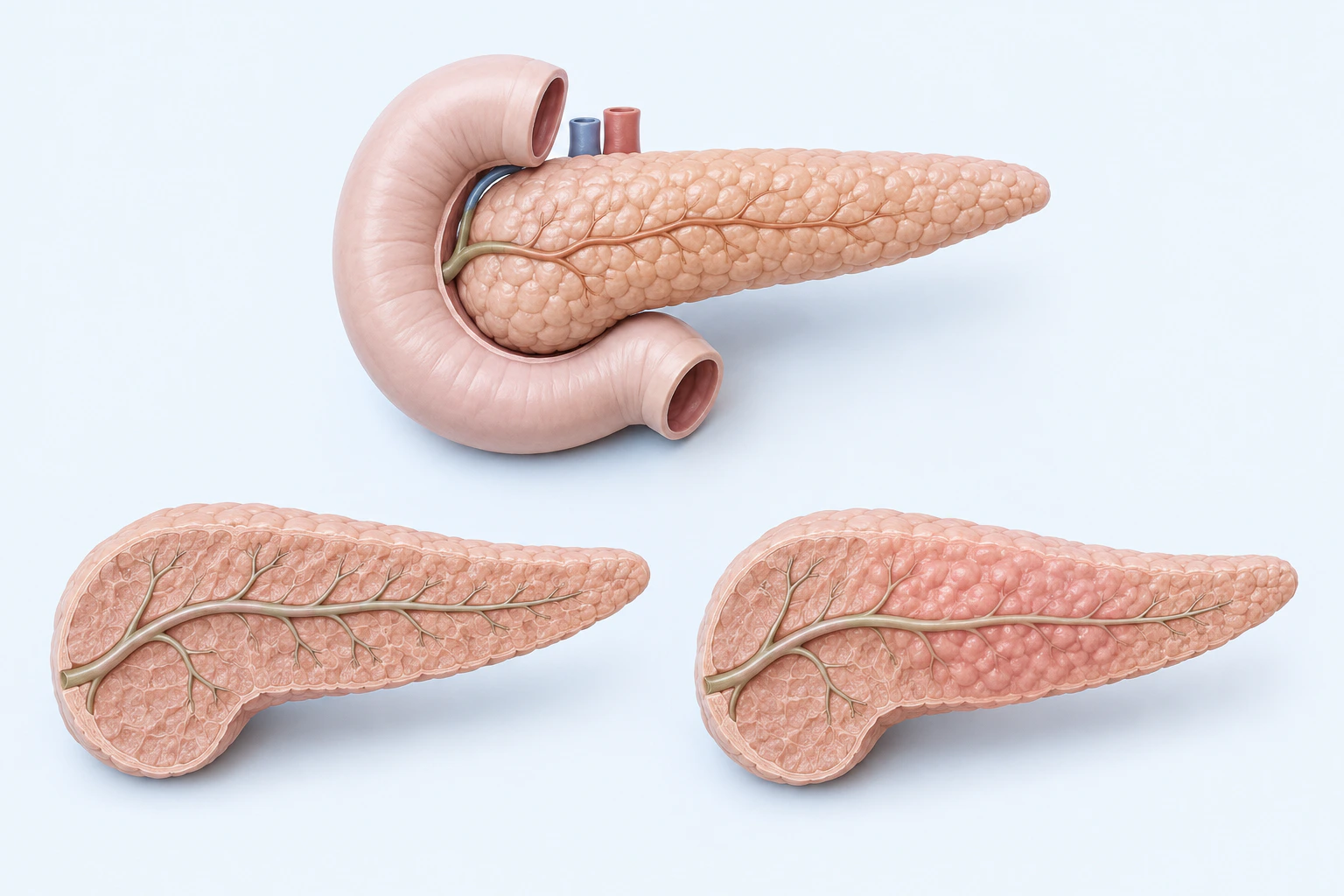
Representative pancreatitis orientation without acute or chronic classification, cause, complication, severity, prognosis, or diagnosis.
Scientific media record1 verified identifier
- Subject
- Pancreatitiscondition
- Identifiers
- MeSH:D010195
- Review
- Editorial review completeIdentifiers authority-verified · Accessibility validated · · pancreatitis|pancreatitis-pathology-v1.webp
- Digital source
- Trained-algorithmic mediaCreated with a trained generative algorithm and reviewed by WikiBiome for subject identity, scientific framing, identifiers, provenance, and accessibility.
- Scientific basis
- Pancreatitis — MeSHDefinition & Facts for Pancreatitis
- License
- CC BY-SA 4.0Created
Pancreatitis is Metal-Driven Inflammation of the pancreas, occurring in acute (AP) and chronic (CP) forms. Acute pancreatitis ranges from mild self-limiting disease to severe necrotizing pancreatitis with 20-30% mortality.
Chronic pancreatitis is a risk factor for Pancreatic Cancer (relative risk 2.7-16x), making the pancreatitis→PDAC progression a clinically important trajectory where microbiome interventions may have preventive value.
Evidence map27 cited passagesInspect provenance +
Fungal dysbiosis is a feature of acute pancreatitis, with altered intestinal fungal communities detected early in the disease course.
Bacterial translocation from a dysbiotic gut is a major driver of secondary pancreatic infection in severe AP.
16S rRNA sequencing of pancreatic infections identifies specific bacterial communities driving infectious complications.
Autoimmune pancreatitis (AIP) has a distinct fecal microbiota compared to pancreatic ductal adenocarcinoma (PDAC), despite overlapping clinical presentations. Shotgun metagenomics revealed differential functional profiles that may serve as diagnostic biomarkers.
mendelian randomization supports a causal relationship between specific gut microbiota and pancreatitis risk.
Meta-analysis of 13 RCTs found that probiotics, prebiotics, and synbiotics reduce infectious complications in severe acute pancreatitis. The mechanism likely involves:
Pancreatitis is inflammation of the pancreas, occurring as acute pancreatitis (AP, 34 per 100,000/year) and chronic pancreatitis (CP, 10 per 100,000). Severe AP carries 20-30% mortality, driven in large part by bacterial translocation from the dysbiotic gut to the pancreas. CP is the strongest non-genetic risk factor for pancreatic cancer (2.7-16x relative r
The pancreatitis signature is distinctive in two ways: (1) it involves both bacterial and fungal dysbiosis—candida albicans dominates the AP mycobiome, and (2) the gut-to-organ translocation pathway is central, with 16S rRNA sequencing identifying 660 bacterial strains in pancreatic infections from intestinal, oral, and airway origins.
Iron (elevated): Iron availability is relevant because the dominant pancreatic infection organisms (Klebsiella, E. coli, Pseudomonas) are highly siderophore-dependent. Parenteral nutrition in severe AP patients may provide unregulated iron that fuels pathobiont expansion. Candida species are also iron-dependent for morphogenesis and virulence.
Alcohol is the most common cause of AP, directly damaging pancreatic acinar cells and altering gut microbiome composition. MR analysis confirms bidirectional causation between gut microbiota and pancreatitis—pancreatitis itself causally increases Proteobacteria and Lachnospiraceae in the gut, while specific taxa causally increase pancreatitis risk. This bi
Gallstones (second most common cause) alter bile acid metabolism, which shapes gut microbial ecology. High-fat diets increase bile-resistant organisms including Bilophila and Alistipes.
Elevated WBC and IL-6: The systemic inflammatory response in AP is severe. Aspergillus abundance shows strong positive correlation with WBC counts, suggesting fungal-mediated immune activation.
Depleted butyrate: Fecal butyrate is significantly decreased in PDAC patients (confirmed by gas chromatography), and the Wood-Ljungdahl pathway (classical acetate production) is depleted.
Depleted SCFA synthesis capacity: The gut microbiome in pancreatitis/PDAC shows depleted metabolic capacity for SCFA synthesis at the functional level, not just at the taxonomic level.
Pancreatic infections in severe AP are polymicrobial in 98.21% of samples, with bacterial communities sourced from the intestines (43%), anaerobic reservoirs (43%), and oral cavity/airways (17%).
klebsiella pneumoniae is the dominant aerobic isolate (48.08% of samples), followed by acinetobacter baumannii, pseudomonas aeruginosa, and escherichia coli. All four are siderophore-producing Proteobacteria whose virulence depends on iron availability.
bacteroides fragilis is the dominant anaerobic isolate (16/56 patients), followed by B. kribbi, B. ovatus, and Dialister invisus.
MR-validated causal risk taxa include Coprococcus3 (OR=1.48), Eubacterium fissicatena group (OR=1.24), and Barnesiella (OR=1.48 for chronic pancreatitis).
candida albicans dominates the AP mycobiome (61.34%), followed by aspergillus (15.18%), Penicillium (5.98%), and Apiotrichum (5.23%). This is a dramatic shift from healthy controls where Aspergillus, Ganoderma, and Penicillium are dominant and Candida is minor.
faecalibacterium prausnitzii and roseburia intestinalis are depleted in PDAC. Eubacterium rectale is the top discriminating biomarker (AUC=90.74%) for distinguishing PDAC from healthy controls. The Firmicutes/Bacteroidetes ratio is decreased in PDAC.
MR-validated protective taxa include Prevotella9 (OR=0.82 for AP) and Ruminiclostridium6 (OR=0.70 for AP).
Type II secretion system: Enriched in PDAC gut microbiome functional analysis, enabling bacterial protein export and toxin delivery.
The central ecological event in severe AP is gut-to-pancreas bacterial translocation. A dysbiotic gut with compromised barrier integrity permits bacteria (and fungi) to reach the pancreas via portal circulation, lymphatics, and direct transmural migration. 16S rRNA sequencing reveals that pancreatic infections originate from the intestines (43%), anaerobic r
Pancreatic infection communities are not static—when sampling intervals exceed 2 weeks, bacterial composition changes significantly, and low-abundance species can become dominant pathogens. This temporal evolution has implications for antibiotic strategy.
Showing 24 of 27 evidence-bearing passages. Every remaining citation is still indexed in the reference record below.
One disease. Five evidence layers.
A generated systems view of the metals, organisms, host sequestration signals, ecological conditions, and microbial functions indexed for Pancreatitis.
Evidence layer
Taxonomic signature
Organisms reported as enriched or depleted, with their indexed functional context kept beside the name.Dominant pancreatic infection isolate (48% of SAP samples); siderophore-dependent iron piracy; LPS drives TLR4 inflammatory cascade
A. baumannii enriched in severe/critical AP pancreatic infections; antimicrobial-resistant opportunist
Enriched in pancreatic infections; iron-dependent virulence, biofilm former
LPS producer; translocates from gut to pancreas in severe AP
Dominant fungal genus in AP (61.34% of mycobiome); iron-dependent; correlates with inflammatory markers
15.18% of AP mycobiome; strong positive correlation with WBC counts
vanadium (V). dispar increased in PDAC and AIP; marker of dysbiotic fermentation
S. parasanguinis increased in both PDAC and AIP
MR-validated causal risk taxon for acute pancreatitis (OR=1.48)
Primary butyrate producer; depleted in PDAC; loss reduces anti-inflammatory signaling and barrier integrity
R. intestinalis depleted in PDAC; butyrate producer; loss contributes to SCFA deficit
Depleted; loss reduces colonization resistance and lactate cross-feeding
Top discriminating biomarker for PDAC (AUC=90.74%); butyrate producer
MR-validated protective taxon for AP (OR=0.82)
Evidence layer
Nutritional immunity
Host metal-withholding, inflammatory, antioxidant, and microbial-metabolite signals indexed in the signature.Evidence layer
Ecological state
The environmental conditions that connect the organism-level observations into a system.Evidence layer
Virulence functions
Microbial structures, enzymes, and acquisition systems implicated by the linked evidence.The disease record, in full.
The original WikiBiome disease narrative remains intact beneath the generated signature atlas.
Microbiome Associations#
Acute Pancreatitis#
Fungal Dysbiosis is a feature of acute pancreatitis, with altered intestinal fungal communities detected early in the disease course.[1]Profile of intestinal fungal microbiota in acute pancreatitis patients and healthy individualsMeng-Qi Zhao, Miao-Yan Fan, Meng-Yan Cui et al. · 2025Open reference 1 ↓
Bacterial translocation from a dysbiotic gut is a major driver of secondary pancreatic infection in severe AP.[2]Identification and characterization of pancreatic infections in severe and critical acute pancreatitis patients using 16S rRNA gene next generation sequencingNing Sun, Yong Chen, Jiaxun Zhang et al. · 2023Open reference 2 ↓
16S rRNA sequencing of pancreatic infections identifies specific bacterial communities driving infectious complications.[2]Identification and characterization of pancreatic infections in severe and critical acute pancreatitis patients using 16S rRNA gene next generation sequencingNing Sun, Yong Chen, Jiaxun Zhang et al. · 2023Open reference 2 ↓
Autoimmune Pancreatitis#
Autoimmune pancreatitis (AIP) has a distinct fecal microbiota compared to pancreatic ductal adenocarcinoma (PDAC), despite overlapping clinical presentations. Shotgun metagenomics revealed differential functional profiles that may serve as diagnostic biomarkers.[3]The fecal microbiota of patients with pancreatic ductal adenocarcinoma and autoimmune pancreatitis characterized by metagenomic sequencingWenli Zhou, De Zhang, Zhengpeng Li et al. · 2021Open reference 3 ↓
Causal Evidence#
Mendelian Randomization supports a causal relationship between specific gut microbiota and pancreatitis risk.[4]Causal link between gut microbiota and four types of pancreatitis: a genetic association and bidirectional Mendelian randomization studyKui Wang, Xianzheng Qin, Taojing Ran et al. · 2023Open reference 4 ↓
Interventions#
Probiotics/Prebiotics/Synbiotics in Severe AP#
Meta-analysis of 13 RCTs found that probiotics, prebiotics, and Synbiotics reduce infectious complications in severe acute pancreatitis.[5]Supplemented Use of Pre-, Pro-, and Synbiotics in Severe Acute Pancreatitis: An Updated Systematic Review and Meta-Analysis of 13 Randomized Controlled TrialsXu Tian, Yuan-Ping Pi, Xiao-Ling Liu et al. · 2018Open reference 5 ↓ The mechanism likely involves.
Strengthening gut barrier integrity to prevent bacterial translocation. Modulating immune response to reduce pancreatic necrosis infection. Competing with pathobionts for intestinal niches.
Pancreatitis-to-Pancreatic Cancer Progression#
Chronic pancreatitis is the strongest non-genetic risk factor for Pancreatic Cancer. The microbiome changes in CP may create a pro-tumorigenic environment through. Chronic inflammation via TLR4/NF-kB activation.
Altered Bile Acid Metabolism affecting immune surveillance. Mycobiome dysbiosis persisting through the progression.
Cross-References#
- Pancreatic Cancer—Downstream malignancy risk
- Synbiotics—Meta-analysis evidence for severe AP
- Mendelian Randomization—Causal microbiota-pancreatitis evidence
- Type 2 Diabetes—Bidirectional relationship with pancreatitis
- Obesity—Risk factor for AP
- TLR4—Inflammatory cascade in pancreatitis
References 6
Numbered by first appearance in the article, then reconciled with its declared source list.
- 1
Meng-Qi Zhao, Miao-Yan Fan, Meng-Yan Cui et al. (2025). Profile of intestinal fungal microbiota in acute pancreatitis patients and healthy individuals. Gut Pathogens.
- 2
Ning Sun, Yong Chen, Jiaxun Zhang et al. (2023). Identification and characterization of pancreatic infections in severe and critical acute pancreatitis patients using 16S rRNA gene next generation sequencing. Frontiers in Microbiology.
- 3
Wenli Zhou, De Zhang, Zhengpeng Li et al. (2021). The fecal microbiota of patients with pancreatic ductal adenocarcinoma and autoimmune pancreatitis characterized by metagenomic sequencing. Journal of Translational Medicine.
- 4
Kui Wang, Xianzheng Qin, Taojing Ran et al. (2023). Causal link between gut microbiota and four types of pancreatitis: a genetic association and bidirectional Mendelian randomization study. Frontiers in Microbiology.
- 5
Xu Tian, Yuan-Ping Pi, Xiao-Ling Liu et al. (2018). Supplemented Use of Pre-, Pro-, and Synbiotics in Severe Acute Pancreatitis: An Updated Systematic Review and Meta-Analysis of 13 Randomized Controlled Trials. Frontiers in Pharmacology.
- 6
Anna Gudan, Ewa Stachowska (2022). Gudan 2022 — The Potential Impact of the Ketogenic Diet on Gut Microbiota in the Context of Neurological Disorders. Advances in Hygiene and Experimental Medicine.
Article network
Connect the evidence
Publicly readable discussion by ORCID-authenticated researchers. Questions, interpretation, methods, corrections, and new evidence stay attached to this record.
No discussion yet. Start with a precise question or a source-backed observation.
Published page changes
This record shows only material changes published on this page, including changes to its content, evidence, conclusions, or author context. Internal processes and discussion activity are excluded. Pending, declined, and withdrawn proposals remain private.
- published revision
Created “Pancreatitis”: Pancreatitis is inflammation of the pancreas, occurring in acute (AP) and chronic (CP) forms. Acute pancreatitis ranges from mild self-limiting disease to severe necrotizing pancreatitis with 20-30%…
Created “Pancreatitis”: Pancreatitis is inflammation of the pancreas, occurring in acute (AP) and chronic (CP) forms. Acute pancreatitis ranges from mild self-limiting disease to severe necrotizing pancreatitis with 20-30%… Published sections: Overview; Acute Pancreatitis; Autoimmune Pancreatitis; Causal Evidence; Probiotics/Prebiotics/Synbiotics in Severe AP; Pancreatitis-to-Pancreatic Cancer Progression; Cross-References. · WikiBiome Deploy Bot · +61 −0
Inspect exact Git diff ↗