

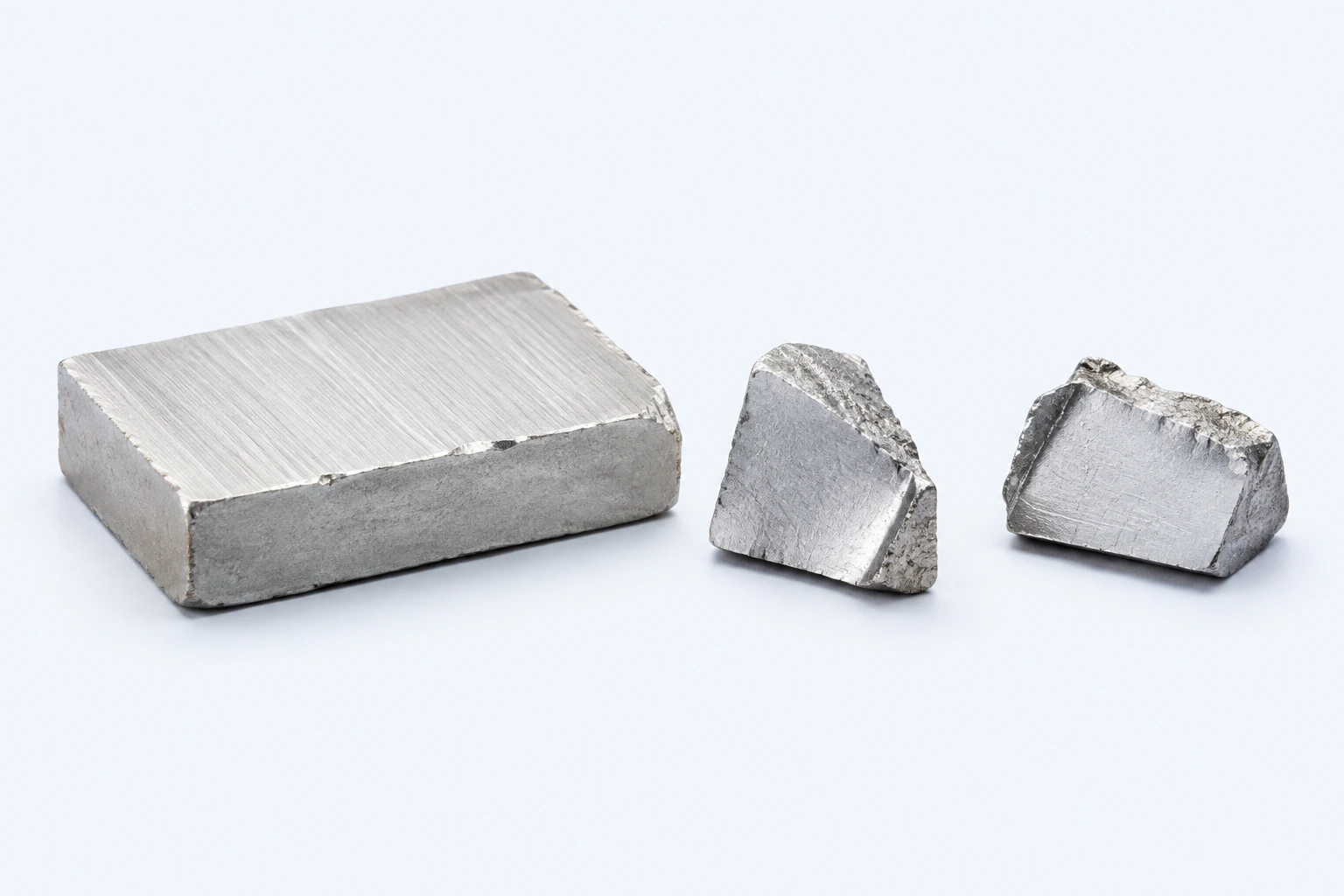
Elemental aluminum (Al), shown as three representative silvery cut specimens. Form and surface vary with purity, processing, and oxidation; this reconstruction is not analytical reference material or a photograph.
Scientific media record2 verified identifiers
- Subject
- Aluminumelement
- Identifiers
- Atomic number 13PubChem CID:5359268
- Review
- Editorial review completeIdentifiers authority-verified · Accessibility validated · · aluminum|aluminum-technical-specimen-v1.webp
- Digital source
- Trained-algorithmic mediaCreated with a trained generative algorithm and reviewed by WikiBiome for subject identity, scientific framing, identifiers, provenance, and accessibility.
- Scientific basis
- Aluminum — PubChem ElementAluminum, PubChem CID 5359268
- License
- CC BY-SA 4.0Created
A non-essential metal and the most abundant metallic element in the Earth's crust. Unlike manganese, iron, or selenium, aluminum has no known biological function in humans. Its significance in metal toxicology stems from two major concerns: proven neurotoxicity at elevated exposures and widespread contamination of infant foods and formulas.
Evidence map39 cited passagesInspect provenance +
Only 0.1% of orally ingested aluminum is absorbed—bioavailability is inherently limited.
Bioaccessibility varies dramatically by food matrix: from 0.5% to 48% depending on composition; polyphenols reduce bioaccessibility, while protein-rich foods show variable patterns.
Found in senile plaques and neurofibrillary tangles in Alzheimer's disease brains.
Prescription infant formulas (UK): All 24 tested were contaminated; ready-to-drink ranged from 49.9 to 1956.3 ug/L; Abbott PediaSure Plus Juice Apple at 1956.3 ug/L (391 ug per serving).
Breast milk has Al content an order of magnitude lower than formula feeds.
Lebanese infant formulas: Al detected in all 41 samples (0.317 mg/kg); hazard quotient (HQ) exceeded 1 for all age groups despite being below FAO/WHO limits.
Brazilian cereals: Total Al ranged 197-1852 ug/kg; bioaccessibility 1.5-10.4%; PTWI contribution up to 10.48%.
Brazilian infant foods: Soy-based drinks reached 4170 ug/kg; consumption of 3 portions/day exceeded 100% of PTWI.
Spanish baby food jars: Vegetable jars contained highest Al (8.22 mg/kg); Al intake reached 55-160% of TWI at typical consumption.
German total diet study: Infant formula Al contribution up to 64% of total dietary Al exposure for infants <1 year.
Key insight: Contamination is NOT inevitable—some prescription formulas (e.g., SMA Alfamino at 41.4 ug/L) had lower Al than any off-the-shelf formula, demonstrating that premium ingredients can reduce contamination.
Aluminum welders showed declining neuropsychological performance at post-shift urinary concentrations of ~120 ug/L.
Antiperspirants (aluminum chlorohydrate), though epidemiological evidence for breast cancer is not consistent.
Cocoa and soy are identified as likely dual contamination sources.
Neurotoxicity is the critical adverse endpoint for aluminum.
Reference values: General population <15 ug/L urine, <5 ug/L serum.
Early signs of neurotoxicity at ~13 ug/L plasma and ~120 ug/L urine (occupational).
Dialysis encephalopathy occurs at ~100 ug/L plasma—the first clinical observation linking Al to neurodegeneration.
Al exposure increases APP mRNA expression and amyloid-beta levels in animal models.
Meta-analysis of 8 cohort/case-control studies: OR 1.71 (95% CI: 1.35-2.18) for AD with chronic aluminum exposure.
Elevated Al content found in AD brains, but unclear whether cause or effect.
Dialysis dementia first raised concerns; geographic correlation studies suggest association; drinking water studies show inconsistent results.
Currently no definitive causal evidence for an Al-AD association, but the epidemiological signal persists.
Serum Al elevated 2.35-fold in lung cancer patients vs healthy controls (p=0.00).
Showing 24 of 39 evidence-bearing passages. Every remaining citation is still indexed in the reference record below.
Contents
1. Chemical Properties and Forms2. Sources of Exposure3. Health Effects4. Mechanism of Toxicity5. Regulatory Framework6. Interactions with Other Metals7. Biomarkers8. Open Questions9. ConnectionsChemical Properties and Forms#
Light metal (Group 13), predominantly found as aluminum(III) (Al3+) in biological systems. Only 0.1% of orally ingested aluminum is absorbed—bioavailability is inherently limited.[1]The Health Effects of Aluminum ExposureKatrin Klotz, Wobbeke Weistenhofer, Frauke Neff et al. · 2017Open reference 1 ↓
Bioaccessibility varies dramatically by food matrix: from 0.5% to 48% depending on composition; polyphenols reduce bioaccessibility, while protein-rich foods show variable patterns.[2]Aluminium in infant foods: Total content, effect of in vitro digestion on bioaccessible fraction and preliminary exposure assessmentde Paiva EL, Medeiros C, Fioravanti MAI et al. · 2020Open reference 2 ↓
Accumulates in bone, liver, and brain; crosses the blood-brain barrier. Found in senile plaques and neurofibrillary tangles in Alzheimer's disease brains.[3]Alzheimer's disease: the role of extrinsic factors in its development, an investigation of the evidenceArmstrong RA, et al. · 2024Open reference 3 ↓
Sources of Exposure#
Dietary and Infant Formula#
Aluminum contamination of infant foods is one of the most consistent and concerning findings across multiple international studies.
Prescription infant formulas (UK): All 24 tested were contaminated; ready-to-drink ranged from 49.9 to 1956.3 ug/L; Abbott PediaSure Plus Juice Apple at 1956.3 ug/L (391 ug per serving).[4]Prescription Infant Formulas Are Contaminated with AluminiumRedgrove J, Rodriguez I, Mahadevan-Bava S et al. · 2019Open reference 4 ↓
Breast milk has aluminum (Al) content an order of magnitude lower than formula feeds.[4]Prescription Infant Formulas Are Contaminated with AluminiumRedgrove J, Rodriguez I, Mahadevan-Bava S et al. · 2019Open reference 4 ↓
Lebanese infant formulas: aluminum detected in all 41 samples (0.317 mg/kg); hazard quotient (HQ) exceeded 1 for all age groups despite being below FAO/WHO limits.[5]Pediatric Health Risk Assessment for Exposure to Aluminum from Infant Formulas and Children under the Age of Five's Food Products among Arab Infants: Experience from LebanonIbrahim C, Kammouni Z, Barake M et al. · 2022Open reference 5 ↓
Brazilian cereals: Total aluminum ranged 197-1852 ug/kg; bioaccessibility 1.5-10.4%; PTWI contribution up to 10.48%.[6]Aluminum content and effect of in vitro digestion on bioaccessible fraction in cereal-based baby foodsde Paiva EL, Medeiros C, Milani RF et al. · 2020Open reference 6 ↓ Brazilian infant foods: Soy-based drinks reached 4170 ug/kg; consumption of 3 portions/day exceeded 100% of PTWI.[2]Aluminium in infant foods: Total content, effect of in vitro digestion on bioaccessible fraction and preliminary exposure assessmentde Paiva EL, Medeiros C, Fioravanti MAI et al. · 2020Open reference 2 ↓
Spanish baby food jars: Vegetable jars contained highest aluminum (8.22 mg/kg); aluminum intake reached 55-160% of TWI at typical consumption.[7]Baby Food Jars as a Dietary Source of Essential (K, Na, Ca, Mg, Fe, Zn, Cu, Co, Mo, Mn) and Toxic Elements (Al, Cd, Pb, B, Ba, V, Sr, Li, Ni)Gonzalez-Suarez S, Paz-Montelongo S, Niebla-Canelo D et al. · 2022Open reference 7 ↓
German total diet study: Infant formula aluminum contribution up to 64% of total dietary aluminum exposure for infants <1 year.[8]The contribution of infant formula to the food survey-based dietary exposure of nine selected elementsHopfner T, Wollenberg M, Jager A et al. · 2025Open reference 8 ↓
Key insight: Contamination is NOT inevitable—some prescription formulas (e.g., SMA Alfamino at 41.4 ug/L) had lower aluminum than any off-the-shelf formula, demonstrating that premium ingredients can reduce contamination.[4]Prescription Infant Formulas Are Contaminated with AluminiumRedgrove J, Rodriguez I, Mahadevan-Bava S et al. · 2019Open reference 4 ↓
Occupational#
Aluminum welders showed declining neuropsychological performance at post-shift urinary concentrations of ~120 ug/L.[1]The Health Effects of Aluminum ExposureKatrin Klotz, Wobbeke Weistenhofer, Frauke Neff et al. · 2017Open reference 1 ↓ Mining, smelting, and manufacturing workers face chronic inhalation exposure.
Other Sources#
Drinking water (aluminum-based coagulants in water treatment). Antiperspirants (aluminum chlorohydrate), though epidemiological evidence for breast cancer is not consistent.[1]The Health Effects of Aluminum ExposureKatrin Klotz, Wobbeke Weistenhofer, Frauke Neff et al. · 2017Open reference 1 ↓ Antacids and buffered analgesics contain aluminum salts.
Cocoa and soy are identified as likely dual contamination sources.[2]Aluminium in infant foods: Total content, effect of in vitro digestion on bioaccessible fraction and preliminary exposure assessmentde Paiva EL, Medeiros C, Fioravanti MAI et al. · 2020Open reference 2 ↓
Health Effects#
Neurotoxicity#
Neurotoxicity is the critical adverse endpoint for aluminum.[1]The Health Effects of Aluminum ExposureKatrin Klotz, Wobbeke Weistenhofer, Frauke Neff et al. · 2017Open reference 1 ↓
Reference values: General population <15 ug/L urine, <5 ug/L serum.[1]The Health Effects of Aluminum ExposureKatrin Klotz, Wobbeke Weistenhofer, Frauke Neff et al. · 2017Open reference 1 ↓ Early signs of neurotoxicity at ~13 ug/L plasma and ~120 ug/L urine (occupational).[1]The Health Effects of Aluminum ExposureKatrin Klotz, Wobbeke Weistenhofer, Frauke Neff et al. · 2017Open reference 1 ↓
Dialysis encephalopathy occurs at ~100 ug/L plasma—the first clinical observation linking aluminum (Al) to neurodegeneration.[1]The Health Effects of Aluminum ExposureKatrin Klotz, Wobbeke Weistenhofer, Frauke Neff et al. · 2017Open reference 1 ↓ aluminum exposure increases APP mRNA expression and amyloid-beta levels in animal models.[9]Environmental pollutants as risk factors for neurodegenerative disorders: Alzheimer and Parkinson diseasesChin-Chan M, Navarro-Yepes J, Quintanilla-Vega B · 2015Open reference 9 ↓
Alzheimer's Disease#
The aluminum (Al)-AD link remains one of the most controversial questions in metal toxicology.
Meta-analysis of 8 cohort/case-control studies: OR 1.71 (95% CI: 1.35-2.18) for AD with chronic aluminum exposure.[1]The Health Effects of Aluminum ExposureKatrin Klotz, Wobbeke Weistenhofer, Frauke Neff et al. · 2017Open reference 1 ↓ Elevated aluminum content found in AD brains, but unclear whether cause or effect.[1]The Health Effects of Aluminum ExposureKatrin Klotz, Wobbeke Weistenhofer, Frauke Neff et al. · 2017Open reference 1 ↓
Dialysis dementia first raised concerns; geographic correlation studies suggest association; drinking water studies show inconsistent results.[3]Alzheimer's disease: the role of extrinsic factors in its development, an investigation of the evidenceArmstrong RA, et al. · 2024Open reference 3 ↓ Currently no definitive causal evidence for an aluminum-AD association, but the epidemiological signal persists.[1]The Health Effects of Aluminum ExposureKatrin Klotz, Wobbeke Weistenhofer, Frauke Neff et al. · 2017Open reference 1 ↓
Lung Cancer#
Serum aluminum (Al) elevated 2.35-fold in lung cancer patients vs healthy controls (p=0.00).[10]Metallomic Signatures of Lung Cancer and Chronic Obstructive Pulmonary DiseaseBelen Callejon-Leblic, Saida Sanchez Espirilla, Carolina Gotera-Rivera et al. · 2023Open reference 10 ↓ aluminum elevation may relate to energy metabolism imbalances via citrate interactions.[10]Metallomic Signatures of Lung Cancer and Chronic Obstructive Pulmonary DiseaseBelen Callejon-Leblic, Saida Sanchez Espirilla, Carolina Gotera-Rivera et al. · 2023Open reference 10 ↓
aluminum/manganese (Mn) ratios showed AUC values close to 1 as biomarkers distinguishing LC from healthy controls.[10]Metallomic Signatures of Lung Cancer and Chronic Obstructive Pulmonary DiseaseBelen Callejon-Leblic, Saida Sanchez Espirilla, Carolina Gotera-Rivera et al. · 2023Open reference 10 ↓
Breast Cancer#
- No consistent epidemiological evidence linking aluminum-containing antiperspirants to breast cancer.[1]The Health Effects of Aluminum ExposureKatrin Klotz, Wobbeke Weistenhofer, Frauke Neff et al. · 2017Open reference 1 ↓
Mechanism of Toxicity#
Amyloid-beta promotion: aluminum (Al) increases APP processing and amyloid-beta production in experimental models.[9]Environmental pollutants as risk factors for neurodegenerative disorders: Alzheimer and Parkinson diseasesChin-Chan M, Navarro-Yepes J, Quintanilla-Vega B · 2015Open reference 9 ↓ Oxidative Stress: aluminum generates ROS, though it is not a Fenton-active metal and acts through indirect mechanisms. Neuroinflammation: aluminum-containing adjuvants demonstrate potent immune-stimulating properties; chronic low-level exposure may sustain neuroinflammation.
Pro-fibrogenic effects: aluminum promotes fibrotic processes in multiple tissues. Endocrine disruption: Potential disruption of energy metabolism via citrate pathway interference.[10]Metallomic Signatures of Lung Cancer and Chronic Obstructive Pulmonary DiseaseBelen Callejon-Leblic, Saida Sanchez Espirilla, Carolina Gotera-Rivera et al. · 2023Open reference 10 ↓
Regulatory Framework#
EFSA TWI: 1 mg aluminum/kg body weight/week.[1]The Health Effects of Aluminum ExposureKatrin Klotz, Wobbeke Weistenhofer, Frauke Neff et al. · 2017Open reference 1 ↓ JECFA PTWI: 2 mg/kg BW/week (used in many international studies).[5]Pediatric Health Risk Assessment for Exposure to Aluminum from Infant Formulas and Children under the Age of Five's Food Products among Arab Infants: Experience from LebanonIbrahim C, Kammouni Z, Barake M et al. · 2022Open reference 5 ↓ FAO/WHO maximal permissible limit for infant formula: 400 ug/kg.[5]Pediatric Health Risk Assessment for Exposure to Aluminum from Infant Formulas and Children under the Age of Five's Food Products among Arab Infants: Experience from LebanonIbrahim C, Kammouni Z, Barake M et al. · 2022Open reference 5 ↓
Critical gap: There are no acceptable guidelines specifically for aluminum exposure in newborn infants.[4]Prescription Infant Formulas Are Contaminated with AluminiumRedgrove J, Rodriguez I, Mahadevan-Bava S et al. · 2019Open reference 4 ↓ EU Commission Regulation 2023/915 sets maximum levels for certain contaminants but aluminum (Al)-specific infant limits remain inadequate.
Interactions with Other Metals#
aluminum (Al) is commonly found alongside other contaminants in baby food matrices—studies typically quantify aluminum, cadmium (Cd), lead (Pb), nickel (Ni), and As simultaneously. aluminum/manganese (Mn) and aluminum/nickel ratios serve as diagnostic markers in metallomic profiling of lung cancer.[10]Metallomic Signatures of Lung Cancer and Chronic Obstructive Pulmonary DiseaseBelen Callejon-Leblic, Saida Sanchez Espirilla, Carolina Gotera-Rivera et al. · 2023Open reference 10 ↓
Food matrix effects (polyphenols, phytates, proteins) modify aluminum bioaccessibility and may also affect co-occurring metal absorption.[6]Aluminum content and effect of in vitro digestion on bioaccessible fraction in cereal-based baby foodsde Paiva EL, Medeiros C, Milani RF et al. · 2020Open reference 6 ↓
Biomarkers#
Urinary aluminum (Al): Reflects recent exposure; general population reference <15 ug/L.[1]The Health Effects of Aluminum ExposureKatrin Klotz, Wobbeke Weistenhofer, Frauke Neff et al. · 2017Open reference 1 ↓ Serum/plasma aluminum: General population reference <5 ug/L; neurotoxicity threshold ~13 ug/L.[1]The Health Effects of Aluminum ExposureKatrin Klotz, Wobbeke Weistenhofer, Frauke Neff et al. · 2017Open reference 1 ↓
Serum aluminum in metallomics panels: 2.35-fold elevation in lung cancer patients.[10]Metallomic Signatures of Lung Cancer and Chronic Obstructive Pulmonary DiseaseBelen Callejon-Leblic, Saida Sanchez Espirilla, Carolina Gotera-Rivera et al. · 2023Open reference 10 ↓
Hazard quotient (HQ): Risk assessment metric; HQ >1 found across all infant age groups in Lebanese study.[5]Pediatric Health Risk Assessment for Exposure to Aluminum from Infant Formulas and Children under the Age of Five's Food Products among Arab Infants: Experience from LebanonIbrahim C, Kammouni Z, Barake M et al. · 2022Open reference 5 ↓
Open Questions#
Unresolved questions identified by the current evidence record.
01Whether chronic low-level dietary aluminum (Al) exposure in infancy contributes to neurodevelopmental outcomes or later-life AD risk.+
The current WikiBiome record identifies this as an unresolved evidence gap.
02The true causal relationship (if any) between aluminum (Al) and Alzheimer's disease—the most enduring open question in aluminum toxicology.+
The current WikiBiome record identifies this as an unresolved evidence gap.
03Why some formula manufacturers achieve dramatically lower aluminum (Al) contamination than others, and what regulatory action could enforce this across the industry.+
The current WikiBiome record identifies this as an unresolved evidence gap.
04Whether bioaccessibility-adjusted exposure estimates (rather than total content) should become the standard for infant food risk assessment.+
The current WikiBiome record identifies this as an unresolved evidence gap.
05The significance of soy and cocoa as aluminum (Al) contamination vehicles in infant diets.+
The current WikiBiome record identifies this as an unresolved evidence gap.
06Whether smoking-related aluminum (Al) elevation contributes to the COPD-to-lung-cancer transition pathway.+
The current WikiBiome record identifies this as an unresolved evidence gap.
Connections#
- Alzheimer's Disease—the most debated aluminum (Al)-disease association; OR 1.71 from meta-analysis
- aluminum is a major contaminant across formula and complementary foods worldwide
- contamination ranges from 41 ug/L to 1956 ug/L across brands
- Developmental Metal Vulnerability: Critical Windows of Susceptibility—infants are disproportionately vulnerable to aluminum due to immature BBB and renal clearance
- Nickel—co-contaminant in baby food; shared regulatory frameworks
- Cadmium—co-contaminant in infant formulas and baby foods
- Nutritional Immunity (Metal Sequestration)—aluminum has no known role in host-pathogen metal competition (unlike iron (Fe), manganese (Mn), zinc (Zn))
- Metallomics—serum aluminum serves as a lung cancer biomarker in metallomic panels
- aluminum bioaccessibility varies 0.5-48%, making total content misleading
- oxidative stress—indirect ROS generation mechanism differs from Fenton-active metals
References 14
Numbered by first appearance in the article, then reconciled with its declared source list.
- 1
Katrin Klotz, Wobbeke Weistenhofer, Frauke Neff et al. (2017). The Health Effects of Aluminum Exposure. Deutsches Arzteblatt International.
- 2
de Paiva EL, Medeiros C, Fioravanti MAI et al. (2020). Aluminium in infant foods: Total content, effect of in vitro digestion on bioaccessible fraction and preliminary exposure assessment. Journal of Food Composition and Analysis.
- 3
Armstrong RA, et al. (2024). Alzheimer's disease: the role of extrinsic factors in its development, an investigation of the evidence. (Journal of Alzheimer's Disease / related journal).
- 4
Redgrove J, Rodriguez I, Mahadevan-Bava S et al. (2019). Prescription Infant Formulas Are Contaminated with Aluminium. International Journal of Environmental Research and Public Health.
- 5
Ibrahim C, Kammouni Z, Barake M et al. (2022). Pediatric Health Risk Assessment for Exposure to Aluminum from Infant Formulas and Children under the Age of Five's Food Products among Arab Infants: Experience from Lebanon. Foods.
- 6
de Paiva EL, Medeiros C, Milani RF et al. (2020). Aluminum content and effect of in vitro digestion on bioaccessible fraction in cereal-based baby foods. Food Research International.
- 7
Gonzalez-Suarez S, Paz-Montelongo S, Niebla-Canelo D et al. (2022). Baby Food Jars as a Dietary Source of Essential (K, Na, Ca, Mg, Fe, Zn, Cu, Co, Mo, Mn) and Toxic Elements (Al, Cd, Pb, B, Ba, V, Sr, Li, Ni). Applied Sciences.
- 8
Hopfner T, Wollenberg M, Jager A et al. (2025). The contribution of infant formula to the food survey-based dietary exposure of nine selected elements. Journal of Environmental Exposure Assessment.
- 9
★Chin-Chan M, Navarro-Yepes J, Quintanilla-Vega B (2015). Environmental pollutants as risk factors for neurodegenerative disorders: Alzheimer and Parkinson diseases. Frontiers in Cellular Neuroscience.
- 10
Belen Callejon-Leblic, Saida Sanchez Espirilla, Carolina Gotera-Rivera et al. (2023). Metallomic Signatures of Lung Cancer and Chronic Obstructive Pulmonary Disease. International Journal of Molecular Sciences.
- 11
Bakulski KM, et al. (2025). Contributions of heavy metal exposure to late-onset Alzheimer's disease. (Behavioural Brain Research / related journal).
- 12
Meli MA, Desideri D, Sisti D et al. (2024). Chemical characterization of baby food consumed in Italy. PLOS ONE.
- 13
Islam F, Shohag S, Akhter S et al. (2022). Exposure of metal toxicity in Alzheimer's disease: An extensive review. Frontiers in Pharmacology.
- 14
Jessica Briffa, Emmanuel Sinagra, Renald Blundell (2020). Heavy Metal Pollution in the Environment and Their Toxicological Effects on Humans. Heliyon.
Article network
Mentioned here 7
Pages linking here 13
Connect the evidence
Publicly readable discussion by ORCID-authenticated researchers. Questions, interpretation, methods, corrections, and new evidence stay attached to this record.
No discussion yet. Start with a precise question or a source-backed observation.
Activity and accepted changes
Accepted researcher context, editorial status, public discussion, and upstream Git revisions are shown together. Pending, declined, and withdrawn proposals remain private.
- published revision
Backfill oxidative stress concept links
Karen Pendergrass · +2 −2
Inspect exact Git diff ↗ - published revision
massive wiki expansion: 149 stubs fixed, 100+ new pages, Rule 15 scan, keystone papers
WikiBiome Deploy Bot · +31 −31
Inspect exact Git diff ↗ - published revision
WikiBiome update — 2026-04-15 17:23
WikiBiome Deploy Bot · +3 −3
Inspect exact Git diff ↗ - published revision
wiki: bulk entity upgrades, new article pages, and site regeneration
WikiBiome Deploy Bot · +6 −0
Inspect exact Git diff ↗ - published revision
WikiBiome v2 migration: signature pages + safety fixes + gap analysis
WikiBiome Deploy Bot · +1 −0
Inspect exact Git diff ↗ - published revision
WikiBiome update — integrity fixes, metallomic diet pages, cross-condition analyses
WikiBiome Deploy Bot · +41 −39
Inspect exact Git diff ↗ - published revision
WikiBiome v7 — interactive microbiome metallomics encyclopedia
Karen Pendergrass · +121 −0
Inspect exact Git diff ↗