
 metals · microbes · host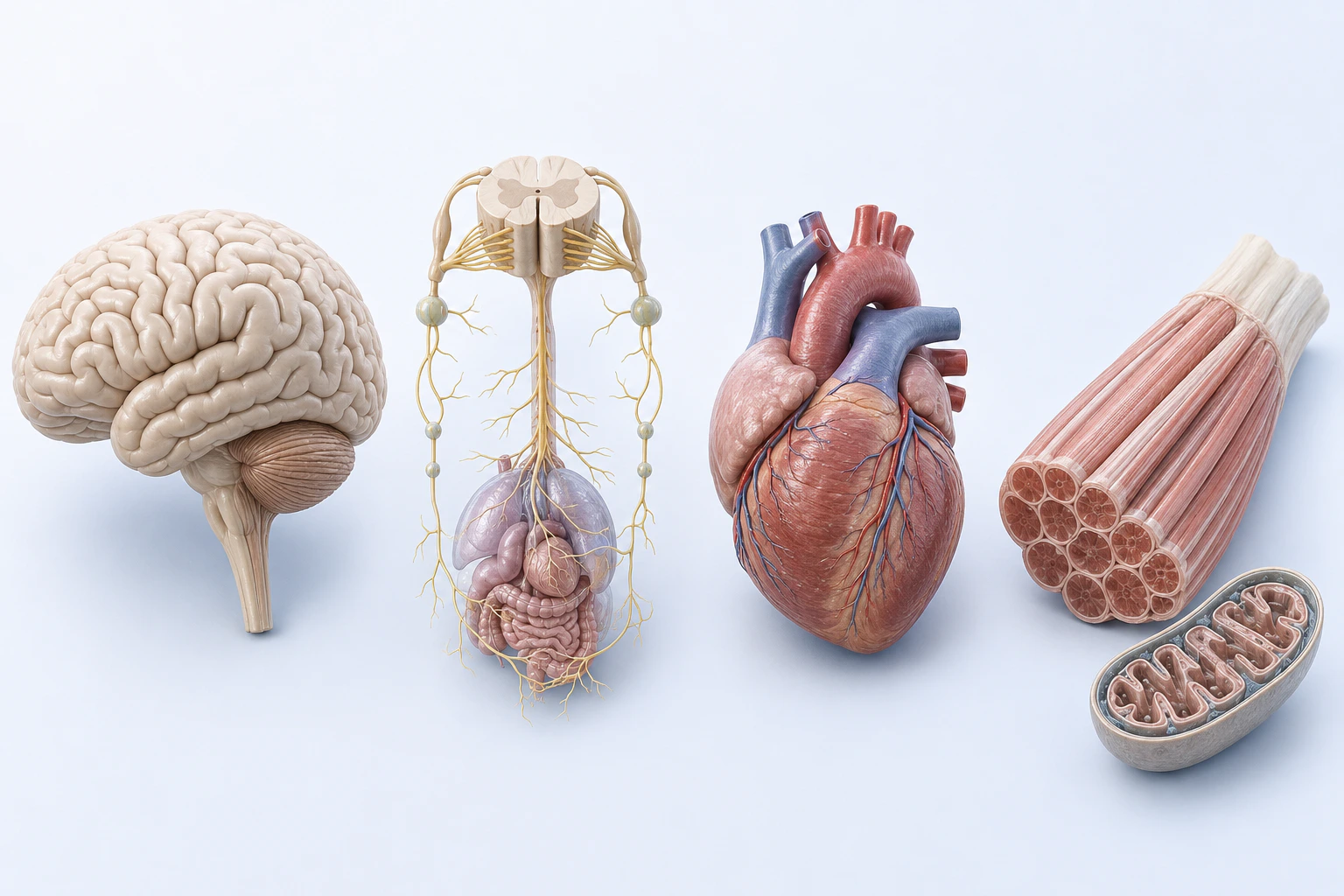
Neutral multisystem orientation for myalgic encephalomyelitis/chronic fatigue syndrome. No confirmatory diagnostic test exists; these teaching models do not depict a disease signature, abnormal biomarker, exercise recommendation, or diagnosis.
Scientific media record1 verified identifier
- Subject
- Fatigue Syndrome, Chroniccondition
- Identifiers
- MeSH:D015673
- Review
- Editorial review completeIdentifiers authority-verified · Accessibility validated · · chronic-fatigue-syndrome|chronic-fatigue-syndrome-pathology-v1.webp
- Digital source
- Trained-algorithmic mediaCreated with a trained generative algorithm and reviewed by WikiBiome for subject identity, scientific framing, identifiers, provenance, and accessibility.
- Scientific basis
- Fatigue Syndrome, Chronic — MeSHDiagnosing ME/CFS
- License
- CC BY-SA 4.0Created
Myalgic encephalomyelitis/chronic fatigue syndrome (ME/CFS) is a complex, disabling condition characterized by profound fatigue not relieved by rest, post-exertional malaise (PEM—symptom worsening after physical or cognitive exertion), unrefreshing sleep, cognitive dysfunction ("brain fog"), and orthostatic intolerance. It affects 17-24 million people globally, with a striking 3:1 female predominance.
ME/CFS lacks a definitive diagnostic biomarker, and its pathophysiology remains contested—though the Gut Microbiome is now recognized as a significant and potentially causal contributor.
The COVID-19 pandemic brought renewed attention to ME/CFS because Long COVID shares its core features, suggesting a common post-infectious Dysbiosis-fatigue pathway.
Evidence map6 cited passagesInspect provenance +
A meta-analysis of gut microbiome studies in severe mental illness and chronic fatigue identified consistent dysbiosis in ME/CFS:
A Mendelian randomization study identified causal relationships between specific gut taxa and ME/CFS:
A provocative observation: nickel allergy is significantly more common in ME/CFS patients than in the general population. Given that:
meta-analysis of gut dysbiosis
MR evidence for causal taxa
nickel allergy enrichment in ME/CFS
One disease. Five evidence layers.
A generated systems view of the metals, organisms, host sequestration signals, ecological conditions, and microbial functions indexed for Chronic Fatigue Syndrome.
Evidence layer
Taxonomic signature
Organisms reported as enriched or depleted, with their indexed functional context kept beside the name.No structured taxa indexed yet.
No structured taxa indexed yet.
Evidence layer
Nutritional immunity
Host metal-withholding, inflammatory, antioxidant, and microbial-metabolite signals indexed in the signature.Elevated host signals
0No structured signals indexed yet.
Depleted protective signals
0No structured signals indexed yet.
Evidence layer
Ecological state
The environmental conditions that connect the organism-level observations into a system.No structured ecological features indexed yet.
Evidence layer
Virulence functions
Microbial structures, enzymes, and acquisition systems implicated by the linked evidence.No structured virulence functions indexed yet.
The disease record, in full.
The original WikiBiome disease narrative remains intact beneath the generated signature atlas.
Microbiome Associations#
Meta-Analytic Evidence#
A meta-analysis of gut microbiome studies in severe mental illness and chronic fatigue identified consistent dysbiosis in ME/CFS.[1]Gut Dysbiosis in Severe Mental Illness and Chronic Fatigue: A Novel Trans-Diagnostic Construct? A Systematic Review and Meta-AnalysisSafadi JM, Quinton AMG, Lennox B et al. · 2022Open reference 1 ↓
Depleted: Faecalibacterium prausnitzii, Bifidobacterium, Roseburia—Butyrate-producing anti-inflammatory commensals. Enriched: Enterobacteriaceae, Enterococcus, certain Clostridium species. Functional: Reduced SCFA production, increased intestinal permeability, elevated LPS translocation.
Mendelian Randomization Evidence#
A Mendelian randomization study identified causal relationships between specific gut taxa and ME/CFS.[2]He et al 2023 — Causal Effects Between Gut Microbiome and Myalgic Encephalomyelitis/Chronic Fatigue Syndrome: A Two-Sample Mendelian Randomization StudyGang He, Yu Cao, Honghao Ma et al. · 2023Open reference 2 ↓
Genetic instruments confirm that certain taxa are upstream drivers of ME/CFS, not merely consequences of inactivity or dietary changes. This is critical because critics have long argued that microbiome changes in ME/CFS reflect deconditioning rather than causation.
The MR evidence rules out this reverse causation, placing specific bacteria as genuine risk factors.
The Nickel Connection#
Nickel Allergy in ME/CFS#
A provocative observation: nickel allergy is significantly more common in ME/CFS patients than in the general population.[3]Nickel Allergy Is Found in a Majority of Women with Chronic Fatigue Syndrome and Muscle Pain - And May Be Triggered by Cigarette Smoke and Dietary Nickel IntakeRegland B, Zachrisson O, Stejskal V et al. · 2001Open reference 3 ↓ Given that.
Nickel directly activates TLR4 in humans (human-specific mechanism via H456/H458 residues). Nickel allergy affects ~15% of the general population but appears to be enriched in ME/CFS. TLR4 activation drives Neuroinflammation via the gut-brain axis.
ME/CFS has a female predominance, and nickel allergy is more common in women.
This raises the possibility that chronic, low-level nickel exposure—dietary, dental, or occupational—could sustain the systemic immune activation seen in ME/CFS through persistent TLR4 signaling. The combination of nickel-driven TLR4 activation and gut dysbiosis-derived LPS (also a TLR4 ligand) could create an additive inflammatory burden.
Metal-Immune Interface#
Beyond nickel, ME/CFS involves broader metal-immune dysregulation. Iron: Functional iron deficiency despite normal serum levels—consistent with Nutritional Immunity (Metal Sequestration) where hepcidin-driven sequestration reduces iron bioavailability. Zinc: Deficiency impairs immune regulation and worsens the Th1/Th2 imbalance.
Magnesium: Intracellular magnesium depletion is reported in ME/CFS and may contribute to mitochondrial dysfunction.
Mitochondrial Dysfunction#
ME/CFS is characterized by impaired cellular energy production:
- Reduced ATP generation under metabolic stress
- Impaired oxidative phosphorylation
- This may connect to metal homeostasis: iron-sulfur clusters are essential components of the electron transport chain, and metal dyshomeostasis could impair mitochondrial function
- Gut-derived metabolites (indoxyl sulfate, p-cresol) from the dysbiotic microbiome directly inhibit mitochondrial complex activity
Post-Infectious Trigger and Long-COVID Overlap#
Many ME/CFS cases are triggered by infection (EBV, enteroviruses, Q fever). Long COVID appears to be a post-SARS-CoV-2 variant of the same syndrome:
- Both conditions share depleted butyrate producers and increased intestinal permeability
- Both show persistent immune activation with elevated pro-inflammatory cytokines
- Both feature post-exertional malaise and cognitive dysfunction
- SARS-CoV-2 viral persistence in the gut has been proposed as a driver of ongoing microbiome disruption
Gut-Brain Axis in ME/CFS#
The ME/CFS gut-brain axis involves:
- Dysbiosis → reduced butyrate → impaired gut barrier
- LPS translocation → systemic immune activation (elevated TNF-alpha, IL-6)
- Tryptophan diversion → kynurenine pathway activation → reduced serotonin, increased quinolinic acid
- Neuroinflammation → microglial activation → cognitive dysfunction, fatigue
- Autonomic dysfunction → impaired vagal tone → orthostatic intolerance
Associated Conditions#
| Condition | Overlap | Significance | |
|---|---|---|---|
| Fibromyalgia | 30-70% comorbidity; shared butyrate depletion, chronic pain | May be the same condition manifesting differently | |
| Long-COVID | Shared post-infectious phenotype; identical microbiome signature | Post-COVID ME/CFS may account for millions of new cases | |
| [[ibs | irritable-bowel-syndrome]] | 50-90% IBS in ME/CFS | Gut dysbiosis likely the common driver |
| Depression | High comorbidity; shared tryptophan diversion | Bidirectional causation likely |
Open Questions#
Unresolved questions identified by the current evidence record.
01Does low-nickel diet improve ME/CFS symptoms in nickel-sensitized patients?+
The current WikiBiome record identifies this as an unresolved evidence gap.
02Can the specific causal taxa from MR studies be targeted with precision probiotics?+
The current WikiBiome record identifies this as an unresolved evidence gap.
03Is viral persistence in the gut (SARS-CoV-2, EBV) the ongoing driver of dysbiosis?+
The current WikiBiome record identifies this as an unresolved evidence gap.
04Can mitochondrial-targeted interventions (CoQ10, NAD+) work synergistically with microbiome restoration?+
The current WikiBiome record identifies this as an unresolved evidence gap.
05Is ME/CFS a form of chronic TLR4 activation that could be treated with TLR4 antagonists?+
The current WikiBiome record identifies this as an unresolved evidence gap.
Key Studies#
- [1]Gut Dysbiosis in Severe Mental Illness and Chronic Fatigue: A Novel Trans-Diagnostic Construct? A Systematic Review and Meta-AnalysisSafadi JM, Quinton AMG, Lennox B et al. · 2022Open reference 1 ↓—meta-analysis of gut dysbiosis
- [2]He et al 2023 — Causal Effects Between Gut Microbiome and Myalgic Encephalomyelitis/Chronic Fatigue Syndrome: A Two-Sample Mendelian Randomization StudyGang He, Yu Cao, Honghao Ma et al. · 2023Open reference 2 ↓—MR evidence for causal taxa
- [3]Nickel Allergy Is Found in a Majority of Women with Chronic Fatigue Syndrome and Muscle Pain - And May Be Triggered by Cigarette Smoke and Dietary Nickel IntakeRegland B, Zachrisson O, Stejskal V et al. · 2001Open reference 3 ↓—nickel allergy enrichment in ME/CFS
Cross-References#
- Fibromyalgia—overlapping condition
- Nickel Allergy and Allergic Contact Dermatitis—TLR4-mediated immune activation
- Toll-Like Receptors—innate immune interface
- Neuroinflammation—brain Metal-Driven Inflammation pathway
- Intestinal Permeability—barrier dysfunction
- butyrate—depleted protective SCFA
References 4
Numbered by first appearance in the article, then reconciled with its declared source list.
- 1
Safadi JM, Quinton AMG, Lennox B et al. (2022). Gut Dysbiosis in Severe Mental Illness and Chronic Fatigue: A Novel Trans-Diagnostic Construct? A Systematic Review and Meta-Analysis. Molecular Psychiatry.
- 2
Gang He, Yu Cao, Honghao Ma et al. (2023). He et al 2023 — Causal Effects Between Gut Microbiome and Myalgic Encephalomyelitis/Chronic Fatigue Syndrome: A Two-Sample Mendelian Randomization Study. Frontiers in Microbiology.
- 3
Regland B, Zachrisson O, Stejskal V et al. (2001). Nickel Allergy Is Found in a Majority of Women with Chronic Fatigue Syndrome and Muscle Pain - And May Be Triggered by Cigarette Smoke and Dietary Nickel Intake. Journal of Chronic Fatigue Syndrome.
- 4
Suguru Saito, Shima Shahbaz, Xian Luo et al. (2024). Saito et al 2024 — Metabolomic and Immune Alterations in Long COVID Patients with Chronic Fatigue Syndrome. Frontiers in Immunology.
Article network
Mentioned here 18
Pages linking here 1
Connect the evidence
Publicly readable discussion by ORCID-authenticated researchers. Questions, interpretation, methods, corrections, and new evidence stay attached to this record.
No discussion yet. Start with a precise question or a source-backed observation.
Activity and accepted changes
Accepted researcher context, editorial status, public discussion, and upstream Git revisions are shown together. Pending, declined, and withdrawn proposals remain private.
- published revision
Consolidate microbial metabolite knowledge
Karen Pendergrass · +1 −1
Inspect exact Git diff ↗ - published revision
Backfill gut microbiome concept links
Karen Pendergrass · +1 −1
Inspect exact Git diff ↗ - published revision
Backfill inflammation concept links
Karen Pendergrass · +1 −1
Inspect exact Git diff ↗ - published revision
Complete corpus-wide Dysbiosis linking
Karen Pendergrass · +1 −1
Inspect exact Git diff ↗ - published revision
massive wiki expansion: 149 stubs fixed, 100+ new pages, Rule 15 scan, keystone papers
WikiBiome Deploy Bot · +22 −21
Inspect exact Git diff ↗ - published revision
ingest: 87 papers (17 endometriosis, 67 erectile dysfunction, 3 cross-condition)
WikiBiome Deploy Bot · +1 −1
Inspect exact Git diff ↗ - published revision
nightly maintenance: 94 stub demotions, 181 source_count fixes, 22 auto-discovered stubs, 5 adversarial audits, 3 boundary fixes, 3 evidence-level corrections
WikiBiome Deploy Bot · +2 −0
Inspect exact Git diff ↗ - published revision
pre-overnight checkpoint 2026-04-18
WikiBiome Deploy Bot · +126 −0
Inspect exact Git diff ↗