

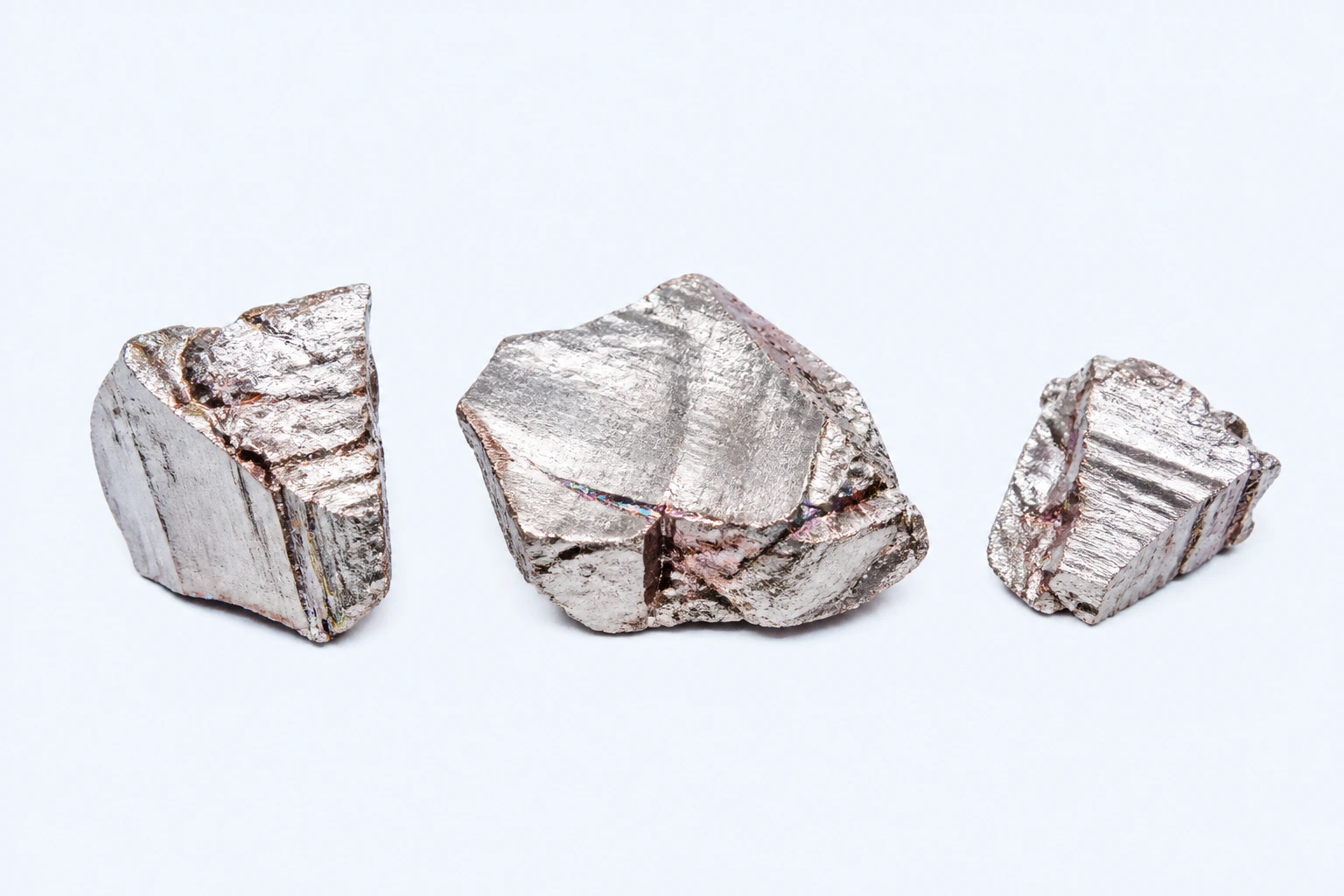
Elemental bismuth (Bi), shown as three representative brittle silvery pieces with restrained surface tarnish. Color and form vary with purity, processing, and oxidation; this is not analytical reference material or a photograph.
Scientific media record2 verified identifiers
- Subject
- Bismuthelement
- Identifiers
- Atomic number 83PubChem CID:5359367
- Review
- Editorial review completeIdentifiers authority-verified · Accessibility validated · · bismuth|bismuth-technical-specimen-v1.webp
- Digital source
- Trained-algorithmic mediaCreated with a trained generative algorithm and reviewed by WikiBiome for subject identity, scientific framing, identifiers, provenance, and accessibility.
- Scientific basis
- Bismuth — PubChem ElementBismuth, PubChem CID 5359367
- License
- CC BY-SA 4.0Created
A heavy metal traditionally considered safe enough for over-the-counter gastrointestinal remedies (Pepto-Bismol, De-Nol), bismuth is re-emerging as a potent antimicrobial synergist. Its key property: Bi3+ competes with iron(III) (Fe3+) for binding sites on siderophores and bacterial metalloenzymes, creating iron starvation conditions that amplify the efficacy of siderophore-conjugated antibiotics.
Despite its position on the periodic table next to lead and polonium, bismuth is the least toxic of the heavy post-transition metals—a consequence of poor gastrointestinal absorption (<1% of ingested dose) and rapid renal clearance of the small absorbed fraction (Sun et al. 2013).
Evidence map4 cited passagesInspect provenance +
Fe3+ displacement—Bi3+ binds siderophores and iron-acquisition proteins with sufficient affinity to displace iron, starving bacteria of their most critical nutrient.
Bismuth-cefiderocol combination achieves enhanced bactericidal activity against multidrug-resistant Gram-negatives by a dual mechanism: Bi3+ competes for iron binding sites, which paradoxically increases bacterial siderophore production and uptake—pulling more cefiderocol into the cell.
Resistance prevention—The combination suppresses resistance evolution because bacteria cannot simultaneously downregulate siderophore uptake (to exclude cefiderocol) and upregulate it (to overcome bismuth-induced iron starvation).
Biofilm penetration—Bismuth disrupts biofilm iron architecture, improving cefiderocol access to biofilm-embedded cells.
Contents
1. Biological Chemistry2. Mechanism of Antimicrobial Action3. Synergy with Cefiderocol4. H. pylori Quadruple Therapy5. Pharmaceutical Forms and Pharmacokinetics6. Nutritional Immunity Parallels7. Environmental and Dietary Exposure8. Open Questions9. Cross-ReferencesBiological Chemistry#
Bismuth has no known essential role in human or bacterial biology.
All of its biological effects derive from its coordination chemistry—a highly oxophilic and thiophilic cation with ionic radius (1.03 Å) similar enough to iron(III) (Fe3+) (0.65 Å octahedral; larger in tetrahedral) and zinc(II) (Zn2+) (0.74 Å) to occupy their binding pockets, but with binding constants for S- and O-donor ligands that can exceed physiological metals by 3-10 log units.
This makes bismuth a promiscuous competitor for soft-donor coordination sites in proteins, particularly cysteine-rich metallothionein-like domains and Histidine/glutamate clusters in metallochaperones.
Because bismuth sequesters thiols and iron-binding sites without participating in physiological redox chemistry, it behaves as an ecological stressor rather than a reactive toxin—it starves organisms of their metal cofactors without producing ROS or alkylating DNA.
Mechanism of Antimicrobial Action#
iron(III) (Fe3+) displacement—Bi3+ binds siderophores and iron-acquisition proteins with sufficient affinity to displace iron, starving bacteria of their most critical nutrient.[1]Wang et al. 2023 — Bismuth-Cefiderocol Synergy as Metallo-Sideromycin StrategyWang, et al. · 2023Open reference 1 ↓
Metalloenzyme inhibition—Bi3+ inactivates iron- and zinc-dependent bacterial enzymes including metallo-beta-lactamases (NDM-1, VIM-2, IMP-4), Urease (a Nickel-dependent enzyme), alcohol dehydrogenase, and fumarase (Wang et al. 2018, Nat. Commun.; Chen et al.
2020, Cell Host Microbe). The NDM-1 inhibition is notable: colloidal bismuth subcitrate restores carbapenem susceptibility in previously resistant Klebsiella pneumoniae and E. coli strains.
Glutathione depletion—Bismuth binds intracellular glutathione with very high affinity (log K ~29), depleting bacterial redox buffers and potentiating oxidative killing by host neutrophils and co-administered antibiotics.
Biofilm disruption—Bismuth compounds destabilize biofilm architecture by interfering with iron-dependent quorum sensing (PQS in Pseudomonas, AI-2 in Streptococcus) and extracellular matrix production. Bismuth-thiol formulations have been tested clinically against Staphylococcus aureus and Pseudomonas aeruginosa biofilm infections (Domenico et al. 2001).
DNA gyrase inhibition—At higher concentrations, Bi3+ perturbs the zinc-dependent catalytic site of bacterial topoisomerases.
Synergy with Cefiderocol#
The most significant recent advance in bismuth pharmacology is its synergy with siderophore-conjugated antibiotics.
Bismuth-cefiderocol combination achieves enhanced bactericidal activity against multidrug-resistant Gram-negatives by a dual mechanism: Bi3+ competes for iron binding sites, which paradoxically increases bacterial siderophore production and uptake—pulling more cefiderocol into the cell.[1]Wang et al. 2023 — Bismuth-Cefiderocol Synergy as Metallo-Sideromycin StrategyWang, et al. · 2023Open reference 1 ↓
Resistance prevention—The combination suppresses resistance evolution because bacteria cannot simultaneously downregulate siderophore uptake (to exclude cefiderocol) and upregulate it (to overcome bismuth-induced iron starvation).[1]Wang et al. 2023 — Bismuth-Cefiderocol Synergy as Metallo-Sideromycin StrategyWang, et al. · 2023Open reference 1 ↓
Biofilm penetration—Bismuth disrupts biofilm iron architecture, improving cefiderocol access to biofilm-embedded cells.[1]Wang et al. 2023 — Bismuth-Cefiderocol Synergy as Metallo-Sideromycin StrategyWang, et al. · 2023Open reference 1 ↓
H. pylori Quadruple Therapy#
Bismuth quadruple therapy (bismuth subsalicylate or subcitrate + metronidazole + tetracycline + PPI) remains a first-line treatment for Helicobacter pylori infection, particularly in regions with clarithromycin resistance >15% (Malfertheiner et al. 2022, Maastricht VI/Florence Consensus; Chey et al. 2017, ACG Guidelines).
Eradication rates exceed 90% even against clarithromycin-resistant strains.
Bismuth's anti-H. pylori activity involves disruption of urease (nickel (Ni)-dependent, essential for acid survival), fumarase and alcohol dehydrogenase, ATP synthase inhibition, and physical coating of the gastric mucosa that blocks bacterial adhesion (Ge et al. 2007, BioMetals).
Proteomic studies show bismuth perturbs at least 166 H. pylori proteins, targeting nickel and iron trafficking (HypA, HypB, NikR) and Oxidative Stress defence (AhpC, TsaA)—a multi-target footprint that explains why resistance to bismuth has never been clinically documented despite half a century of use (Sun et al.
2013, Metallomics).
The combination of bismuth's direct bactericidal effects with its metalloenzyme inhibition explains its sustained clinical efficacy despite decades of use.
Pharmaceutical Forms and Pharmacokinetics#
Bismuth is administered as insoluble salts that release Bi3+ locally in the GI tract.
Bismuth subsalicylate (BSS, Pepto-Bismol)—dissociates in the stomach to bismuth oxychloride and salicylic acid; the salicylate moiety contributes anti-inflammatory activity. Colloidal bismuth subcitrate (CBS, De-Nol, Pylera component)—forms a glycoprotein-bismuth precipitate on ulcer surfaces at acidic pH.
Ranitidine bismuth citrate (Tritec, now withdrawn)—combined acid suppression with bismuth activity. Bismuth-thiol compounds (investigational)—e.g., bismuth-ethanedithiol (BisEDT), designed to penetrate biofilms of P. aeruginosa and S. aureus.
Systemic absorption is <1% with normal renal function; the absorbed fraction is cleared in urine with half-life ~5 days. Chronic high-dose exposure (>3 g/day for months) can cause reversible bismuth encephalopathy, seen historically in French patients using bismuth as a laxative (Supino-Viterbo et al. 1977).
Nutritional Immunity Parallels#
Bismuth pharmacology mimics mechanisms of host nutritional immunity. When the host upregulates Lactoferrin and Lipocalin-2 to sequester iron from pathogens, it is executing the same chemistry bismuth executes therapeutically: outcompete microbes for essential metals without producing toxic oxidants.
Framing bismuth this way reframes its clinical role—not as an antacid with minor antibacterial properties, but as an exogenous nutritional-immunity reinforcement that selectively disables metal-dependent pathogens while sparing host metal homeostasis (which bismuth can't meaningfully disrupt due to poor absorption).
Environmental and Dietary Exposure#
Unlike Lead, Cadmium, or Arsenic, bismuth contributes negligible background exposure through diet or environment. Crustal abundance is very low (~0.009 ppm), bismuth does not bioaccumulate in crops, and industrial uses (low-melting alloys, cosmetics, nuclear reactor fuel cladding) rarely produce community-level exposure.
For practical purposes, pharmaceutical intake dominates human bismuth exposure—a factor that distinguishes it from every other heavy metal in the WikiBiome knowledge base and explains why bismuth can be discussed as a therapeutic lever rather than a contamination concern.
Open Questions#
Unresolved questions identified by the current evidence record.
01Can bismuth salts be formulated to selectively target pathogenic Gram-negatives without disrupting beneficial gut anaerobes?+
Current quadruple therapy does cause transient depletion of Bifidobacterium and Lactobacillus, though recovery is typically complete within 4-8 weeks.
02Does chronic low-dose bismuth exposure affect the microbiome of daily Pepto-Bismol users (e.g., travellers on long-term prophylaxis)?+
The current WikiBiome record identifies this as an unresolved evidence gap.
03Is the reported anti-inflammatory effect of bismuth subsalicylate attributable to the bismuth or the salicylate moiety, and does bismuth contribute independently to the control of traveller's diarrhoea caused by enterotoxigenic Escherichia coli?+
The current WikiBiome record identifies this as an unresolved evidence gap.
Cross-References#
- Gallium—Partner in siderophore-antibiotic Trojan horse strategies; gallium mimics iron(III) (Fe3+) redox-inactively, bismuth competes for the same sites
- Iron—The metal bismuth competes with
- Zinc—Displaced from metallo-beta-lactamases by bismuth
- Nickel—Urease active site that bismuth inactivates
- Siderophores and Metallophores—The uptake systems bismuth exploits
- Helicobacter pylori—Primary clinical target
- cefiderocol—Siderophore-antibiotic synergy partner
- Biofilm—Disrupted by bismuth-iron competition
- Antimicrobial Resistance—Bismuth combinations suppress resistance evolution
- Pseudomonas aeruginosa—Target pathogen for bismuth-cefiderocol synergy
- Escherichia coli—Traveller's diarrhoea target of bismuth subsalicylate
- Lactoferrin—Host nutritional-immunity analogue of bismuth's mechanism
References 6
Numbered by first appearance in the article, then reconciled with its declared source list.
- 1
Wang, et al. (2023). Wang et al. 2023 — Bismuth-Cefiderocol Synergy as Metallo-Sideromycin Strategy. Nature Communications.
- 2
Ikhazuagbe, I., et al. (2025). Ikhazuagbe et al. 2025 — Gallium Nanoparticles as Antimicrobial Agents. RSC Advances.
- 3
Ngoc Huu Nguyen, Zufu Lu, Aaron Elbourne et al. (2024). Nguyen 2024 — Engineering Antibacterial Bioceramics: Design Principles and Mechanisms of Action. Materials Today Bio.
- 4
Lopez-Botella A, Gomez-Torres MJ, Sanchez R et al. (2023). Elevated Lead, Nickel, and Bismuth Levels in the Peritoneal Fluid of a Peritoneal Endometriosis Patient without Toxic Habits or Occupational Exposure following a Vegetarian Diet. Toxics.
- 5
Maurya AP, Rajkumari J, Bhattacharjee A et al. (2020). Development, spread and persistence of antibiotic resistance genes (ARGs) in the soil microbiomes through co-selection. Reviews on Environmental Health.
- 6
Stephanie L. Neville, Jacqueline R. Morey, Erin B. Gillen et al. (2020). Neville et al. 2020 — Cadmium Stress Dictates Central Carbon Flux and Alters Membrane Composition in Streptococcus pneumoniae. Communications Biology.
Article network
Mentioned here 18
Pages linking here 3
Connect the evidence
Publicly readable discussion by ORCID-authenticated researchers. Questions, interpretation, methods, corrections, and new evidence stay attached to this record.
No discussion yet. Start with a precise question or a source-backed observation.
Activity and accepted changes
Accepted researcher context, editorial status, public discussion, and upstream Git revisions are shown together. Pending, declined, and withdrawn proposals remain private.
- published revision
Backfill oxidative stress concept links
Karen Pendergrass · +1 −1
Inspect exact Git diff ↗ - published revision
Add reviewed Histidine concept coverage
Karen Pendergrass · +1 −1
Inspect exact Git diff ↗ - published revision
Complete reviewed Urease contextual coverage
Karen Pendergrass · +1 −1
Inspect exact Git diff ↗ - published revision
massive wiki expansion: 149 stubs fixed, 100+ new pages, Rule 15 scan, keystone papers
WikiBiome Deploy Bot · +35 −25
Inspect exact Git diff ↗ - published revision
nightly maintenance: 94 stub demotions, 181 source_count fixes, 22 auto-discovered stubs, 5 adversarial audits, 3 boundary fixes, 3 evidence-level corrections
WikiBiome Deploy Bot · +2 −0
Inspect exact Git diff ↗ - published revision
pre-overnight checkpoint 2026-04-18
WikiBiome Deploy Bot · +1 −1
Inspect exact Git diff ↗ - published revision
Deep citation pass on 10 disease entities + expand 3 thin entities
WikiBiome Deploy Bot · +50 −9
Inspect exact Git diff ↗ - published revision
Health check fixes: 40 intervention pages + 14 entity Connections sections
WikiBiome Deploy Bot · +1 −0
Inspect exact Git diff ↗ - published revision
Health check gap fill: 15 missing pages identified and created
WikiBiome Deploy Bot · +49 −0
Inspect exact Git diff ↗