

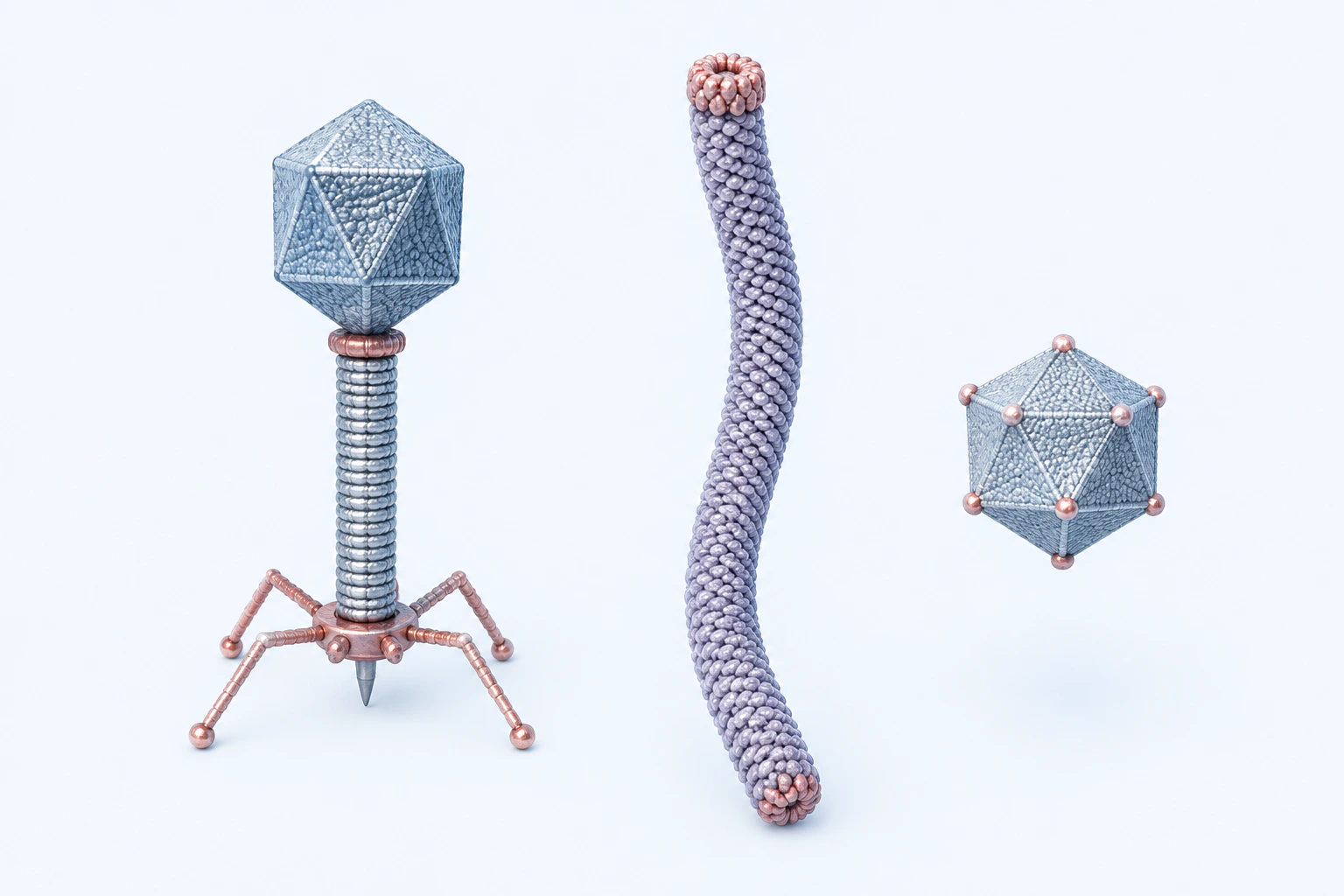
Representative bacteriophage morphology. These separated models do not identify taxa, establish universal morphology, show a host interaction or lifecycle stage, measure ecology, or support a therapeutic claim.
Scientific media record2 verified identifiers
- Subject
- Bacteriophagesbiological-process
- Identifiers
- WikiBiome:bacteriophagesMeSH:D001435
- Review
- Editorial review completeIdentifiers authority-verified · Accessibility validated · · bacteriophages|bacteriophages-mechanism-v1.webp
- Digital source
- Trained-algorithmic mediaCreated with a trained generative algorithm and reviewed by WikiBiome for subject identity, scientific framing, identifiers, provenance, and accessibility.
- Scientific basis
- Bacteriophages — Medical Subject HeadingsBacteriophages
- License
- CC BY-SA 4.0Created
Viruses that exclusively infect bacteria. Bacteriophages—phages for short—are the most abundant biological entities on Earth, outnumbering bacteria in most environments by ratios of 1:1 to 10:1. In the human gut, the phageome represents a powerful but underexplored force shaping microbial community structure.
Where traditional microbiome research has focused on bacteria, a growing body of evidence reveals that phages act as selective predators capable of driving Dysbiosis patterns in diseases ranging from Parkinson's disease to colorectal cancer—and that this predatory activity intersects with metal ecology in ways that are only beginning to be understood.
Evidence map9 cited passagesInspect provenance +
The most extensively documented phage-dysbiosis connection involves the gut phageome in parkinsons disease. Lytic phages targeting lactic acid bacteria—particularly Lactococcus—are more than 10-fold enriched in PD gut microbiomes, with corresponding depletion of the targeted bacteria (, cross-sectional). This phage-bacterial predator-prey dynamic offer
The ASD gut phageome shows wider diversity and higher abundance than typically developing controls, with significant expansion of Caudoviricetes bacteriophages (, computational-prediction). Phages infecting Bacteroidaceae and prophages within Faecalibacterium are enriched in ASD, potentially contributing to the depletion of this protective commensal observed
Gut virome alterations are documented in colorectal adenomas (), post-surgical CRC recurrence (), and metabolic syndrome (). In healthy individuals, prophages (integrated, quiescent) predominate; in disease states, extracellular lytic phage virions increase, suggesting activation of prophages under disease-associated stress.
Phage therapy—using phages to target specific pathogenic bacteria—is being explored as an alternative to conventional antibiotics, particularly for multidrug-resistant infections. A systematic review of clinical data (2000-2021) covering 59 studies found phage therapy well tolerated across pneumonia, urology, musculoskeletal, cardiovascular, and dermat
Targeted phage therapy against specific gut bacteria has shown promise in animal models: phages against cytolysin-positive Enterococcus faecalis reduced liver disease in humanized mice, and Klebsiella pneumoniae-targeting phages reduced steatohepatitis inflammation without altering the broader microbiota (, animal-model). Fecal virome transplantation (FVT) -
(cross-sectional)—Foundational study demonstrating 10-fold enrichment of lytic Lactococcus phages in PD gut; proposes phage-driven dysbiosis model.
(systematic-review-meta-analysis)—59-study systematic review confirming phage therapy safety across multiple clinical indications.
(animal-model)—Reviews phage therapy potential for cardiometabolic diseases; introduces FVT and temperate phage engineering concepts.
(computational-prediction)—Demonstrates expanded Caudoviricetes phageome in ASD with Bacteroidaceae-targeting and Faecalibacterium prophage enrichment.
Contents
1. Phage Biology2. Phage-Driven Dysbiosis3. Phage Therapy4. Connection to Metal Ecology5. Key Studies6. Cross-ReferencesPhage Biology#
Life Cycles#
Phages follow three major life cycles, each with different ecological consequences. Lytic—The phage hijacks bacterial machinery, replicates, and lyses the host cell to release progeny. This is the "predator" mode that directly reduces bacterial populations.
Lysogenic (temperate)—The phage integrates its genome into the bacterial chromosome as a prophage, replicating passively with the host. Lysogeny can alter bacterial function through lysogenic conversion—adding virulence factors, metabolic capabilities, or antibiotic resistance genes.
Chronic—The phage reduces bacterial growth without killing, maintaining a parasitic relationship that shifts competitive dynamics without eliminating the host.
Host Specificity#
Phages are typically highly specific, targeting individual bacterial species or even strains. This specificity makes them precision tools—capable of removing specific taxa without disrupting the broader microbial community, unlike broad-spectrum antibiotics.
Phage-Driven Dysbiosis#
Parkinson's Disease#
The most extensively documented phage-dysbiosis connection involves the gut phageome in Parkinson's Disease. Lytic phages targeting lactic acid bacteria—particularly Lactococcus—are more than 10-fold enriched in PD gut microbiomes, with corresponding depletion of the targeted bacteria (,[1]Tetz 2018 -- Bacteriophage and Gut Dysbiosis in Parkinson's DiseaseGeorge Tetz, Stuart M Brown, Yuhan Hao et al. · 2018Open reference 1 ↓ cross-sectional).
This phage-bacterial predator-prey dynamic offers a mechanistic explanation for the selective bacterial depletion observed in PD that cannot be explained by diet or medication alone.
The depleted lactic acid bacteria are key producers of Short-Chain Fatty Acids (SCFAs) and contribute to gut barrier integrity; their loss removes metal-buffering capacity and increases free Iron, Zinc, and Manganese availability for metal-tolerant pathogens.
Autism Spectrum Disorder#
The ASD gut phageome shows wider diversity and higher abundance than typically developing controls, with significant expansion of Caudoviricetes bacteriophages (,[2]Shahin 2023 — Metagenomics Revealed a Correlation of Gut Phageome with Autism Spectrum DisorderKhashayar Shahin, Abbas Soleimani-Delfan, Zihan He et al. · 2023Open reference 2 ↓ computational-prediction).
Phages infecting Bacteroidaceae and prophages within Faecalibacterium are enriched in ASD, potentially contributing to the depletion of this protective commensal observed across ASD microbiome studies.
Colorectal Cancer and Metabolic Disease#
Gut virome alterations are documented in colorectal adenomas ([3]Characteristics of the gut virome in patients with premalignant colorectal adenomaPan Zhang, Xiaofeng Tuo, Jiong Jiang et al. · 2025Open reference 3 ↓), post-surgical CRC recurrence ([4]Alterations in colorectal cancer virome and its persistence after surgerySi Xian Ho, Jia-Hao Law, Chin-Wen Png et al. · 2024Open reference 4 ↓), and metabolic syndrome ([5]Gut Virome Profiling Identifies a Widespread Bacteriophage Family Associated with Metabolic SyndromePatrick A. de Jonge, Koen Wortelboer, Torsten P. M. Scheithauer et al. · 2022Open reference 5 ↓).
In healthy individuals, prophages (integrated, quiescent) predominate; in disease states, extracellular lytic phage virions increase, suggesting activation of prophages under disease-associated stress.
Phage Therapy#
Clinical Evidence#
Phage therapy—using phages to target specific pathogenic bacteria—is being explored as an alternative to conventional antibiotics, particularly for multidrug-resistant infections.
A systematic review of clinical data (2000-2021) covering 59 studies found phage therapy well tolerated across pneumonia, urology, musculoskeletal, cardiovascular, and dermatological indications (,[6]Safety and efficacy of phage therapy in difficult-to-treat infections: a systematic reviewSaartje Uyttebroek, Baisong Chen, Jolien Onsea et al. · 2022Open reference 6 ↓ systematic-review-meta-analysis). However, no randomized controlled trials were identified, and most evidence derives from case reports and case series.
Phage resistance development and neutralizing antiphage antibodies were noted in some cases.
Cardiometabolic Applications#
Targeted phage therapy against specific gut bacteria has shown promise in animal models: phages against cytolysin-positive Enterococcus faecalis reduced liver disease in humanized mice, and Klebsiella pneumoniae-targeting phages reduced steatohepatitis Metal-Driven Inflammation without altering the broader microbiota (,[7]Opportunities and challenges in phage therapy for cardiometabolic diseasesKoen Wortelboer, Hilde Herrema · 2024Open reference 7 ↓ animal-model).
Fecal virome transplantation (FVT)—transferring the phage-containing filtrate of fecal matter—can alter gut microbiota composition similarly to full FMT, offering a bacteria-free alternative.
Temperate Phage Engineering#
An emerging approach uses temperate phages not to kill bacteria but to alter their function through lysogenic conversion—shifting metabolite production from harmful to beneficial (e.g., increased SCFA production). CRISPR-Cas systems could engineer phages for enhanced specificity.
Connection to Metal Ecology#
The intersection of phages and metal ecology remains largely unexplored but mechanistically compelling. Phage predation of metal-buffering commensals—Lactic acid bacteria, bifidobacteria, and other commensals bind dietary metals and maintain gut barrier integrity. Their phage-mediated depletion releases metals into the luminal environment, potentially feeding metal-dependent pathogens.
Prophage induction by metal stress—Environmental stressors including Oxidative Stress and DNA damage (both downstream of metal toxicity) can trigger prophage induction, converting lysogenic bacteria to lytic phage factories.
Phage-resistant mutants—Bacteria that survive phage predation often carry surface modifications that also alter metal binding and transport properties.
Key Studies#
[1]Tetz 2018 -- Bacteriophage and Gut Dysbiosis in Parkinson's DiseaseGeorge Tetz, Stuart M Brown, Yuhan Hao et al. · 2018Open reference 1 ↓ (cross-sectional)—Foundational study demonstrating >10-fold enrichment of lytic Lactococcus phages in PD gut; proposes phage-driven dysbiosis model.
[6]Safety and efficacy of phage therapy in difficult-to-treat infections: a systematic reviewSaartje Uyttebroek, Baisong Chen, Jolien Onsea et al. · 2022Open reference 6 ↓ (systematic-review-meta-analysis)—59-study systematic review confirming phage therapy safety across multiple clinical indications.[7]Opportunities and challenges in phage therapy for cardiometabolic diseasesKoen Wortelboer, Hilde Herrema · 2024Open reference 7 ↓ (animal-model)—Reviews phage therapy potential for cardiometabolic diseases; introduces FVT and temperate phage engineering concepts.
[2]Shahin 2023 — Metagenomics Revealed a Correlation of Gut Phageome with Autism Spectrum DisorderKhashayar Shahin, Abbas Soleimani-Delfan, Zihan He et al. · 2023Open reference 2 ↓ (computational-prediction)—Demonstrates expanded Caudoviricetes phageome in ASD with Bacteroidaceae-targeting and Faecalibacterium prophage enrichment.
Cross-References#
- Parkinson's Disease—Primary disease model for phage-driven gut dysbiosis
- Autism Spectrum Disorder—Phageome expansion and diversification documented
- Colorectal Cancer—Virome alterations in adenomas and post-surgical persistence
- dysbiosis—Phage predation as an underexplored driver of microbial imbalance
- Gut Microbiome—Phageome as the "dark matter" of the gut ecosystem
- Short-Chain Fatty Acids (SCFAs)—Lost when phage predation depletes SCFA-producing commensals
- Iron—Freed when metal-buffering commensals are phage-depleted
- Antimicrobial Resistance—Phage therapy as an alternative to antibiotics for MDR infections
References 14
Numbered by first appearance in the article, then reconciled with its declared source list.
- 1
George Tetz, Stuart M Brown, Yuhan Hao et al. (2018). Tetz 2018 -- Bacteriophage and Gut Dysbiosis in Parkinson's Disease. Scientific Reports.
- 2
Khashayar Shahin, Abbas Soleimani-Delfan, Zihan He et al. (2023). Shahin 2023 — Metagenomics Revealed a Correlation of Gut Phageome with Autism Spectrum Disorder. Gut Pathogens.
- 3
Pan Zhang, Xiaofeng Tuo, Jiong Jiang et al. (2025). Characteristics of the gut virome in patients with premalignant colorectal adenoma. Journal of Translational Medicine.
- 4
Si Xian Ho, Jia-Hao Law, Chin-Wen Png et al. (2024). Alterations in colorectal cancer virome and its persistence after surgery. Scientific Reports.
- 5
Patrick A. de Jonge, Koen Wortelboer, Torsten P. M. Scheithauer et al. (2022). Gut Virome Profiling Identifies a Widespread Bacteriophage Family Associated with Metabolic Syndrome. Nature Communications.
- 6
Saartje Uyttebroek, Baisong Chen, Jolien Onsea et al. (2022). Safety and efficacy of phage therapy in difficult-to-treat infections: a systematic review. The Lancet Infectious Diseases.
- 7
Koen Wortelboer, Hilde Herrema (2024). Opportunities and challenges in phage therapy for cardiometabolic diseases. Trends in Endocrinology and Metabolism.
- 8
George Tetz, Victor Tetz (2021). Tetz 2021 -- Gut Virome Alterations in Parkinson's Disease. Communications Biology.
- 9
George Tetz, Victor Tetz (2022). Tetz 2022 -- The Effects of Gut Dysbiosis via Bacteriophages and Its Role in Parkinson's Disease. Pathogens.
- 10
George Tetz, Victor Tetz (2024). Tetz 2024 -- The Impact of Bacteriophage on the Aging Brain and Inflammatory Response: Relevance to Parkinson's Disease. Scientific Reports.
- 11
George Tetz, Victor Tetz (2025). Tetz 2025 -- The Impact of Combined Bacteriophage and Toxin Exposure on Gut Viability in Parkinson's Disease Models. Scientific Reports.
- 12
Ren Y, Zhang P, Yu H et al. (2025). Metagenome-Based Characterization of the Gut Virome in Patients with Schizophrenia. Journal of Translational Medicine.
- 13
Kosuke Fujimoto, Daichi Miyaoka, Satoshi Uematsu (2022). Characterization of the Human Gut Virome in Metabolic and Autoimmune Diseases. Inflammation and Regeneration.
- 14
Zhuo Liu, Meihong Liu, Huixiang Chen et al. (2026). Distinct gut virome profiles are associated with response to anti-PD-1 therapy in non-small cell lung cancer. Journal of Translational Medicine.
Article network
Connect the evidence
Publicly readable discussion by ORCID-authenticated researchers. Questions, interpretation, methods, corrections, and new evidence stay attached to this record.
No discussion yet. Start with a precise question or a source-backed observation.
Published page changes
This record shows only material changes published on this page, including changes to its content, evidence, conclusions, or author context. Internal processes and discussion activity are excluded. Pending, declined, and withdrawn proposals remain private.
- published revision
Created “Bacteriophages”: Viruses that exclusively infect bacteria. Bacteriophages -- phages for short -- are the most abundant biological entities on Earth, outnumbering bacteria in most environments by ratios of 1:1 to 10:1.…
Created “Bacteriophages”: Viruses that exclusively infect bacteria. Bacteriophages -- phages for short -- are the most abundant biological entities on Earth, outnumbering bacteria in most environments by ratios of 1:1 to 10:1.… Published sections: Bacteriophages; Life Cycles; Host Specificity; Parkinson's Disease; Autism Spectrum Disorder; Colorectal Cancer and Metabolic Disease; Clinical Evidence; Cardiometabolic Applications; Temperate Phage Engineering; Connection to Metal Ecology; Key Studies; Cross-References. · WikiBiome Deploy Bot · +85 −0
Inspect exact Git diff ↗