
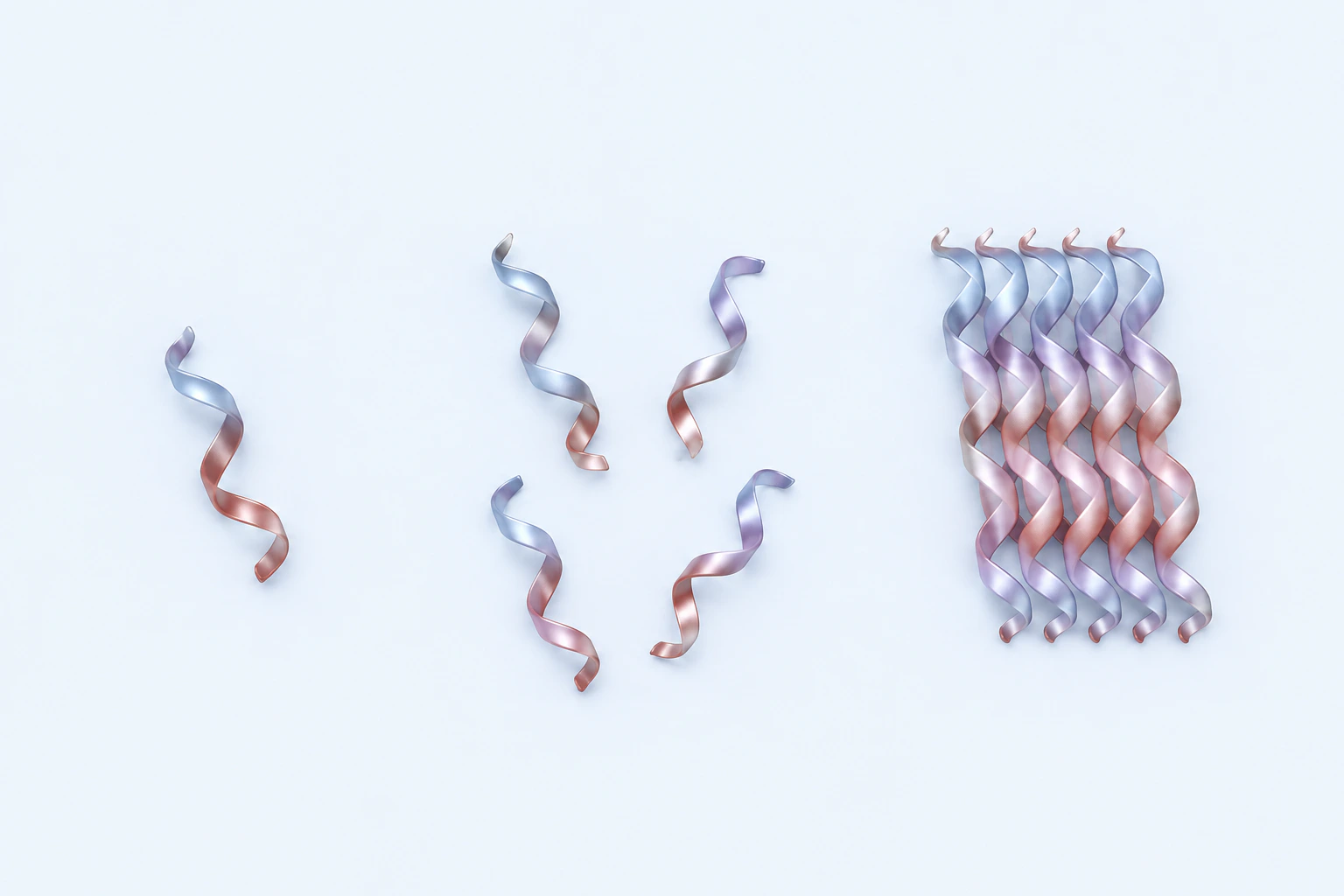
Qualitative amyloid-beta aggregation-state orientation. Left-to-right placement does not establish time, kinetics, stoichiometry, inevitability, toxicity, mechanism, biomarker, or diagnosis.
Scientific media record2 verified identifiers
- Subject
- Amyloid-Beta Aggregationbiological-process
- Review
- Editorial review completeIdentifiers authority-verified · Accessibility validated · · amyloid-beta-aggregation|amyloid-beta-aggregation-mechanism-v1.webp
- Digital source
- Trained-algorithmic mediaCreated with a trained generative algorithm and reviewed by WikiBiome for subject identity, scientific framing, identifiers, provenance, and accessibility.
- Scientific basis
- Amyloid beta-Peptides — MeSHAmyloid-Beta Aggregation
- License
- CC BY-SA 4.0Created
The process by which soluble amyloid-beta (Aβ) monomers assemble into neurotoxic oligomers and insoluble fibrillar plaques in the brain—the defining neuropathological event of Alzheimer's Disease.
What distinguishes WikiBiome's treatment of this process from conventional neuroscience is the recognition that amyloid-beta aggregation is not a spontaneous protein misfolding event but a metal-catalyzed process that is accelerated by copper, zinc, and iron, modulated by the Gut Microbiome, and potentially triggered by chronic innate immune responses to microbial products.
For the broader biology of the peptide (antimicrobial function, infection hypothesis, gut-brain interactions), see Amyloid-Beta. This page focuses specifically on the aggregation mechanism and the metals that drive it.
Evidence map8 cited passagesInspect provenance +
Aβ contains specific metal-binding residues in its N-terminal region,:
Zinc is the most potent direct aggregation promoter:
Copper's role is less about aggregation speed and more about redox toxicity:
Iron does not directly cross-link Aβ monomers but accumulates at plaque surfaces and amplifies damage:
A particularly specific finding: a nickel chelator (DMG-H) inhibited amyloid-beta aggregation in vitro:
Arsenic operates upstream of aggregation—it increases Aβ production rather than accelerating aggregation:
Nickel chelation: DMG-H specifically inhibits Ni-driven Aβ aggregation
Microbiome modulation: FMT from healthy donors reduced brain Aβ in AD mouse models—addressing the upstream microbial drivers
Contents
1. Metal-Catalyzed Aggregation2. The Aggregation Cascade3. Gut Microbiome Contributions4. Therapeutic Implications5. ConnectionsMetal-Catalyzed Aggregation#
The Binding Sites#
Aβ contains specific metal-binding residues in its N-terminal region:[1]Common and Trace Metals in Alzheimer's and Parkinson's DiseasesDoroszkiewicz J, Farhan JA, Mroczko J et al. · 2023Open reference 1 ↓[2]Exposure of metal toxicity in Alzheimer's disease: An extensive reviewIslam F, Shohag S, Akhter S et al. · 2022Open reference 2 ↓
- His6, His13, His14: Primary binding sites for zinc, copper, and nickel
- Glu11: Additional zinc coordination site
- Met35: Involved in copper redox chemistry (copper(II) (Cu2+) reduction to copper+)
- Asp1, Tyr10: Secondary copper coordination residues
The same binding sites accommodate different metals with different consequences—a form of Mis-Metallation at the peptide level.
Zinc-Driven Aggregation#
Zinc is the most potent direct aggregation promoter.[1]Common and Trace Metals in Alzheimer's and Parkinson's DiseasesDoroszkiewicz J, Farhan JA, Mroczko J et al. · 2023Open reference 1 ↓
zinc(II) (Zn2+) binds Aβ at His6/His13/His14/Glu11, cross-linking monomers into oligomeric and fibrillar aggregates at physiological concentrations. Zinc-Aβ aggregates are structurally distinct from unmetallated fibrils—they form faster and resist disaggregation. Synaptic zinc release during neurotransmission may drive local Aβ aggregation at synaptic clefts, explaining the synapse-specific pathology of early AD.
Zinc accumulation in amyloid plaques is 2-3x higher than in adjacent tissue.
Copper-Driven Toxicity#
Copper's role is less about aggregation speed and more about redox toxicity.[2]Exposure of metal toxicity in Alzheimer's disease: An extensive reviewIslam F, Shohag S, Akhter S et al. · 2022Open reference 2 ↓
copper(II) (Cu2+) binds Aβ at the same Histidine sites as zinc, with higher affinity. copper(I/II) redox cycling at the Aβ surface catalyzes H2O2 and hydroxyl radical generation—Fenton Chemistry directly on the peptide surface. copper-Aβ complexes are more neurotoxic than Aβ alone; soluble copper-Aβ oligomers show elevated pro-apoptotic activity.
Ceruloplasmin activity is reduced in AD brain, impairing ferroxidase function and promoting both copper and iron mislocalization.
Iron Accumulation#
Iron does not directly cross-link Aβ monomers but accumulates at plaque surfaces and amplifies damage:[1]Common and Trace Metals in Alzheimer's and Parkinson's DiseasesDoroszkiewicz J, Farhan JA, Mroczko J et al. · 2023Open reference 1 ↓
- iron(II) (Fe2+) at plaque surfaces generates hydroxyl radicals via Fenton chemistry, oxidizing surrounding neurons
- Elevated Ferritin and reduced transferrin saturation in CSF are early AD biomarkers
- Hippocampal iron accumulation tracks with cognitive decline progression
- Ferroportin expression is disrupted in AD brain, trapping iron intracellularly
Nickel and Mis-Metallation#
A particularly specific finding: a nickel chelator (DMG-H) inhibited amyloid-beta aggregation in vitro.[3]Benoit & Maier 2021 — Nickel Chelator Inhibits Amyloid-Beta AggregationBenoit, S.L., Bhatt et al. · 2021Open reference 3 ↓
This suggests nickel occupancy of Aβ metal-binding sites contributes to pathological aggregation. Nickel in plaque-associated Aβ would represent Mis-Metallation—the wrong metal in the binding site, altering aggregation kinetics. This connects environmental nickel exposure to AD pathology through a specific molecular mechanism.
Arsenic-Enhanced Production#
Arsenic operates upstream of aggregation—it increases Aβ production rather than accelerating aggregation.[4]Associations of Environmental Exposure to Arsenic, Manganese, Lead, and Cadmium with Alzheimer's Disease: A Review of Recent Evidence from Mechanistic StudiesGiasuddin Ahmed, Md. Shiblur Rahaman, Enrique Perez et al. · 2025Open reference 4 ↓
10 ppm chronic arsenic exposure elevates amyloid plaques and RAGE expression 220-fold in 3xTg-AD mice. Mechanism: arsenic disrupts iron regulatory protein activity and increases BACE1 (beta-secretase) activity, increasing Aβ(1-42) cleavage from APP. Arsenic also disrupts S-nitrosylation signaling in hippocampus and striatum.
The Aggregation Cascade#
The metal-catalyzed aggregation of Aβ proceeds through distinct stages:
- Monomers (soluble, physiological)—bind metals reversibly for antimicrobial and synaptic functions
- Metal-bound monomers—zinc (Zn)-Aβ or copper (Cu)-Aβ complexes with altered conformation
- Oligomers (soluble, TOXIC)—small metal-crosslinked assemblies that are the most neurotoxic species; copper-Aβ oligomers generate ROS
- Protofibrils—elongating structures that nucleate further aggregation
- Mature fibrils/plaques (insoluble)—the visible pathology; paradoxically may be less toxic than oligomers because they sequester reactive Aβ species
Critical insight: The most dangerous species are the soluble oligomers (step 3), not the plaques (step 5). This explains why anti-amyloid therapies that clear plaques have shown limited clinical benefit—the damage is done at the oligomer stage.
Gut Microbiome Contributions#
The gut microbiome contributes to Aβ aggregation through multiple upstream pathways (see Amyloid-Beta for full details).
Curli-mediated cross-seeding: E. coli curli fibers structurally cross-seed mammalian amyloid aggregation. LPS-driven BACE1 upregulation: Systemic LPS from Gram-negative pathobionts increases Aβ production. SCFA depletion: Loss of Butyrate-producing bacteria removes BBB protection and anti-inflammatory brakes.
Blood-brain-barrier failure: Gut-derived LPS and Heavy Metals disrupt BBB tight junctions, allowing metal-laden and microbial products to reach brain parenchyma where they accelerate metal-Aβ aggregation.
Therapeutic Implications#
Metal-targeted strategies for Aβ aggregation.
Metal chelation: PBT2 (a zinc/copper ionophore) showed modest cognitive benefits in Phase II AD trials by redistributing metals away from plaques. Nickel chelation: DMG-H specifically inhibits nickel (Ni)-driven Aβ aggregation.[3]Benoit & Maier 2021 — Nickel Chelator Inhibits Amyloid-Beta AggregationBenoit, S.L., Bhatt et al. · 2021Open reference 3 ↓ Iron management: Deferiprone (iron chelator) is in clinical trials for AD.
Microbiome modulation: FMT from healthy donors reduced brain Aβ in AD mouse models[5]Romano 2021 -- The Role of Microbiome-Host Interactions in the Development of Alzheimer's DiseaseStefano Romano, George M Savva, Janis R Bedarf · 2021Open reference 5 ↓—addressing the upstream microbial drivers.
Connections#
- Amyloid-Beta—the peptide itself; antimicrobial function, infection hypothesis
- Alzheimer's Disease—Aβ aggregation as the defining AD pathology
- Copper—copper (Cu)-Aβ redox cycling generates ROS at plaque surfaces
- Zinc—the most potent direct Aβ aggregation promoter
- Iron—accumulates at plaques; Fenton chemistry amplifies damage
- Nickel—nickel (Ni) chelation inhibits Aβ aggregation; mis-metallation mechanism
- Arsenic—increases BACE1 activity and Aβ production
- Ceruloplasmin—reduced activity in AD brain promotes metal mislocalization
- Ferroptosis—iron-driven cell death in Aβ plaque-adjacent neurons
- Mis-Metallation—toxic metals occupying Aβ binding sites alter aggregation
- Blood-Brain Barrier—gateway for gut-derived metals and microbial products
- Copper Dysregulation—the peripheral-central copper paradox in AD
References 8
Numbered by first appearance in the article, then reconciled with its declared source list.
- 1
Doroszkiewicz J, Farhan JA, Mroczko J et al. (2023). Common and Trace Metals in Alzheimer's and Parkinson's Diseases. International Journal of Molecular Sciences.
- 2
Islam F, Shohag S, Akhter S et al. (2022). Exposure of metal toxicity in Alzheimer's disease: An extensive review. Frontiers in Pharmacology.
- 3
Benoit, S.L., Bhatt et al. (2021). Benoit & Maier 2021 — Nickel Chelator Inhibits Amyloid-Beta Aggregation. Scientific Reports.
- 4
★Giasuddin Ahmed, Md. Shiblur Rahaman, Enrique Perez et al. (2025). Associations of Environmental Exposure to Arsenic, Manganese, Lead, and Cadmium with Alzheimer's Disease: A Review of Recent Evidence from Mechanistic Studies. Journal of Xenobiotics.
- 5
Stefano Romano, George M Savva, Janis R Bedarf (2021). Romano 2021 -- The Role of Microbiome-Host Interactions in the Development of Alzheimer's Disease. Frontiers in Pharmacology.
- 6
Jakubowska E, Hoppe-Mitera E, Sionek I et al. (2024). Metal toxicity exposure in Alzheimer's disease - literature review. Journal of Education, Health and Sport.
- 7
★Melissa Scholefield, Stephanie J. Church, Jingshu Xu et al. (2024). Scholefield et al. 2024 — Brain Metallomic Signatures Distinguish DLB from AD and PDD. Frontiers in Neuroscience.
- 8
Passeri E, et al. (2024). Recent Advances in Therapeutics for the Treatment of Alzheimer's Disease. (Brain Sciences / related journal).
Article network
Connect the evidence
Publicly readable discussion by ORCID-authenticated researchers. Questions, interpretation, methods, corrections, and new evidence stay attached to this record.
No discussion yet. Start with a precise question or a source-backed observation.
Published page changes
This record shows only material changes published on this page, including changes to its content, evidence, conclusions, or author context. Internal processes and discussion activity are excluded. Pending, declined, and withdrawn proposals remain private.
- published revision
Created “Amyloid-Beta Aggregation”: The process by which soluble amyloid-beta (Aβ) monomers assemble into neurotoxic oligomers and insoluble fibrillar plaques in the brain -- the defining neuropathological event of alzheimers disease.…
Created “Amyloid-Beta Aggregation”: The process by which soluble amyloid-beta (Aβ) monomers assemble into neurotoxic oligomers and insoluble fibrillar plaques in the brain -- the defining neuropathological event of alzheimers disease.… Published sections: Amyloid-Beta Aggregation; The Binding Sites; Zinc-Driven Aggregation; Copper-Driven Toxicity; Iron Accumulation; Nickel and Mis-Metallation; Arsenic-Enhanced Production; The Aggregation Cascade; Gut Microbiome Contributions; Therapeutic Implications; Connections. · WikiBiome Deploy Bot · +120 −0
Inspect exact Git diff ↗