

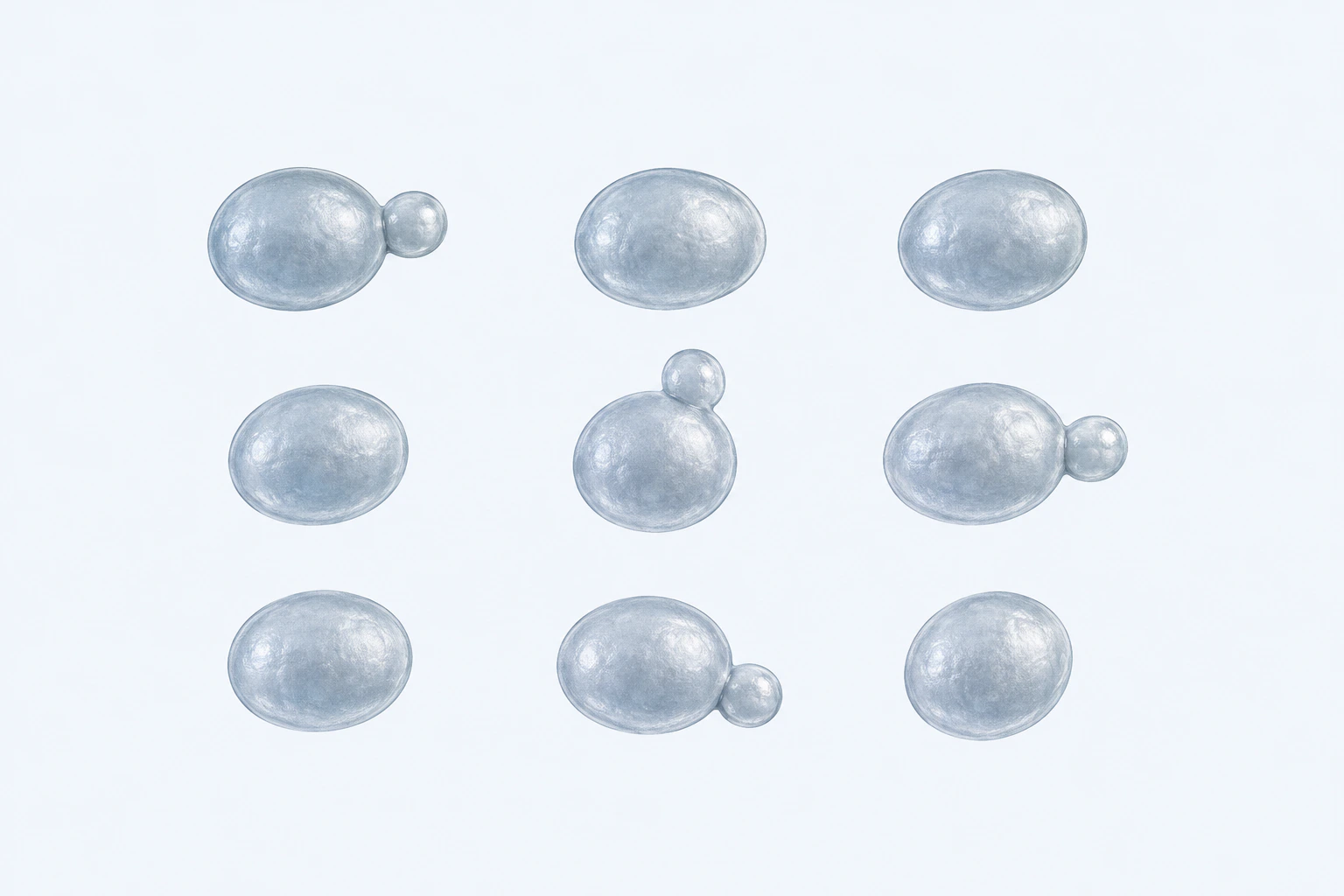
Type-species-anchored Torulaspora reconstruction with nine ovoid mother cells and four buds. Representative, non-diagnostic, and not a micrograph.
Scientific media record1 verified identifier
- Subject
- Torulasporataxon · genus
- Identifiers
- NCBITaxon:4948
- Review
- Editorial review completeIdentifiers authority-verified · Accessibility validated · · torulaspora|torulaspora-morphology-v1.webp
- Digital source
- Trained-algorithmic mediaCreated with a trained generative algorithm and reviewed by WikiBiome for subject identity, scientific framing, identifiers, provenance, and accessibility.
- License
- CC BY-SA 4.0Created
A genus of ascomycete yeasts (formerly classified as Zygosaccharomyces) found in fermentation environments (bread, wine, kombucha) and increasingly detected as a component of the human gut mycobiome.
While typically at low abundance in healthy individuals, Torulaspora delbrueckii and related species expand in certain disease states and dysbiotic conditions, marking a potential transition from commensal to pathobiont under specific metabolic and immune pressures. The genus is zinc and manganese-dependent for core metabolic enzymes and biofilm formation.
Contents
1. Taxonomy and Species2. Growth Physiology and Fermentation3. Metal Dependencies and Virulence Potential4. Biofilm and Adhesion5. Role in the Gut Mycobiome6. Probiotic and Fermentation Potential7. Ecological Interactions8. Detection and Abundance9. ConnectionsTaxonomy and Species#
Torulaspora delbrueckii—the primary species in food fermentation (sourdough, wine); occasionally isolated from human samples. Torulaspora globosa—emerging as a distinct mycobiome member; documented in gut samples from IBD and metabolic syndrome cohorts. Classification: Saccharomycetaceae (close relative to Saccharomyces cerevisiae), but ecologically distinct from baker's yeast.
Growth Physiology and Fermentation#
Facultative anaerobe: Thrives under both aerobic (fermentation with oxidative phosphorylation) and anaerobic (fermentation to ethanol and CO2) conditions. Sugar utilization: Ferments glucose, fructose, and sucrose; produces ethanol and CO2 as major fermentation products. Osmotolerance: Survives high-sugar and high-alcohol environments (wine, preserved foods), giving it competitive advantage in specific niches.
Metal Dependencies and Virulence Potential#
Zinc-Dependent Enzymes#
Alcohol dehydrogenase (ADH)—zinc (Zn)-dependent enzyme critical for both ethanol fermentation and ethanol metabolism during aerobic growth. Carboxypeptidases—zinc-metalloproteases; required for protein catabolism and nutrient scavenging. Zinc availability influences Torulaspora growth rate and biofilm formation.
Manganese and Iron#
Manganese: Cofactor for MnSOD (Oxidative Stress defense); manganese (Mn) availability impacts survival in inflamed gut environments.
Iron: Essential for respiration and core metabolic enzymes; iron sequestration by host Lactoferrin and Transferrin may suppress Torulaspora under health but allow expansion in iron-rich dysbiotic states.
Biofilm and Adhesion#
Forms yeast-to-pseudohyphae transitions similar to Candida albicans, enabling adhesion to epithelial surfaces and biofilm formation. Biofilm matrix contains carbohydrates and proteins; zinc (Zn) and manganese (Mn) requirements for matrix synthesis and remodeling. Adhesion molecules may enable colonization of damaged epithelium in inflammatory bowel disease.
Role in the Gut Mycobiome#
Healthy State#
At very low abundance (<1% of mycobiome in most individuals). May transiently populate following fermented food consumption (dietary source). Typically outcompeted by dominant commensal yeasts Saccharomyces cerevisiae, *Debaryomyces*.
Disease States#
Inflammatory Bowel Disease: Elevated Torulaspora abundance reported in some IBD cohorts; co-enrichment with pathogenic bacteria suggests dysbiotic consortia. Obesity and Metabolic Syndrome: Altered mycobiome composition with increased Torulaspora in some studies; potential role in metabolic endotoxemia via altered fungal metabolites.
Type 2 Diabetes: Emerging evidence for dysbiotic mycobiome expansion including Torulaspora; unclear whether causative or consequence.
Interkingdom Cooperation#
Torulaspora may participate in polymicrobial biofilms alongside bacteria Bacteroides fragilis, Escherichia coli and other fungi Candida albicans. Fungal-derived polysaccharides can shield bacterial cell walls from antimicrobials and immune attack. Fermentation products (ethanol, short-chain alcohols) may provide growth substrates for partner bacteria.
Probiotic and Fermentation Potential#
Torulaspora delbrueckii has been explored as a probiotic in animal models; shows potential for improving barrier function and reducing pathogenic bacterial load. GRAS status in food fermentation suggests safety profile superior to pathogenic yeasts (e.g., Candida albicans).
Open question: Whether dietary Torulaspora (from fermented foods) confers health benefit or merely transiently colonizes.
Ecological Interactions#
Fermentation Niche#
Dominates or co-dominates in alcohol/sugar-rich anaerobic environments (wine, fermented beverages). Produces antimicrobial ethanol, creating selective pressure against non-ethanol-tolerant bacteria. Metabolic byproducts (acetaldehyde, fusel alcohols) may inhibit competing microbes.
Gut Dysbiosis Context#
Emerges when commensal bacterial structure is disrupted (antibiotics, dietary shifts, Metal-Driven Inflammation). Iron-rich, hypoxic dysbiotic environments (similar to those favoring Fusobacterium varium) may favor Torulaspora expansion. Expansion correlates with reduced microbial diversity and altered SCFA production.
Detection and Abundance#
Sequencing: ITS (Internal Transcribed Spacer) barcoding; rarely cultured from fecal samples due to fastidiousness. Typical abundance: <0.5% in healthy controls; can reach 1-5% in dysbiotic IBD and obesity cohorts. Challenge: Distinguishing dietary Torulaspora (from fermented foods) from established colonization requires temporal sampling and dietary tracking.
Connections#
- Zinc—essential cofactor for alcohol dehydrogenase and carboxypeptidases
- Manganese—MnSOD cofactor; oxidative stress defense in inflamed gut
- Iron—core metabolic requirement; iron sequestration may suppress expansion
- Saccharomyces cerevisiae—related yeast genus; ecological competitor in some niches
- Candida albicans—potential interkingdom biofilm partner
- Mycobiome—emerging component of dysbiotic signatures
- Inflammatory Bowel Disease (IBD)—enriched in some IBD cohorts
- Obesity—altered mycobiome with potential Torulaspora elevation
- Dysbiosis—expansion marker in polymicrobial disease states
- dominant in alcohol/sugar-rich anaerobic food environments
References 6
Numbered by first appearance in the article, then reconciled with its declared source list.
- 1
Xiaopeng Li, Jiahui Feng, Zhanggui Wang et al. (2023). Features of combined gut bacteria and fungi from a Chinese cohort of colorectal cancer, colorectal adenoma, and post-operative patients. Frontiers in Microbiology.
- 2
Yichao Shi, Jianfeng Li, Shuntian Cai et al. (2023). Shi 2023 — PPI-Induced Fungal Dysbiosis in Patients with Gastroesophageal Reflux Disease. Frontiers in Cellular and Infection Microbiology.
- 3
Eduardo De Pablo-Fernandez, Huw R Morris, Andrew J Lees et al. (2024). De Pablo-Fernandez 2024 -- The Faecal Metabolome and Mycobiome in Parkinson's Disease. npj Parkinson's Disease.
- 4
Hiroki Mizutani, Shunsuke Fukui, Kazuki Oosuka et al. (2025). Biliary microbiome profiling via 16 S rRNA amplicon sequencing in patients with cholangiocarcinoma, pancreatic carcinoma and choledocholithiasis. Scientific Reports.
- 5
Agnieszka Krawczyk, Tomasz Kasperski, Tomasz Gosiewski et al. (2025). Krawczyk 2025 — Effects of Fecal Microbiota Transplantation on the Abundance and Diversity of Selected Fungal and Archaeal Species in the Gut Microbiota in the Rat Model of Schizophrenia. Pharmacological Reports.
- 6
Tomasz Gosiewski, Dominika Salamon, Magdalena Szopa et al. (2014). Gosiewski 2014 — Quantitative Evaluation of Fungi of the Genus Candida in Feces of Adult Patients with Type 1 and 2 Diabetes. Gut Pathogens.
Article network
Connect the evidence
Publicly readable discussion by ORCID-authenticated researchers. Questions, interpretation, methods, corrections, and new evidence stay attached to this record.
No discussion yet. Start with a precise question or a source-backed observation.
Activity and accepted changes
Accepted researcher context, editorial status, public discussion, and upstream Git revisions are shown together. Pending, declined, and withdrawn proposals remain private.
- published revision
Backfill oxidative stress concept links
Karen Pendergrass · +1 −1
Inspect exact Git diff ↗ - published revision
Backfill inflammation concept links
Karen Pendergrass · +1 −1
Inspect exact Git diff ↗ - published revision
massive wiki expansion: 149 stubs fixed, 100+ new pages, Rule 15 scan, keystone papers
WikiBiome Deploy Bot · +27 −23
Inspect exact Git diff ↗ - published revision
nightly maintenance: 94 stub demotions, 181 source_count fixes, 22 auto-discovered stubs, 5 adversarial audits, 3 boundary fixes, 3 evidence-level corrections
WikiBiome Deploy Bot · +3 −0
Inspect exact Git diff ↗ - published revision
pre-overnight checkpoint 2026-04-18
WikiBiome Deploy Bot · +2 −1
Inspect exact Git diff ↗ - published revision
Citation integrity pass: 38 citations added, 24 parenthesized citations fixed
WikiBiome Deploy Bot · +2 −2
Inspect exact Git diff ↗ - published revision
WikiBiome update — 2026-04-15 17:23
WikiBiome Deploy Bot · +3 −1
Inspect exact Git diff ↗ - published revision
WikiBiome update — integrity fixes, metallomic diet pages, cross-condition analyses
WikiBiome Deploy Bot · +2 −0
Inspect exact Git diff ↗ - published revision
WikiBiome update — 2026-04-10 17:16
WikiBiome Deploy Bot · +104 −0
Inspect exact Git diff ↗