
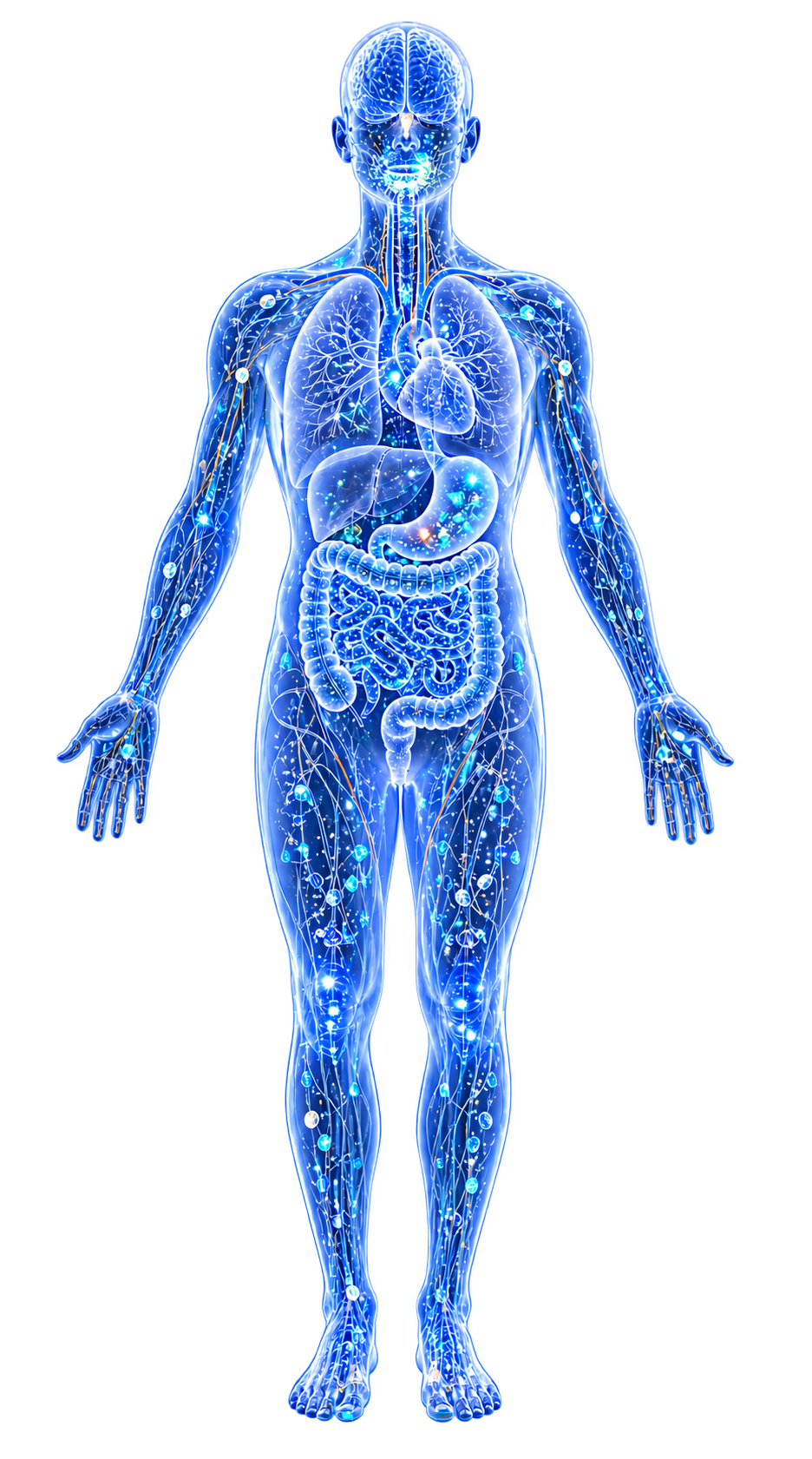
The primary androgen in human biology, testosterone sits at a critical intersection in WikiBiome's framework: it is both regulated by the Gut Microbiome and disrupted by Heavy Metals, making it a node where environmental metal exposure, microbial ecology, and endocrine pathology converge.
This convergence is most visible in Polycystic Ovary Syndrome, where hyperandrogenism, gut Dysbiosis, and metallomic disruption co-occur in a pattern that no single-cause model adequately explains.
Evidence map5 cited passagesInspect provenance +
The gut microbiome and testosterone engage in bidirectional signaling:
Testosterone shapes gut microbial community composition, contributing to sex differences in microbiome structure
The gut microbiome's processing of sex hormones contributes to sex-specific susceptibility to listeriosis and other infections
In polycystic ovary syndrome, heavy metals disrupt androgen homeostasis through multiple mechanisms:
PCOS represents the clearest convergence of testosterone, microbiome, and metals in this wiki:
Contents
1. Testosterone-Microbiome Axis2. Heavy Metal Disruption of Testosterone3. PCOS: The Convergence Point4. Open Questions5. ConnectionsTestosterone-Microbiome Axis#
Bidirectional Relationship#
The gut microbiome and testosterone engage in bidirectional signaling:[1]The Gut Microbiome and Sex Hormone-Related DiseasesSong He, Hao Li, Zehui Yu et al. · 2021Open reference 1 ↓
Microbiome influences testosterone. Gut bacteria express hydroxysteroid dehydrogenases (HSDs) that interconvert active and inactive androgen forms. The Estrobolome modulates the estrogen-to-androgen ratio by controlling estrogen recirculation via Beta-Glucuronidase activity.
Germ-free mice show altered testosterone levels compared to conventionally raised animals.
Specific taxa correlate with androgen levels: Ruminococcaceae and Prevotella are associated with higher testosterone in some cohorts.
Testosterone influences the microbiome. Testosterone shapes gut microbial community composition, contributing to sex differences in microbiome structure.[2]Sex, gut microbiome, and cardiovascular disease riskAlexander C. Razavi, Kaitlin S. Potts, Tanika N. Kelly et al. · 2019Open reference 2 ↓ Androgen-driven immune modulation alters the intestinal environment.
Pubertal testosterone surge coincides with a shift in gut microbiome composition.
Sex Differences in Disease#
The testosterone-microbiome axis contributes to sex-specific disease patterns. Women have higher prevalence of autoimmune diseases—partly attributed to estrogen-driven immune activation, but testosterone's immunosuppressive effects (mediated partly through gut microbiome composition) are also reduced.
Men have higher cardiovascular disease risk, which correlates with microbiome-mediated TMAO production differences between sexes. The gut microbiome's processing of sex hormones contributes to sex-specific susceptibility to listeriosis and other infections.[3]Pung 1984 — Influence of Steroidal and Nonsteroidal Sex Hormones on Host Resistance in Mice: Increased Susceptibility to Listeria monocytogenes After Exposure to Estrogenic HormonesOscar J. Pung, Michael I. Luster, Howard T. Hayes et al. · 1984Open reference 3 ↓
Heavy Metal Disruption of Testosterone#
PCOS Context#
In polycystic ovary syndrome, heavy metals disrupt androgen homeostasis through multiple mechanisms.[4]Heavy Metals and Essential Elements in Association with Oxidative Stress in Women with Polycystic Ovary Syndrome -- A Systematic ReviewSmovrsnik T, Virant-Klun I, Pinter B · 2023Open reference 4 ↓
Cadmium and Lead disrupt steroidogenic enzyme function in ovarian theca cells. Copper elevation correlates with BMI and triglycerides in PCOS, reflecting metabolic-endocrine coupling. Nickel may act as a Metalloestrogen, altering the estrogen/testosterone ratio.
Oxidative Stress from metal exposure damages ovarian follicles and disrupts the hypothalamic-pituitary-gonadal axis. The combination of heavy metal burden and dysbiotic microbiome creates dual disruption: metals directly impair steroidogenesis while dysbiosis alters microbial hormone processing.
Metal-Androgen Interactions#
Several metals directly affect testosterone biology. Lead: Associated with reduced testosterone in men at occupational exposure levels; in PCOS, lead co-occurs with hyperandrogenism through a mechanism that may involve adrenal rather than gonadal androgen production.
Cadmium: Testicular toxicity is well-established; cadmium (Cd) accumulates in testicular tissue and disrupts Leydig cell steroidogenesis.
Zinc: An essential cofactor for testosterone synthesis—zinc deficiency correlates with hypogonadism. The zinc (Zn)-testosterone connection is one of the clearest examples of how essential metal deficiency directly impairs hormone production.
Mercury: Associated with altered testosterone levels in occupational and environmental exposure studies.
PCOS: The Convergence Point#
PCOS represents the clearest convergence of testosterone, microbiome, and metals in this wiki.[5]Alterations of bacteriome, mycobiome and metabolome characteristics in PCOS patients with normal/overweight individualsYin G, Chen F, Chen G et al. · 2022Open reference 5 ↓
Hyperandrogenism is a defining feature (elevated total and free testosterone, DHEA-S). Gut dysbiosis is consistently documented (reduced diversity, altered Firmicutes/Bacteroidetes ratio, mycobiome changes). Heavy metal burden is elevated (cadmium (Cd), lead (Pb), nickel (Ni), copper (Cu), Antimony).
Oxidative stress is increased (depleted SOD, GSH; elevated MDA, ROS).
The question is directionality: Do metals cause hyperandrogenism? Does hyperandrogenism alter metal handling? Does dysbiosis drive both?
Or is this a self-reinforcing cycle where each element amplifies the others?
Current evidence supports a cyclic model: metal exposure disrupts ovarian steroidogenesis and gut barrier function; gut dysbiosis alters hormone metabolism and increases metal absorption; hyperandrogenism reshapes the gut microbiome and alters metal-binding protein expression.
Intervening at any point in the cycle (metal chelation, dysbiosis correction, anti-androgen therapy) may partially restore the others.
Open Questions#
Unresolved questions identified by the current evidence record.
01Which specific gut bacteria are most important for androgen metabolism, and how does metal exposure alter their activity?+
The current WikiBiome record identifies this as an unresolved evidence gap.
02Can microbiome-targeted interventions (prebiotics, probiotics, FMT) reduce hyperandrogenism in PCOS by restoring normal microbial hormone processing?+
The current WikiBiome record identifies this as an unresolved evidence gap.
03Does zinc supplementation improve testosterone levels specifically through its microbiome effects, or is the pathway purely enzymatic?+
The current WikiBiome record identifies this as an unresolved evidence gap.
Connections#
- Polycystic Ovary Syndrome—hyperandrogenism as cardinal feature; metal-microbiome-androgen convergence
- Estrobolome—microbial estrogen metabolism that modulates estrogen/androgen ratio
- Metalloestrogen—metals that mimic estrogen, altering the androgen-estrogen balance
- Zinc—essential cofactor for testosterone synthesis
- Cadmium—testicular toxicity; ovarian disruption in PCOS
- Copper—elevated in PCOS; correlates with metabolic parameters
- oxidative stress—metal-induced ROS damages steroidogenic cells
- Insulin Resistance—links hyperandrogenism to metabolic syndrome in PCOS
References 5
Numbered by first appearance in the article, then reconciled with its declared source list.
- 1
Song He, Hao Li, Zehui Yu et al. (2021). The Gut Microbiome and Sex Hormone-Related Diseases. Frontiers in Microbiology.
- 2
Alexander C. Razavi, Kaitlin S. Potts, Tanika N. Kelly et al. (2019). Sex, gut microbiome, and cardiovascular disease risk. Biology of Sex Differences.
- 3
Oscar J. Pung, Michael I. Luster, Howard T. Hayes et al. (1984). Pung 1984 — Influence of Steroidal and Nonsteroidal Sex Hormones on Host Resistance in Mice: Increased Susceptibility to Listeria monocytogenes After Exposure to Estrogenic Hormones. Infection and Immunity.
- 4
Smovrsnik T, Virant-Klun I, Pinter B (2023). Heavy Metals and Essential Elements in Association with Oxidative Stress in Women with Polycystic Ovary Syndrome -- A Systematic Review. Antioxidants.
- 5
Yin G, Chen F, Chen G et al. (2022). Alterations of bacteriome, mycobiome and metabolome characteristics in PCOS patients with normal/overweight individuals. Journal of Ovarian Research.
Article network
Connect the evidence
Publicly readable discussion by ORCID-authenticated researchers. Questions, interpretation, methods, corrections, and new evidence stay attached to this record.
No discussion yet. Start with a precise question or a source-backed observation.
Published page changes
This record shows only material changes published on this page, including changes to its content, evidence, conclusions, or author context. Internal processes and discussion activity are excluded. Pending, declined, and withdrawn proposals remain private.
- published revision
Revised “PCOS Context”: now reads “metalloestrogen, altering the estrogen/testosterone ratio - oxidative stress from metal exposure damages ovarian”.
Revised “PCOS Context”: changed “metalloestrogen, altering the estrogen/testosterone ratio - Oxidative stress from metal exposure damages ovarian” to “metalloestrogen, altering the estrogen/testosterone ratio - oxidative stress from metal exposure damages ovarian”. · Karen Pendergrass · +2 −2
Inspect exact Git diff ↗ - published revision
Created “Testosterone”: The primary androgen in human biology, testosterone sits at a critical intersection in WikiBiome's framework: it is both regulated by the gut microbiome and disrupted by heavy metals, making it a node…
Created “Testosterone”: The primary androgen in human biology, testosterone sits at a critical intersection in WikiBiome's framework: it is both regulated by the gut microbiome and disrupted by heavy metals, making it a node… Published sections: Testosterone; Bidirectional Relationship; Sex Differences in Disease; PCOS Context; Metal-Androgen Interactions; PCOS: The Convergence Point; Open Questions; Connections. · WikiBiome Deploy Bot · +93 −0
Inspect exact Git diff ↗