

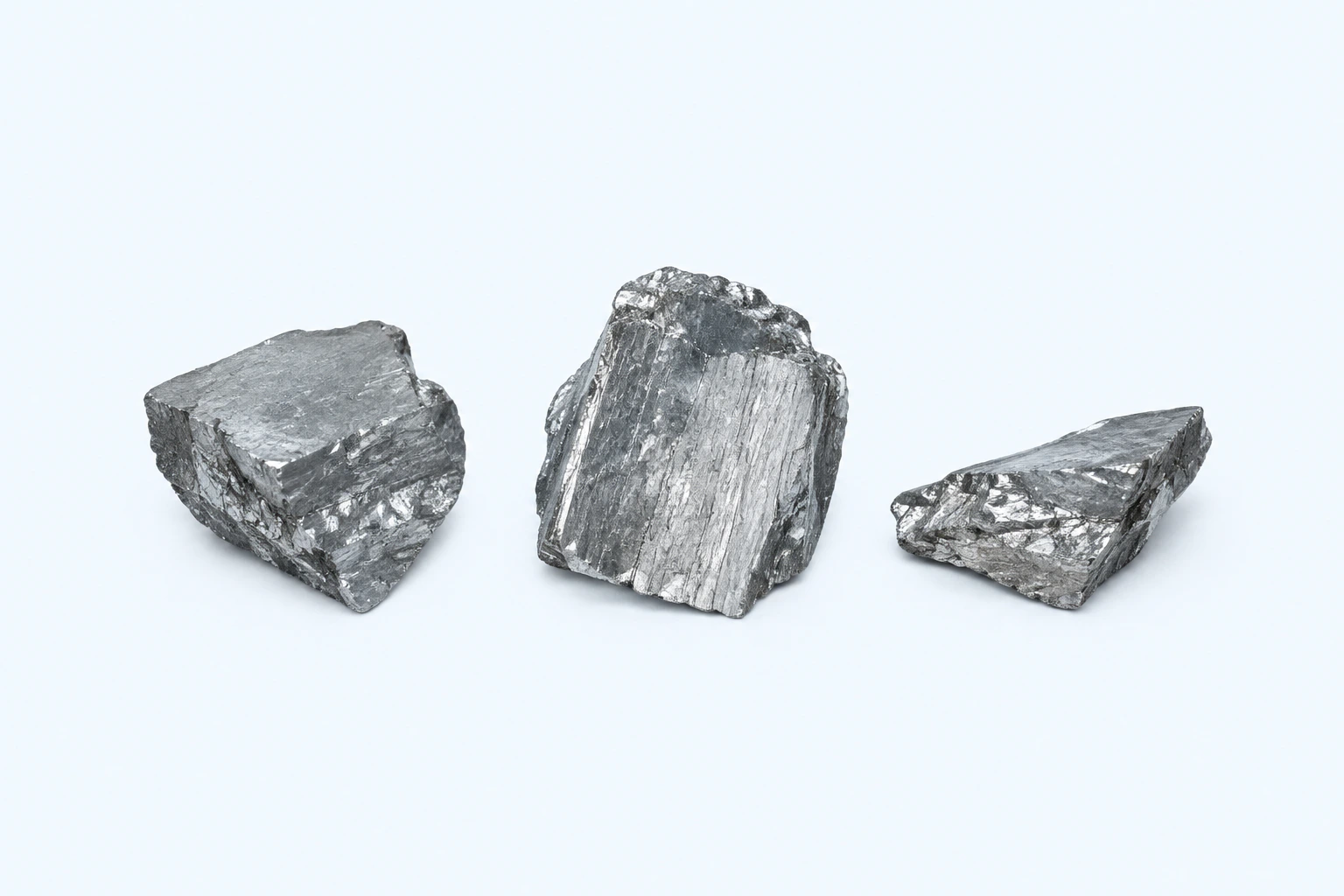
Elemental antimony (Sb), shown as three representative brittle silvery-gray fragments. Form and surface vary with purity, processing, and oxidation; this is not stibnite, analytical reference material, or a photograph.
Scientific media record2 verified identifiers
- Subject
- Antimonyelement
- Identifiers
- Atomic number 51PubChem CID:5354495
- Review
- Editorial review completeIdentifiers authority-verified · Accessibility validated · · antimony|antimony-technical-specimen-v1.webp
- Digital source
- Trained-algorithmic mediaCreated with a trained generative algorithm and reviewed by WikiBiome for subject identity, scientific framing, identifiers, provenance, and accessibility.
- Scientific basis
- Antimony — PubChem ElementAntimony, PubChem CID 5354495
- License
- CC BY-SA 4.0Created
A metalloid that sits in the shadows of better-studied toxic metals like Lead, Cadmium, and Mercury, yet appears with surprising consistency in metallomic studies of endocrine and inflammatory conditions.
Antimony (symbol antimony (Sb), from Latin stibium; atomic number 51) exists primarily in trivalent (antimony(III)) and pentavalent (Sb5+) oxidation states, with the trivalent form being more toxic and more biologically active.
It shares chemical behavior with Arsenic, its Group 15 neighbor, including the ability to enter cells through aquaporin channels and interfere with thiol-containing enzymes.
Evidence map6 cited passagesInspect provenance +
oxidative stress induction: Antimony exposure generates reactive oxygen species through disruption of mitochondrial electron transport and depletion of GSH reserves
Dietary: Present in infant foods, including baby food preparations in Italy, at levels requiring monitoring
Antimony has been measured alongside other heavy metals in PCOS metallomic studies. The PCOS metallomic profile includes elevations of multiple toxic metals (Cd, Pb, Ni, and Sb) alongside oxidative stress marker disruption,. Whether antimony independently contributes to PCOS pathophysiology or is a marker of broader environmental metal burden remains unresol
Machine learning analysis of heavy metal associations with arthritis identified antimony among the metals contributing to disease risk prediction. Its role appears to be as part of a multi-metal signature rather than as an independent risk factor.
Toenail antimony was assessed in the Sister Study prospective analysis of breast cancer risk. The study found limited evidence for an independent antimony-breast cancer association, though the multi-metal mixture context warrants further investigation.
Antimony is present in commercially prepared baby foods, contributing to the total metalloid burden during critical developmental windows. The developing gut microbiome's response to antimony exposure has not been studied.
Contents
1. Biological Relevance2. Sources of Exposure3. Health Effects4. Microbiome Interactions5. Open Questions6. Cross-ReferencesBiological Relevance#
Antimony has no known essential biological function. Its toxicological significance arises from three properties. Thiol affinity: antimony(III) (Sb3+) binds sulfhydryl groups on Glutathione (GSH), cysteine residues, and enzyme active sites, depleting antioxidant reserves and inactivating metal-dependent enzymes—a mechanism shared with arsenic.
Oxidative Stress induction: Antimony exposure generates reactive oxygen species through disruption of mitochondrial electron transport and depletion of GSH reserves.[1]Heavy Metals and Essential Elements in Association with Oxidative Stress in Women with Polycystic Ovary Syndrome -- A Systematic ReviewSmovrsnik T, Virant-Klun I, Pinter B · 2023Open reference 1 ↓
Metal-metal interactions: Antimony co-occurs with other toxic metals in environmental exposures, making it difficult to isolate its individual effects from the mixture toxicity of multi-metal burdens.
Sources of Exposure#
Dietary: Present in infant foods, including baby food preparations in Italy, at levels requiring monitoring.[2]Meli 2024 — Chemical characterization of baby food consumed in ItalyMaria Assunta Meli, Donatella Desideri, Davide Sisti et al. · 2024Open reference 2 ↓ Industrial: Antimony trioxide is used as a flame retardant in textiles, plastics, and electronics; occupational exposure occurs in smelting, mining, and manufacturing.
Drinking water: Leaches from PET plastic bottles and some plumbing materials. Ammunition and alloys: Used in lead alloys for batteries and bullets.
Health Effects#
PCOS Association#
Antimony has been measured alongside other Heavy Metals in PCOS metallomic studies. The PCOS metallomic profile includes elevations of multiple toxic metals (cadmium (Cd), lead (Pb), nickel (Ni), and antimony (Sb)) alongside oxidative stress marker disruption.[1]Heavy Metals and Essential Elements in Association with Oxidative Stress in Women with Polycystic Ovary Syndrome -- A Systematic ReviewSmovrsnik T, Virant-Klun I, Pinter B · 2023Open reference 1 ↓[3]Are Heavy Metal Exposure and Trace Element Levels Related to Metabolic and Endocrine Problems in Polycystic Ovary Syndrome?Kirmizi DA, Baser E, Turksoy VA et al. · 2020Open reference 3 ↓
Whether antimony independently contributes to PCOS pathophysiology or is a marker of broader environmental metal burden remains unresolved.
Rheumatoid Arthritis#
Machine learning analysis of heavy metal associations with arthritis identified antimony among the metals contributing to disease risk prediction.[4]Analyzing the impact of heavy metal exposure on osteoarthritis and rheumatoid arthritis: an approach based on interpretable machine learningFan W, Pi Z, Kong K et al. · 2024Open reference 4 ↓ Its role appears to be as part of a multi-metal signature rather than as an independent risk factor.
Breast Cancer#
Toenail antimony was assessed in the Sister Study prospective analysis of breast cancer risk. The study found limited evidence for an independent antimony-breast cancer association,[5]Metals and Breast Cancer Risk: A Prospective Study Using Toenail BiomarkersNiehoff NM, O'Brien KM, Keil AP et al. · 2021Open reference 5 ↓ though the multi-metal mixture context warrants further investigation.
Infant Exposure#
Antimony is present in commercially prepared baby foods, contributing to the total metalloid burden during critical developmental windows.[2]Meli 2024 — Chemical characterization of baby food consumed in ItalyMaria Assunta Meli, Donatella Desideri, Davide Sisti et al. · 2024Open reference 2 ↓ The developing Gut Microbiome's response to antimony exposure has not been studied.
Microbiome Interactions#
The microbiome dimensions of antimony toxicity remain largely unexplored. By analogy with arsenic (its chemical cousin), antimony may:
- beryllium (Be) biotransformed by gut bacteria (methylation, oxidation/reduction)
- Alter microbial community composition through selective toxicity
- Interact with microbial thiol-based detoxification systems
These are plausible but unverified hypotheses.
Open Questions#
Unresolved questions identified by the current evidence record.
01Does antimony have independent endocrine-disrupting activity, or is it always a co-traveler with other metals in PCOS and reproductive conditions?+
The current WikiBiome record identifies this as an unresolved evidence gap.
02What is the gut microbiome's capacity for antimony biotransformation, and does this affect host exposure?+
The current WikiBiome record identifies this as an unresolved evidence gap.
03Are antimony's thiol-binding properties sufficient to classify it as a metalloestrogen?+
The current WikiBiome record identifies this as an unresolved evidence gap.
Cross-References#
- Arsenic—chemical cousin; shared Group 15 chemistry and aquaporin entry
- Polycystic Ovary Syndrome—co-elevated with other toxic metals in metallomic studies
- Lead—co-occurs in environmental exposures and alloys
- Heavy Metals—classification and general mechanisms
- oxidative stress—primary mechanism of antimony toxicity
References 5
Numbered by first appearance in the article, then reconciled with its declared source list.
- 1
Smovrsnik T, Virant-Klun I, Pinter B (2023). Heavy Metals and Essential Elements in Association with Oxidative Stress in Women with Polycystic Ovary Syndrome -- A Systematic Review. Antioxidants.
- 2
Maria Assunta Meli, Donatella Desideri, Davide Sisti et al. (2024). Meli 2024 — Chemical characterization of baby food consumed in Italy. PLOS ONE.
- 3
★Kirmizi DA, Baser E, Turksoy VA et al. (2020). Are Heavy Metal Exposure and Trace Element Levels Related to Metabolic and Endocrine Problems in Polycystic Ovary Syndrome?. Biological Trace Element Research.
- 4
Fan W, Pi Z, Kong K et al. (2024). Analyzing the impact of heavy metal exposure on osteoarthritis and rheumatoid arthritis: an approach based on interpretable machine learning. Frontiers in Nutrition.
- 5
Niehoff NM, O'Brien KM, Keil AP et al. (2021). Metals and Breast Cancer Risk: A Prospective Study Using Toenail Biomarkers. American Journal of Epidemiology.
Article network
Connect the evidence
Publicly readable discussion by ORCID-authenticated researchers. Questions, interpretation, methods, corrections, and new evidence stay attached to this record.
No discussion yet. Start with a precise question or a source-backed observation.
Published page changes
This record shows only material changes published on this page, including changes to its content, evidence, conclusions, or author context. Internal processes and discussion activity are excluded. Pending, declined, and withdrawn proposals remain private.
- published revision
Revised “Cross-References”: now reads “in environmental exposures and alloys - Heavy Metals -- classification and general mechanisms -”.
Revised “Cross-References”: changed “in environmental exposures and alloys - heavy metals -- classification and general mechanisms -” to “in environmental exposures and alloys - Heavy Metals -- classification and general mechanisms -”. · Karen Pendergrass · +2 −2
Inspect exact Git diff ↗ - published revision
Revised “Biological Relevance”: now reads “a mechanism shared with arsenic - oxidative stress induction: Antimony exposure generates reactive”.
Revised “Biological Relevance”: changed “a mechanism shared with arsenic - Oxidative stress induction: Antimony exposure generates reactive” to “a mechanism shared with arsenic - oxidative stress induction: Antimony exposure generates reactive”. · Karen Pendergrass · +2 −2
Inspect exact Git diff ↗ - published revision
Created “Antimony”: A metalloid that sits in the shadows of better-studied toxic metals like lead, cadmium, and mercury, yet appears with surprising consistency in metallomic studies of endocrine and inflammatory…
Created “Antimony”: A metalloid that sits in the shadows of better-studied toxic metals like lead, cadmium, and mercury, yet appears with surprising consistency in metallomic studies of endocrine and inflammatory… Published sections: Antimony (Sb); Biological Relevance; Sources of Exposure; PCOS Association; Rheumatoid Arthritis; Breast Cancer; Infant Exposure; Microbiome Interactions; Open Questions; Cross-References. · WikiBiome Deploy Bot · +75 −0
Inspect exact Git diff ↗