
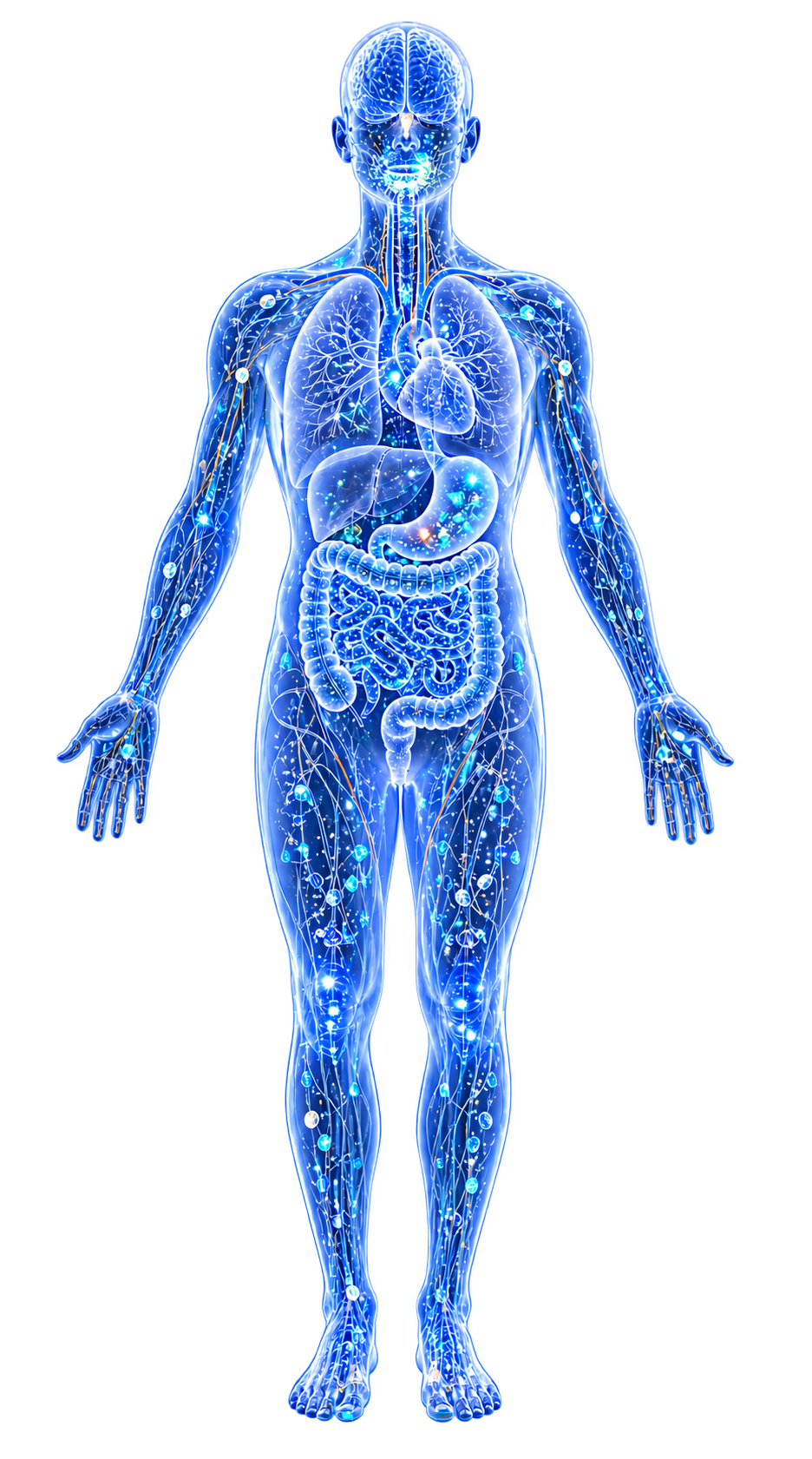
A condition in which cells fail to respond normally to insulin, requiring progressively higher insulin levels to maintain glucose homeostasis. Insulin resistance is central to PCOS, type 2 diabetes, and metabolic syndrome, and has extensive but complex connections to metal exposure.
The metallomic dimension of insulin resistance is frequently overlooked in clinical management.
Evidence map11 cited passagesInspect provenance +
However, Cr essentiality is now debated: the 2014 removal of Cr from the list of essential trace elements by some authorities reflects insufficient evidence for a specific biological function.
Zn depletion impairs insulin signaling and is consistently associated with IR across multiple disease contexts.
Mg intake is an independent predictor of HOMA-IR; low Mg correlates with IR, elevated CRP, and higher testosterone in PCOS.
Cadmium: Associated with IR in multiple epidemiological studies. Cd disrupts insulin receptor signaling and pancreatic beta-cell function. Cd accumulation is higher in iron-depleted individuals (shared DMT1 transporter), creating a link between iron deficiency anemia and metabolic dysfunction.
Arsenic: Chronic low-level As exposure associated with increased T2D risk in dose-response meta-analyses. As disrupts insulin signaling, impairs GLUT4 translocation, and induces pancreatic beta-cell apoptosis.
Lead: Associated with IR and MetS in NHANES and occupational cohorts. Pb disrupts calcium-dependent insulin secretion and impairs insulin receptor signaling.
A key finding: dietary fiber intake and BMI are independent predictors of HOMA-IR, explaining 54% of the variance in insulin resistance in PCOS women:
mediterranean diet: PREDIMED score inversely predicts testosterone levels (AUC 0.848); lower adherence associated with higher HOMA-IR in PCOS.
High-fiber diets: improve insulin sensitivity and hormonal profiles in PCOS.
Ketogenic/low-carb diets: improve IR markers in PCOS but may reduce fiber intake if poorly designed.
Probiotics: some evidence for IR improvement in PCOS, possibly through gut-mediated metal and metabolic pathways.
Contents
1. Metal Connections to Insulin Resistance2. The Fiber-Magnesium-IR Axis in PCOS3. Dietary Interventions4. ConnectionsMetal Connections to Insulin Resistance#
Essential Metals#
Chromium (III). Historically proposed as essential for glucose tolerance via the "glucose tolerance factor" (GTF) and chromodulin/low-molecular-weight chromium-binding substance (LMWCr). The proposed mechanism involves chromium (Cr)(III) potentiating insulin signaling by enhancing GLUT4 translocation and insulin receptor tyrosine kinase activity.
However, chromium essentiality is now debated: the 2014 removal of chromium from the list of essential trace elements by some authorities reflects insufficient evidence for a specific biological function.[1]Metals in the pathogenesis of type 2 diabetesAbdul Rehman Khan, Fazli Rabbi Awan · 2014Open reference 1 ↓
Clinical trials of chromium supplementation for IR show mixed results.
Zinc. zinc (Zn) is essential for insulin storage (insulin is stored as zinc-insulin hexamers in pancreatic beta-cell granules), secretion, and signaling. zinc depletion impairs insulin signaling and is consistently associated with IR across multiple disease contexts.[2]Association of Trace Elements with Polycystic Ovary Syndrome in Women -- A Case-Control StudySmovrsnik T, Pinter B, Horvat M et al. · 2025Open reference 2 ↓
zinc transporter variants (e.g., ZIP8/SLC39A8 A391T in Crohn's disease) link metal dyshomeostasis to metabolic dysfunction.
Magnesium. magnesium (Mg) intake is an independent predictor of HOMA-IR; low magnesium correlates with IR, elevated CRP, and higher testosterone in PCOS.[3]Low intakes of dietary fiber and magnesium are associated with insulin resistance and hyperandrogenism in polycystic ovary syndrome: A cohort studyCutler DA, Pride SM, Cheung AP · 2019Open reference 3 ↓
magnesium is a cofactor for >300 enzymes including those in insulin signaling cascades.
Toxic Metals#
Cadmium: Associated with IR in multiple epidemiological studies. cadmium (Cd) disrupts insulin receptor signaling and pancreatic beta-cell function. cadmium accumulation is higher in iron-depleted individuals (shared DMT1 transporter), creating a link between iron deficiency anemia and metabolic dysfunction.[1]Metals in the pathogenesis of type 2 diabetesAbdul Rehman Khan, Fazli Rabbi Awan · 2014Open reference 1 ↓
Arsenic: Chronic low-level arsenic (As) exposure associated with increased T2D risk in dose-response meta-analyses. arsenic disrupts insulin signaling, impairs GLUT4 translocation, and induces pancreatic beta-cell apoptosis.[1]Metals in the pathogenesis of type 2 diabetesAbdul Rehman Khan, Fazli Rabbi Awan · 2014Open reference 1 ↓
Lead: Associated with IR and MetS in NHANES and occupational cohorts. lead (Pb) disrupts calcium-dependent insulin secretion and impairs insulin receptor signaling.[1]Metals in the pathogenesis of type 2 diabetesAbdul Rehman Khan, Fazli Rabbi Awan · 2014Open reference 1 ↓
The Fiber-Magnesium-IR Axis in PCOS#
A key finding: dietary fiber intake and BMI are independent predictors of HOMA-IR, explaining 54% of the variance in insulin resistance in PCOS women.[3]Low intakes of dietary fiber and magnesium are associated with insulin resistance and hyperandrogenism in polycystic ovary syndrome: A cohort studyCutler DA, Pride SM, Cheung AP · 2019Open reference 3 ↓
Women with PCOS consumed significantly less fiber (19.6 vs 24.7 g) and magnesium (238.9 vs 273.9 mg) than controls. Low fiber tertile had significantly higher testosterone and DHEAS. Fiber's effects may be mediated through Gut Microbiome modulation (SCFA production, barrier integrity), linking IR to Dysbiosis.
This finding persisted despite similar total caloric intake between groups.
Dietary Interventions#
Mediterranean Diet: PREDIMED score inversely predicts testosterone levels (AUC 0.848); lower adherence associated with higher HOMA-IR in PCOS.[4]Adherence to the Mediterranean Diet, Dietary Patterns and Body Composition in Women with Polycystic Ovary Syndrome (PCOS)Barrea L, Arnone A, Annunziata G et al. · 2019Open reference 4 ↓ High-fiber diets: improve insulin sensitivity and hormonal profiles in PCOS.[5]High-Fiber Diet or Combined With Acarbose Alleviates Heterogeneous Phenotypes of Polycystic Ovary Syndrome by Regulating Gut MicrobiotaWang X, Xu T, Liu R et al. · 2022Open reference 5 ↓
Ketogenic/low-carb diets: improve IR markers in PCOS but may reduce fiber intake if poorly designed.[6]The effects of a low-carbohydrate, ketogenic diet on the polycystic ovary syndrome: A pilot studyMavropoulos JC, Yancy WS, Hepburn J et al. · 2005Open reference 6 ↓ Probiotics: some evidence for IR improvement in PCOS, possibly through gut-mediated metal and metabolic pathways.[7]Probiotics and Polycystic Ovary Syndrome: A Perspective for Management in Adolescents with ObesityCalcaterra V, Rossi V, Massini G et al. · 2023Open reference 7 ↓
Connections#
- Metabolic Syndrome and Metal Exposure—IR is a core component of MetS
- Polycystic Ovary Syndrome—IR drives hyperandrogenism and is central to PCOS pathophysiology
- Zinc, Chromium—essential metals involved in insulin signaling
- Cadmium, Arsenic, Lead—toxic metals associated with IR
- dysbiosis—gut microbiome mediates dietary effects on IR
- Mediterranean Diet—dietary pattern that improves IR
- Gut-Metal-Microbiome Interactions—fiber/metal interactions in the gut influence metabolic outcomes
References 10
Numbered by first appearance in the article, then reconciled with its declared source list.
- 1
★Abdul Rehman Khan, Fazli Rabbi Awan (2014). Metals in the pathogenesis of type 2 diabetes. Journal of Diabetes and Metabolic Disorders.
- 2
Smovrsnik T, Pinter B, Horvat M et al. (2025). Association of Trace Elements with Polycystic Ovary Syndrome in Women -- A Case-Control Study. Metabolites.
- 3
Cutler DA, Pride SM, Cheung AP (2019). Low intakes of dietary fiber and magnesium are associated with insulin resistance and hyperandrogenism in polycystic ovary syndrome: A cohort study. Food Science & Nutrition.
- 4
Barrea L, Arnone A, Annunziata G et al. (2019). Adherence to the Mediterranean Diet, Dietary Patterns and Body Composition in Women with Polycystic Ovary Syndrome (PCOS). Nutrients.
- 5
Wang X, Xu T, Liu R et al. (2022). High-Fiber Diet or Combined With Acarbose Alleviates Heterogeneous Phenotypes of Polycystic Ovary Syndrome by Regulating Gut Microbiota. Frontiers in Endocrinology.
- 6
Mavropoulos JC, Yancy WS, Hepburn J et al. (2005). The effects of a low-carbohydrate, ketogenic diet on the polycystic ovary syndrome: A pilot study. Nutrition & Metabolism.
- 7
Calcaterra V, Rossi V, Massini G et al. (2023). Probiotics and Polycystic Ovary Syndrome: A Perspective for Management in Adolescents with Obesity. Nutrients.
- 8
★Kirmizi DA, Baser E, Turksoy VA et al. (2020). Are Heavy Metal Exposure and Trace Element Levels Related to Metabolic and Endocrine Problems in Polycystic Ovary Syndrome?. Biological Trace Element Research.
- 9
Sarah H. Mhaibes, Mohammed A. Taher, Ala H. Badr (2017). A Comparative Study of Blood Levels of Manganese, Some Macroelements and Heavy Metals in Obese and Non-Obese Polycystic Ovary Syndrome Patients. Iraqi Journal of Pharmaceutical Sciences.
- 10
★Karen Pendergrass (2026). Heavy Metals, Microbial Metallomics, and the US Obesity Epidemic: A Mechanistic Examination of a Population-Level Metabolic Disruption. Zenodo Preprint.
Article network
Mentioned here 11
Pages linking here 15
Connect the evidence
Publicly readable discussion by ORCID-authenticated researchers. Questions, interpretation, methods, corrections, and new evidence stay attached to this record.
No discussion yet. Start with a precise question or a source-backed observation.
Activity and accepted changes
Accepted researcher context, editorial status, public discussion, and upstream Git revisions are shown together. Pending, declined, and withdrawn proposals remain private.
- published revision
Backfill gut microbiome concept links
Karen Pendergrass · +1 −1
Inspect exact Git diff ↗ - published revision
Complete corpus-wide Dysbiosis linking
Karen Pendergrass · +1 −1
Inspect exact Git diff ↗ - published revision
massive wiki expansion: 149 stubs fixed, 100+ new pages, Rule 15 scan, keystone papers
WikiBiome Deploy Bot · +12 −12
Inspect exact Git diff ↗ - published revision
nightly maintenance: 94 stub demotions, 181 source_count fixes, 22 auto-discovered stubs, 5 adversarial audits, 3 boundary fixes, 3 evidence-level corrections
WikiBiome Deploy Bot · +1 −0
Inspect exact Git diff ↗ - published revision
pre-overnight checkpoint 2026-04-18
WikiBiome Deploy Bot · +3 −1
Inspect exact Git diff ↗ - published revision
WikiBiome update — 2026-04-15 17:23
WikiBiome Deploy Bot · +0 −1
Inspect exact Git diff ↗ - published revision
WikiBiome update — integrity fixes, metallomic diet pages, cross-condition analyses
WikiBiome Deploy Bot · +20 −11
Inspect exact Git diff ↗ - published revision
WikiBiome v7 — interactive microbiome metallomics encyclopedia
Karen Pendergrass · +64 −0
Inspect exact Git diff ↗