
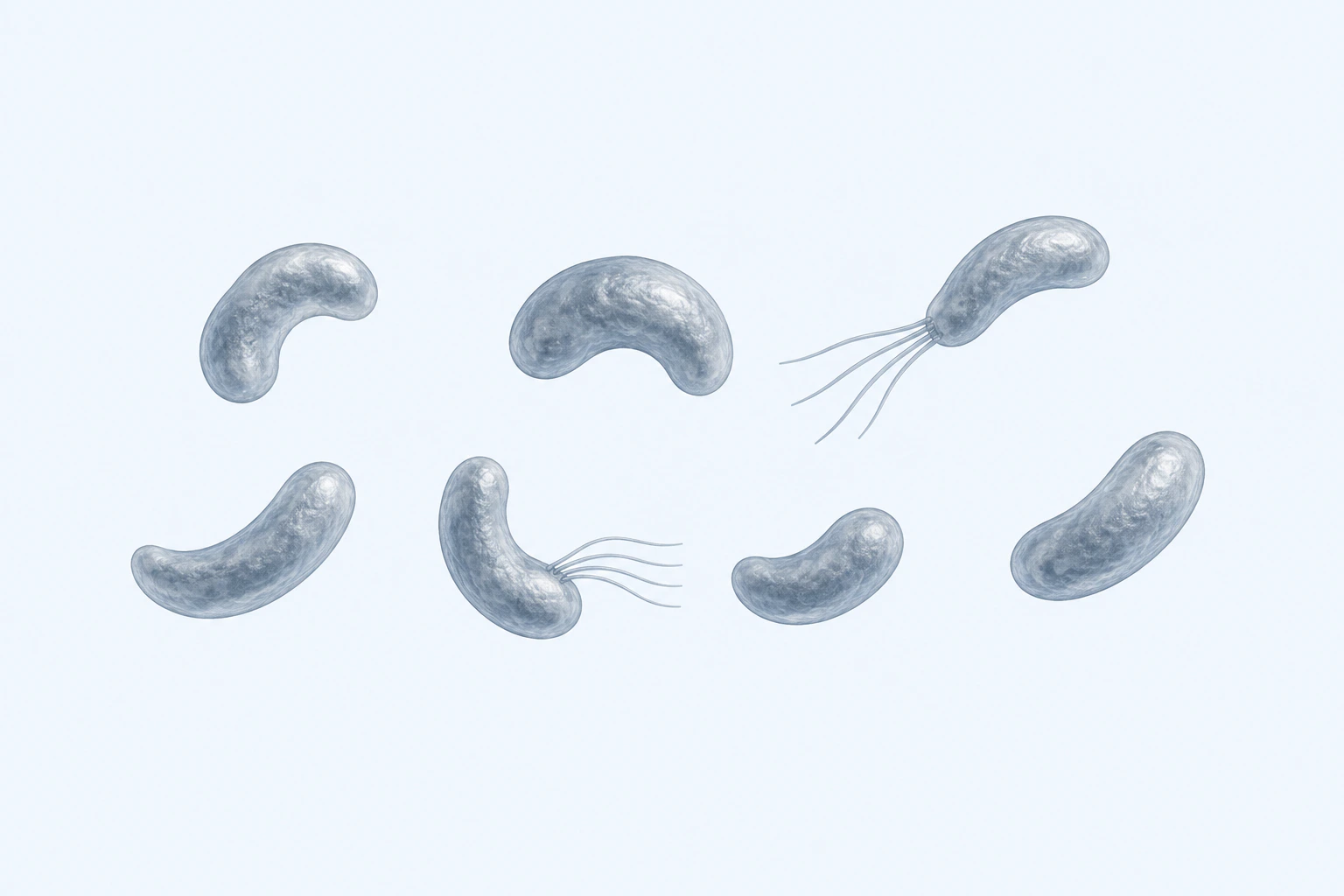
Type-species-anchored Selenomonas reconstruction with seven crescent-to-kidney bodies; two show limited concave-surface filament context. This genus plate is representative, variable, non-diagnostic, and not a micrograph.
Scientific media record1 verified identifier
- Subject
- Selenomonastaxon · genus
- Identifiers
- NCBITaxon:970
- Review
- Editorial review completeIdentifiers authority-verified · Accessibility validated · · selenomonas|selenomonas-morphology-v1.webp
- Digital source
- Trained-algorithmic mediaCreated with a trained generative algorithm and reviewed by WikiBiome for subject identity, scientific framing, identifiers, provenance, and accessibility.
- Scientific basis
- Selenomonas — NCBI TaxonomySelenomonas — LPSNSelenomonas sputigena type strain — BacDiveSelenomonas morphology study
- License
- CC BY-SA 4.0Created
A genus of Gram-negative, crescent-shaped, strictly anaerobic bacteria found in both the oral cavity and the gastrointestinal tract.
Selenomonas species are characterized by their distinctive morphology—a curved rod with a tuft of flagella arising from the concave side—and their metabolic versatility, producing propionate and hydrogen sulfide (H2S) among other metabolites.
The genus occupies an unusual ecological position: it appears as a commensal in healthy gut and oral ecosystems but is consistently enriched in several disease states, suggesting context-dependent pathogenic behavior that may be driven by altered metal and metabolite environments.
Evidence map9 cited passagesInspect provenance +
Selenomonas is a normal resident of the human oral cavity, particularly in subgingival plaque. In schizophrenia, oral Selenomonas is among the H2S-producing bacteria enriched in patients with first-episode psychosis, correlating with neuroinflammation markers including CRP, IFN-gamma, TNF-alpha, IL-8, IL-1beta, and S100B (, cross-sectional). H2S can bind iro
In the gut, Selenomonas participates in saccharolytic fermentation. In a synbiotic intervention trial for chronic kidney disease (CKD stages IIIb-IV), Selenomonas unexpectedly increased with synbiotic treatment alongside the intended restoration of lachnospiraceae (, randomized-controlled-trial, n=50). This suggests Selenomonas may benefit from the saccharol
Selenomonas is consistently enriched in proximal (right-sided) colorectal tumors, distinguishing them from distal tumors where Fusobacterium and Escherichia-Shigella predominate (, cross-sectional, n=61). This anatomical specificity suggests Selenomonas colonization is influenced by the distinct metabolic and oxygen gradients of the proximal colon.
Colorectal cancer—Enriched specifically in proximal tumors; part of the "driver-passenger" model of CRC microbial ecology (, cross-sectional)
Schizophrenia—Enriched in first-episode psychosis oral microbiome as an H2S-producing bacterium; correlates with neuroinflammation (, cross-sectional)
Chronic kidney disease—Increased with synbiotic treatment, suggesting a role in saccharolytic fermentation (, RCT, n=50)
(cross-sectional, n=208)—Identifies Selenomonas among H2S-producing bacteria enriched in first-episode schizophrenia; correlates with neuroinflammation markers.
(cross-sectional, n=61)—Maps Selenomonas enrichment in proximal CRC tumors with PCA separation from distal tumors.
(RCT, n=50)—Documents unexpected Selenomonas enrichment during synbiotic-mediated metabolic shift in CKD.
Contents
1. Metal Dependencies2. Key Enzymes and Virulence Factors3. Ecological Role4. Conditions Associated5. Key Studies6. Cross-ReferencesMetal Dependencies#
Selenomonas species require Iron for their anaerobic metabolic machinery, including iron-sulfur cluster-dependent enzymes involved in propionate production. The genus is poorly characterized at the metallomic level compared to major pathogens—an important knowledge gap given its consistent appearance in disease-associated microbiome signatures.
Key Enzymes and Virulence Factors#
Propionate production enzymes—Selenomonas contributes to the succinate/propionate pathway, producing Propionic Acid as a major fermentation end product. H2S-producing enzymes—Generation of hydrogen sulfide, a gasotransmitter that at high concentrations damages colonocytes and binds metal cofactors in host enzymes.
Flagellar motility—Unusual lateral flagellation pattern enables movement through viscous mucosal environments.
Ecological Role#
In the Oral Cavity#
Selenomonas is a normal resident of the human oral cavity, particularly in subgingival plaque. In schizophrenia, oral Selenomonas is among the H2S-producing bacteria enriched in patients with first-episode psychosis, correlating with neuroinflammation markers including CRP, IFN-gamma, TNF-alpha, IL-8, IL-1beta, and S100B (,[1]Qing 2021 -- Salivary microbiome profiling reveals a dysbiotic schizophrenia-associated microbiotaYing Qing, Lihua Xu, Ganqing Cui et al. · 2021Open reference 1 ↓ cross-sectional).
H2S can bind Iron, Copper, and Zinc in metalloenzymes, potentially contributing to Mis-Metallation—a mechanism that links oral microbial metabolites to systemic metal homeostasis disruption.
In the Gut#
In the gut, Selenomonas participates in saccharolytic fermentation. In a synbiotic intervention trial for chronic kidney disease (CKD stages IIIb-IV), Selenomonas unexpectedly increased with synbiotic treatment alongside the intended restoration of Lachnospiraceae (,[2]Vacca et al. 2023 — Synbiotic Intervention in CKD Stage IIIb-IVVacca, Calabrese, Nesti et al. · 2023Open reference 2 ↓ randomized-controlled-trial, n=50).
This suggests Selenomonas may benefit from the saccharolytic environment created by prebiotic supplementation (FOS + inulin).
In Colorectal Cancer#
Selenomonas is consistently enriched in proximal (right-sided) colorectal tumors, distinguishing them from distal tumors where Fusobacterium and Escherichia-Shigella predominate (,[3]Microbiota disbiosis is associated with colorectal cancerZhiguang Gao, Bomin Guo, Renyuan Gao et al. · 2015Open reference 3 ↓ cross-sectional, n=61). This anatomical specificity suggests Selenomonas colonization is influenced by the distinct metabolic and oxygen gradients of the proximal colon.
Conditions Associated#
Colorectal cancer—Enriched specifically in proximal tumors; part of the "driver-passenger" model of CRC microbial ecology (,[3]Microbiota disbiosis is associated with colorectal cancerZhiguang Gao, Bomin Guo, Renyuan Gao et al. · 2015Open reference 3 ↓ cross-sectional).
Schizophrenia—Enriched in first-episode psychosis oral microbiome as an H2S-producing bacterium; correlates with neuroinflammation (,[1]Qing 2021 -- Salivary microbiome profiling reveals a dysbiotic schizophrenia-associated microbiotaYing Qing, Lihua Xu, Ganqing Cui et al. · 2021Open reference 1 ↓ cross-sectional). Chronic kidney disease—Increased with synbiotic treatment, suggesting a role in saccharolytic fermentation (,[2]Vacca et al. 2023 — Synbiotic Intervention in CKD Stage IIIb-IVVacca, Calabrese, Nesti et al. · 2023Open reference 2 ↓ RCT, n=50).
Key Studies#
[1]Qing 2021 -- Salivary microbiome profiling reveals a dysbiotic schizophrenia-associated microbiotaYing Qing, Lihua Xu, Ganqing Cui et al. · 2021Open reference 1 ↓ (cross-sectional, n=208)—Identifies Selenomonas among H2S-producing bacteria enriched in first-episode schizophrenia; correlates with neuroinflammation markers.[3]Microbiota disbiosis is associated with colorectal cancerZhiguang Gao, Bomin Guo, Renyuan Gao et al. · 2015Open reference 3 ↓ (cross-sectional, n=61)—Maps Selenomonas enrichment in proximal CRC tumors with PCA separation from distal tumors.
[2]Vacca et al. 2023 — Synbiotic Intervention in CKD Stage IIIb-IVVacca, Calabrese, Nesti et al. · 2023Open reference 2 ↓ (RCT, n=50)—Documents unexpected Selenomonas enrichment during synbiotic-mediated metabolic shift in CKD.
Cross-References#
- Colorectal Cancer—Proximal tumor enrichment in CRC
- Schizophrenia—Oral H2S-producing enrichment in first-episode psychosis
- Oral Microbiome—Native oral habitat; disease-associated enrichment patterns
- Propionic Acid—Major fermentation end product
- Dysbiosis—Context-dependent enrichment across multiple disease states
- Gut-Brain Axis—H2S production as potential mediator of neuroinflammation
References 7
Numbered by first appearance in the article, then reconciled with its declared source list.
- 1
Ying Qing, Lihua Xu, Ganqing Cui et al. (2021). Qing 2021 -- Salivary microbiome profiling reveals a dysbiotic schizophrenia-associated microbiota. npj Schizophrenia.
- 2
Vacca, Calabrese, Nesti et al. (2023). Vacca et al. 2023 — Synbiotic Intervention in CKD Stage IIIb-IV. Frontiers in Nutrition.
- 3
Zhiguang Gao, Bomin Guo, Renyuan Gao et al. (2015). Microbiota disbiosis is associated with colorectal cancer. Frontiers in Microbiology.
- 4
Gong W, Jin G, Bao Y et al. (2025). Characteristics and potential diagnostic value of gut microbiota in ovarian tumor patients. Scientific Reports.
- 5
Choi S, Chung J, Cho ML et al. (2021). Analysis of Changes in Microbiome Compositions Related to the Prognosis of Colorectal Cancer Patients Based on Tissue-Derived 16S rRNA Sequences. Journal of Translational Medicine.
- 6
Liang T, Liu F, Liu L et al. (2021). Effects of Helicobacter pylori Infection on the Oral Microbiota of Reflux Esophagitis Patients. Frontiers in Cellular and Infection Microbiology.
- 7
Jessica Roelands, Peter J. K. Kuppen, Eiman I. Ahmed et al. (2023). An integrated tumor, immune and microbiome atlas of colon cancer. Nature Medicine.
Article network
Connect the evidence
Publicly readable discussion by ORCID-authenticated researchers. Questions, interpretation, methods, corrections, and new evidence stay attached to this record.
No discussion yet. Start with a precise question or a source-backed observation.
Published page changes
This record shows only material changes published on this page, including changes to its content, evidence, conclusions, or author context. Internal processes and discussion activity are excluded. Pending, declined, and withdrawn proposals remain private.
- published revision
Created “Selenomonas”: A genus of Gram-negative, crescent-shaped, strictly anaerobic bacteria found in both the oral cavity and the gastrointestinal tract. Selenomonas species are characterized by their distinctive…
Created “Selenomonas”: A genus of Gram-negative, crescent-shaped, strictly anaerobic bacteria found in both the oral cavity and the gastrointestinal tract. Selenomonas species are characterized by their distinctive… Published sections: Selenomonas; Metal Dependencies; Key Enzymes and Virulence Factors; In the Oral Cavity; In the Gut; In Colorectal Cancer; Conditions Associated; Key Studies; Cross-References. · WikiBiome Deploy Bot · +70 −0
Inspect exact Git diff ↗