
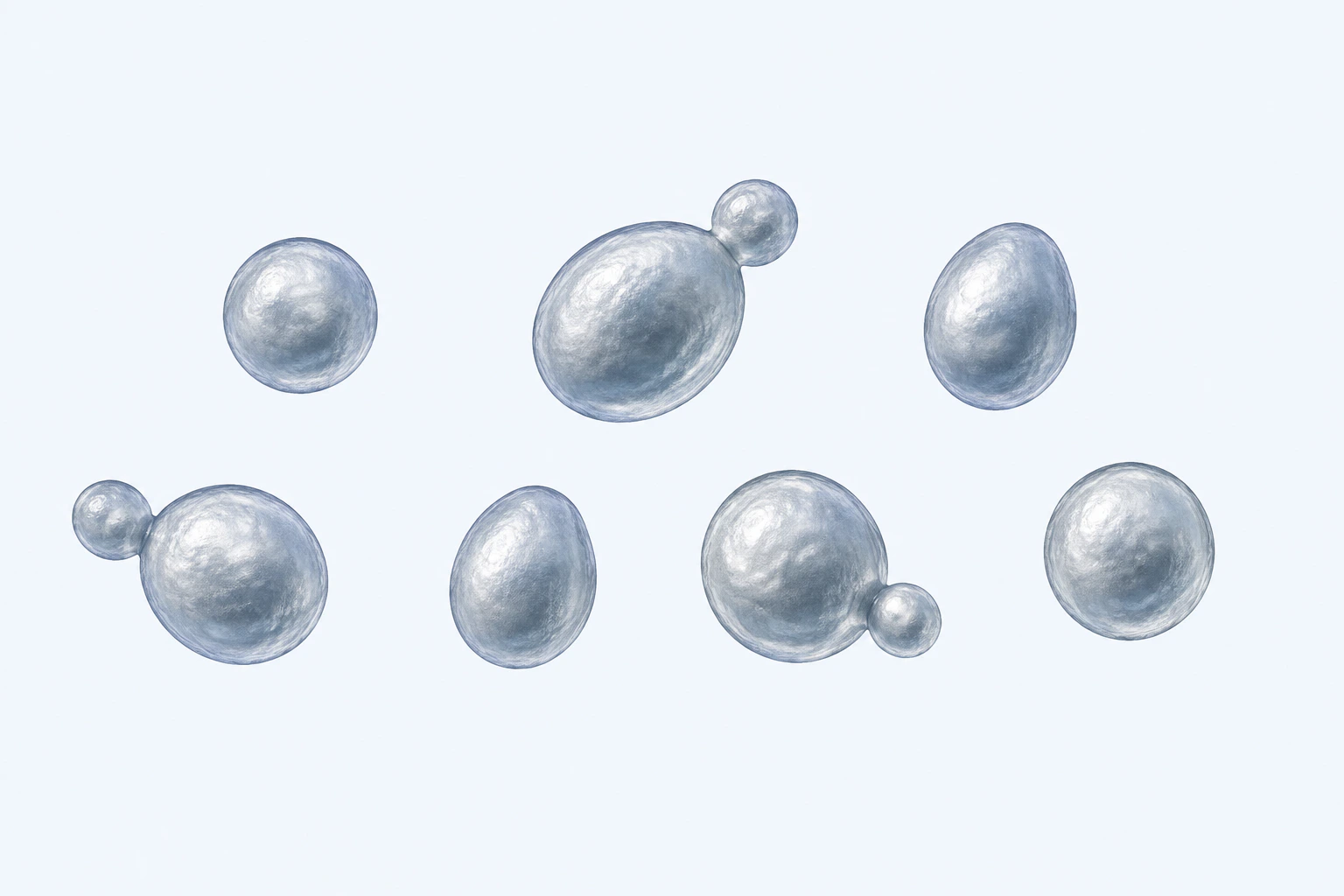
Type-species-anchored Saccharomyces reconstruction with spherical-to-ovoid single and budding forms. This genus plate is representative, non-universal, non-diagnostic, and not a micrograph.
Scientific media record1 verified identifier
- Subject
- Saccharomycestaxon · genus
- Identifiers
- NCBITaxon:4930
- Review
- Editorial review completeIdentifiers authority-verified · Accessibility validated · · saccharomyces|saccharomyces-morphology-v1.webp
- Digital source
- Trained-algorithmic mediaCreated with a trained generative algorithm and reviewed by WikiBiome for subject identity, scientific framing, identifiers, provenance, and accessibility.
- Scientific basis
- Saccharomyces — NCBI TaxonomySaccharomyces cerevisiae — Index FungorumSaccharomyces cerevisiae morphology review
- License
- CC BY-SA 4.0Created
A genus of ascomycete yeasts that includes both a proven therapeutic probiotic (S. boulardii) and species associated with disease states (S. cerevisiae enriched in CRC mycobiome). This dual nature—commensal/probiotic versus disease-associated—parallels the bacterial genus Ruminococcus and highlights the importance of species-level resolution in mycobiome studies.
Evidence map8 cited passagesInspect provenance +
The best-characterized fungal probiotic, with demonstrated efficacy in: - C. difficile infection: reduces recurrence by 50-60% when combined with antibiotics (McFarland 2006 Am J Gastroenterol; Surawicz et al. 2000 Clin Infect Dis); inhibits toxin A/B binding to colonocytes and degrades toxin receptor sites (Castagliuolo et al. 1999 Infect Immun). - Anti-inf
S. cerevisiae is enriched in the CRC mycobiome in multiple cohorts. Saccharomycetaceae showed significant reductions in CRC in some studies, suggesting context-dependent effects.
Interacts with bacterial communities: Saccharomyces abundance positively correlated with Bifidobacterium, Roseburia, and Ruminococcus in IBD patients.
Saccharomyces enriched in HTN+CKD comorbidity patients; positively associated with IFN-gamma, IL-4, and eGFR.
Present in hypertensive cohorts (8.46% of fungal community in HTN vs lower in normotensive controls).
Saccharomyces abundance altered in gut mycobiome of ASD children, part of the broader fungal dysbiosis profile in the condition.
Combined 16S and ITS profiling in Chinese CRC/adenoma cohorts places Saccharomyces within the fungal signature alongside key bacterial CRC biomarkers.
Beta-glucans—cell wall polysaccharides that stimulate Dectin-1 immune receptor, upregulating tight junction proteins and modulating macrophage function.
Contents
1. S. boulardii—Therapeutic Probiotic2. S. cerevisiae in Disease3. Metal Biosorption4. Key Metabolites5. ConnectionsS. boulardii—Therapeutic Probiotic#
The best-characterized fungal probiotic, with demonstrated efficacy in.
C. difficile infection: reduces recurrence by 50-60% when combined with antibiotics (McFarland 2006 Am J Gastroenterol; Surawicz et al. 2000 Clin Infect Dis); inhibits toxin A/B binding to colonocytes and degrades toxin receptor sites (Castagliuolo et al. 1999 Infect Immun).
Anti-inflammatory effects: secretes anti-inflammatory factors that inhibit NF-kB signaling and reduce IL-8 and TNF-alpha production in intestinal epithelial cells (Sougioultzis et al. 2006 BBRC).
Barrier protection: upregulates tight junction proteins and secretory IgA production (Czerucka et al. 2007 Aliment Pharmacol Ther). Antibiotic-associated diarrhea: reduces incidence by approximately 50% across meta-analyses (Szajewska & Kołodziej 2015 Aliment Pharmacol Ther; Hempel et al.
2012 JAMA).
Multiple sclerosis adjunctive use: evaluated as an adjunctive microbiome-targeted intervention in RCT.[1]Motlagh Asghari 2023 — Saccharomyces boulardii probiotic supplementation in multiple sclerosis: 4-month randomized clinical trialKimia Motlagh Asghari, Neda Dolatkhah, Hormoz Ayromlou et al. · 2023Open reference 1 ↓
Unlike bacterial probiotics, S. boulardii is inherently resistant to all antibacterial antibiotics, making it uniquely suited for co-administration during antibiotic therapy (Czerucka et al. 2007 Aliment Pharmacol Ther).
Produces 54-kDa serine protease that degrades C. difficile toxin A and its intestinal receptor (Castagliuolo et al. 1996 Infect Immun; Castagliuolo et al. 1999 Infect Immun).
S. cerevisiae in Disease#
Colorectal Cancer Mycobiome#
S. cerevisiae is enriched in the CRC mycobiome in multiple cohorts. Saccharomycetaceae showed significant reductions in CRC in some studies, suggesting context-dependent effects.[2]Unveiling the overlooked fungi: the vital of gut fungi in inflammatory bowel disease and colorectal cancerYilin Huang, Yang Wang, Xiaotian Huang et al. · 2024Open reference 2 ↓
Interacts with bacterial communities: Saccharomyces abundance positively correlated with Bifidobacterium, Roseburia, and Ruminococcus in IBD patients.[2]Unveiling the overlooked fungi: the vital of gut fungi in inflammatory bowel disease and colorectal cancerYilin Huang, Yang Wang, Xiaotian Huang et al. · 2024Open reference 2 ↓
Cardiometabolic Disease#
Saccharomyces enriched in HTN+CKD comorbidity patients; positively associated with IFN-gamma, IL-4, and eGFR.[3]Exploring the gut mycobiome: differential composition and clinical associations in hypertension, chronic kidney disease, and their comorbidityJuan Qiu, Longyou Zhao, Yiwen Cheng et al. · 2023Open reference 3 ↓ Present in hypertensive cohorts (8.46% of fungal community in HTN vs lower in normotensive controls).[4]Gut mycobiome in cardiometabolic disease progression: current evidence and future directionsXiaoyu Wei, Zixin Guo, Jingyang Wang et al. · 2025Open reference 4 ↓
S. boulardii supplementation failed to improve cardiac function in the GutHeart trial for heart failure (Awoyemi et al. 2021 eBioMedicine—GutHeart trial).
Autism Spectrum Disorder#
- Saccharomyces abundance altered in gut mycobiome of ASD children, part of the broader fungal Dysbiosis profile in the condition.[5]Strati 2017 — New Evidences on the Altered Gut Microbiota in Autism Spectrum DisordersFrancesco Strati, Duccio Cavalieri, Davide Albanese et al. · 2017Open reference 5 ↓
CRC Mycobiome-Bacteriome Integration#
- Combined 16S and ITS profiling in Chinese CRC/adenoma cohorts places Saccharomyces within the fungal signature alongside key bacterial CRC biomarkers.[6]Features of combined gut bacteria and fungi from a Chinese cohort of colorectal cancer, colorectal adenoma, and post-operative patientsXiaopeng Li, Jiahui Feng, Zhanggui Wang et al. · 2023Open reference 6 ↓
Crohn's Disease and ASCA#
Anti-Saccharomyces cerevisiae antibodies (ASCA) are a well-established serological marker for Crohn's disease, suggesting immune sensitization to this yeast in the inflamed gut (Main et al. 1988 BMJ; Quinton et al. 1998 Gut).
ASCA positivity distinguishes Crohn's from UC (sensitivity ~55%, specificity ~90%) and is associated with more aggressive disease phenotype including stricturing and penetrating complications (Dubinsky et al. 2006 Inflamm Bowel Dis).
Metal Biosorption#
Saccharomyces species have significant metal biosorption capacity, binding Heavy Metals to cell wall components (mannoproteins, glucans, chitin) (Wang & Chen 2006 Biotechnol Adv).
S. cerevisiae cell walls bind Cadmium, Lead, Copper, Zinc, and Chromium from solution, a property exploited in industrial bioremediation (Wang & Chen 2006 Biotechnol Adv; Machado et al. 2010 J Hazard Mater).
In the gut context, dietary or supplemental yeast may reduce bioavailable metal concentrations, potentially mitigating metal-induced dysbiosis. Zinc-dependent alcohol dehydrogenase and copper (Cu)/zinc (Zn)-superoxide dismutase are key metalloenzymes in Saccharomyces biology.
Key Metabolites#
Ethanol—primary fermentation product of S. cerevisiae; small amounts produced in the gut may affect hepatic metabolism.
Beta-glucans—cell wall polysaccharides that stimulate Dectin-1 immune receptor, upregulating tight junction proteins and modulating macrophage function.[2]Unveiling the overlooked fungi: the vital of gut fungi in inflammatory bowel disease and colorectal cancerYilin Huang, Yang Wang, Xiaotian Huang et al. · 2024Open reference 2 ↓
Proteases—S. boulardii secretes serine proteases that degrade bacterial toxins and pro-inflammatory signaling molecules. Short-chain fatty acids—indirect contribution via cross-kingdom metabolic interactions with SCFA-producing bacteria.
Connections#
- Clostridioides difficile—S. boulardii is a proven therapeutic against CDI recurrence
- Colorectal Cancer—S. cerevisiae enriched in CRC mycobiome; ASCA antibodies relevant
- Crohn's Disease—ASCA antibodies as serological marker; immune sensitization to yeast
- Cardiovascular Disease—enriched in HTN+CKD; failed to improve heart failure in GutHeart trial
- Cadmium—cell wall biosorption capacity for cadmium (Cd) and other heavy metals
- Lead—metal biosorption may reduce bioavailable lead (Pb) in the gut
- Zinc—zinc (Zn)-dependent enzymes; cell wall zinc-binding capacity
- Copper—copper/zinc superoxide dismutase (Cu/Zn-SOD) for Oxidative Stress defense
- dysbiosis—S. boulardii counters dysbiosis; S. cerevisiae may signal disease states
- Metal-Driven Inflammation—S. boulardii anti-inflammatory (NF-kB inhibition); beta-glucans immunomodulatory
- Gut-Metal-Microbiome Interactions—metal biosorption capacity links fungal biology to metal homeostasis
- Roseburia—positive correlation in IBD mycobiome-bacteriome interactions
References 6
Numbered by first appearance in the article, then reconciled with its declared source list.
- 1
Kimia Motlagh Asghari, Neda Dolatkhah, Hormoz Ayromlou et al. (2023). Motlagh Asghari 2023 — Saccharomyces boulardii probiotic supplementation in multiple sclerosis: 4-month randomized clinical trial. Scientific Reports.
- 2
Yilin Huang, Yang Wang, Xiaotian Huang et al. (2024). Unveiling the overlooked fungi: the vital of gut fungi in inflammatory bowel disease and colorectal cancer. Gut Pathogens.
- 3
Juan Qiu, Longyou Zhao, Yiwen Cheng et al. (2023). Exploring the gut mycobiome: differential composition and clinical associations in hypertension, chronic kidney disease, and their comorbidity. Frontiers in Immunology.
- 4
Xiaoyu Wei, Zixin Guo, Jingyang Wang et al. (2025). Gut mycobiome in cardiometabolic disease progression: current evidence and future directions. Frontiers in Microbiology.
- 5
Francesco Strati, Duccio Cavalieri, Davide Albanese et al. (2017). Strati 2017 — New Evidences on the Altered Gut Microbiota in Autism Spectrum Disorders. Microbiome.
- 6
Xiaopeng Li, Jiahui Feng, Zhanggui Wang et al. (2023). Features of combined gut bacteria and fungi from a Chinese cohort of colorectal cancer, colorectal adenoma, and post-operative patients. Frontiers in Microbiology.
Article network
Mentioned here 17
Pages linking here 5
Connect the evidence
Publicly readable discussion by ORCID-authenticated researchers. Questions, interpretation, methods, corrections, and new evidence stay attached to this record.
No discussion yet. Start with a precise question or a source-backed observation.
Activity and accepted changes
Accepted researcher context, editorial status, public discussion, and upstream Git revisions are shown together. Pending, declined, and withdrawn proposals remain private.
- published revision
Backfill heavy metals concept links
Karen Pendergrass · +1 −1
Inspect exact Git diff ↗ - published revision
Backfill oxidative stress concept links
Karen Pendergrass · +1 −1
Inspect exact Git diff ↗ - published revision
Complete corpus-wide Dysbiosis linking
Karen Pendergrass · +3 −3
Inspect exact Git diff ↗ - published revision
Complete Tight junctions contextual coverage
Karen Pendergrass · +1 −1
Inspect exact Git diff ↗ - published revision
massive wiki expansion: 149 stubs fixed, 100+ new pages, Rule 15 scan, keystone papers
WikiBiome Deploy Bot · +11 −11
Inspect exact Git diff ↗ - published revision
nightly maintenance: 94 stub demotions, 181 source_count fixes, 22 auto-discovered stubs, 5 adversarial audits, 3 boundary fixes, 3 evidence-level corrections
WikiBiome Deploy Bot · +1 −0
Inspect exact Git diff ↗ - published revision
Add 11 deepened microbe entities and 9 new OC/CVD/infertility source pages
WikiBiome Deploy Bot · +8 −1
Inspect exact Git diff ↗ - published revision
Deep content + citation pass: 10 entities enriched, 7 new sources, DOI integrity
WikiBiome Deploy Bot · +11 −11
Inspect exact Git diff ↗ - published revision
WikiBiome update — 2026-04-15 17:23
WikiBiome Deploy Bot · +4 −5
Inspect exact Git diff ↗ - published revision
v2 migration Priority 3: 17 metal + 82 microbe entities upgraded with seo_target, wikipedia_differentiation, conditions data
WikiBiome Deploy Bot · +6 −0
Inspect exact Git diff ↗ - published revision
WikiBiome update — integrity fixes, metallomic diet pages, cross-condition analyses
WikiBiome Deploy Bot · +14 −6
Inspect exact Git diff ↗ - published revision
WikiBiome update — 2026-04-10 13:49
WikiBiome Deploy Bot · +68 −0
Inspect exact Git diff ↗