
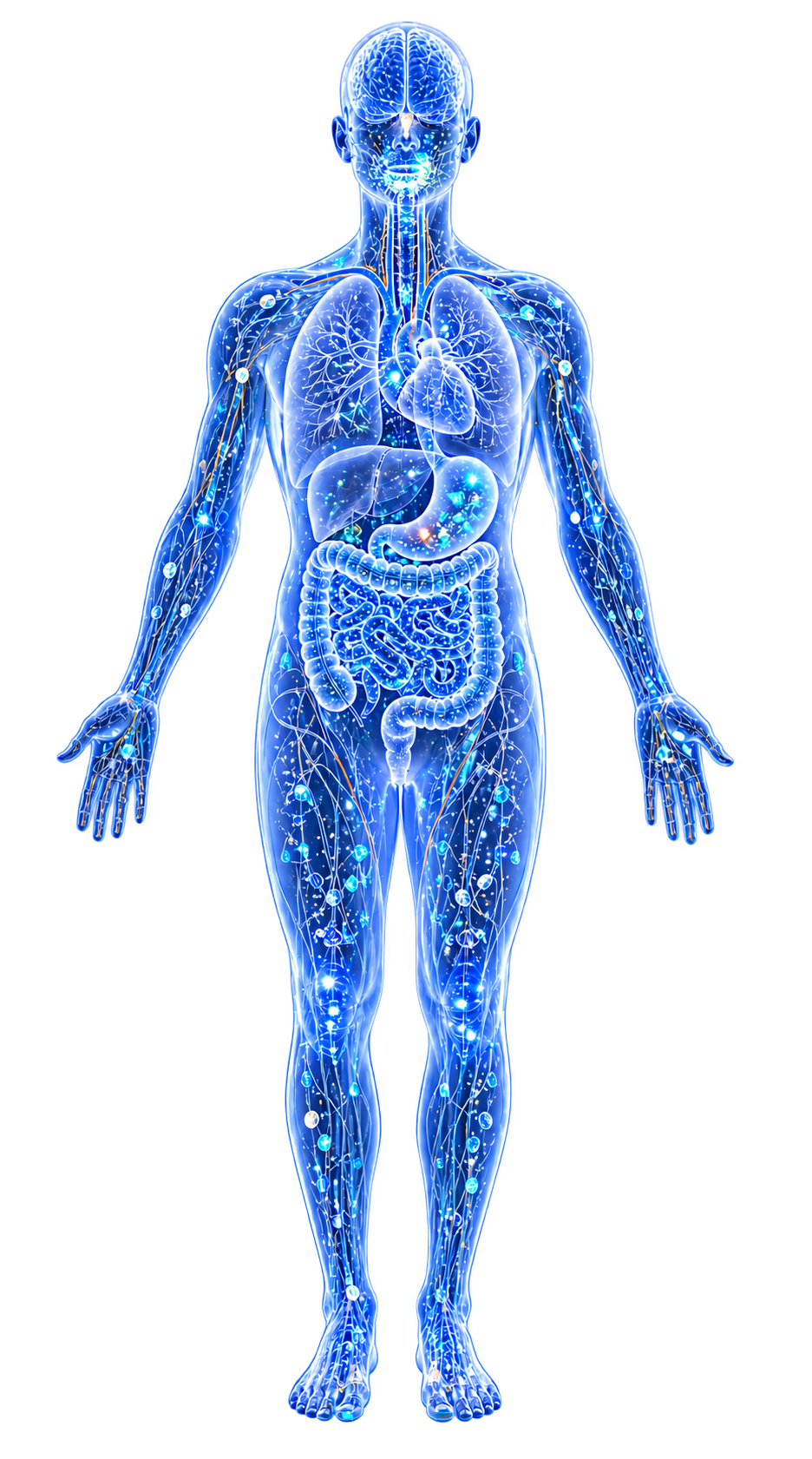
Quinolinic acid (QA) is a neurotoxic metabolite of the Kynurenine Pathway—the branch of tryptophan catabolism driven by IFN-γ-induced IDO activation. QA is an NMDA receptor agonist that causes excitotoxic neuronal death at elevated concentrations.
It is produced primarily by activated Microglia and macrophages, and its accumulation in the CNS is implicated in schizophrenia, depression, Alzheimer's, and MS.
Evidence map1 cited passagesInspect provenance +
Chronic inflammation (elevated IFN-γ, IL-6, TNF-alpha) activates microglia, shifting the balance toward QA → excitotoxicity.
The Kynurenine Branch Point#
Tryptophan → kynurenine branches into. Astrocyte branch → kynurenic acid (KYNA)—neuroprotective NMDA antagonist. Microglia branch → quinolinic acid (QA)—neurotoxic NMDA agonist.
Chronic Metal-Driven Inflammation (elevated IFN-γ, IL-6, TNF-alpha) activates microglia, shifting the balance toward QA → excitotoxicity.[1]Interactions between the Gut Microbiome and the Central Nervous System and Their Role in Schizophrenia, Bipolar Disorder and DepressionChrobak AA, Nowakowski J, Dudek D · 2016Open reference 1 ↓[2]Kamath 2025 — Gut Microbiome and Mental Health: Causation or Correlation? (Review)Srinivas Kamath, Elysia Sokolenko, Scott R Clark et al. · 2025Open reference 2 ↓
Microbiome Connection#
The Gut Microbiome determines tryptophan partitioning: Dysbiosis → inflammation → IDO induction → tryptophan shunting from Serotonin synthesis to kynurenine → QA accumulation in the brain. Restoring SCFA-producing commensals reduces inflammation → reduces IDO → restores serotonin production and reduces QA.
Cross-References#
- Kynurenine Pathway—metabolic pathway producing QA
- IFN-gamma (Interferon Gamma)—drives IDO activation
- Microglia—primary QA producer in CNS
- Serotonin—QA pathway competes with serotonin for tryptophan
- Tryptophan—shared precursor
- Neuroinflammation—inflammation drives QA accumulation
References 3
Numbered by first appearance in the article, then reconciled with its declared source list.
- 1
Chrobak AA, Nowakowski J, Dudek D (2016). Interactions between the Gut Microbiome and the Central Nervous System and Their Role in Schizophrenia, Bipolar Disorder and Depression. Archives of Psychiatry and Psychotherapy.
- 2
Srinivas Kamath, Elysia Sokolenko, Scott R Clark et al. (2025). Kamath 2025 — Gut Microbiome and Mental Health: Causation or Correlation? (Review). Preprint (no DOI found in document).
- 3
Correale J (2021). Immunosuppressive Amino-Acid Catabolizing Enzymes in Multiple Sclerosis. Frontiers in Immunology.
Article network
Connect the evidence
Publicly readable discussion by ORCID-authenticated researchers. Questions, interpretation, methods, corrections, and new evidence stay attached to this record.
No discussion yet. Start with a precise question or a source-backed observation.
Activity and accepted changes
Accepted researcher context, editorial status, public discussion, and upstream Git revisions are shown together. Pending, declined, and withdrawn proposals remain private.
- published revision
Backfill gut microbiome concept links
Karen Pendergrass · +1 −1
Inspect exact Git diff ↗ - published revision
Backfill inflammation concept links
Karen Pendergrass · +1 −1
Inspect exact Git diff ↗ - published revision
massive wiki expansion: 149 stubs fixed, 100+ new pages, Rule 15 scan, keystone papers
WikiBiome Deploy Bot · +43 −0
Inspect exact Git diff ↗