

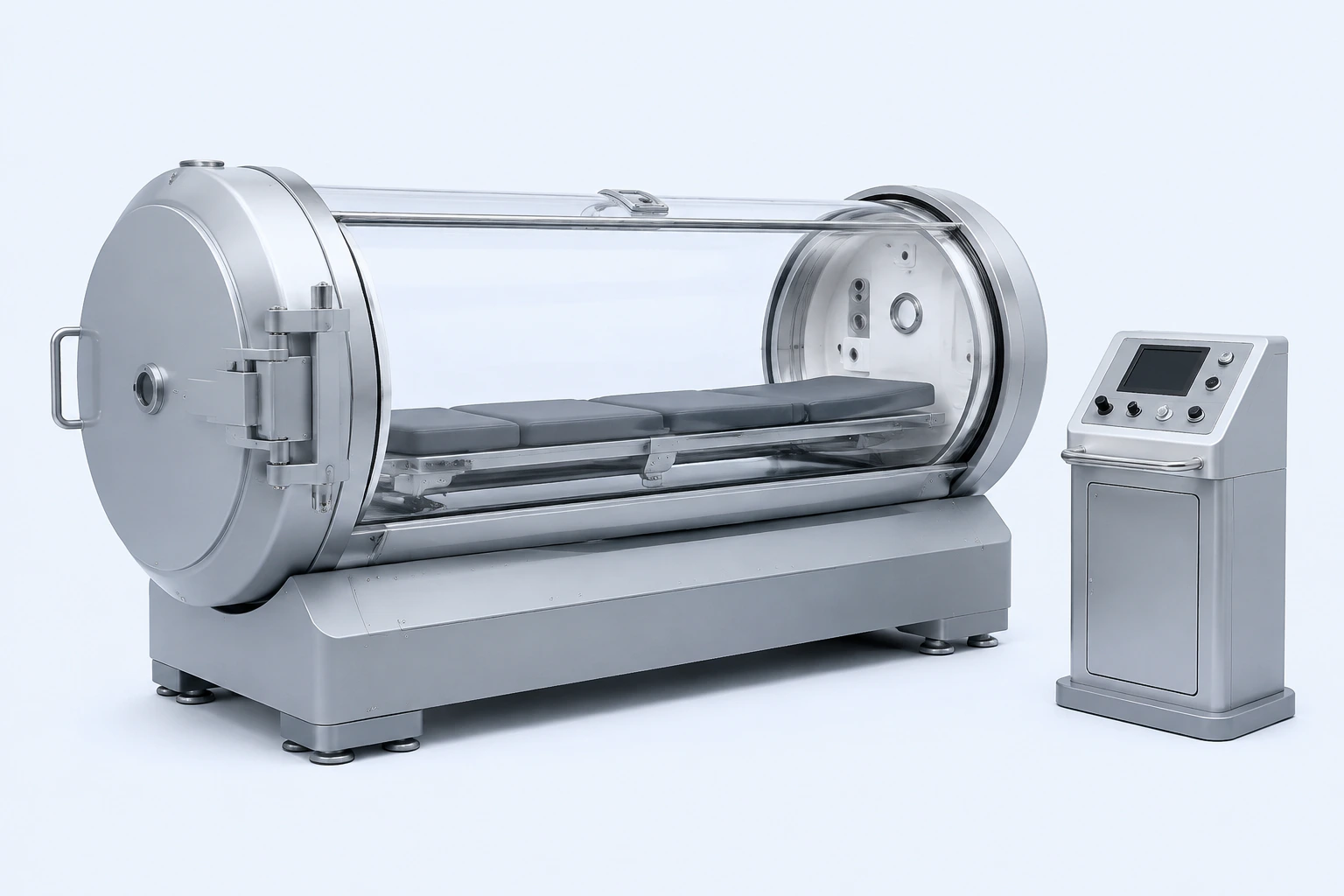
Representative unoccupied monoplace hyperbaric chamber device orientation. It depicts one generic chamber form only and does not establish a manufacturer, pressure or oxygen dose, indication, clearance for a named condition, microbiome effect, efficacy, safety, or treatment recommendation; this is an educational reconstruction, not a source photograph or operating instruction.
Scientific media record4 verified identifiers
- Subject
- Hyperbaric oxygen therapyintervention
- Review
- Editorial review completeIdentifiers authority-verified · Accessibility validated · · hbot|hbot-intervention-v1.webp
- Digital source
- Trained-algorithmic mediaCreated with a trained generative algorithm and reviewed by WikiBiome for subject identity, scientific framing, identifiers, provenance, and accessibility.
- Scientific basis
- Hyperbaric Oxygenation — Medical Subject HeadingsFollow Instructions for Safe Use of Hyperbaric Oxygen Therapy DevicesHyperbaric chamber product classificationOxyHeal 1000 Monoplace Hyperbaric Chamber 510(k)Hyperbaric Oxygen Therapy
- License
- CC BY-SA 4.0Created
> Research summary—not medical advice. This page synthesizes published research on a mechanism-level intervention. It is not a clinical recommendation.
Evidence map4 cited passagesInspect provenance +
The healthy colon maintains a steep oxygen gradient: the epithelial surface is relatively oxygenated (fed by capillaries), while the lumen is nearly anoxic (<1% O₂). This gradient is maintained by colonocyte oxygen consumption—which depends on butyrate oxidation as the primary energy source.
Luminal oxygenation paradoxically favors facultative anaerobes (Enterobacteriaceae) that can exploit the newly available oxygen, while obligate anaerobic commensals (Bacteroidetes, Clostridia) lose their competitive advantage.
Hypoxia stabilizes HIF-1α → upregulates ferroportin → increases iron export from cells → increases luminal iron → favors siderophore-producing Enterobacteriaceae.
| Condition | Rationale | Evidence | |-----------|-----------|----------| | Endometriosis | Peritoneal hypoxia sustains anaerobic pathobionts and biofilm | Animal models + case series | | Chronic wounds / diabetic ulcers | Wound hypoxia impairs neutrophil killing; polymicrobial biofilm | RCTs (FDA-approved indication) | | IBD | Mucosal hypoxia drives inflamm
Contents
1. Overview2. The Ecological Mechanism—Why Oxygen Changes the Microbiome3. Fermentation and Oxygen4. Iron-Oxygen Interface5. Conditions with HBOT Evidence6. Limitations and Open Questions7. Cross-ReferencesOverview#
Hyperbaric oxygen therapy (HBOT) delivers 100% oxygen at pressures above atmospheric (typically 1.5–3.0 ATA), dramatically increasing tissue oxygen tension. In the WikiBiome framework, HBOT is not merely a wound-healing modality—it is an ecological intervention that directly targets Karen's Brain Primitive 9 (Oxygen State as Ecological Determinant).
By changing the oxygen environment, HBOT reshapes which organisms can survive, altering the entire microbial ecosystem without directly killing any specific pathogen.
The Ecological Mechanism—Why Oxygen Changes the Microbiome#
The healthy colon maintains a steep oxygen gradient: the epithelial surface is relatively oxygenated (fed by capillaries), while the lumen is nearly anoxic (<1% O₂).
This gradient is maintained by colonocyte oxygen consumption—which depends on Butyrate oxidation as the primary energy source.[1]Participation of short-chain fatty acids and their receptors in gut inflammation and colon cancerMaria Daniella Carretta, John Quiroga, Rodrigo Lopez et al. · 2021Open reference 1 ↓
The Dysbiosis-Hypoxia Vicious Cycle#
- Dysbiosis depletes butyrate-producing commensals (Faecalibacterium prausnitzii, Roseburia).
- Lost butyrate → colonocytes switch from butyrate oxidation to glucose fermentation → reduced epithelial oxygen consumption → oxygen leaks into the lumen.
- Luminal oxygenation paradoxically favors facultative anaerobes (Enterobacteriaceae) that can exploit the newly available oxygen, while obligate anaerobic commensals (Bacteroidetes, Clostridia) lose their competitive advantage.[2]Short-chain fatty acids in cancer pathogenesisMark A. Feitelson, Alla Arzumanyan, Arvin Medhat et al. · 2023Open reference 2 ↓
- This is the opposite of what might be expected—in the healthy gut, more oxygen is bad because it disrupts the anaerobic equilibrium. The pathological state is not simply "too anaerobic" but rather a disrupted gradient where oxygen is in the wrong place.
How HBOT Intervenes#
HBOT's ecological effects depend on the tissue compartment:
In hypoxic lesion sites (endometriosis, tumors, chronic wounds). These environments are pathologically anaerobic—obligate anaerobes (Porphyromonas gingivalis, Fusobacterium, Prevotella, Desulfovibrio) thrive because the hypoxic niche excludes aerobic competitors and impairs neutrophil oxidative killing.
HBOT restores oxygen → disrupts obligate anaerobe viability → collapses Biofilm architecture (biofilm anaerobic cores are destabilized by O₂ penetration) → exposes embedded bacteria to immune clearance.
Enhanced neutrophil oxidative burst: HBOT provides the O₂ substrate for myeloperoxidase and NADPH oxidase—the primary antimicrobial weapons of Innate Immunity.
In the gut lumen. The effect is more nuanced. HBOT increases mucosal oxygenation → may enhance colonocyte butyrate oxidation capacity → potentially restore the normal oxygen gradient that favors obligate anaerobic commensals.
This is Karen's key insight: HBOT may help restore the conditions under which butyrate-producing obligate anaerobes thrive—not by feeding them oxygen (they're strict anaerobes) but by restoring the colonocyte oxygen consumption that maintains their anoxic habitat.
Fermentation and Oxygen#
Oxygen state determines which fermentation mode dominates:
| Oxygen State | Dominant Organisms | Fermentation | Products |
|---|---|---|---|
| Normal gradient (epithelium oxygenated, lumen anoxic) | Obligate anaerobes (Bacteroidetes, Clostridia) | Saccharolytic Fermentation | Butyrate, Acetate, propionate (beneficial) |
| Disrupted gradient (oxygen leaking into lumen) | Facultative anaerobes (Enterobacteriaceae) | Aerobic/mixed | LPS, Endotoxemia, less SCFA |
| Pathological hypoxia (lesion/tumor sites) | Obligate anaerobes + biofilm consortia | Proteolytic/sulfidogenic | Hydrogen Sulfide (H₂S), Cadaverine, ammonia (toxic) |
HBOT targets the pathological hypoxia compartment specifically—it does not flood the colonic lumen with oxygen but increases tissue oxygenation at hypoxic lesion sites and mucosal surfaces.
Iron-Oxygen Interface#
Oxygen state and iron ecology are inseparable. Hypoxia stabilizes HIF-1α → upregulates ferroportin → increases iron export from cells → increases luminal iron → favors siderophore-producing Enterobacteriaceae.[3]Mechanism of Iron Ion Homeostasis in Intestinal Immunity and Gut Microbiota RemodelingHonghong Bao, Yi Wang, Hanlin Xiong et al. · 2024Open reference 3 ↓
HBOT reverses hypoxia → destabilizes HIF-1α → normalizes iron handling → reduces the iron windfall that feeds pathobionts. NiFe-hydrogenases (nickel-iron enzymes used by Enterobacteriaceae for anaerobic H₂ oxidation) are oxygen-sensitive—HBOT inactivates them, removing a key competitive advantage of pathobionts.
Conditions with HBOT Evidence#
| Condition | Rationale | Evidence |
|---|---|---|
| Endometriosis | Peritoneal hypoxia sustains anaerobic pathobionts and biofilm | Animal models + case series |
| Chronic wounds / diabetic ulcers | Wound hypoxia impairs neutrophil killing; polymicrobial biofilm | RCTs (FDA-approved indication) |
| IBD | Mucosal hypoxia drives inflammatory cycle | Case series, small trials |
| Chronic fatigue / Long COVID | Tissue hypoperfusion, neuroinflammation | Emerging RCT evidence |
| Neurodegeneration | Cerebral hypoperfusion, microglial activation | Preclinical + early clinical |
| Chronic pelvic pain / ED | Pelvic ischemia drives tissue hypoxia | [4]Shim 2016 — Omega-3 Fatty Acids Improve Erectile Function in Atherosclerosis-induced Chronic Pelvic Ischemia Rat ModelJi Sung Shim, Dae Hee Kim, Jae Hyun Bae et al. · 2016Open reference 4 ↓ (ischemia context) |
Open Questions#
Unresolved questions identified by the current evidence record.
01Gut lumen effects are indirect: HBOT primarily affects tissue oxygenation, not luminal oxygen. The microbiome effects are mediated through colonocyte physiology and immune function, not direct O₂ exposure to luminal bacteria.+
The current WikiBiome record identifies this as an unresolved evidence gap.
02Rebound risk: If the underlying dysbiosis (butyrate producer depletion) is not addressed, the hypoxic niche may re-establish after HBOT cessation.+
The current WikiBiome record identifies this as an unresolved evidence gap.
03Oxidative stress: Repeated HBOT sessions generate Reactive Oxygen Species (ROS)—beneficial for antimicrobial killing but potentially damaging to host tissue. Balance is critical.+
The current WikiBiome record identifies this as an unresolved evidence gap.
04No RCTs for microbiome-specific endpoints: Current HBOT trials measure clinical outcomes, not microbiome composition. Studies measuring 16S/shotgun metagenomics before and after HBOT courses are needed.+
The current WikiBiome record identifies this as an unresolved evidence gap.
Cross-References#
- Hypoxia—the ecological condition HBOT targets
- Biofilm—anaerobic cores destabilized by O₂ penetration
- Functional Shielding—hypoxia enables interkingdom biofilm shielding
- Butyrate—colonocyte butyrate oxidation maintains the oxygen gradient
- Faecalibacterium prausnitzii—obligate anaerobe requiring anoxic lumen (paradoxically supported by HBOT restoring the gradient)
- Saccharolytic Fermentation—the beneficial fermentation mode favored by normal oxygen gradients
- Innate Immunity—HBOT enhances neutrophil oxidative burst
- Reactive Oxygen Species (ROS)—HBOT generates therapeutic ROS
- Iron—oxygen-iron-HIF-1α axis determines pathobiont iron access
- Endometriosis—primary disease target
- Cortisol—stress compounds hypoxia-driven dysbiosis
References 4
Numbered by first appearance in the article, then reconciled with its declared source list.
- 1
Maria Daniella Carretta, John Quiroga, Rodrigo Lopez et al. (2021). Participation of short-chain fatty acids and their receptors in gut inflammation and colon cancer. Frontiers in Physiology.
- 2
Mark A. Feitelson, Alla Arzumanyan, Arvin Medhat et al. (2023). Short-chain fatty acids in cancer pathogenesis. Cancer and Metastasis Reviews.
- 3
★Honghong Bao, Yi Wang, Hanlin Xiong et al. (2024). Mechanism of Iron Ion Homeostasis in Intestinal Immunity and Gut Microbiota Remodeling. International Journal of Molecular Sciences.
- 4
Ji Sung Shim, Dae Hee Kim, Jae Hyun Bae et al. (2016). Shim 2016 — Omega-3 Fatty Acids Improve Erectile Function in Atherosclerosis-induced Chronic Pelvic Ischemia Rat Model. Journal of Korean Medical Science.
Article network
Mentioned here 18
Pages linking here 2
Connect the evidence
Publicly readable discussion by ORCID-authenticated researchers. Questions, interpretation, methods, corrections, and new evidence stay attached to this record.
No discussion yet. Start with a precise question or a source-backed observation.
Activity and accepted changes
Accepted researcher context, editorial status, public discussion, and upstream Git revisions are shown together. Pending, declined, and withdrawn proposals remain private.
- published revision
massive wiki expansion: 149 stubs fixed, 100+ new pages, Rule 15 scan, keystone papers
WikiBiome Deploy Bot · +88 −28
Inspect exact Git diff ↗ - published revision
Adversarial audit fixes: confidence downgrades, disclaimers, STOP safety, entity cleanup
WikiBiome Deploy Bot · +7 −0
Inspect exact Git diff ↗ - published revision
Health check fixes: 40 intervention pages + 14 entity Connections sections
WikiBiome Deploy Bot · +51 −0
Inspect exact Git diff ↗