
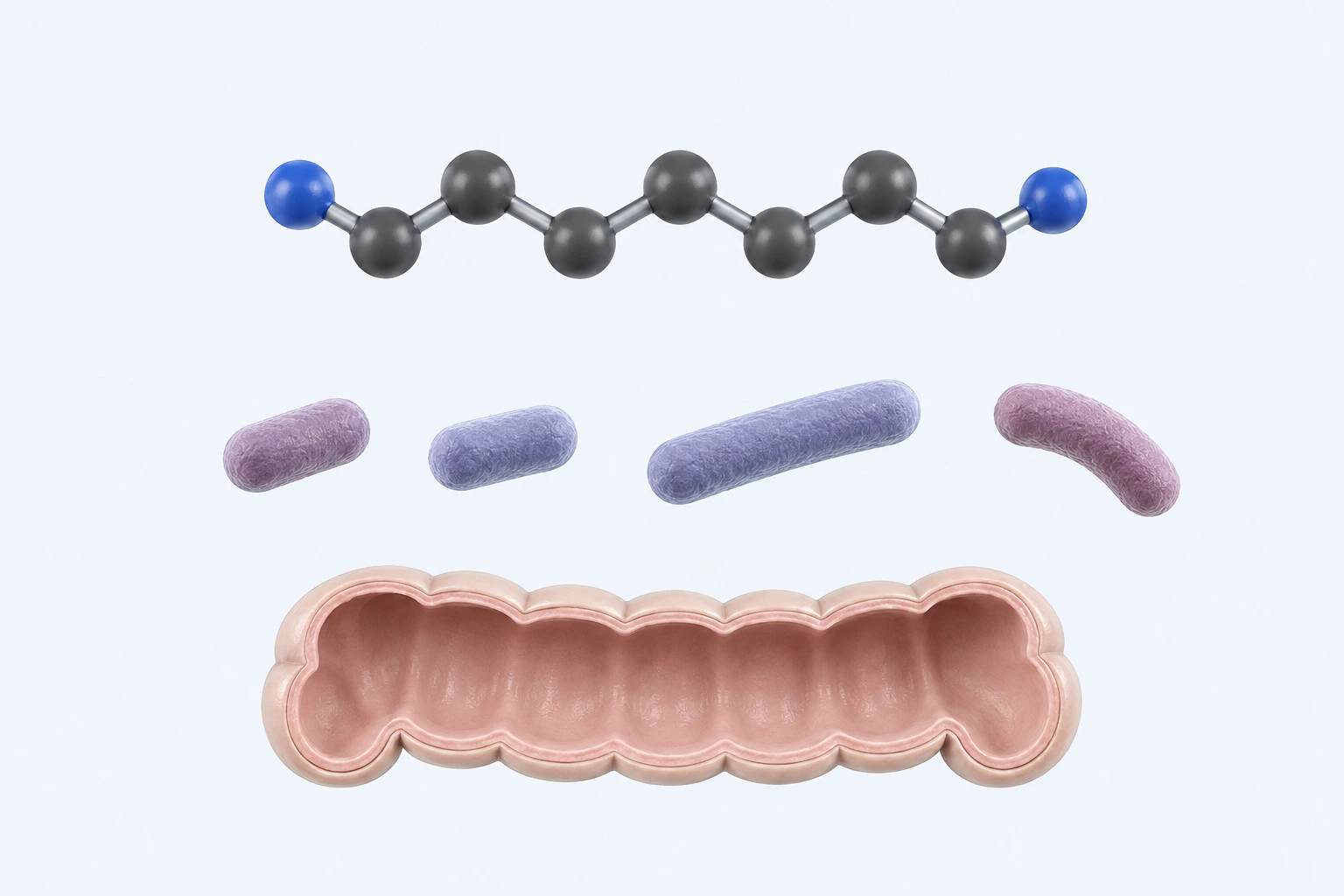
Cadaverine identity and separated microbial-colonic context. Hydrogens are omitted; the plate does not show a conformation, production pathway, species assignment, concentration, toxicology result, biomarker performance, disease, or treatment effect.
Scientific media record2 verified identifiers
- Subject
- Cadaverinebiological-process
- Identifiers
- WikiBiome:cadaverinePubChem:273
- Review
- Editorial review completeIdentifiers authority-verified · Accessibility validated · · cadaverine|cadaverine-mechanism-v1.webp
- Digital source
- Trained-algorithmic mediaCreated with a trained generative algorithm and reviewed by WikiBiome for subject identity, scientific framing, identifiers, provenance, and accessibility.
- Scientific basis
- Cadaverine — PubChem CID 273Cadaverine
- License
- CC BY-SA 4.0Created
Cadaverine (1,5-diaminopentane) is a biogenic amine produced by bacterial lysine decarboxylase—primarily by Enterobacteriaceae, Fusobacterium, and Clostridium—during proteolytic fermentation of undigested protein in the distal colon. It is a product of putrefaction and a marker of proteolytic (vs. saccharolytic) microbial activity.
Evidence map2 cited passagesInspect provenance +
CRC: Elevated fecal cadaverine is part of the metabolomic signature distinguishing CRC from healthy controls. High protein/low fiber diets increase cadaverine production.
Endometriosis: Altered in fecal metabolomics of endometriosis models.
Clinical Relevance#
CRC: Elevated fecal cadaverine is part of the metabolomic signature distinguishing CRC from healthy controls.[1]Towards the Human Colorectal Cancer MicrobiomeMarchesi JR, Dutilh BE, Hall N et al. · 2011Open reference 1 ↓[2]Stool Microbiome and Metabolome Differences between Colorectal Cancer Patients and Healthy AdultsTiffany L Weir, Daniel K Manter, Amy M Sheflin et al. · 2013Open reference 2 ↓ High protein/low fiber diets increase cadaverine production.
Endometriosis: Altered in fecal metabolomics of endometriosis models.[3]Ni 2020 — Fecal Metabolomics and Gut Microbiota Correlation in Endometriosis MiceZhexin Ni, Shuai Sun, Yanli Bi et al. · 2020Open reference 3 ↓ Cadaverine at high concentrations is cytotoxic and mutagenic—contributing to the CRC-promoting effect of proteolytic fermentation.
Cross-References#
- Saccharolytic Fermentation—healthy counterpart (fiber→SCFA vs. protein→cadaverine)
- Colorectal Cancer—cadaverine as CRC metabolomic biomarker
- Hydrogen Sulfide (H₂S)—co-product of proteolytic fermentation
References 3
Numbered by first appearance in the article, then reconciled with its declared source list.
- 1
Marchesi JR, Dutilh BE, Hall N et al. (2011). Towards the Human Colorectal Cancer Microbiome. PLOS ONE.
- 2
Tiffany L Weir, Daniel K Manter, Amy M Sheflin et al. (2013). Stool Microbiome and Metabolome Differences between Colorectal Cancer Patients and Healthy Adults. PLoS ONE.
- 3
Zhexin Ni, Shuai Sun, Yanli Bi et al. (2020). Ni 2020 — Fecal Metabolomics and Gut Microbiota Correlation in Endometriosis Mice. American Journal of Reproductive Immunology.
Article network
Mentioned here 3
Pages linking here 2
Connect the evidence
Publicly readable discussion by ORCID-authenticated researchers. Questions, interpretation, methods, corrections, and new evidence stay attached to this record.
No discussion yet. Start with a precise question or a source-backed observation.
Activity and accepted changes
Accepted researcher context, editorial status, public discussion, and upstream Git revisions are shown together. Pending, declined, and withdrawn proposals remain private.
- published revision
massive wiki expansion: 149 stubs fixed, 100+ new pages, Rule 15 scan, keystone papers
WikiBiome Deploy Bot · +32 −0
Inspect exact Git diff ↗