

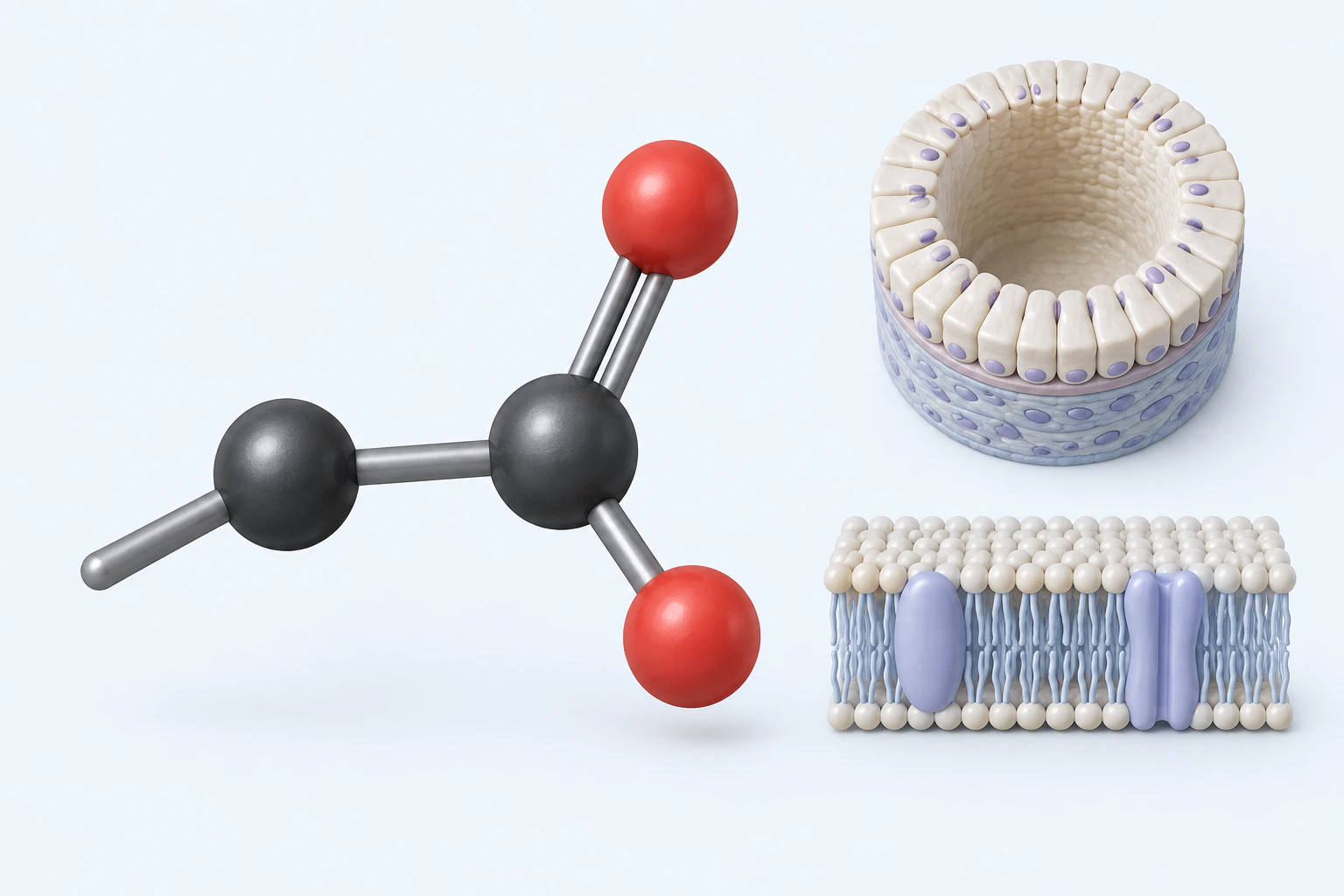
Acetate identity-and-context orientation. Hydrogens and charge are omitted; the plate is not a complete structural formula and does not establish concentration, transport, receptor activity, physiology, or diagnosis.
Scientific media record3 verified identifiers
- Subject
- Acetatebiological-process
- Identifiers
- WikiBiome:acetatePubChem:175ChEBI:30089
- Review
- Editorial review completeIdentifiers authority-verified · Accessibility validated · · acetate|acetate-mechanism-v1.webp
- Digital source
- Trained-algorithmic mediaCreated with a trained generative algorithm and reviewed by WikiBiome for subject identity, scientific framing, identifiers, provenance, and accessibility.
- Scientific basis
- Acetate — PubChemAcetate — ChEBI
- License
- CC BY-SA 4.0Created
Acetate (acetic acid, C2) is the most abundant SCFA in the colon (~60% of total SCFAs) and the primary cross-feeding substrate for Butyrate production.
Produced by Bacteroides, Bifidobacterium, Prevotella, and acetogens from dietary fiber fermentation, acetate reaches portal concentrations of 100–300 µM and peripheral circulation at 50–200 µM—making it the only SCFA with significant systemic concentrations.
Evidence map2 cited passagesInspect provenance +
cross feeding substrate: Acetate is converted to butyrate by butyrate-producing Firmicutes (roseburia, faecalibacterium prausnitzii) via butyryl-CoA:acetate CoA-transferase. This acetate→butyrate chain means acetate producers are upstream of the entire butyrate-dependent protective cascade.
Cancer: Context-dependent effects—anti-proliferative via HDAC inhibition in some cancers, but Acetyl-CoA supply for lipogenesis in others.
Functions#
Cross-Feeding substrate: Acetate is converted to butyrate by butyrate-producing Firmicutes (Roseburia, Faecalibacterium prausnitzii) via butyryl-CoA:acetate CoA-transferase. This acetate→butyrate chain means acetate producers are upstream of the entire butyrate-dependent protective cascade.[1]Louis et al. 2022 — Microbial Lactate Utilisation and the Stability of the Gut MicrobiomeLouis P, et al. · 2022Open reference 1 ↓
Appetite regulation: Acetate crosses the blood-brain barrier and reduces appetite via hypothalamic signaling. Immune modulation: Activates GPR43 (FFAR2) on immune cells, promoting neutrophil recruitment and Treg differentiation. Histone acetylation: Systemic acetate contributes to histone H3/H4 acetylation in peripheral tissues—an epigenetic mechanism linking Gut Microbiome to systemic gene regulation.
Cancer: Context-dependent effects—anti-proliferative via HDAC inhibition in some cancers, but Acetyl-CoA supply for lipogenesis in others.[2]Short-chain fatty acids in cancer pathogenesisMark A. Feitelson, Alla Arzumanyan, Arvin Medhat et al. · 2023Open reference 2 ↓
Cross-References#
- Short-Chain Fatty Acids (SCFAs)—SCFA umbrella
- butyrate—downstream product of acetate cross-feeding
- Cross-Feeding—acetate→butyrate trophic chain
- Bacteroides—major acetate producer
- Bifidobacterium—major acetate producer
- Dietary Fiber (Cross-Condition)—fermentation substrate
References 4
Numbered by first appearance in the article, then reconciled with its declared source list.
- 1
Louis P, et al. (2022). Louis et al. 2022 — Microbial Lactate Utilisation and the Stability of the Gut Microbiome. Gut Microbiome.
- 2
Mark A. Feitelson, Alla Arzumanyan, Arvin Medhat et al. (2023). Short-chain fatty acids in cancer pathogenesis. Cancer and Metastasis Reviews.
- 3
Fiona C. Ross, Dhrati Patangia, Ghjuvan Grimaud et al. (2024). The interplay between diet and the gut microbiome: implications for health and disease. Nature Reviews Microbiology.
- 4
Yingdong Lu, Yang Zhang, Xin Zhao et al. (2022). Microbiota-derived short-chain fatty acids: Implications for cardiovascular and metabolic disease. Frontiers in Cardiovascular Medicine.
Article network
Connect the evidence
Publicly readable discussion by ORCID-authenticated researchers. Questions, interpretation, methods, corrections, and new evidence stay attached to this record.
No discussion yet. Start with a precise question or a source-backed observation.
Activity and accepted changes
Accepted researcher context, editorial status, public discussion, and upstream Git revisions are shown together. Pending, declined, and withdrawn proposals remain private.
- published revision
Backfill gut microbiome concept links
Karen Pendergrass · +1 −1
Inspect exact Git diff ↗ - published revision
massive wiki expansion: 149 stubs fixed, 100+ new pages, Rule 15 scan, keystone papers
WikiBiome Deploy Bot · +40 −0
Inspect exact Git diff ↗