

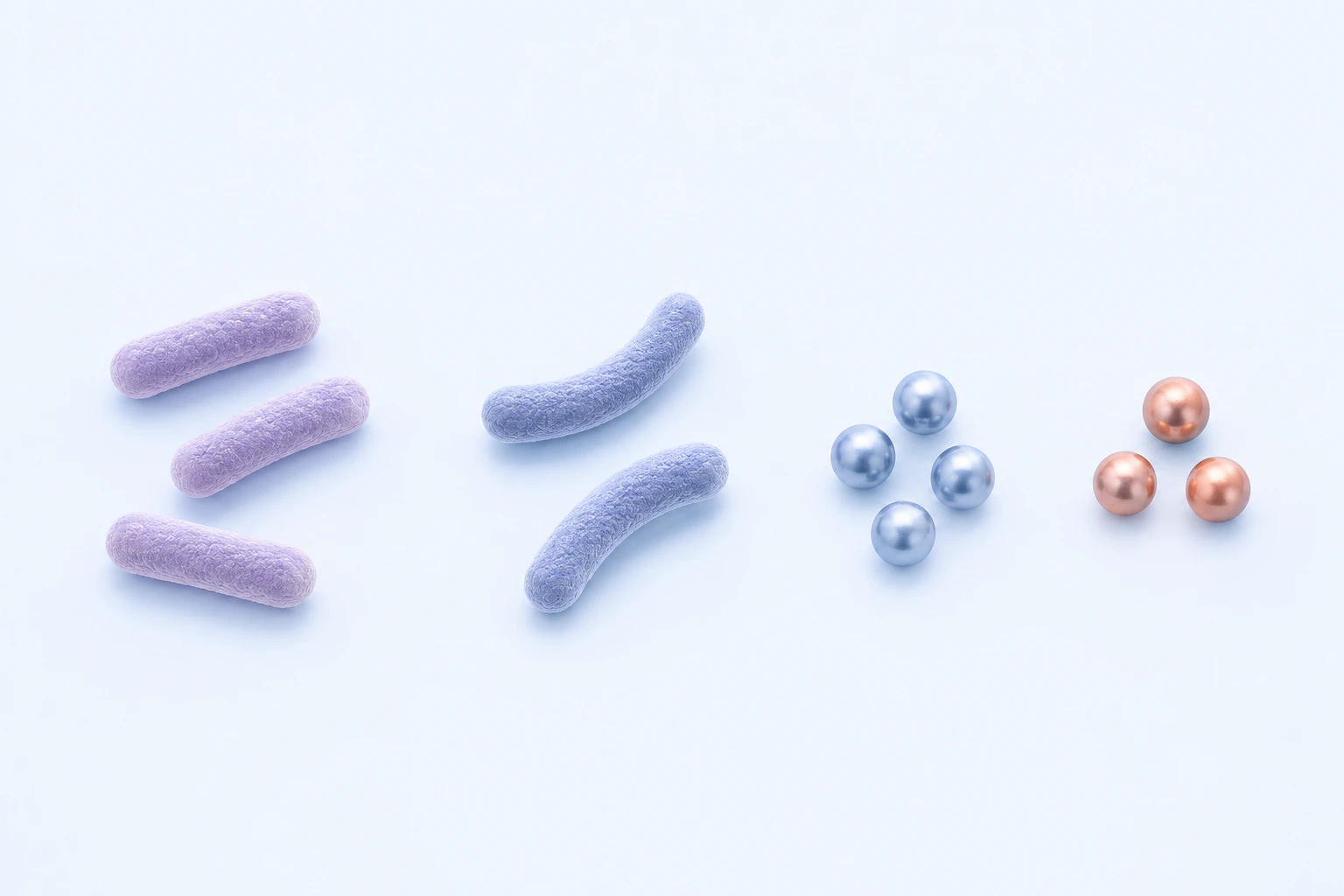
Gut-microbial cross-feeding context. The separated groups do not show exchange, direction, secretion, uptake, named taxa or metabolites, biochemical conversion, abundance, community function, consortium efficacy, or treatment guidance.
Scientific media record2 verified identifiers
- Subject
- Cross-Feedingbiological-process
- Identifiers
- WikiBiome:cross-feedingPMID:37054671
- Review
- Editorial review completeIdentifiers authority-verified · Accessibility validated · · cross-feeding|cross-feeding-mechanism-v1.webp
- Digital source
- Trained-algorithmic mediaCreated with a trained generative algorithm and reviewed by WikiBiome for subject identity, scientific framing, identifiers, provenance, and accessibility.
- License
- CC BY-SA 4.0Created
Cross-feeding (syntrophy) is the metabolic cooperation in which one organism's waste product becomes another's substrate. It is the cooperative counterpart to Competitive Exclusion—rather than competing for the same resource, organisms partition metabolic labor into sequential steps.
Cross-feeding is the foundation of the gut ecosystem's SCFA production chain and explains why single-organism probiotics often fail while consortium approaches succeed.
Evidence map2 cited passagesInspect provenance +
Lactate-utilizing organisms (clostridium butyricum, megasphaera, Anaerostipes) convert lactate to butyrate.
Why fiber works: Dietary fiber → acetate (by Bacteroides) → butyrate (by Roseburia) → barrier protection. The benefit requires the complete trophic chain.
Key Trophic Chains#
Acetate → Butyrate Conversion#
Acetate producers (Bacteroides, Bifidobacterium) generate acetate from dietary fiber. Butyrate producers (Faecalibacterium prausnitzii, Roseburia, Eubacterium) convert acetate to butyrate via butyryl-CoA:acetate CoA-transferase. This two-step chain means butyrate production depends on acetate availability—disrupting acetate producers indirectly depletes butyrate.
Lactate → Butyrate Conversion#
Lactate-producing bacteria (Lactobacillus, Streptococcus, Bifidobacterium) generate lactate from carbohydrate fermentation. Lactate-utilizing organisms (Clostridium butyricum, Megasphaera, Anaerostipes) convert lactate to butyrate.[1]Louis et al. 2022 — Microbial Lactate Utilisation and the Stability of the Gut MicrobiomeLouis P, et al. · 2022Open reference 1 ↓ This prevents harmful lactate accumulation (D-lactic acidosis) while generating beneficial butyrate.
Metal Cross-Feeding#
Within interkingdom biofilms, fungi can monopolize iron(III) (Fe3+) uptake via siderophores then transfer iron to bacterial partners—a form of metal cross-feeding that stabilizes polymicrobial communities.
Why Cross-Feeding Matters#
Cross-feeding explains several clinical observations. Why fiber works: Dietary fiber → acetate (by Bacteroides) → butyrate (by Roseburia) → barrier protection. The benefit requires the complete trophic chain.[2]The interplay between diet and the gut microbiome: implications for health and diseaseFiona C. Ross, Dhrati Patangia, Ghjuvan Grimaud et al. · 2024Open reference 2 ↓
Why single-strain probiotics often fail: Without cross-feeding partners, a butyrate producer cannot function if acetate supply is missing. Why Dysbiosis cascades: Losing one organism in a trophic chain collapses downstream production.
Cross-References#
- Short-Chain Fatty Acids (SCFAs)—the primary products of cross-feeding chains
- butyrate—end product of acetate→butyrate and lactate→butyrate chains
- Competitive Exclusion—competitive counterpart
- Functional Shielding—interkingdom metal cross-feeding in biofilms
- Dietary Fiber (Cross-Condition)—substrate that initiates the cross-feeding cascade
References 4
Numbered by first appearance in the article, then reconciled with its declared source list.
- 1
Louis P, et al. (2022). Louis et al. 2022 — Microbial Lactate Utilisation and the Stability of the Gut Microbiome. Gut Microbiome.
- 2
Fiona C. Ross, Dhrati Patangia, Ghjuvan Grimaud et al. (2024). The interplay between diet and the gut microbiome: implications for health and disease. Nature Reviews Microbiology.
- 3
Mark A. Feitelson, Alla Arzumanyan, Arvin Medhat et al. (2023). Short-chain fatty acids in cancer pathogenesis. Cancer and Metastasis Reviews.
- 4
Jean A. Hall, Matthew I. Jackson, Dennis E. Jewell et al. (2020). Hall et al. 2020 — CKD in Cats Alters Response of the Plasma Metabolome and Fecal Microbiome to Dietary Fiber. PLOS ONE.
Article network
Mentioned here 10
Pages linking here 5
Connect the evidence
Publicly readable discussion by ORCID-authenticated researchers. Questions, interpretation, methods, corrections, and new evidence stay attached to this record.
No discussion yet. Start with a precise question or a source-backed observation.
Published page changes
This record shows only material changes published on this page, including changes to its content, evidence, conclusions, or author context. Internal processes and discussion activity are excluded. Pending, declined, and withdrawn proposals remain private.
- published revision
Revised “Acetate → Butyrate Conversion”: now reads “generate acetate from dietary fiber. - butyrate producers (faecalibacterium prausnitzii, roseburia, Eubacterium) convert”.
Revised “Acetate → Butyrate Conversion”: changed “generate acetate from dietary fiber. - Butyrate producers (faecalibacterium prausnitzii, roseburia, Eubacterium) convert” to “generate acetate from dietary fiber. - butyrate producers (faecalibacterium prausnitzii, roseburia, Eubacterium) convert”. · Karen Pendergrass · +2 −2
Inspect exact Git diff ↗ - published revision
Created “Cross-Feeding”: Cross-feeding (syntrophy) is the metabolic cooperation in which one organism's waste product becomes another's substrate. It is the cooperative counterpart to competitive exclusion — rather than…
Created “Cross-Feeding”: Cross-feeding (syntrophy) is the metabolic cooperation in which one organism's waste product becomes another's substrate. It is the cooperative counterpart to competitive exclusion — rather than… Published sections: Overview; Acetate → Butyrate Conversion; Lactate → Butyrate Conversion; Metal Cross-Feeding; Why Cross-Feeding Matters; Cross-References. · WikiBiome Deploy Bot · +53 −0
Inspect exact Git diff ↗