

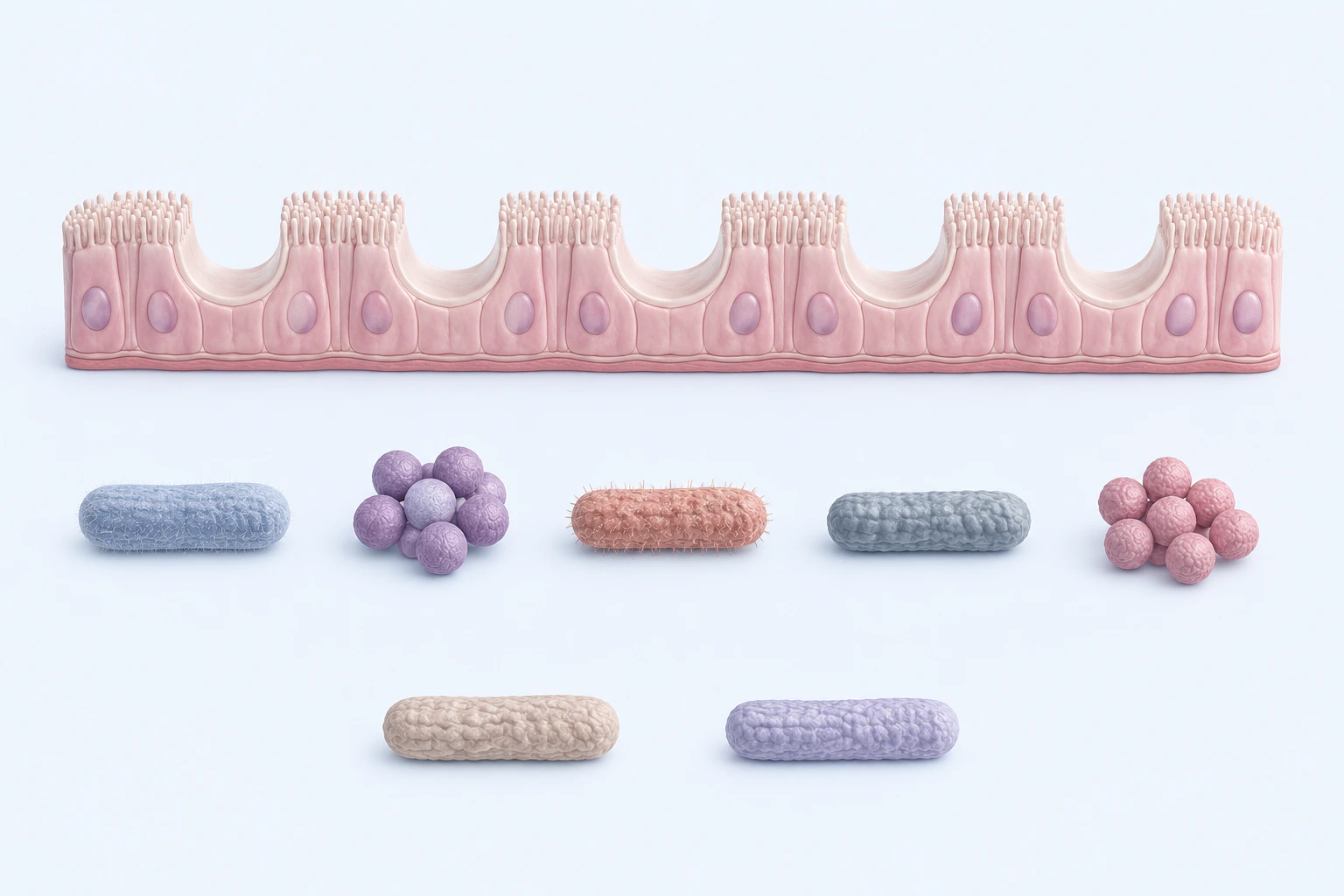
Competitive-exclusion niche context. Separation does not show occupation, exclusion, competition, a winner or loser, species identity, infection, fitness, abundance, probiotic efficacy, or treatment guidance.
Scientific media record2 verified identifiers
- Subject
- Competitive Exclusionbiological-process
- Identifiers
- WikiBiome:competitive-exclusionPMID:31895538
- Review
- Editorial review completeIdentifiers authority-verified · Accessibility validated · · competitive-exclusion|competitive-exclusion-mechanism-v1.webp
- Digital source
- Trained-algorithmic mediaCreated with a trained generative algorithm and reviewed by WikiBiome for subject identity, scientific framing, identifiers, provenance, and accessibility.
- Scientific basis
- Chemical Mechanisms of Colonization Resistance by the Gut Microbial MetabolomeCompetitive Exclusion
- License
- CC BY-SA 4.0Created
Competitive exclusion is the ecological principle that two species competing for the same limiting resource cannot coexist indefinitely—one will outcompete the other.
In the Gut Microbiome, competitive exclusion is the primary mechanism by which commensal bacteria prevent pathogen colonization, and it is the mechanistic basis for probiotic intervention (Karen's Brain Primitive 5).
Evidence map2 cited passagesInspect provenance +
Siderophore competition (Primitive 8): Organisms with superior iron acquisition systems (siderophores) outcompete iron-dependent pathogens.
Siderophore-producing enterobacteriaceae (E. coli, Klebsiella) outcompete siderophore-deficient commensals under iron restriction.
Mechanisms in the Gut#
Nutrient competition: Commensals that are more efficient at utilizing dietary fiber, amino acids, or host-derived glycans starve pathobionts.
Siderophore competition (Primitive 8): Organisms with superior iron acquisition systems (Siderophores) outcompete iron-dependent pathogens.[1]Passari et al. 2023 — Siderophores: Medical Applications Beyond AntimicrobialsPassari, A.K., et al. · 2023Open reference 1 ↓[2]Bushman 2025 — The Exploitation of Nutrient Metals by Bacteria for Survival and Infection in the GutSummer D Bushman, Eric P Skaar, N Luisa Hiller · 2025Open reference 2 ↓
Niche occupation: Physical occupation of mucosal adhesion sites prevents pathogen attachment. Bacteriocin production: Antimicrobial peptides (lantibiotics, colicins) directly kill competing organisms. pH modification: Lactic acid and SCFA production creates acidic environments inhospitable to pH-sensitive pathogens.
Metal Connection#
Iron is the most common limiting resource driving competitive exclusion in the gut. During Metal-Driven Inflammation, Hepcidin-driven iron sequestration intensifies competition for luminal iron. Siderophore-producing Enterobacteriaceae (E. coli, Klebsiella) outcompete siderophore-deficient commensals under iron restriction.[3]Khorsand 2022 — Overrepresentation of Enterobacteriaceae and Escherichia coli is the major gut microbiome signature in Crohn's and UC: comprehensive metagenomic analysis of IBDMDB datasetsBabak Khorsand, Hamid Asadzadeh Aghdaei, Ehsan Nazemalhosseini-Mojarad et al. · 2022Open reference 3 ↓
E. coli Nissle 1917 is a probiotic that works via competitive exclusion—its superior siderophore arsenal outcompetes pathogenic E. coli for iron.
Cross-References#
- Colonization Resistance—the community-level outcome of competitive exclusion
- Siderophore Competition—iron-mediated competitive exclusion (Primitive 8)
- Siderophores—molecular weapons of iron competition
- Cross-Feeding—cooperative counterpart to competitive exclusion
- Nutritional Immunity (Metal Sequestration)—host metal restriction intensifying microbial competition
References 5
Numbered by first appearance in the article, then reconciled with its declared source list.
- 1
Passari, A.K., et al. (2023). Passari et al. 2023 — Siderophores: Medical Applications Beyond Antimicrobials. Applied Microbiology and Biotechnology.
- 2
Summer D Bushman, Eric P Skaar, N Luisa Hiller (2025). Bushman 2025 — The Exploitation of Nutrient Metals by Bacteria for Survival and Infection in the Gut. PLOS Pathogens.
- 3
Babak Khorsand, Hamid Asadzadeh Aghdaei, Ehsan Nazemalhosseini-Mojarad et al. (2022). Khorsand 2022 — Overrepresentation of Enterobacteriaceae and Escherichia coli is the major gut microbiome signature in Crohn's and UC: comprehensive metagenomic analysis of IBDMDB datasets. Frontiers in Cellular and Infection Microbiology.
- 4
★Honghong Bao, Yi Wang, Hanlin Xiong et al. (2024). Mechanism of Iron Ion Homeostasis in Intestinal Immunity and Gut Microbiota Remodeling. International Journal of Molecular Sciences.
- 5
Joe Alcock, Carlo C. Maley, C. Athena Aktipis (2014). Alcock, Maley & Aktipis 2014 — Is Eating Behavior Manipulated by the Gastrointestinal Microbiota? Evolutionary Pressures and Potential Mechanisms. BioEssays.
Article network
Connect the evidence
Publicly readable discussion by ORCID-authenticated researchers. Questions, interpretation, methods, corrections, and new evidence stay attached to this record.
No discussion yet. Start with a precise question or a source-backed observation.
Published page changes
This record shows only material changes published on this page, including changes to its content, evidence, conclusions, or author context. Internal processes and discussion activity are excluded. Pending, declined, and withdrawn proposals remain private.
- published revision
Created “Competitive Exclusion”: Competitive exclusion is the ecological principle that two species competing for the same limiting resource cannot coexist indefinitely — one will outcompete the other. In the gut microbiome,…
Created “Competitive Exclusion”: Competitive exclusion is the ecological principle that two species competing for the same limiting resource cannot coexist indefinitely — one will outcompete the other. In the gut microbiome,… Published sections: Overview; Mechanisms in the Gut; Metal Connection; Cross-References. · WikiBiome Deploy Bot · +47 −0
Inspect exact Git diff ↗