

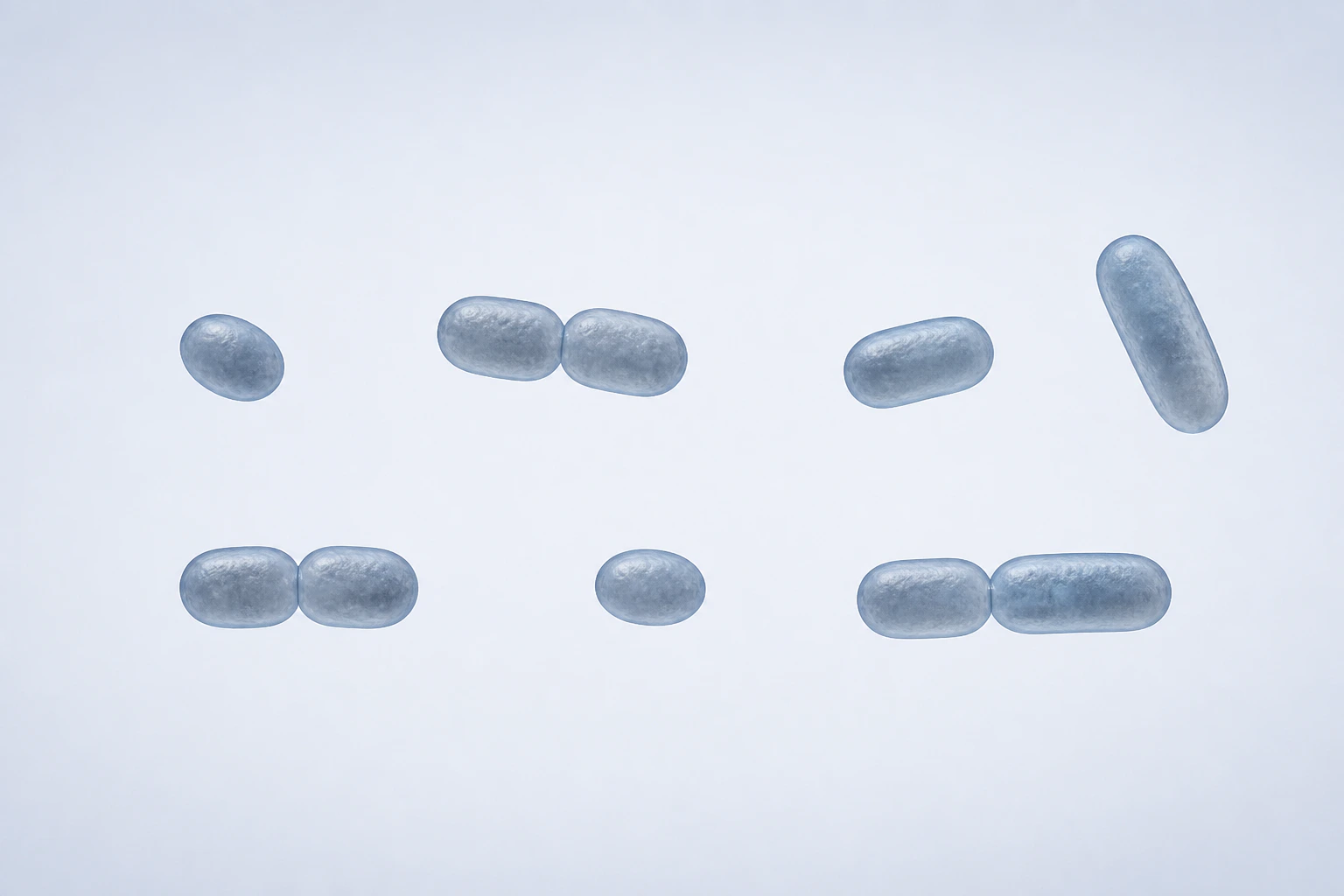
Type-species-anchored Haemophilus pleomorphic short rods and coccobacilli, shown as ten bodies in four single and three paired groupings. This genus-level reconstruction is representative, non-diagnostic, and not a universal genus form, pathology image, or micrograph.
Scientific media record1 verified identifier
- Subject
- Haemophilustaxon · genus
- Identifiers
- NCBITaxon:724
- Review
- Editorial review completeIdentifiers authority-verified · Accessibility validated · · haemophilus|haemophilus-morphology-v1.webp
- Digital source
- Trained-algorithmic mediaCreated with a trained generative algorithm and reviewed by WikiBiome for subject identity, scientific framing, identifiers, provenance, and accessibility.
- Scientific basis
- Haemophilus — NCBI TaxonomyHaemophilus — LPSNHaemophilus influenzae — LPSNHaemophilus genus treatmentGenomic emendation of Haemophilus
- License
- CC BY-SA 4.0Created
Haemophilus is a genus of small, Gram-negative, facultatively anaerobic coccobacilli that inhabit the upper respiratory tract, oral cavity, and gastrointestinal tract.
The genus name literally means "blood-loving"—a direct reference to its absolute requirement for heme-derived growth factors (X factor, hemin) and NAD (vanadium (V) factor) that it cannot synthesize on its own. This metal dependency makes Haemophilus a revealing indicator of iron ecology across body sites.
While H. influenzae dominates clinical attention as a respiratory pathogen, the species most commonly encountered in Gut Microbiome studies is Haemophilus parainfluenzae, a commensal of the oropharynx that appears across esophageal, gastric, and intestinal niches.
Its enrichment in inflammatory conditions of the esophagus and gut positions it as a marker of oral-gut microbial translocation and disrupted mucosal immunity.
Evidence map10 cited passagesInspect provenance +
Tryptophanase: Haemophilus is among the genera that produce indole from tryptophan. Indole and its derivatives (indoxyl sulfate, indole-3-acetic acid) activate the aryl hydrocarbon receptor (ahr) and influence vascular inflammation, making Haemophilus tryptophan metabolism relevant to cardiovascular disease (, expert-opinion).
Gastroesophageal reflux: Acid suppression with proton pump inhibitors raises gastric pH, permitting oral microbes like Haemophilus to survive transit (, systematic-review).
Mucosal inflammation: Haemophilus was significantly increased in untreated eosinophilic esophagitis (EoE) compared with normal subjects, with increased bacterial load regardless of treatment status (, cross-sectional).
Eosinophilic esophagitis: Significantly increased in untreated EoE, associated with eosinophilic mucosal inflammation and increased bacterial load (, cross-sectional).
Multiple sclerosis: H. parainfluenzae enriched in RRMS patients alongside Veillonella rogosae; beta diversity significantly different from healthy controls (, prospective-cohort, n=296).
GERD/esophageal reflux: Prevotella and Haemophilus dominant in GERD oral samples, consistent with the oral-esophageal translocation hypothesis (, systematic-review).
Crohn's disease: H. parainfluenzae identified as one of three cross-study reproducible species in IBD metagenomics (, cross-sectional).
Pancreatic cancer: Identified in fecal microbiota of PC patients alongside Lactobacillus and Streptococcus; part of a Random Forest classifier with AUC 82.5% (, expert-opinion).
Schizophrenia: Among 18 genera depleted in first-episode drug-naive schizophrenia patients; part of a 10-biomarker panel achieving AUC 0.879 for diagnosis. After 24 weeks of risperidone treatment, alpha diversity improved but remained below healthy baseline (, prospective-cohort, n=214).
| Study | Finding | Evidence Level | |-------|---------|---------------| | | Haemophilus significantly increased in untreated EoE vs normal | Cross-sectional | | | H. parainfluenzae enriched in RRMS (n=296) | Prospective cohort | | | Depleted in schizophrenia; part of diagnostic biomarker panel | Prospective cohort | | | Indole producer linking tryptophan me
Contents
1. Metal Dependencies2. Key Enzymes and Virulence Factors3. Ecological Role4. Conditions Associated5. Key Studies6. Cross-ReferencesMetal Dependencies#
Haemophilus species are defined by their dependence on iron in the form of heme and hemin. They lack the biosynthetic pathway for protoporphyrin IX and therefore cannot produce heme de novo. Instead, they scavenge free heme, hemoglobin, and hemoglobin-haptoglobin complexes from the host environment.
Iron acquisition systems include TonB-dependent outer membrane receptors for heme and transferrin binding proteins (Tbp1/Tbp2) that strip iron from host transferrin.
This dependency means Haemophilus thrives in iron-rich, heme-available environments—precisely the conditions found in inflamed mucosa where tissue damage liberates heme from lysed red blood cells.
The genus thus acts as a biological indicator of heme availability: where Haemophilus expands, free heme is abundant, suggesting mucosal Metal-Driven Inflammation and barrier breakdown.
Key Enzymes and Virulence Factors#
Tryptophanase: Haemophilus is among the genera that produce indole from tryptophan. Indole and its derivatives (indoxyl sulfate, indole-3-acetic acid) activate the aryl hydrocarbon receptor (AhR (Aryl Hydrocarbon Receptor)) and influence vascular inflammation, making Haemophilus tryptophan metabolism relevant to Cardiovascular Disease (,[1]Microbiota-derived tryptophan metabolites in vascular inflammation and cardiovascular diseaseNadja Paeslack, Maximilian Mimmler, Stefanie Becker et al. · 2022Open reference 1 ↓ expert-opinion).
Catalase and oxidase: Enable survival in oxygen-variable environments from the aerobic oral cavity to the microaerobic esophagus to the anaerobic distal gut. IgA1 protease: Cleaves human secretory IgA1, subverting mucosal immune defenses and facilitating colonization of inflamed epithelia.
Ecological Role#
Haemophilus occupies a distinctive niche as an oral-esophageal-gut bridging organism. Its presence in fecal samples often reflects translocation from the oral cavity through the esophagus, a process amplified by.
Gastroesophageal reflux: Acid suppression with proton pump inhibitors raises gastric pH, permitting oral microbes like Haemophilus to survive transit (,[2]Alageel 2025 — Examining the Microbiome Composition in Patients with Gastroesophageal Reflux Disease: A Systematic ReviewAlageel AA, Alomran DA, Alharbi HB et al. · 2025Open reference 2 ↓ systematic-review).
Mucosal inflammation: Haemophilus was significantly increased in untreated eosinophilic esophagitis (EoE) compared with normal subjects, with increased bacterial load regardless of treatment status (,[3]Esophageal Microbiome in Eosinophilic EsophagitisHarris JK, Fang R, Wagner BD et al. · 2015Open reference 3 ↓ cross-sectional).
Disrupted mucosal immunity: In conditions where secretory IgA is impaired or overwhelmed, Haemophilus IgA1 protease activity facilitates persistence.
In the healthy gut, Haemophilus is typically a low-abundance member of the community. Its expansion signals a shift toward a more oxygen-tolerant, oral-type community—often at the expense of strict anaerobes like Faecalibacterium prausnitzii and Roseburia.
Conditions Associated#
Enriched in:#
Eosinophilic esophagitis: Significantly increased in untreated EoE, associated with eosinophilic mucosal inflammation and increased bacterial load (,[3]Esophageal Microbiome in Eosinophilic EsophagitisHarris JK, Fang R, Wagner BD et al. · 2015Open reference 3 ↓ cross-sectional).
Multiple sclerosis: H. parainfluenzae enriched in RRMS patients alongside Veillonella rogosae; beta diversity significantly different from healthy controls (,[4]The Gut Microbiota in Multiple Sclerosis Varies with Disease ActivityThirion F, Sellebjerg F, Fan Y et al. · 2023Open reference 4 ↓ prospective-cohort, n=296).
GERD/esophageal reflux: Prevotella and Haemophilus dominant in GERD oral samples, consistent with the oral-esophageal translocation hypothesis (,[2]Alageel 2025 — Examining the Microbiome Composition in Patients with Gastroesophageal Reflux Disease: A Systematic ReviewAlageel AA, Alomran DA, Alharbi HB et al. · 2025Open reference 2 ↓ systematic-review).
Crohn's disease: H. parainfluenzae identified as one of three cross-study reproducible species in IBD metagenomics (,[5]Diagnosis of Crohn's Disease and Ulcerative Colitis Using the MicrobiomeKang DY, Park JL, Yeo MK et al. · 2023Open reference 5 ↓ cross-sectional).
Pancreatic cancer: Identified in fecal microbiota of PC patients alongside Lactobacillus and Streptococcus; part of a Random Forest classifier with AUC 82.5% (,[6]Microbiome as a biomarker and therapeutic target in pancreatic cancerGhazaleh Pourali, Danial Kazemi, Amir Shayan Chadeganipour et al. · 2024Open reference 6 ↓ expert-opinion).
Depleted in:#
- Schizophrenia: Among 18 genera depleted in first-episode drug-naive schizophrenia patients; part of a 10-biomarker panel achieving AUC 0.879 for diagnosis. After 24 weeks of risperidone treatment, alpha diversity improved but remained below healthy baseline (,[7]Gut Microbial Biomarkers for the Treatment Response in First-Episode, Drug-Naive Schizophrenia: A 24-Week Follow-Up StudyYuan X, Wang Y, Li X et al. · 2021Open reference 7 ↓ prospective-cohort, n=214).
Key Studies#
| Study | Finding | Evidence Level |
|---|---|---|
| [3]Esophageal Microbiome in Eosinophilic EsophagitisHarris JK, Fang R, Wagner BD et al. · 2015Open reference 3 ↓ | Haemophilus significantly increased in untreated EoE vs normal | Cross-sectional |
| [4]The Gut Microbiota in Multiple Sclerosis Varies with Disease ActivityThirion F, Sellebjerg F, Fan Y et al. · 2023Open reference 4 ↓ | H. parainfluenzae enriched in RRMS (n=296) | Prospective cohort |
| [7]Gut Microbial Biomarkers for the Treatment Response in First-Episode, Drug-Naive Schizophrenia: A 24-Week Follow-Up StudyYuan X, Wang Y, Li X et al. · 2021Open reference 7 ↓ | Depleted in schizophrenia; part of diagnostic biomarker panel | Prospective cohort |
| [1]Microbiota-derived tryptophan metabolites in vascular inflammation and cardiovascular diseaseNadja Paeslack, Maximilian Mimmler, Stefanie Becker et al. · 2022Open reference 1 ↓ | Indole producer linking tryptophan metabolism to CVD | Expert opinion |
| [5]Diagnosis of Crohn's Disease and Ulcerative Colitis Using the MicrobiomeKang DY, Park JL, Yeo MK et al. · 2023Open reference 5 ↓ | Cross-study reproducible IBD species | Cross-sectional |
Cross-References#
- Iron—heme dependency as ecological driver
- AhR (Aryl Hydrocarbon Receptor)—indole activation of aryl hydrocarbon receptor
- Streptococcus—co-occurring oral-translocation genus
- Veillonella—co-enriched in MS and esophageal conditions
- Gastroesophageal Reflux Disease (GERD)—acid suppression enabling oral-gut translocation
- Multiple Sclerosis—neuroinflammatory condition with H. parainfluenzae enrichment
- Tryptophan Metabolism—indole production pathway
References 9
Numbered by first appearance in the article, then reconciled with its declared source list.
- 1
Nadja Paeslack, Maximilian Mimmler, Stefanie Becker et al. (2022). Microbiota-derived tryptophan metabolites in vascular inflammation and cardiovascular disease. Amino Acids.
- 2
Alageel AA, Alomran DA, Alharbi HB et al. (2025). Alageel 2025 — Examining the Microbiome Composition in Patients with Gastroesophageal Reflux Disease: A Systematic Review. TPM (The Primary Care Companion for CNS Disorders).
- 3
Harris JK, Fang R, Wagner BD et al. (2015). Esophageal Microbiome in Eosinophilic Esophagitis. PLoS ONE.
- 4
Thirion F, Sellebjerg F, Fan Y et al. (2023). The Gut Microbiota in Multiple Sclerosis Varies with Disease Activity. Genome Medicine.
- 5
Kang DY, Park JL, Yeo MK et al. (2023). Diagnosis of Crohn's Disease and Ulcerative Colitis Using the Microbiome. BMC Microbiology.
- 6
Ghazaleh Pourali, Danial Kazemi, Amir Shayan Chadeganipour et al. (2024). Microbiome as a biomarker and therapeutic target in pancreatic cancer. BMC Microbiology.
- 7
Yuan X, Wang Y, Li X et al. (2021). Gut Microbial Biomarkers for the Treatment Response in First-Episode, Drug-Naive Schizophrenia: A 24-Week Follow-Up Study. Translational Psychiatry.
- 8
Liu Y, Yu J, Yang Y et al. (2024). Investigating the causal relationship of gut microbiota with GERD and BE: a bidirectional mendelian randomization. BMC Genomics.
- 9
Liu J, Qin X, Lin B et al. (2022). Analysis of gut microbiota diversity in Hashimoto's thyroiditis patients. BMC Microbiology.
Article network
Mentioned here 12
Pages linking here 2
Connect the evidence
Publicly readable discussion by ORCID-authenticated researchers. Questions, interpretation, methods, corrections, and new evidence stay attached to this record.
No discussion yet. Start with a precise question or a source-backed observation.
Published page changes
This record shows only material changes published on this page, including changes to its content, evidence, conclusions, or author context. Internal processes and discussion activity are excluded. Pending, declined, and withdrawn proposals remain private.
- published revision
Created “Haemophilus”: Haemophilus is a genus of small, Gram-negative, facultatively anaerobic coccobacilli that inhabit the upper respiratory tract, oral cavity, and gastrointestinal tract. The genus name literally means…
Created “Haemophilus”: Haemophilus is a genus of small, Gram-negative, facultatively anaerobic coccobacilli that inhabit the upper respiratory tract, oral cavity, and gastrointestinal tract. The genus name literally means… Published sections: Haemophilus; Metal Dependencies; Key Enzymes and Virulence Factors; Ecological Role; Enriched in:; Depleted in:; Key Studies; Cross-References. · WikiBiome Deploy Bot · +87 −0
Inspect exact Git diff ↗