
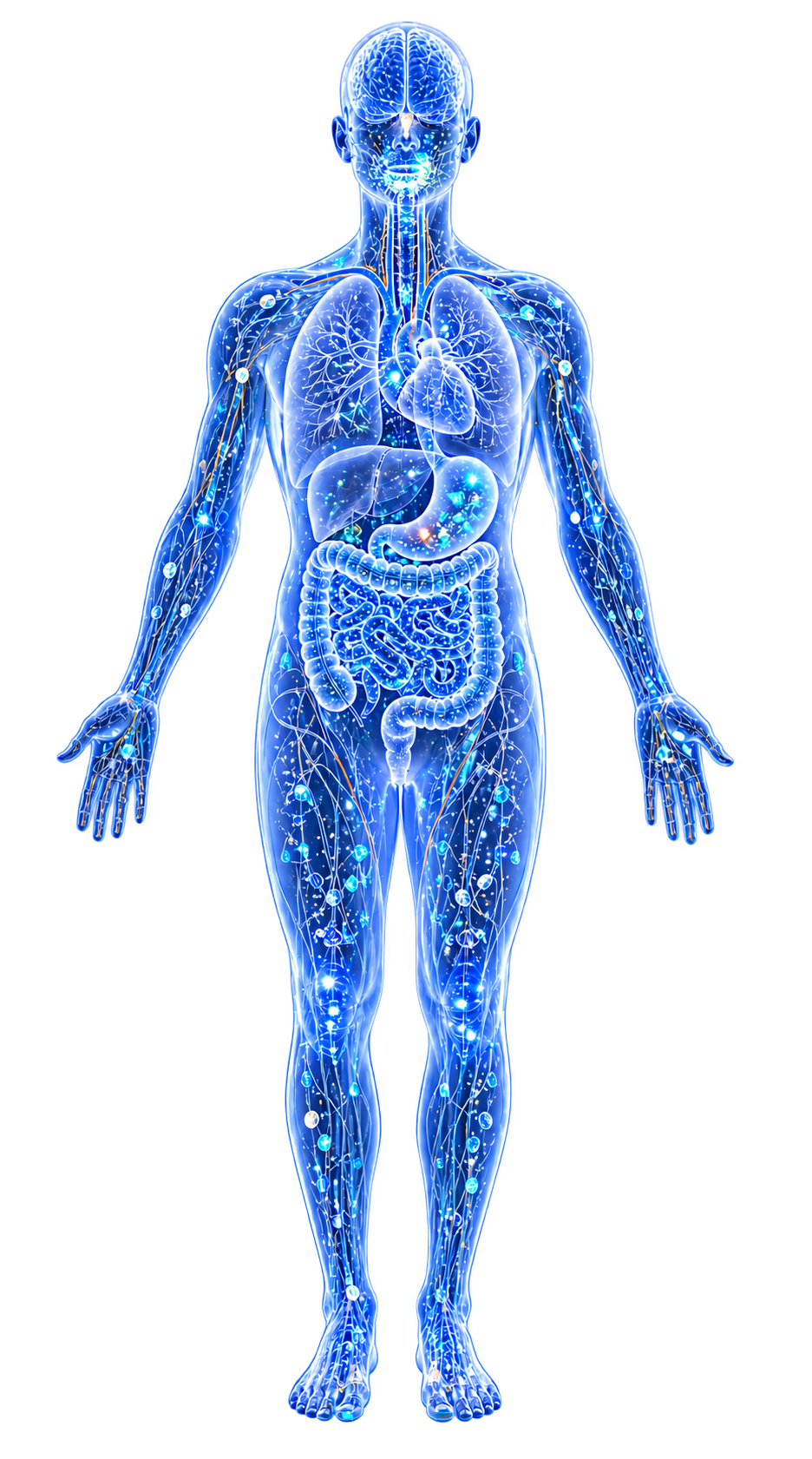
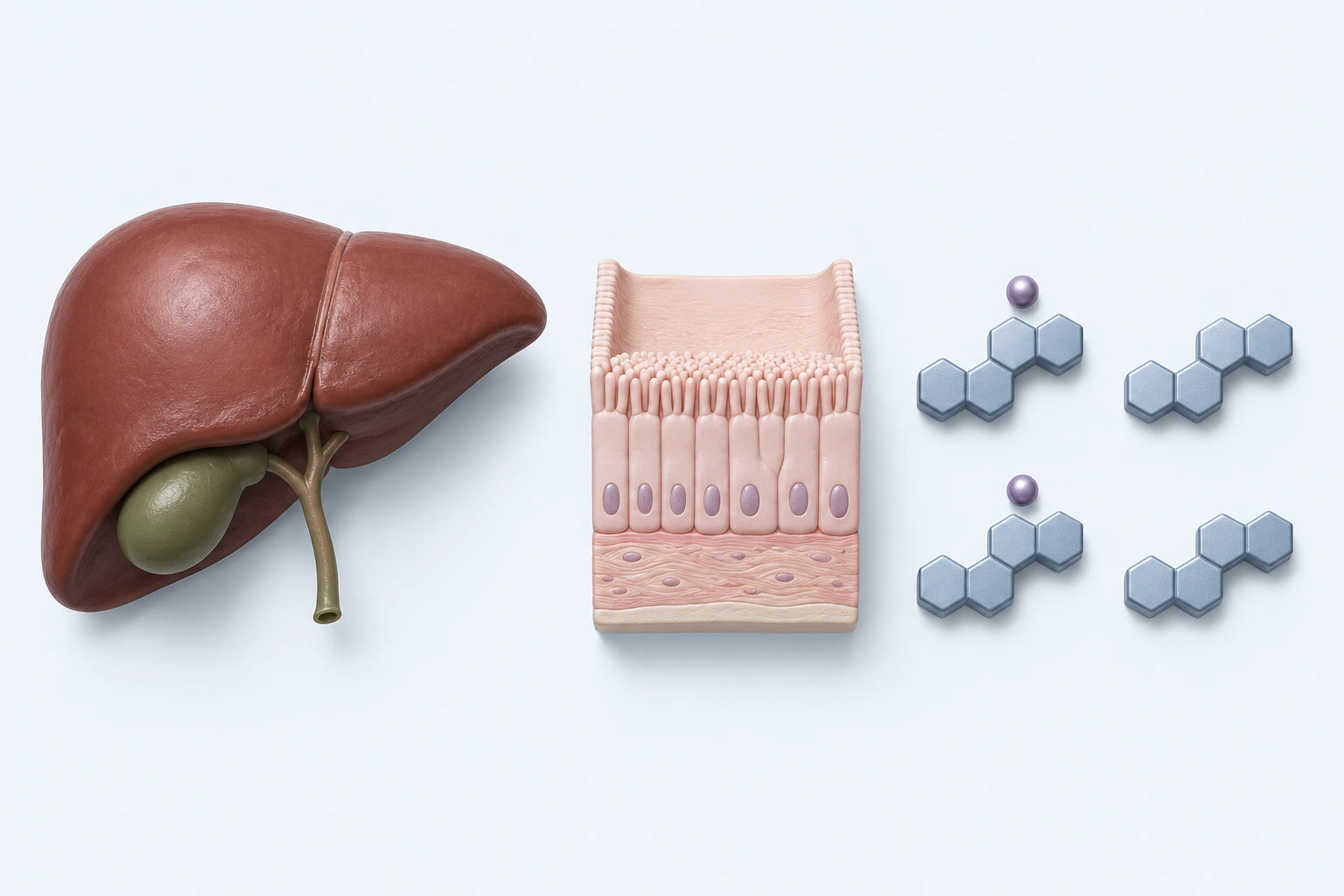
Separated hepatobiliary, intestinal-barrier, and conjugation-context teaching models. The plate does not show direction, conversion, absorption, recirculation rate, systemic exposure, microbial causality, or disease effect.
Scientific media record4 verified identifiers
- Subject
- Estrogen Recirculationbiological-process
- Review
- Editorial review completeIdentifiers authority-verified · Accessibility validated · · estrogen-recirculation|estrogen-recirculation-mechanism-v1.webp
- Digital source
- Trained-algorithmic mediaCreated with a trained generative algorithm and reviewed by WikiBiome for subject identity, scientific framing, identifiers, provenance, and accessibility.
- Scientific basis
- Estrogen RecirculationEnterohepatic Circulation — Medical Subject HeadingsEstrogens — Medical Subject HeadingsEstrogen metabolic process — GO:0008210Estrogen–microbiome recirculation context
- License
- CC BY-SA 4.0Created
Estrogen recirculation is the recycling loop by which conjugated estrogens excreted in bile are deconjugated by gut bacterial Beta-Glucuronidase, reabsorbed across the intestinal epithelium, and returned to systemic circulation.[1]The bidirectional relationship between endometriosis and microbiomeUzuner C, Mak J, El-Assaad F et al. · 2023Open reference 1 ↓[2]Direct and indirect effects of estrogens, androgens and intestinal microbiota on colorectal cancerZihong Wu, Yi Sun, Wenbo Huang et al. · 2024Open reference 2 ↓
This process, driven by the estrobolome (estrogen-metabolizing bacterial community), effectively amplifies circulating estrogen levels and duration.[3]Zim 2025 — Estrogen-Gut-Brain Axis: COCs, Mental Health, and the Gut MicrobiomeZim A, Bommareddy A · 2025Open reference 3 ↓ Dysbiosis-induced overgrowth of high-glucuronidase taxa—including Escherichia coli, Bacteroides fragilis, Bifidobacterium, Lactobacillus, and the genus Eggerthella (notably E. lenta, one of the most potent deconjugators in the human gut, Plottel & Blaser 2011; Ervin et al. 2019)—hyperactivates this loop, driving estrogen-dependent diseases including Endometriosis, Breast Cancer, and Polycystic Ovary Syndrome.[1]The bidirectional relationship between endometriosis and microbiomeUzuner C, Mak J, El-Assaad F et al. · 2023Open reference 1 ↓[2]Direct and indirect effects of estrogens, androgens and intestinal microbiota on colorectal cancerZihong Wu, Yi Sun, Wenbo Huang et al. · 2024Open reference 2 ↓
This exemplifies primitive-7-estrobolome: the bacterial metabolic capacity to recirculate hormones is a controllable lever in hormone-dependent disease.
Evidence map6 cited passagesInspect provenance +
Estrogen recirculation is the recycling loop by which conjugated estrogens excreted in bile are deconjugated by gut bacterial beta glucuronidase, reabsorbed across the intestinal epithelium, and returned to systemic circulation,. This process, driven by the estrobolome (estrogen-metabolizing bacterial community), effectively amplifies circulating estrogen le
Bacterial deconjugation: Colonic beta glucuronidase (β-glucuronidase) from dysbiotic taxa cleaves the glucuronide bond, regenerating free estradiol and estrone. This is the rate-limiting step controlled by microbial abundance,.
The dysbiotic amplification: In healthy microbiota, lachnospiraceae, faecalibacterium prausnitzii, and other commensals have low glucuronidase activity. Dysbiotic overgrowth of high-glucuronidase escherichia coli, bacteroides fragilis, and Eggerthella lenta can increase β-glucuronidase activity up to 100-fold, creating a hyperactive recirculation loop (Ervin
endometriosis—Amplified local estrogen via high β-glucuronidase in dysbiotic microbiota; sustained estrogen drives ectopic endometrial growth and inflammation.
breast cancer—Elevated systemic estrogen from hyperactive recirculation is a major risk factor; estrogen promotes proliferation of ER+ tumor cells. Eggerthella, Bacteroides, and Escherichia enrichment correlate with breast cancer incidence through the estrobolome mechanism (Plottel & Blaser 2011; Kwa et al. 2016).
pcos—Elevated androgens + recirculated estrogen drive irregular ovulation and metabolic dysfunction.
Mechanism#
Step-by-step process. Hepatic conjugation: Liver Phase II enzymes (glucuronidases, sulfatases) conjugate estradiol (E2) to estradiol-17β-glucuronide (E2-G) and estrone-glucuronide (E1-G). These water-soluble conjugates are excreted in bile.
Biliary secretion: E2-G and E1-G flow into the small intestine via the common bile duct.
Bacterial deconjugation: Colonic Beta-Glucuronidase (β-glucuronidase) from dysbiotic taxa cleaves the glucuronide bond, regenerating free estradiol and estrone. This is the rate-limiting step controlled by microbial abundance.[1]The bidirectional relationship between endometriosis and microbiomeUzuner C, Mak J, El-Assaad F et al. · 2023Open reference 1 ↓[2]Direct and indirect effects of estrogens, androgens and intestinal microbiota on colorectal cancerZihong Wu, Yi Sun, Wenbo Huang et al. · 2024Open reference 2 ↓
Intestinal reabsorption: Free estrogens passively diffuse across the intestinal epithelium, especially in the colon where permeability is high.
Portal return: Reabsorbed estrogens enter the portal circulation and return to systemic circulation via the liver (but bypass inactivation if recirculation rate exceeds detoxification capacity).
Tissue re-uptake: Estrogen-responsive tissues (uterus, breast, ovaries, adipose) upregulate estrogen receptor expression in response to sustained high circulating levels.
The dysbiotic amplification: In healthy microbiota, Lachnospiraceae, Faecalibacterium prausnitzii, and other commensals have low glucuronidase activity. Dysbiotic overgrowth of high-glucuronidase Escherichia coli, Bacteroides fragilis, and Eggerthella lenta can increase β-glucuronidase activity up to 100-fold, creating a hyperactive recirculation loop[1]The bidirectional relationship between endometriosis and microbiomeUzuner C, Mak J, El-Assaad F et al. · 2023Open reference 1 ↓ (Ervin et al. 2019).
Role in Disease#
Estrogen recirculation is mechanistically linked to. Endometriosis—Amplified local estrogen via high β-glucuronidase in dysbiotic microbiota; sustained estrogen drives ectopic endometrial growth and Metal-Driven Inflammation.[1]The bidirectional relationship between endometriosis and microbiomeUzuner C, Mak J, El-Assaad F et al. · 2023Open reference 1 ↓
Breast Cancer—Elevated systemic estrogen from hyperactive recirculation is a major risk factor; estrogen promotes proliferation of ER+ tumor cells. Eggerthella, Bacteroides, and Escherichia enrichment correlate with breast cancer incidence through the estrobolome mechanism (Plottel & Blaser 2011; Kwa et al. 2016).[2]Direct and indirect effects of estrogens, androgens and intestinal microbiota on colorectal cancerZihong Wu, Yi Sun, Wenbo Huang et al. · 2024Open reference 2 ↓
Polycystic Ovary Syndrome—Elevated androgens + recirculated estrogen drive irregular ovulation and metabolic dysfunction.[3]Zim 2025 — Estrogen-Gut-Brain Axis: COCs, Mental Health, and the Gut MicrobiomeZim A, Bommareddy A · 2025Open reference 3 ↓ uterine-fibroids—Estrogen-driven smooth muscle proliferation amplified by dysbiotic recirculation. menstrual-migraine—Estrogen fluctuations trigger migraine; dysbiotic recirculation flattens normal cycle dynamics and shifts trigger thresholds.
Metal Connections#
Iron and copper are cofactors in hepatic Phase II conjugation enzymes. Cytochrome P450 (Phase I, liver) requires heme iron. UDP-glucuronosyltransferase (UGT) (Phase II) has iron-dependent variants.
Copper is a cofactor in ceruloplasmin, which regulates iron homeostasis and affects estrogen metabolism indirectly.
Metal availability and dysbiosis are linked: dysbiotic taxa often have altered iron and copper handling, which can suppress Phase II enzyme activity and slow hepatic estrogen conjugation, compounding the recirculation problem.
Zinc and glutathione are also implicated: dysbiosis often involves depleted glutathione (see Nutritional Immunity (Metal Sequestration)), reducing hepatic detoxification capacity.
Connections#
Linked concepts. Beta-Glucuronidase—The bacterial enzyme driving deconjugation; inhibiting or reducing this is a direct intervention target. Enterohepatic Circulation—The broader recycling process of which estrogen recirculation is one example. Estrobolome—Collective term for the estrogen-metabolizing bacterial community.
—The microbial composition shift that hyperactivates recirculation.
Linked entities. Escherichia coli—Major high-glucuronidase dysbiotic overgrowth species. Bacteroides fragilis—High β-glucuronidase; BFT toxin-producing strains correlate with dysbiosis severity. Lachnospiraceae—Healthy, low-glucuronidase commensals; reduced in dysbiosis.
—The primary hormone being recirculated.
Intervention targets. Reducing β-glucuronidase-producing taxa via or specific . Supporting Lachnospiraceae and low-glucuronidase commensals via .
Binding recirculated estrogen in the gut via , or .
Inhibiting bacterial β-glucuronidase directly (early-stage drug research).
References 3
Numbered by first appearance in the article, then reconciled with its declared source list.
- 1
Uzuner C, Mak J, El-Assaad F et al. (2023). The bidirectional relationship between endometriosis and microbiome. Frontiers in Endocrinology.
- 2
Zihong Wu, Yi Sun, Wenbo Huang et al. (2024). Direct and indirect effects of estrogens, androgens and intestinal microbiota on colorectal cancer. Frontiers in Cellular and Infection Microbiology.
- 3
Zim A, Bommareddy A (2025). Zim 2025 — Estrogen-Gut-Brain Axis: COCs, Mental Health, and the Gut Microbiome. Cureus.
Article network
Mentioned here 14
Pages linking here 7
Connect the evidence
Publicly readable discussion by ORCID-authenticated researchers. Questions, interpretation, methods, corrections, and new evidence stay attached to this record.
No discussion yet. Start with a precise question or a source-backed observation.
Activity and accepted changes
Accepted researcher context, editorial status, public discussion, and upstream Git revisions are shown together. Pending, declined, and withdrawn proposals remain private.
- published revision
Backfill inflammation concept links
Karen Pendergrass · +1 −1
Inspect exact Git diff ↗ - published revision
Complete corpus-wide Dysbiosis linking
Karen Pendergrass · +1 −1
Inspect exact Git diff ↗ - published revision
massive wiki expansion: 149 stubs fixed, 100+ new pages, Rule 15 scan, keystone papers
WikiBiome Deploy Bot · +23 −23
Inspect exact Git diff ↗ - published revision
ingest: 87 papers (17 endometriosis, 67 erectile dysfunction, 3 cross-condition)
WikiBiome Deploy Bot · +2 −2
Inspect exact Git diff ↗ - published revision
nightly maintenance: 94 stub demotions, 181 source_count fixes, 22 auto-discovered stubs, 5 adversarial audits, 3 boundary fixes, 3 evidence-level corrections
WikiBiome Deploy Bot · +1 −0
Inspect exact Git diff ↗ - published revision
pre-overnight checkpoint 2026-04-18
WikiBiome Deploy Bot · +4 −2
Inspect exact Git diff ↗ - published revision
Deepen metal/concept entities + 8 new sources for T1D/schizophrenia
WikiBiome Deploy Bot · +7 −7
Inspect exact Git diff ↗ - published revision
WikiBiome update — 2026-04-15 17:23
WikiBiome Deploy Bot · +5 −5
Inspect exact Git diff ↗ - published revision
WikiBiome update — integrity fixes, metallomic diet pages, cross-condition analyses
WikiBiome Deploy Bot · +17 −15
Inspect exact Git diff ↗ - published revision
WikiBiome update — 2026-04-10 17:16
WikiBiome Deploy Bot · +75 −0
Inspect exact Git diff ↗