

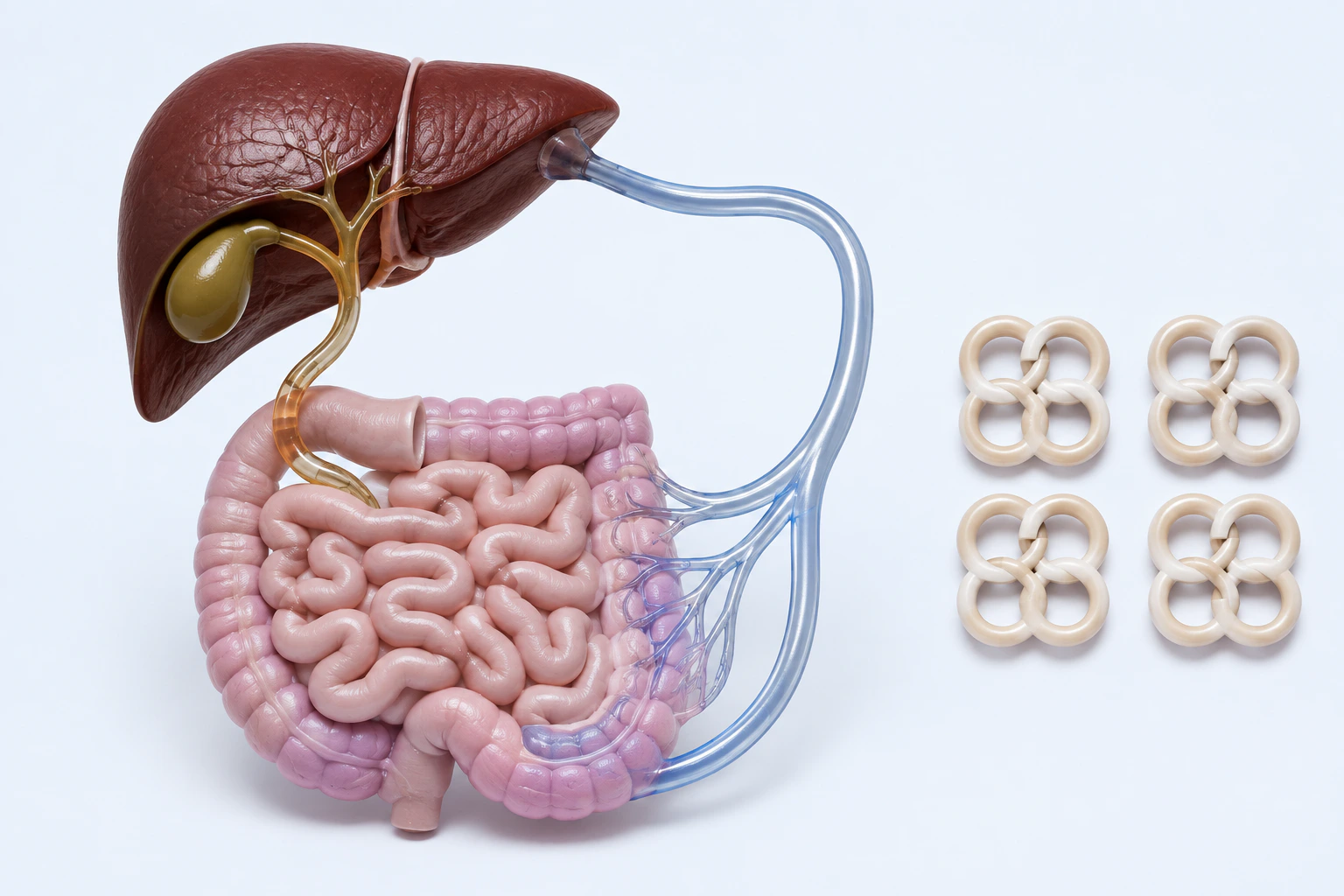
Enterohepatic-circulation anatomy orientation. The added large-intestinal frame is context rather than a claim about the principal site of bile-acid reabsorption. The reconstruction does not show measured direction, flux, recovery, exact molecules, dysbiosis, disease, detoxification, or treatment.
Scientific media record2 verified identifiers
- Subject
- Enterohepatic Circulationbiological-process
- Review
- Editorial review completeIdentifiers authority-verified · Accessibility validated · · enterohepatic-circulation|enterohepatic-circulation-mechanism-v1.webp
- Digital source
- Trained-algorithmic mediaCreated with a trained generative algorithm and reviewed by WikiBiome for subject identity, scientific framing, identifiers, provenance, and accessibility.
- Scientific basis
- Enterohepatic Circulation — Medical Subject HeadingsBile Acids and Salts — Medical Subject HeadingsTransport of bile acids and organic solutes in the hepatocyteGut-liver axis and bile-acid circulation contextEnterohepatic Circulation
- License
- CC BY-SA 4.0Created
Enterohepatic circulation (EHC) is the recycling loop by which compounds—primarily bile acids, conjugated estrogens, conjugated glucuronides, and metabolites of drugs and xenobiotics—are excreted in bile, reach the intestine, undergo deconjugation or dehydroxylation by bacterial enzymes (especially Beta-Glucuronidase and bile salt hydrolase), are reabsorbed across the intestinal epithelium, and return to systemic circulation via the portal blood to the liver.
This recycling amplifies the bioavailability and lifetime in circulation of these compounds. In a healthy microbiota, the efficiency of EHC is tightly regulated; in Dysbiosis, dysbiotic taxa often hyperexpress deconjugating enzymes, causing pathological overrecirculation of estrogens, bile acids, and drug metabolites.
The Estrobolome is the best-studied example, but EHC failures drive multiple disease states.
This exemplifies primitive-7-estrobolome extended beyond estrogen: the gut microbiota controls the fate of systemically recycled compounds.
Mechanism#
Step-by-step EHC cycle. Hepatic metabolism (Phase I & II): Liver detoxifies compounds via. Phase I enzymes (cytochrome P450s)—oxidation, reduction, hydrolysis.
Cofactors: heme iron, NAD(P)H.
Phase II enzymes (UDP-glucuronosyltransferases [UGTs], sulfotransferases [SULTs], glutathione S-transferases [GSTs], N-acetyltransferases [NATs])—add polar groups (glucuronide, sulfate, glutathione, acetyl) to make compounds water-soluble.
Result: Conjugated compounds are far more hydrophilic and cannot be reabsorbed in the small intestine.
Biliary secretion: Conjugated compounds are transported via bile salt export pumps (BSEP) and multidrug resistance-associated proteins (MRPs) into canalicular bile. They mix with cholesterol and bile acids and are emulsified into micelles.
Intestinal transit: Bile flows through the common bile duct, mixes with food in the duodenum, and travels to the terminal ileum and colon. Most bile acids are reabsorbed passively in the terminal ileum (part of selective EHC); conjugated metabolites continue to the colon.
Bacterial deconjugation: Colonic microbiota express. Beta-Glucuronidase (β-Glu)—cleaves glucuronide bonds; highly upregulated in dysbiosis.
Bile salt hydrolase (BSH)—removes the taurine or glycine from conjugated bile acids (taurocholic acid → cholic acid), enabling secondary bile acid production.
Sulfatase—cleaves sulfate conjugates. Result: Free compounds are regenerated in the colon.
Intestinal reabsorption: Free compounds (estrogens, bile acids, drug aglycones) are lipophilic enough to passively diffuse across the colonic epithelium. Some use specific transporters (e.g., apical sodium-dependent bile acid transporter, ASBT).
Portal return & systemic recirculation: Reabsorbed compounds enter portal blood, return to the liver, and re-enter systemic circulation. If hepatic conjugation cannot keep pace with the reabsorbed load, compounds accumulate systemically.
Secondary recycling: Compounds can be conjugated again and re-excreted in the next biliary cycle, perpetuating the loop. A single molecule can recirculate 4–12 times daily.
Key regulatory lever: The amount of functional Beta-Glucuronidase activity in the colon determines the efficiency of EHC for glucuronidated substrates.
Role in Disease#
Dysbiotic hyperactivation of EHC is implicated in multiple conditions. Endometriosis—Dysbiotic overgrowth of high-β-Glu taxa (especially Escherichia coli, Bacteroides fragilis) hyperactivates Estrogen Recirculation; amplified circulating estrogen drives lesion growth and Metal-Driven Inflammation. See Estrogen Recirculation.
Breast Cancer—High estrogen from dysbiotic EHC is a major risk factor for ER+ tumors. Aromatase inhibitor (AI) therapy reduces systemic estrogen; dysbiotic EHC partially overcomes this therapeutic blockade.
Cholestasis—Dysbiotic hyperactivation of BSH increases secondary bile acid production and reabsorption, exacerbating bile acid–induced liver damage in primary biliary cirrhosis (PBC) and primary sclerosing cholangitis (PSC).
drug-metabolism-variability—High dysbiotic β-Glu causes unpredictable reabsorption of glucuronidated drugs (acetaminophen, irinotecan, morphine), reducing drug clearance and increasing systemic exposure. This explains "slow metabolizer" phenotypes in dysbiotic patients.
Inflammatory Bowel Disease (IBD)—Dysbiotic EHC of inflammatory lipid mediators (e.g., eicosanoids) and estrogens perpetuates systemic inflammation and female-predominant severity.
Metal Connections#
Metal ions are cofactors in Phase II conjugation enzymes. UDP-glucuronosyltransferases (UGTs): Require magnesium (Mg)²⁺ for optimal catalytic activity; dysbiotic inflammation often depletes intracellular magnesium.
Cytochrome P450 (Phase I): Heme iron cofactor. Iron dysregulation (high Lactoferrin, high Hepcidin) impairs Phase I enzyme activity, reducing first-pass detoxification and increasing the load of unconjugated compounds reaching the liver.
Sulfotransferases (SULTs): Require PAPS (3′-phosphoadenosine-5′-phosphosulfate) synthesis; indirectly impaired by metal dysregulation.
Consequence: In dysbiosis with elevated Hepcidin (iron withholding response), hepatic Phase I enzyme activity is suppressed, reducing the rate of conjugation and amplifying EHC efficiency—creating a vicious cycle where the host's attempt to restrict iron paradoxically worsens pathological compound recirculation.
Metal-dependent dysbiotic β-Glu: Some dysbiotic taxa upregulate β-Glu production in response to metal stress (elevated iron or nickel). This creates a link: dysbiotic metal accumulation → increased β-Glu expression → enhanced EHC of estrogens and drugs.
Connections#
Linked concepts. Estrogen Recirculation—The most well-characterized EHC failure; driven by dysbiotic β-Glu. Beta-Glucuronidase—The bacterial enzyme controlling EHC efficiency for glucuronidated substrates. Bile Acid Metabolism—A major EHC substrate; dysbiotic BSH hyperactivity worsens bile acid toxicity.
—Hepatic Phase II conjugation + bacterial deconjugation determine drug clearance.
Linked entities. Escherichia coli—High β-Glu in dysbiotic strains; major driver of estrogen EHC overstimulation. Bacteroides fragilis—High β-Glu; elevated in Inflammatory Bowel Disease (IBD) and Endometriosis. Lachnospiraceae, Faecalibacterium prausnitzii—Low β-Glu; healthy commensals that dampen EHC.
Beta-Glucuronidase—The rate-limiting enzyme for estrogen, drug, and metabolite recirculation.—Primary substrate for pathological EHC in estrogen-dependent diseases.
Intervention implications.
β-Glucuronidase inhibitors: Compounds that directly inhibit bacterial β-Glu (under research; saccharolactone is a known inhibitor) could dampen dysbiotic EHC. Dysbiosis correction: Restoring Lachnospiraceae and suppressing Escherichia coli, Bacteroides fragilis reduces EHC efficiency. Hepatic support: Enhancing Phase II conjugation (via sulfation support, glutathione repletion) increases conjugation rate, reducing reabsorption opportunity.
Fiber and binding agents: and high-fiber diets can bind free compounds in the colon, preventing reabsorption and reducing EHC efficiency. Drainage support: Castor oil packs and similar interventions may enhance biliary flow, reducing residence time in the colon for bacterial deconjugation.
References 8
Numbered by first appearance in the article, then reconciled with its declared source list.
- 1
Docimo G, Cangiano A, Romano RM et al. (2020). Docimo et al. 2020 — The Human Microbiota in Endocrinology: Implications for Pathophysiology, Treatment, and Prognosis in Thyroid Diseases. Frontiers in Endocrinology.
- 2
Mendoza L (2019). Potential effect of probiotics in the treatment of breast cancer. Oncology Reviews.
- 3
Natalia Kurhaluk, Piotr Kaminski, Halina Tkaczenko (2025). Kurhaluk 2025 — Oxidative Stress, Antioxidants, Gut Microbiota and Male Fertility. Cellular Physiology and Biochemistry.
- 4
Di Ciaula A, Garruti G, Lunardi Baccetto R et al. (2017). Bile acid physiology. Annals of Hepatology.
- 5
Syer SD, Blackler RW, Martin R et al. (2015). NSAID Enteropathy and Bacteria: A Complicated Relationship. Journal of Gastroenterology.
- 6
Rezen T, Rozman D, Kovacs T et al. (2022). Rezen et al. 2022 — The Role of Bile Acids in Carcinogenesis. Cellular and Molecular Life Sciences.
- 7
Christine M. Velicer, Susan R. Heckbert, John W. Lampe et al. (2004). Velicer et al. 2004 — Antibiotic Use in Relation to the Risk of Breast Cancer. JAMA.
- 8
Virili C, Stramazzo I, Bagaglini MF et al. (2024). The relationship between thyroid and human-associated microbiota: A systematic review of reviews. Reviews in Endocrine and Metabolic Disorders.
Article network
Mentioned here 17
Pages linking here 4
Connect the evidence
Publicly readable discussion by ORCID-authenticated researchers. Questions, interpretation, methods, corrections, and new evidence stay attached to this record.
No discussion yet. Start with a precise question or a source-backed observation.
Activity and accepted changes
Accepted researcher context, editorial status, public discussion, and upstream Git revisions are shown together. Pending, declined, and withdrawn proposals remain private.
- published revision
Backfill inflammation concept links
Karen Pendergrass · +1 −1
Inspect exact Git diff ↗ - published revision
Complete corpus-wide Dysbiosis linking
Karen Pendergrass · +1 −1
Inspect exact Git diff ↗ - published revision
massive wiki expansion: 149 stubs fixed, 100+ new pages, Rule 15 scan, keystone papers
WikiBiome Deploy Bot · +43 −37
Inspect exact Git diff ↗ - published revision
ingest: 87 papers (17 endometriosis, 67 erectile dysfunction, 3 cross-condition)
WikiBiome Deploy Bot · +2 −2
Inspect exact Git diff ↗ - published revision
nightly maintenance: 94 stub demotions, 181 source_count fixes, 22 auto-discovered stubs, 5 adversarial audits, 3 boundary fixes, 3 evidence-level corrections
WikiBiome Deploy Bot · +3 −0
Inspect exact Git diff ↗ - published revision
pre-overnight checkpoint 2026-04-18
WikiBiome Deploy Bot · +3 −1
Inspect exact Git diff ↗ - published revision
WikiBiome update — 2026-04-15 17:23
WikiBiome Deploy Bot · +10 −10
Inspect exact Git diff ↗ - published revision
WikiBiome update — integrity fixes, metallomic diet pages, cross-condition analyses
WikiBiome Deploy Bot · +19 −17
Inspect exact Git diff ↗ - published revision
WikiBiome update — 2026-04-10 17:16
WikiBiome Deploy Bot · +90 −0
Inspect exact Git diff ↗