

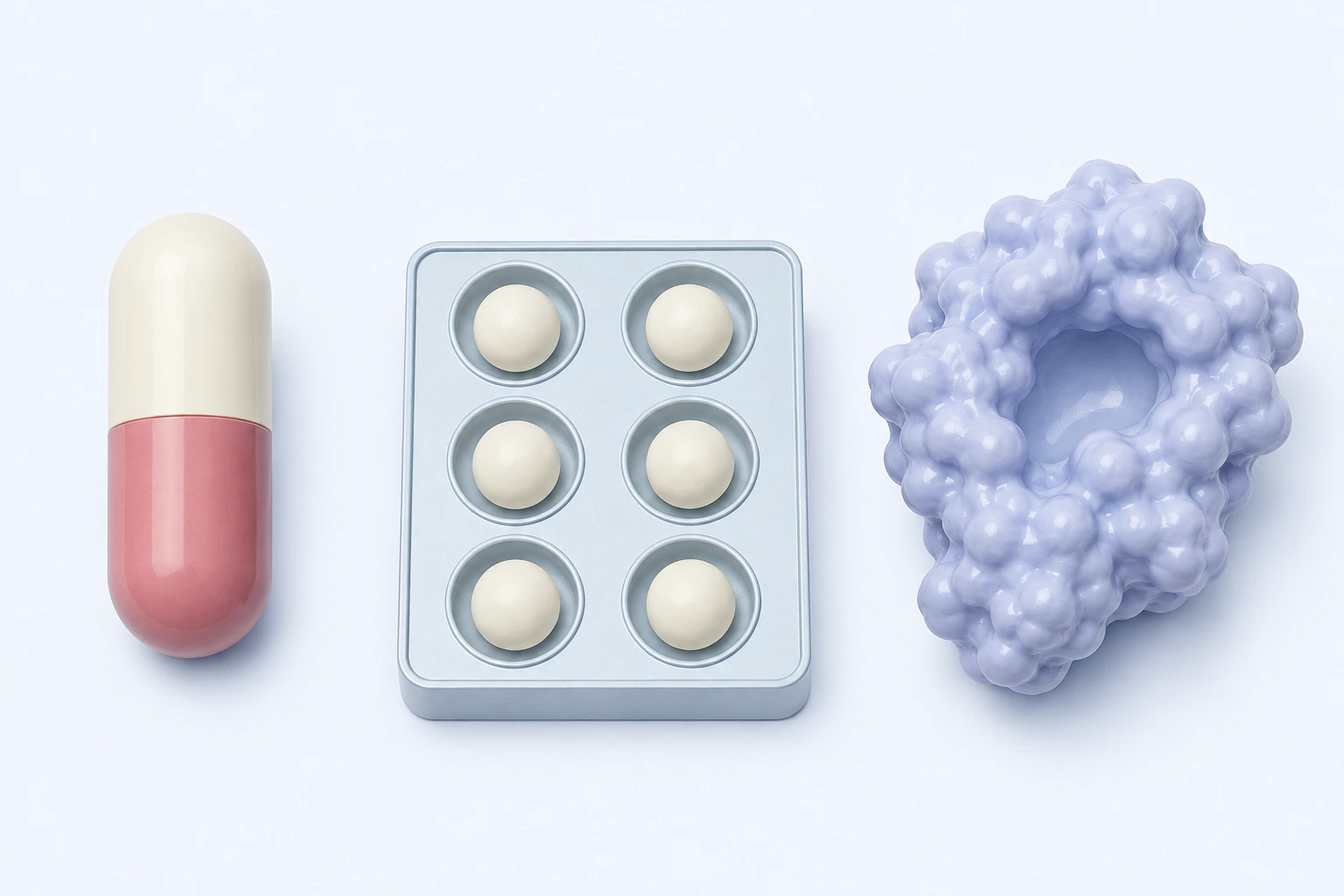
Drug-repurposing research orientation. The separated drug, screening, and target contexts do not identify a product or disease and do not establish a selected hit, docking result, new use, efficacy, safety, approval, or treatment recommendation.
Scientific media record2 verified identifiers
- Subject
- Drug Repurposingbiological-process
- Identifiers
- WikiBiome:drug-repurposingMeSH:D058492
- Review
- Editorial review completeIdentifiers authority-verified · Accessibility validated · · drug-repurposing|drug-repurposing-mechanism-v1.webp
- Digital source
- Trained-algorithmic mediaCreated with a trained generative algorithm and reviewed by WikiBiome for subject identity, scientific framing, identifiers, provenance, and accessibility.
- Scientific basis
- Drug Repositioning — Medical Subject HeadingsDrug repurposing: a systematic review of computational approachesDrug repurposing: a systematic review of computational approachesDrug Repurposing
- License
- CC BY-SA 4.0Created
Drug repurposing (also called drug repositioning) is the strategy of identifying new therapeutic uses for existing approved drugs. It dramatically accelerates the path from bench to bedside because safety, pharmacokinetics, and manufacturing are already established.
In the WikiBiome context, drug repurposing is particularly powerful because many existing drugs have unrecognized microbiome effects or metal-modulating properties that map to disease signatures in ways their original developers never intended.
The convergence of Pharmacomicrobiomics and metallomics creates a rich landscape for repurposing: a drug developed for one purpose may happen to restrict a critical metal cofactor, reshape the Gut Microbiome toward a healthier configuration, or disable a metal-dependent virulence factor in a pathogenic organism.
Evidence map1 cited passagesInspect provenance +
Individual variation: Microbiome-mediated drug effects vary 100-fold between individuals
Contents
1. Paradigm Examples2. Microbiome-Mediated Repurposing Opportunities3. Metal-Targeting Repurposing4. The Repurposing Pipeline in WikiBiome5. Challenges6. Open Questions7. Cross-ReferencesParadigm Examples#
Metformin: Diabetes Drug as Microbiome Modulator#
Metformin is the clearest example of a drug whose therapeutic effects are partly microbiome-mediated:
- Originally developed as an antidiabetic agent
- Increases Akkermansia muciniphila abundance and Short-Chain Fatty Acids (SCFAs) production
- Improves gut barrier function and reduces endotoxemia
- Reduces vitamin B12 (cobalamin) absorption—a metallomics interaction (cobalt-containing vitamin)
- Now being explored for cancer prevention, cardiovascular protection, and aging—all conditions with microbiome components
Disulfiram: Alcohol Deterrent as Metal Chelator and Antimicrobial#
Disulfiram (Antabuse) exemplifies multi-target repurposing:
- Original use: Alcohol deterrent (blocks aldehyde dehydrogenase)
- Metal chelation: Active metabolite DDC chelates nickel (specific antidote for nickel carbonyl poisoning) and copper
- Anticancer: Copper-DDC complex inhibits proteasome and NF-kB; being explored in pancreatic and breast cancer
- Anti-parasitic: Activity against Giardia, Leishmania, Trypanosoma
- Biofilm disruption: Disrupts Candida albicans biofilms—connecting to Inter-Kingdom Metal Shielding
Statins: Cholesterol Drugs as Microbiome and Immune Modulators#
See Statins for detailed treatment. Statins modulate bile acid metabolism, influence gut microbial composition, and have anti-inflammatory effects independent of cholesterol lowering.
Microbiome-Mediated Repurposing Opportunities#
Antifungals in Bacterial Disease#
Antifungal drugs that disrupt fungal-bacterial cooperation in biofilms. Fluconazole disrupts Candida albicans biofilm scaffolds that protect bacterial pathogens. Amphotericin B disrupts ergosterol in fungal membranes, collapsing Inter-Kingdom Metal Shielding.
These have implications for conditions where fungal-bacterial biofilms drive disease (IBD, CRC).
NSAIDs and Aspirin#
Low-dose aspirin reduces CRC risk, partly through COX-2 inhibition and partly through microbiome modulation. NSAIDs alter gut microbial composition and increase Intestinal Permeability—a double-edged effect.
Antidepressants#
- SSRIs (fluoxetine) have direct antimicrobial activity against gut bacteria
- Tricyclics alter gut motility and microbiome composition
- These microbiome effects may contribute to both therapeutic and adverse effects in neuropsychiatric conditions
Metal-Targeting Repurposing#
Iron-Targeting Strategies#
Deferasirox: Iron chelator being explored for antimicrobial activity by starving pathogens of iron (see Metal Chelation Therapy). Gallium compounds: Gallium mimics iron and is taken up by siderophore systems, poisoning iron-dependent enzymes (Gallium). Lactoferrin: Natural iron-binding protein with both antimicrobial and immune-modulatory effects.
Zinc-Targeting Strategies#
- EDTA-based compounds: Zinc chelation to disable Zinc-Metalloprotease virulence factors
- Zinc ionophores: Compounds that deliver zinc into cells, enhancing intracellular antimicrobial defense
Nickel-Targeting Strategies#
- Disulfiram/DDC: Nickel chelation to disable Nickel-Urease and NiFe-Hydrogenase in Helicobacter pylori
- Low-nickel diet: Dietary metal restriction as an intervention (see Low-Nickel Diet)
The Repurposing Pipeline in WikiBiome#
Drug repurposing candidates in the WikiBiome framework are identified through a systematic process:
- Signature analysis: Identify the metal-dependent virulence factors driving a disease signature
- Metal restriction screen: Which existing drugs chelate, sequester, or compete with the required metal?
- Microbiome effect screen: Which existing drugs shift the microbiome toward the depleted-taxon profile needed for ecological restoration?
- Triangle validation: Does the drug have evidence for all three edges (I→f, I→D, f→D)?
- Safety assessment: Since the drug is already approved, human safety data exists
Challenges#
Regulatory: Repurposed drugs often lack patent protection, reducing commercial incentive for clinical trials. Dosing: Optimal dose for microbiome modulation may differ from the approved indication. Off-target effects: Microbiome disruption by repurposed drugs may cause unexpected adverse effects.
Individual variation: Microbiome-mediated drug effects vary 100-fold between individuals.[1]Microbiome-Drug Interactions: A Critical Review of Pharmacokinetic and Pharmacodynamic ModulationRamya Sree Maddu, Aarthi Saima Ghanta, Veeresh Pratap · 2025Open reference 1 ↓
Open Questions#
Unresolved questions identified by the current evidence record.
01Can computational screening of drug-metal interactions identify repurposing candidates systematically?+
The current WikiBiome record identifies this as an unresolved evidence gap.
02Do drug-microbiome interactions explain why clinical trials for repurposed drugs sometimes fail (wrong patient microbiome)?+
The current WikiBiome record identifies this as an unresolved evidence gap.
03Which metal-chelating drugs have the best therapeutic index for antimicrobial metal restriction?+
The current WikiBiome record identifies this as an unresolved evidence gap.
04Can combination strategies (metal chelator + probiotic) achieve synergistic effects?+
The current WikiBiome record identifies this as an unresolved evidence gap.
Cross-References#
- Pharmacomicrobiomics—bidirectional drug-microbiome interactions
- Metal Chelation Therapy—chelation agents as repurposing candidates
- Metformin—paradigm repurposed drug
- Statins—cholesterol drugs with microbiome effects
- Gallium—iron-mimicking antimicrobial metal
- Metal-Dependent Virulence—targets for metal-based repurposing
References 5
Numbered by first appearance in the article, then reconciled with its declared source list.
- 1
Ramya Sree Maddu, Aarthi Saima Ghanta, Veeresh Pratap (2025). Microbiome-Drug Interactions: A Critical Review of Pharmacokinetic and Pharmacodynamic Modulation. Tropical Journal of Pharmaceutical and Life Sciences.
- 2
Timothy R Sampson, Madelyn C Houser (2024). Sampson 2024 -- Drug Repurposing for Parkinson's Disease Through Microbiome Modulation. Clinical Pharmacology & Therapeutics.
- 3
Ying Xia, Ming Sun, Hai Huang et al. (2024). Drug Repurposing for Cancer Therapy. Signal Transduction and Targeted Therapy.
- 4
Jin MZ, Jin WL (2020). The updated landscape of tumor microenvironment and drug repurposing. Signal Transduction and Targeted Therapy.
- 5
Reda R. Mabrouk, Amani Magdy Beshbishy, Waad Mohamed Elmalah et al. (2026). Mabrouk 2026 -- Repurposing Gut Microbiota Modulators: Insights into Current and Novel Applications. Beni-Suef University Journal of Basic and Applied Sciences.
Article network
Mentioned here 17
Pages linking here 1
Connect the evidence
Publicly readable discussion by ORCID-authenticated researchers. Questions, interpretation, methods, corrections, and new evidence stay attached to this record.
No discussion yet. Start with a precise question or a source-backed observation.
Published page changes
This record shows only material changes published on this page, including changes to its content, evidence, conclusions, or author context. Internal processes and discussion activity are excluded. Pending, declined, and withdrawn proposals remain private.
- published revision
Created “Drug Repurposing”: Drug repurposing (also called drug repositioning) is the strategy of identifying new therapeutic uses for existing approved drugs. It dramatically accelerates the path from bench to bedside because…
Created “Drug Repurposing”: Drug repurposing (also called drug repositioning) is the strategy of identifying new therapeutic uses for existing approved drugs. It dramatically accelerates the path from bench to bedside because… Published sections: Overview; Metformin: Diabetes Drug as Microbiome Modulator; Disulfiram: Alcohol Deterrent as Metal Chelator and Antimicrobial; Statins: Cholesterol Drugs as Microbiome and Immune Modulators; Antifungals in Bacterial Disease; NSAIDs and Aspirin; Antidepressants; Iron-Targeting Strategies; Zinc-Targeting Strategies; Nickel-Targeting Strategies; The Repurposing Pipeline in WikiBiome; Challenges; Open Questions; Cross-References. · WikiBiome Deploy Bot · +118 −0
Inspect exact Git diff ↗