
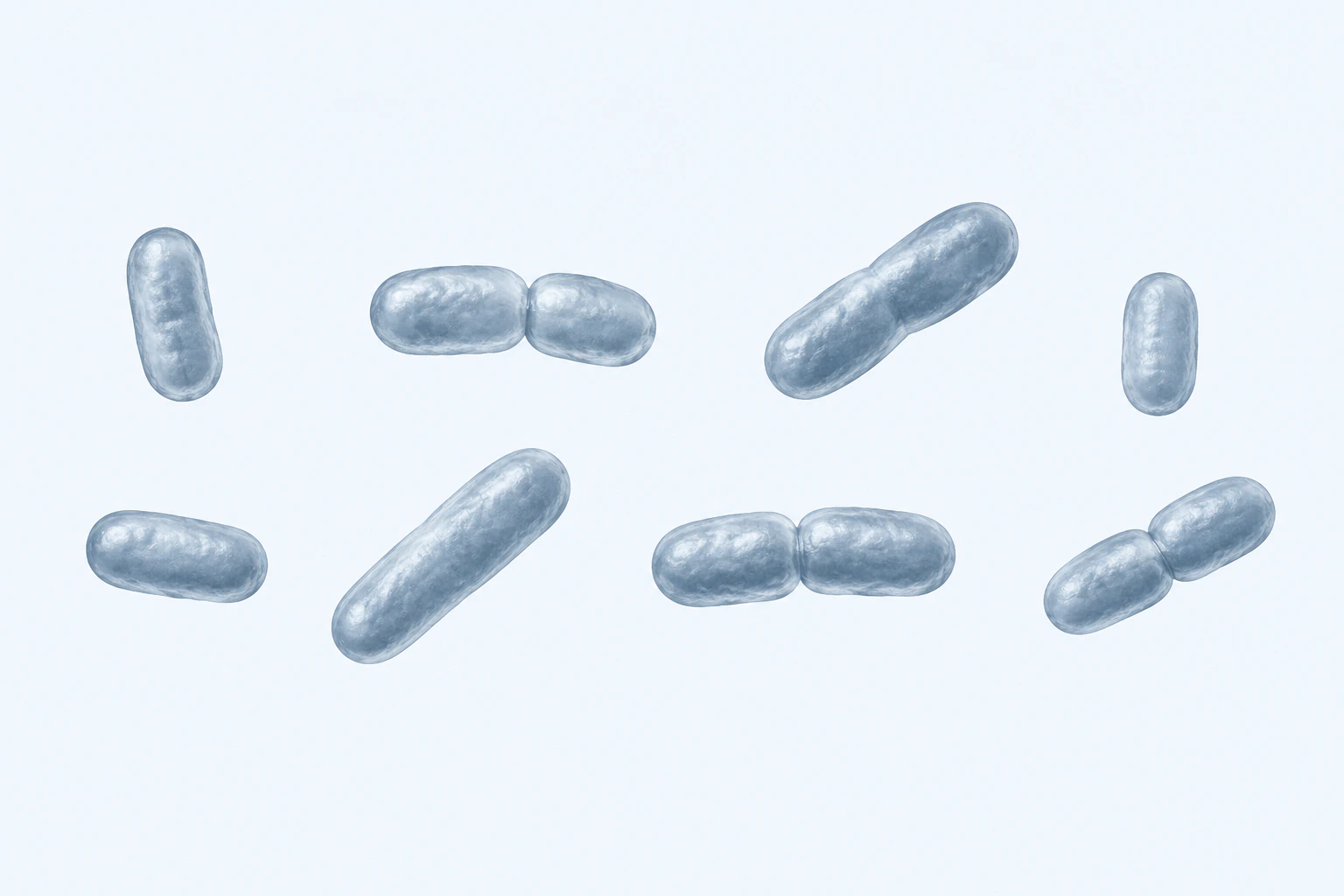
Type-species-anchored Phascolarctobacterium reconstruction showing eleven pleomorphic rounded-pole rods in five single and three paired groupings. This genus plate is representative, non-universal, non-diagnostic, and not a micrograph.
Scientific media record1 verified identifier
- Subject
- Phascolarctobacteriumtaxon · genus
- Identifiers
- NCBITaxon:33024
- Review
- Editorial review completeIdentifiers authority-verified · Accessibility validated · · phascolarctobacterium|phascolarctobacterium-morphology-v1.webp
- Digital source
- Trained-algorithmic mediaCreated with a trained generative algorithm and reviewed by WikiBiome for subject identity, scientific framing, identifiers, provenance, and accessibility.
- Scientific basis
- Phascolarctobacterium — NCBI TaxonomyPhascolarctobacterium — LPSNPhascolarctobacterium faecium gen. nov., spec. nov.
- License
- CC BY-SA 4.0Created
A Gram-negative, obligate anaerobic genus within the Firmicutes phylum (family Acidaminococcaceae, class Negativicutes). The primary species P. faecium and the recently characterized P. succinatutens are specialized propionate producers that utilize succinate as their main carbon source, occupying a unique metabolic niche in the cross-feeding network of the human colon.
Named after its original isolation from koala feces, Phascolarctobacterium has emerged as a protective commensal in autoimmune and metabolic disease contexts—though with notable exceptions in psychiatric conditions.
Evidence map12 cited passagesInspect provenance +
Mendelian randomization analysis supports a causal protective role.
Depleted in untreated GD patients alongside other SCFA-producing commensals.
After methimazole treatment and thyroid function recovery, Phascolarctobacterium increases significantly, establishing it as a biomarker of thyroid function restoration. Concurrently, Ruminococcus, Streptococcus, and Blautia decrease—suggesting that propionate-producing Negativicutes recover as immune normalization proceeds.
Negatively correlated with TRAb (thyroid receptor antibody), TGAb, and TPOAb in untreated GD, supporting a direct immunomodulatory link.
Hypertension causally decreases Phascolarctobacterium abundance in reverse Mendelian randomization—listed alongside Alistipes, Bilophila, and Butyricomonas as taxa reduced by hypertensive disease state. This is consistent with propionate's established role in renin-angiotensin system modulation and blood pressure regulation.
Depletion in ASD children with constipation, consistent with the broader loss of SCFA producers in constipation-predominant ASD; lower propionate may contribute to reduced Treg activity and gut-brain axis disruption.
P. succinatutens is enriched in schizophrenia patients in shotgun metagenomic analysis, alongside Paraprevotella clara (another succinate-pathway organism). This is paradoxical given the protective associations in autoimmune and cardiovascular conditions, and may reflect:
Identified among differentially abundant taxa in endometriosis stool microbiome signatures, with significant difference noted alongside Blautia, Dorea, Bifidobacterium, Streptococcus, Bacteroides, and Subdoligranulum,. The direction of change in endometriosis is context-dependent; reduced propionate production in endometriosis may contribute to the inflammat
—MR evidence for protective role in Graves'
—methimazole recovery biomarker; TRAb correlation
—P. succinatutens enrichment in SCZ
—depletion by hypertension (reverse MR)
Contents
1. Classification and Ecology2. Role in Gut Ecosystem—The Succinate Cross-Feeding Niche3. Metal Dependencies4. Key Enzymes and Metabolites5. Disease Associations6. Dietary Modulation7. What Wikipedia Doesn't Cover8. Cross-ReferencesClassification and Ecology#
The Negativicutes class within Firmicutes is distinctive: these organisms stain Gram-negative despite being phylogenetically Gram-positive. Phascolarctobacterium shares this class with Veillonella, Selenomonas, and Dialister—all succinate utilizers or SCFA producers occupying specialized metabolic niches.
P. faecium is the dominant species in human adults; P. succinatutens was described in 2012 and is present in subset of healthy individuals.
Role in Gut Ecosystem—The Succinate Cross-Feeding Niche#
The defining ecological feature of Phascolarctobacterium is its role as a second-tier cross-feeder in the colonic fermentation network:
1. Primary fermenters (Bacteroides fragilis, Parabacteroides, and other Bacteroidetes) ferment complex carbohydrates and produce succinate as an intermediate metabolic product. 2. Phascolarctobacterium converts succinate to propionate via the methylmalonyl-CoA decarboxylase pathway—a sodium-gradient-coupled mechanism distinct from the acrylate pathway used by other propionate producers. 3. By consuming succinate, it prevents succinate accumulation, which at high concentrations: - Acts as a pro-inflammatory signal via SUCNR1 (GPR91) receptor activation - Promotes HIF-1α stabilization and macrophage activation in gut tissue - Creates a metabolic environment that favors pathogen expansion 4. The resulting propionate: - Signals through GPR43 (free fatty acid receptor 2) to promote Treg differentiation - Contributes to hepatic gluconeogenesis regulation and lipid metabolism suppression - Reduces histone deacetylase activity, exerting epigenetic anti-inflammatory effects
This cross-feeding function means Phascolarctobacterium abundance is indirectly controlled by dietary patterns that regulate upstream Bacteroidetes activity—it is a second-order fiber responder.
Metal Dependencies#
No essential metal dependencies specific to the succinate-to-propionate pathway have been confirmed for Phascolarctobacterium. The methylmalonyl-CoA decarboxylase enzyme uses biotin as a cofactor. This absence of heavy metal dependency is notable—unlike iron-dependent fermenters, Phascolarctobacterium may be relatively resilient to the metal-driven Dysbiosis that disrupts iron-sulfur-cluster-dependent organisms.
Key Enzymes and Metabolites#
| Enzyme / Metabolite | Function |
|---|---|
| Methylmalonyl-CoA decarboxylase | Core succinate → propionate conversion; biotin-dependent, sodium-pumping |
| Propionate | GPR43 ligand; Treg promoter; anti-inflammatory; hepatic metabolic regulator |
| Succinate (consumed) | Prevents SUCNR1 inflammatory signaling; removes pathogen-favorable substrate |
Disease Associations#
Graves' Disease—Protective#
Phascolarctobacterium is identified as a protective taxon in Graves' Disease through multiple lines of evidence.
Mendelian randomization analysis supports a causal protective role.[1]Liu et al. 2022 — Gut Microbiome and the Role of Metabolites in the Study of Graves' DiseaseLiu H, Liu H, Liu C et al. · 2022Open reference 1 ↓ Propionate production by Phascolarctobacterium promotes Treg differentiation via GPR43 signaling, counteracting the Th17/Treg imbalance that drives GD pathogenesis. Depleted in untreated GD patients alongside other SCFA-producing commensals.[2]Chen et al. 2021 — Associations between Gut Microbiota and Thyroidal Function Status in Chinese Patients with Graves' DiseaseChen J, Wang W, Guo Z et al. · 2021Open reference 2 ↓
After methimazole treatment and thyroid function recovery, Phascolarctobacterium increases significantly, establishing it as a biomarker of thyroid function restoration.[3]Preliminary Observation of the Changes in the Intestinal Flora of Patients With Graves' Disease Before and After Methimazole TreatmentYang M, Zheng X, Wu Y et al. · 2022Open reference 3 ↓ Concurrently, Ruminococcus, Streptococcus, and Blautia decrease—suggesting that propionate-producing Negativicutes recover as immune normalization proceeds.
Negatively correlated with TRAb (thyroid receptor antibody), TGAb, and TPOAb in untreated GD, supporting a direct immunomodulatory link.[3]Preliminary Observation of the Changes in the Intestinal Flora of Patients With Graves' Disease Before and After Methimazole TreatmentYang M, Zheng X, Wu Y et al. · 2022Open reference 3 ↓
Hypertension—Depleted by Disease#
Hypertension causally decreases Phascolarctobacterium abundance in reverse Mendelian randomization—listed alongside Alistipes, Bilophila, and Butyricomonas as taxa reduced by hypertensive disease state.[4]Causality of gut microbiome and hypertension: A bidirectional mendelian randomization studyYihui Li, Ru Fu, Ruixuan Li et al. · 2023Open reference 4 ↓ This is consistent with propionate's established role in renin-angiotensin system modulation and blood pressure regulation.
Autism Spectrum Disorder—Context-Dependent#
Depletion in ASD children with constipation, consistent with the broader loss of SCFA producers in constipation-predominant ASD; lower propionate may contribute to reduced Treg activity and gut-brain axis disruption.[5]He 2023 — Altered Gut Microbiota and Short-Chain Fatty Acids in Chinese Children with Constipated Autism Spectrum DisorderJianquan He, Xiuhua Gong, Bing Hu et al. · 2023Open reference 5 ↓
Schizophrenia—Enriched (Paradox)#
P. succinatutens is enriched in schizophrenia patients in shotgun metagenomic analysis, alongside Paraprevotella clara (another succinate-pathway organism).[6]Functional Associations of the Gut Microbiome with Dopamine, Serotonin, and BDNF in Schizophrenia: A Pilot StudyGhorbani M, Joseph GBS, Tew MM et al. · 2024Open reference 6 ↓ This is paradoxical given the protective associations in autoimmune and cardiovascular conditions, and may reflect.
Elevated succinate availability in the SCZ gut (from altered fermentation) providing substrate for P. succinatutens enrichment. Species-level differences between P. faecium (depleted in autoimmunity) and P. succinatutens (enriched in SCZ). Disrupted downstream propionate signaling in SCZ—propionate produced but not properly utilized in a neuroinflammatory context.
This SCZ enrichment alongside succinate pathway bacteria (when Butyrate producers are depleted) suggests a shift in fermentation equilibrium rather than a beneficial enrichment.
Endometriosis—Differential Abundance#
Identified among differentially abundant taxa in Endometriosis stool microbiome signatures, with significant difference noted alongside Blautia, Dorea, Bifidobacterium, Streptococcus, Bacteroides, and Subdoligranulum.[7]Gut microbiota imbalance and its correlations with hormone and inflammatory factors in patients with stage 3/4 endometriosisShan J, Ni Z, Cheng W et al. · 2021Open reference 7 ↓[8]Hicks et al. 2025 — Oral, Vaginal, and Stool Microbial Signatures in Patients With Endometriosis as Potential Diagnostic Non-Invasive BiomarkersChloe Hicks, Mathew Leonardi, Xin-Yi Chua et al. · 2025Open reference 8 ↓
The direction of change in endometriosis is context-dependent; reduced propionate production in endometriosis may contribute to the inflammatory milieu and estrogen dysregulation characteristic of the condition.
Dietary Modulation#
The succinate-to-propionate cross-feeding niche makes Phascolarctobacterium sensitive to diet through an indirect mechanism.
Mediterranean diet enriches Phascolarctobacterium through increased availability of complex carbohydrates that promote succinate-producing Bacteroidetes, which in turn feed Phascolarctobacterium. High-fiber diets generally support the succinate cross-feeding network, though the effect is indirect and dependent on upstream Bacteroidetes proliferation.
Western diet (high fat, low fiber) depletes upstream succinate producers, indirectly starving Phascolarctobacterium. This fiber-indirect dependency means that prebiotic interventions targeting Phascolarctobacterium should focus on Bacteroidetes-promoting fiber types (pectin, inulin) rather than direct substrate provision.
What Wikipedia Doesn't Cover#
Wikipedia does not have a Phascolarctobacterium page. This page provides the first structured characterization of its succinate-to-propionate cross-feeding mechanism with clinical disease associations, including the methimazole treatment recovery marker data, the paradoxical schizophrenia enrichment, and the distinction between its protective (P. faecium) and potentially pathological (P. succinatutens) species.
Cross-References#
- Graves' Disease—protective via MR evidence; increases after methimazole treatment
- Bacteroides fragilis—upstream cross-feeding partner; provides succinate substrate
- Parabacteroides—another upstream succinate source in the cross-feeding network
- Short-Chain Fatty Acids (SCFAs)—specialized propionate producer via succinate pathway
- Autism Spectrum Disorder—depleted in constipation-predominant ASD
- Schizophrenia—P. succinatutens paradoxically enriched in SCZ patients
- Endometriosis—differentially abundant in endometriosis stool signatures
- Cardiovascular Disease—propionate effects on blood pressure; depleted by hypertension
- Metal-Driven Inflammation—anti-inflammatory via propionate-GPR43-Treg axis; prevents succinate-SUCNR1 signaling
- Faecalibacterium prausnitzii—fellow SCFA producer; complementary butyrate production
- dysbiosis—depletion indicates disrupted cross-feeding networks; restoration parallels immune recovery
References 9
Numbered by first appearance in the article, then reconciled with its declared source list.
- 1
Liu H, Liu H, Liu C et al. (2022). Liu et al. 2022 — Gut Microbiome and the Role of Metabolites in the Study of Graves' Disease. Frontiers in Molecular Biosciences.
- 2
Chen J, Wang W, Guo Z et al. (2021). Chen et al. 2021 — Associations between Gut Microbiota and Thyroidal Function Status in Chinese Patients with Graves' Disease. Journal of Endocrinological Investigation.
- 3
Yang M, Zheng X, Wu Y et al. (2022). Preliminary Observation of the Changes in the Intestinal Flora of Patients With Graves' Disease Before and After Methimazole Treatment. Frontiers in Cellular and Infection Microbiology.
- 4
Yihui Li, Ru Fu, Ruixuan Li et al. (2023). Causality of gut microbiome and hypertension: A bidirectional mendelian randomization study. Frontiers in Cardiovascular Medicine.
- 5
Jianquan He, Xiuhua Gong, Bing Hu et al. (2023). He 2023 — Altered Gut Microbiota and Short-Chain Fatty Acids in Chinese Children with Constipated Autism Spectrum Disorder. Scientific Reports.
- 6
Ghorbani M, Joseph GBS, Tew MM et al. (2024). Functional Associations of the Gut Microbiome with Dopamine, Serotonin, and BDNF in Schizophrenia: A Pilot Study. Egyptian Journal of Neurology, Psychiatry and Neurosurgery.
- 7
Shan J, Ni Z, Cheng W et al. (2021). Gut microbiota imbalance and its correlations with hormone and inflammatory factors in patients with stage 3/4 endometriosis. Archives of Gynecology and Obstetrics.
- 8
Chloe Hicks, Mathew Leonardi, Xin-Yi Chua et al. (2025). Hicks et al. 2025 — Oral, Vaginal, and Stool Microbial Signatures in Patients With Endometriosis as Potential Diagnostic Non-Invasive Biomarkers. BJOG: An International Journal of Obstetrics and Gynaecology.
- 9
Su X, Yin X, Liu Y et al. (2020). Alteration in gut microbiota is associated with immune imbalance in Graves' disease. EBioMedicine.
Article network
Mentioned here 12
Pages linking here 7
Connect the evidence
Publicly readable discussion by ORCID-authenticated researchers. Questions, interpretation, methods, corrections, and new evidence stay attached to this record.
No discussion yet. Start with a precise question or a source-backed observation.
Activity and accepted changes
Accepted researcher context, editorial status, public discussion, and upstream Git revisions are shown together. Pending, declined, and withdrawn proposals remain private.
- published revision
Complete corpus-wide Dysbiosis linking
Karen Pendergrass · +2 −2
Inspect exact Git diff ↗ - published revision
massive wiki expansion: 149 stubs fixed, 100+ new pages, Rule 15 scan, keystone papers
WikiBiome Deploy Bot · +11 −11
Inspect exact Git diff ↗ - published revision
Deepen schizophrenia/CKD entities + 8 microbe entities; add 6 source pages
WikiBiome Deploy Bot · +90 −41
Inspect exact Git diff ↗ - published revision
WikiBiome update — 2026-04-15 17:23
WikiBiome Deploy Bot · +0 −1
Inspect exact Git diff ↗ - published revision
wiki: bulk entity upgrades, new article pages, and site regeneration
WikiBiome Deploy Bot · +6 −0
Inspect exact Git diff ↗ - published revision
WikiBiome update — integrity fixes, metallomic diet pages, cross-condition analyses
WikiBiome Deploy Bot · +14 −7
Inspect exact Git diff ↗ - published revision
WikiBiome update — 2026-04-10 13:49
WikiBiome Deploy Bot · +60 −0
Inspect exact Git diff ↗